
The Great Unbundling: How the Decentralized Social Web Actually Works in 2026
After years of being locked into corporate walled gardens, users are embracing open protocols that allow them to own their audiences and move seamlessly between social networks.
By Factlen Editorial Team
- Open-Web Advocates
- Argue that true freedom requires independent servers and nonprofit governance to prevent corporate capture.
- Commercial Platforms
- View interoperability as a feature that can coexist with massive scale, algorithmic discovery, and ad-supported models.
- Ecosystem Builders
- Focus on portable identity and developer tools, believing that user choice in algorithms and clients is the key to the next social era.
What's not represented
- · Mainstream users who prefer algorithmic feeds and find decentralization too complex
- · Advertisers trying to navigate a fragmented, chronological social landscape
Why this matters
For the first time in a decade, internet users are gaining the ability to own their social media presence and move between platforms without losing their friends, fundamentally shifting power away from Big Tech walled gardens.
Key points
- Decentralized social media allows users to communicate across different platforms, much like email.
- ActivityPub and the AT Protocol are the two dominant frameworks powering this shift in 2026.
- Meta's Threads has integrated ActivityPub, bridging a 200-million-user app with the open web.
- Bluesky's AT Protocol focuses on 'portable identity,' letting users take their followers to competing apps.
- Content moderation in decentralized networks happens at the community server level, not via a central corporate team.
- Independent publishing platforms like Ghost and WordPress now allow creators to publish directly to the Fediverse.
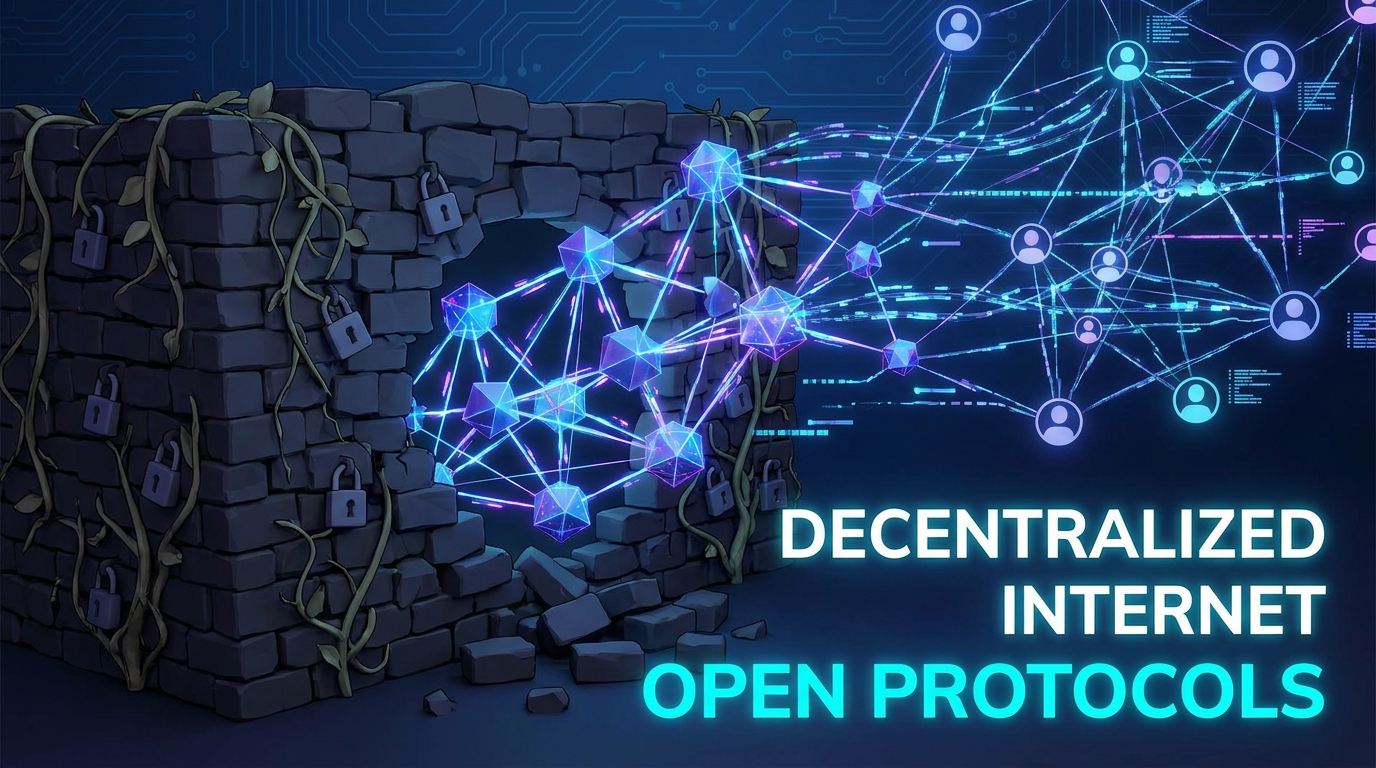
For the last fifteen years, joining a social network meant moving into a walled garden. If a user decided to leave Facebook, Twitter, or Instagram, they had to leave their friends, followers, and digital history behind. But in 2026, the architecture of the internet is undergoing a fundamental rewiring. The era of platform lock-in is giving way to the "decentralized social web," a model where users own their connections and can carry them across different applications.[2][5]
The shift is driven by a concept called interoperability. To understand it, technologists often point to email. A person using Gmail can seamlessly send a message to someone using Microsoft Outlook or a private company server. No single corporation owns the email network; they simply build interfaces for it. Decentralized social media applies this exact open-protocol logic to posts, likes, and follows, ensuring that no single entity holds the keys to public discourse.[2][5]
Two dominant protocols have emerged to power this new ecosystem: ActivityPub and the AT Protocol. ActivityPub, recognized as an official standard by the World Wide Web Consortium (W3C), is the older and more widely adopted of the two. It serves as the backbone for the "Fediverse," a sprawling network of interconnected platforms that includes Mastodon for microblogging, Pixelfed for photos, and PeerTube for video.[7][8]

Mastodon remains the philosophical heart of the Fediverse. Rather than logging into a central corporate server, users join independent "instances"—servers run by communities, nonprofits, or individuals. A user on a photography-focused instance can easily follow and interact with a user on a tech-focused instance. By early 2026, Mastodon boasted between 10 and 15 million registered accounts and roughly 1.5 million monthly active users, sustaining steady growth driven by users seeking ad-free, chronological feeds.[5][7]
But the true test of ActivityPub's viability arrived when Meta entered the chat. In a move that surprised industry observers, Meta's text-based app, Threads, began integrating ActivityPub support. By 2026, what started as a limited test for Meta executives evolved into a bidirectional bridge. Threads users who opt in can push their posts to the Fediverse, and Mastodon users can follow and reply to Threads accounts without ever downloading a Meta product.[3]
This integration represents a massive collision of scales. On one side is the grassroots Fediverse; on the other is a trillion-dollar company with over 200 million Threads users. While only a fraction of Threads users have actively turned on federation, the sheer technical reality of a major Big Tech platform plugging into the open web marks a historic departure from the walled-garden business models of the 2010s.[3]

Meanwhile, a parallel ecosystem is thriving on the AT Protocol, the engine behind Bluesky. Originally incubated within Twitter before spinning out as an independent company, Bluesky approaches decentralization differently than Mastodon. Instead of focusing primarily on independent community servers, the AT Protocol prioritizes "portable identity."[4][7]
Meanwhile, a parallel ecosystem is thriving on the AT Protocol, the engine behind Bluesky.
On Bluesky, a user's identity is tied to a decentralized identifier (DID) and their data lives in a Personal Data Server (PDS). If a user becomes dissatisfied with the main Bluesky app, they can theoretically pack up their username, their posts, and their entire social graph, and plug it into a competing app built on the AT Protocol. This portability sits at the foundational level of the code, rather than functioning as a simple export button.[1][7]

Bluesky's 2026 product roadmap heavily emphasizes this "Atmosphere" ecosystem. The platform, which scaled past 40 million users, has begun rolling out interoperability features like "LIVE badges" that connect directly to external streaming platforms like Twitch. By encouraging third-party developers to build custom algorithms and client apps, Bluesky aims to create an environment where the user controls how their feed is curated, rather than submitting to a single corporate algorithm.[6]
The existence of two major, incompatible protocols—ActivityPub and the AT Protocol—has created a new challenge: bridging the divide. Projects like Bridgy Fed have emerged to translate between the two networks, allowing a Mastodon user to follow a Bluesky user. While these third-party bridges are still experimental and occasionally clunky, they represent the messy, active frontier of internet development in 2026.[3][7]
Decentralization also fundamentally rewrites the rules of content moderation. On centralized platforms, a single trust and safety team dictates what is permissible for billions of people. In the Fediverse, moderation happens at the instance level. A server dedicated to academic research might have strict rules against profanity, while an art server might allow adult content. If one server becomes a haven for harassment, other servers can simply "defederate" or block it, isolating bad actors without requiring a global ban.[2][7]
For the creator economy, this architecture offers a profound new value proposition: true audience ownership. Independent publishing platforms like Ghost and WordPress have integrated ActivityPub, allowing writers to publish a blog post that instantly appears as a native post in their followers' Mastodon or Threads feeds. If a creator decides to change platforms, they no longer have to rebuild their audience from scratch.[2][5][8]

Despite the technical triumphs, significant uncertainties remain. The primary question is whether mainstream users actually care about protocols and data ownership, or if they simply want a frictionless place to see their friends. Decentralized networks still suffer from a learning curve; choosing an instance or managing a decentralized handle introduces friction that centralized apps intentionally eliminate.[4][7]
Furthermore, Meta's long-term motives remain a subject of intense debate. Optimists view Threads' federation as a genuine commitment to the open web, while skeptics argue it is a strategic maneuver to appease antitrust regulators and commoditize the social layer, ultimately driving more users toward Meta's highly profitable ad network.[4]
Regardless of corporate maneuvering, the underlying technology is now proven and deployed at scale. The social web is slowly transitioning from a collection of isolated digital malls into a shared public infrastructure. While the walled gardens have not collapsed entirely, the gates have been forced open, giving users more leverage over their digital lives than they have had in over a decade.[2][5][9]
How we got here
Jan 2018
The W3C publishes ActivityPub as a recommended web standard for decentralized networking.
Nov 2022
Elon Musk acquires Twitter, sparking the first massive wave of user migration to Mastodon.
Jul 2023
Meta launches Threads and announces future support for the ActivityPub protocol.
Mar 2024
Threads launches its public beta for Fediverse integration, allowing outward federation.
Early 2026
Bluesky rolls out its 'Atmosphere' ecosystem for cross-app interoperability, while Mastodon surpasses 10 million accounts.
Viewpoints in depth
The Open-Web Advocates
Argue that true freedom requires severing ties with corporate servers entirely.
This camp points to Mastodon's nonprofit structure and instance-level moderation as the only way to prevent billionaire owners from rewriting the rules of public discourse overnight. They view Meta's entry into the Fediverse with deep suspicion, warning that a trillion-dollar ad company could attempt to 'embrace, extend, and extinguish' the open protocol. For these advocates, true decentralization means hosting your own data and relying on community-funded infrastructure.
The Commercial Platforms
View federation as a feature that complements, rather than replaces, massive scale.
Meta and other large players argue that 99% of users want frictionless onboarding and algorithmic discovery, not the technical burden of choosing a server. They believe that bridging centralized apps like Threads to the Fediverse offers the best of both worlds: openness for the power users who demand it, and simplicity for everyone else. In their view, interoperability is a strategic feature that keeps users happy and satisfies antitrust regulators.
The Ecosystem Builders
Believe the focus should be on portable identity rather than server hosting.
The Bluesky and AT Protocol camp argues that users shouldn't have to understand 'instances' or server administration to own their data. They advocate for a system where users hold a cryptographic ID that lets them swap out algorithms and client interfaces at will. To them, the future of social media looks like an app store for feeds, where the underlying social graph remains constant but the user experience is endlessly customizable.
What we don't know
- Whether mainstream users will ever care enough about data ownership to overcome the friction of decentralized onboarding.
- If Meta will eventually allow full, seamless bidirectional integration with the Fediverse, or keep it as a niche opt-in feature.
- How decentralized networks will handle large-scale coordinated disinformation campaigns without a central moderation team.
Key terms
- Fediverse
- A portmanteau of 'federation' and 'universe,' referring to the collection of independent social networks that can communicate with each other.
- ActivityPub
- The open, W3C-standardized protocol that powers the Fediverse, allowing platforms like Mastodon and Threads to interoperate.
- AT Protocol
- An open-source framework developed by Bluesky that emphasizes portable user identity and customizable algorithms.
- Instance
- An independent server hosting a community on a decentralized network, complete with its own rules and moderation policies.
- Decentralized Identifier (DID)
- A cryptographic ID that proves a user owns their account, allowing them to move their profile between different apps.
Frequently asked
Can I move my Instagram followers to Mastodon?
No. While Meta's Threads app allows you to federate posts to Mastodon, the core Instagram social graph remains locked within Meta's ecosystem.
Do I have to pay to use decentralized social media?
Most platforms are free and supported by community donations. However, some specialized or highly moderated instances may charge a small subscription fee to cover server costs.
Are Bluesky and Mastodon the same thing?
No. They are built on entirely different underlying protocols (AT Protocol and ActivityPub, respectively), though third-party developers are actively building bridges to connect them.
Who moderates content on the Fediverse?
Content is moderated by the administrators of the specific server (instance) you join, rather than a central corporate trust and safety team.
Sources
Source coverage
9 outlets
3 viewpoints surfaced









[1]BlueskyEcosystem Builders
The AT Protocol: A standard for public conversation
Read on Bluesky →[2]Ethereum.orgOpen-Web Advocates
Decentralized social networks explained
Read on Ethereum.org →[3]Federated MindCommercial Platforms
Part 2 of Federation Across Networks: Threads and the Fediverse
Read on Federated Mind →[4]Social Media TodayCommercial Platforms
Algorithmic vs Chronological Feeds: The Shift in User Control
Read on Social Media Today →[5]LifehackerOpen-Web Advocates
A brief, jargon-free explainer on the freer future of the social web
Read on Lifehacker →[6]ContentGripEcosystem Builders
What's new in Bluesky's 2026 roadmap
Read on ContentGrip →[7]FediviewOpen-Web Advocates
A practical comparison of Mastodon, Bluesky, and Nostr
Read on Fediview →[8]Wikipedia
Fediverse
Read on Wikipedia →[9]Factlen Editorial Team
Synthesis by Factlen editorial team
Read on Factlen Editorial Team →



Every angle. Every day.
Get technology stories with full source coverage and perspective breakdowns delivered to your inbox.