
How Designers Are Growing Furniture From Mushrooms to Replace Toxic Plastics
Biofabrication is transforming agricultural waste into high-performance, compostable furniture using the root structure of fungi, offering a VOC-free alternative to traditional plastics and foams.
By Factlen Editorial Team
- Bio-Design Innovators
- Scientists and engineers focused on scaling mycelium as a direct industrial replacement for plastics and foams.
- Circular Economy Advocates
- Environmentalists and researchers prioritizing zero-waste lifecycles and the elimination of toxic chemicals.
- Experimental Designers
- Artists and boutique studios using fungi to challenge traditional aesthetics and consumer expectations.
What's not represented
- · Traditional hardwood furniture manufacturers
- · Mass-market retail logistics experts
Why this matters
The traditional furniture industry relies heavily on toxic resins and plastics that pollute indoor air and sit in landfills for centuries. Mycelium biofabrication offers a fully compostable, VOC-free alternative that could drastically reduce the environmental footprint of our homes while improving indoor air quality.
Key points
- Biofabrication uses mycelium—the root structure of fungi—to bind agricultural waste into solid, durable furniture.
- The process eliminates the need for toxic, formaldehyde-based resins, resulting in VOC-free products that improve indoor air quality.
- Mycelium biocomposites are naturally fire-retardant, lightweight, and offer excellent acoustic dampening properties.
- Unlike conventional plastics and foams, mycelium furniture is 100% home compostable at the end of its useful life.
- Scaling the technology requires overcoming challenges related to biological contamination and oxygen requirements for thick molds.
The modern furniture industry is facing a metabolic crisis. Every year, millions of tables, chairs, and sofas are discarded, destined for landfills where they will sit for centuries. Conventional mass-market furniture relies heavily on medium-density fiberboard (MDF), polyurethane foams, and synthetic fabrics. These materials are bound together by petrochemical resins that not only resist natural decomposition but actively leach harmful chemicals into the soil and groundwater. As consumers cycle through interior design trends at an accelerating pace, the environmental toll of "fast furniture" has become impossible to ignore. In response, a radical shift in manufacturing is taking root—one that abandons the industrial processes of cutting, refining, and synthesizing in favor of biology.[1]
This emerging paradigm is known as biofabrication, and it treats the interior environment as a biological entity rather than a static collection of manufactured goods. Instead of extracting raw materials from the earth to build a chair, designers and scientists are partnering with nature to literally grow it. By harnessing the natural growth cycles of living organisms, manufacturers can produce high-performance materials with a fraction of the energy required by traditional factories. At the forefront of this movement is an organism that has been quietly recycling the earth's waste for millions of years, now being coaxed out of the forest floor and into the living room.[1][8]
The secret to this biological revolution is mycelium. While most people are familiar with mushrooms—the fruiting bodies that pop up above ground—mycelium is the vast, hidden vegetative root structure that thrives beneath the surface. It consists of millions of microscopic, branching, thread-like filaments called hyphae. In nature, these hyphae secrete enzymes that break down organic matter, acting as the digestive system of the forest. In the context of design, however, mycelium is prized for its structural capabilities. It is a self-assembling, living polymer that can bind loose particles together into a cohesive, solid mass, offering a sustainable alternative to the toxic glues used in conventional furniture.[6]
The biofabrication process begins not in a lumber yard, but with agricultural waste. Designers collect low-value organic byproducts that would otherwise be burned or left to rot, such as hemp fibers, sawdust, rice husks, or discarded wood chips. This substrate serves as both the physical scaffolding and the nutritional food source for the fungus. By utilizing waste streams from the agricultural and forestry sectors, mycelium furniture production immediately solves a secondary environmental problem, transforming useless refuse into the foundational building blocks of high-end interior design.[3][5]

Before the fungus can be introduced, the agricultural substrate must undergo a rigorous sterilization process. Mushrooms are incredibly efficient growers, but the nutrient-rich substrate is also highly attractive to rogue molds and bacteria. If the mixture is not properly sterilized, competing organisms can easily overtake the batch, ruining the material. Once the substrate is clean, it is inoculated with specific strains of mushroom spores. Oyster mushrooms and species like Fomes fomentarius are frequently chosen for their aggressive growth rates and the dense, durable root networks they produce.[3]
The inoculated mixture is then packed tightly into custom-designed molds, which dictate the final shape of the furniture piece. Over the course of four to six days, the magic of biofabrication takes place in a dark, climate-controlled incubation chamber. The mycelium wakes up and begins to feed on the agricultural waste, sending its thread-like hyphae spiderwebbing through the substrate. As it digests the cellulose, it acts as "nature's glue," weaving the loose particles together into a dense, solid matrix that perfectly takes on the geometry of the mold.[2][5]
If left unchecked, the mycelium would eventually consume all the nutrients and sprout actual mushrooms. To prevent the furniture from fruiting in a consumer's living room, the growth process must be permanently halted. Once the piece has achieved the desired density and shape, it is removed from the mold and placed into an oven. Baking the material at approximately 200 degrees Fahrenheit kills the living fungus, removes all residual moisture, and renders the composite completely inert. The resulting product is a lightweight, dry, and structurally stable piece of furniture that will never grow again.[4]
Despite its lightweight, foam-like appearance, cured mycelium is remarkably robust. The cell walls of the fungal hyphae contain chitin, the same tough, protective polymer found in the exoskeletons of crabs and insects. This gives the resulting biocomposite surprising structural integrity. Artist and mycotecture pioneer Phil Ross, who has spent years experimenting with fungal building materials, once demonstrated the material's density by firing a handgun at a block of cured mycelium; the root network was strong enough to absorb the impact and stop the bullet after just a few inches.[4]
Despite its lightweight, foam-like appearance, cured mycelium is remarkably robust.
Beyond its physical strength, mycelium furniture offers profound benefits for human health, particularly regarding indoor air quality. Conventional engineered woods like particleboard are notorious for off-gassing Volatile Organic Compounds (VOCs), primarily due to the formaldehyde-based adhesives used to bind the wood dust together. Because mycelium is entirely self-binding, it requires zero synthetic resins. The resulting furniture is completely VOC-neutral, making it a critical innovation for modern, tightly sealed homes where poor indoor air quality can lead to respiratory issues and cognitive fatigue.[2][8]

The material also boasts exceptional thermal and acoustic properties. Unlike cold plastics or metals, mycelium maintains a neutral temperature relative to the human body, providing a tactile warmth that aligns with biophilic design principles. Furthermore, its porous, cellular structure acts as a natural "sonic sponge." Companies like Mogu have leveraged this property to create modular acoustic wall panels that absorb sound waves, lowering ambient decibel levels in noisy urban environments and open-plan offices far more sustainably than synthetic acoustic foams.[6][8]
Aesthetically, mycelium does not have to look like a raw, earthy science experiment. Designers are constantly pushing the visual boundaries of the material. In their "Mycelium + Timber" project, designers Sebastian Cox and Ninela Ivanova sliced discarded willow wood into thin strips, weaving them into elegant molds. The mycelium was then grown directly into the woven wood, binding the structure together to create sophisticated, contemporary stools and lighting fixtures that look entirely at home in a high-end gallery.[5]
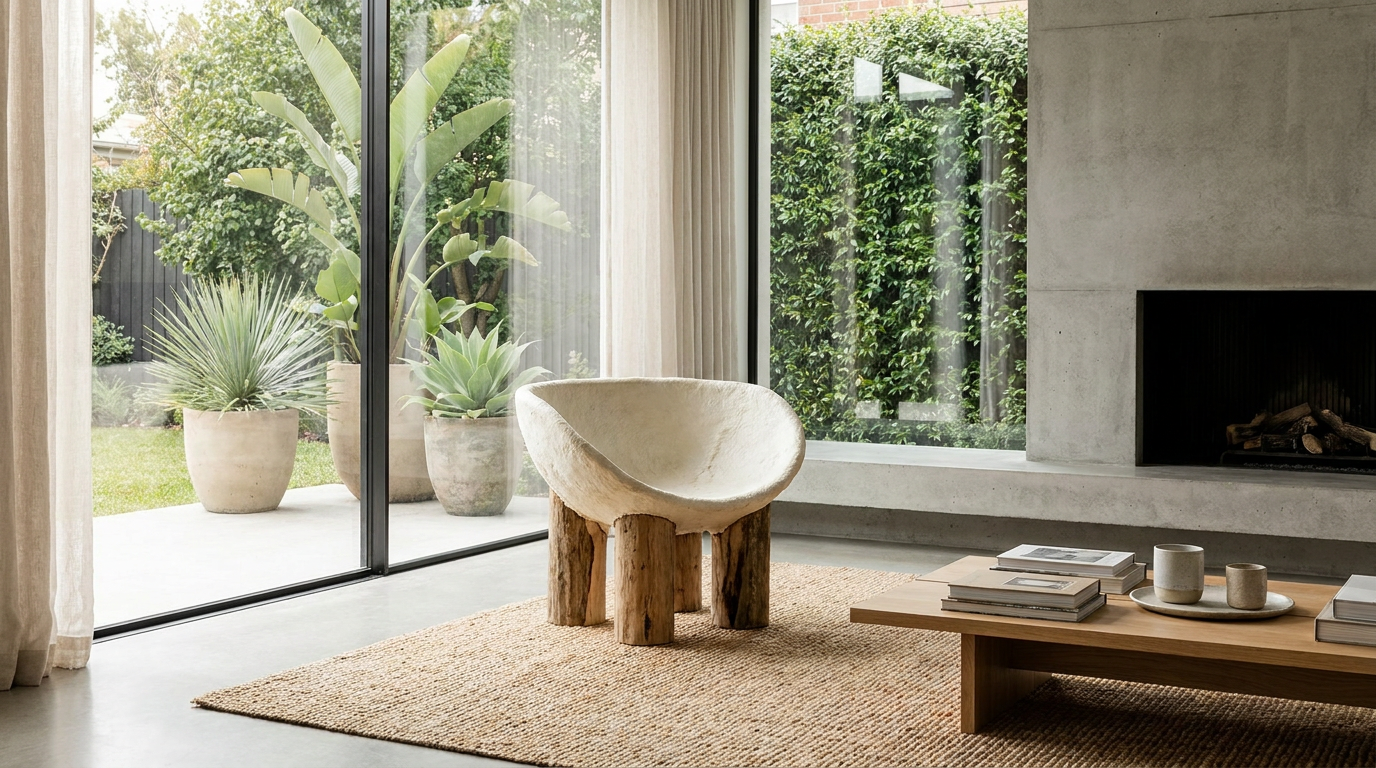
Other designers are embracing the material's inherent strangeness to challenge our perceptions of sustainable design. At the 3 Days of Design festival in Copenhagen, the Dutch brand Aifunghi unveiled a collection of "furry" mycelium chairs. By manipulating the growth conditions and the curing process, they achieved a highly tactile, textured surface that proved biodegradable materials can be visually provocative and luxurious, pushing eco-friendly furniture beyond its traditionally austere reputation.[7]
On an industrial scale, companies are proving that mycelium can compete directly with ubiquitous building materials. Ecovative Design, a pioneer in the space, has developed MycoBoard, an engineered wood alternative grown from hemp and flax fibers bound by their proprietary mycelium resin. This biofabricated board can be molded into complex shapes for seating or pressed into flat panels for cabinetry and desks, offering major furniture manufacturers a drop-in replacement for toxic particleboard without requiring them to completely retool their assembly lines.[2]

Perhaps the most revolutionary aspect of mycelium furniture is its end-of-life cycle. When a conventional plastic chair breaks, it becomes a permanent ecological burden. When a mycelium chair is no longer needed, it can simply be broken into pieces and thrown into a backyard compost bin. Because it is made entirely of organic matter, it will safely biodegrade in a matter of weeks, returning valuable nutrients to the soil and fulfilling the ultimate promise of a truly circular, zero-waste economy.[2][3]
Despite its immense promise, the biofabrication industry still faces significant hurdles when attempting to scale up production to meet global demand. The primary challenge remains biological contamination. Because the agricultural substrate is a perfect food source, maintaining absolute sterility in massive, factory-scale incubation chambers is both difficult and expensive. A single microscopic breach in protocol can allow competing green molds or bacteria to infiltrate a batch, ruining days of growth and forcing manufacturers to discard entire production runs before they even reach the curing oven.[3]
There are also strict physical limitations to how the material can be grown. Fungi are living organisms that require oxygen to survive and grow. If a mold is too thick—generally anything over a few inches deep—the mycelium in the very center will suffocate and die before it can bind the substrate together. To create large, voluminous pieces of furniture, designers must either grow the object in thinner, hollow sections that are later joined together, or engineer complex aeration systems within the molds.[1]

Durability is another area where mycelium currently requires compromise. While it is incredibly strong in compression and can easily support human weight, it lacks the sheer tensile strength and shear resistance of solid hardwoods or steel. As a result, most mycelium chairs and tables still rely on salvaged wooden legs or internal armatures to handle the dynamic stresses of daily use. It is currently best utilized as a replacement for foams, padding, and paneling, rather than as the sole structural load-bearing element.[4]
Looking ahead, the future of biofabricated furniture may blur the line between object and organism even further. Currently, all commercial mycelium furniture is baked and rendered "dormant." However, researchers and synthetic biologists envision a near future of "active" furniture. By carefully controlling hydration, future mycelium surfaces could remain alive in a suspended state, allowing a scratched table to literally heal itself, or incorporating bioluminescent fungi to provide zero-electricity ambient lighting. The era of the living living-room is only just beginning.[8]
Viewpoints in depth
Bio-Design Innovators
Scientists and engineers focused on scaling mycelium as a direct industrial replacement for plastics and foams.
This camp views mycelium primarily as a high-performance material that can seamlessly drop into existing supply chains. Companies like Ecovative argue that the only way to make a meaningful environmental impact is to match the cost and utility of ubiquitous materials like particleboard and polyurethane foam. They prioritize standardized mechanical properties, fire resistance, and acoustic dampening, aiming to convince Fortune 500 companies to adopt bio-composites without sacrificing mass-market appeal.
Circular Economy Advocates
Environmentalists and researchers prioritizing zero-waste lifecycles and the elimination of toxic chemicals.
For this group, the aesthetic or structural properties of the furniture are secondary to its metabolic lifecycle. They emphasize that the true value of mycelium lies in its ability to upcycle low-value agricultural waste and, crucially, return to the earth as compost. This perspective highlights the elimination of VOCs and formaldehyde, arguing that our interior environments should be treated as biological ecosystems that support human health rather than chemical traps.
Experimental Designers
Artists and boutique studios using fungi to challenge traditional aesthetics and consumer expectations.
Rather than trying to make mycelium mimic traditional wood or foam, these designers embrace the material's inherent organic strangeness. By creating 'furry' chairs or exposing the raw, root-like textures of the hyphae, they aim to provoke a psychological shift in how consumers relate to their belongings. They argue that sustainable design shouldn't just be a hidden material swap; it should visually communicate its connection to nature and challenge the sterile perfection of industrial manufacturing.
What we don't know
- Whether biofabricated materials can reach price parity with mass-produced, heavily subsidized petrochemical plastics in the near term.
- How 'active' self-healing mycelium furniture concepts will perform in real-world, non-sterile domestic environments.
- The exact long-term durability of mycelium composites when subjected to decades of fluctuating indoor humidity.
Key terms
- Mycelium
- The vegetative, root-like network of a fungus, consisting of millions of branching threads that digest organic matter.
- Biofabrication
- The manufacturing process of using living organisms, like fungi or bacteria, to grow materials and products rather than synthesizing them chemically.
- Hyphae
- The microscopic, branching filaments that make up the mycelium network and act as a natural binding glue.
- Chitin
- A tough, protective polymer found in the cell walls of fungi that gives biofabricated furniture its structural strength.
- VOCs (Volatile Organic Compounds)
- Harmful chemicals emitted as gases from traditional furniture glues and paints, which are entirely absent in mycelium biocomposites.
Frequently asked
Does mycelium furniture smell like mushrooms?
No. The high-heat curing process removes all moisture and neutralizes odors, leaving only a faint, earthy wood scent that quickly fades.
Will the furniture sprout mushrooms if it gets wet?
No. The baking process permanently kills the living fungus, rendering the material completely inert so it cannot grow again.
How long does biofabricated furniture last?
When kept indoors and dry, mycelium biocomposites can last for decades, offering durability comparable to standard softwoods and synthetic foams.
Can I leave mycelium furniture outside?
Without heavy synthetic sealants, exposure to soil, rain, and outdoor microbes will cause the furniture to naturally biodegrade, which is its intended end-of-life feature.
Sources
Source coverage
8 outlets
3 viewpoints surfaced








[1]Factlen Editorial TeamCircular Economy Advocates
Synthesis by Factlen editorial team
Read on Factlen Editorial Team →[2]EcovativeBio-Design Innovators
Growing Mycelium Furniture and Packaging
Read on Ecovative →[3]University of British ColumbiaCircular Economy Advocates
Mushroom Furniture: Mycelium Biocomposites
Read on University of British Columbia →[4]SFGateExperimental Designers
Artist Phil Ross creates furniture by growing fungi
Read on SFGate →[5]Green MattersExperimental Designers
Mycelium + Timber: Furniture Bound by Mushrooms
Read on Green Matters →[6]Materials AssembleBio-Design Innovators
Bespoke Mycelium Furniture and Acoustic Panels
Read on Materials Assemble →[7]Trend HunterExperimental Designers
Aifunghi is a Brand Working to Make Mycelium Furniture Enticing
Read on Trend Hunter →[8]Nuvira SpaceBio-Design Innovators
The Bio-Fabricated Interior: Mycelium Furniture
Read on Nuvira Space →
Every angle. Every day.
Get home stories with full source coverage and perspective breakdowns delivered to your inbox.