
How the Live Music Industry is Decarbonizing the Modern Mega-Tour
Major artists like Coldplay and Massive Attack are proving that stadium-scale concerts can drastically cut carbon emissions without sacrificing the spectacle. Through kinetic dance floors, mobile battery grids, and plant-based catering, the live entertainment sector is writing a new blueprint for sustainable touring.
By Factlen Editorial Team
- Climate-Conscious Artists
- Artists leveraging their massive influence and budgets to force the live entertainment supply chain to adopt green technologies.
- Live Event Producers
- Industry professionals tasked with the practical implementation and scaling of sustainable infrastructure across global venues.
- Environmental Scientists
- Researchers focused on measuring actual emission reductions and designing scientifically backed roadmaps for the sector.
What's not represented
- · Independent Venue Owners
- · Mid-Tier Touring Musicians
Why this matters
Live entertainment has historically carried a massive environmental footprint due to global logistics and diesel power. By proving that sustainable technology can scale to stadium levels, these tours are establishing new operational standards that will eventually trickle down to local venues and community events.
Key points
- Coldplay achieved a verified 59% reduction in direct carbon emissions on their latest world tour.
- Fans generate clean electricity during shows using kinetic dance floors and stationary power bikes.
- Massive Attack's Act 1.5 festival cut energy emissions by 98% using renewable battery grids.
- Eliminating car parks and mandating plant-based food drastically reduced fan-related emissions.
- The industry is pushing for 'plug and play' venues to reduce the need for heavy freight transport.
The modern mega-tour is a logistical marvel, but historically, it has also been an environmental nightmare. Moving thousands of tons of steel, LED screens, and massive audio arrays across continents requires fleets of diesel trucks and cargo planes. For decades, the live music industry accepted this massive carbon footprint as the unavoidable cost of doing business, prioritizing spectacle over sustainability. But a quiet revolution has taken hold of the global touring circuit, driven by a new wave of artists who are refusing to hit the road unless the road goes green. The shift transitioned from niche environmental activism to mainstream operational protocol when Coldplay paused their touring schedule in 2019, vowing not to return to the stage until they could drastically reduce their environmental impact.[2][6]
By 2026, their "Music of the Spheres" world tour has become the definitive blueprint for decarbonizing live entertainment on a global scale. Verified by the Massachusetts Institute of Technology's Environmental Solutions Initiative, Coldplay has achieved a staggering 59 percent reduction in direct carbon emissions compared to their previous global tour. This milestone was not achieved through simple carbon offsetting—a practice often criticized by environmentalists as greenwashing—but through fundamental, ground-up changes to how a stadium show is powered, transported, and experienced. The most visible innovation lies quite literally beneath the fans' feet, turning the audience into an active power grid.[2][6]
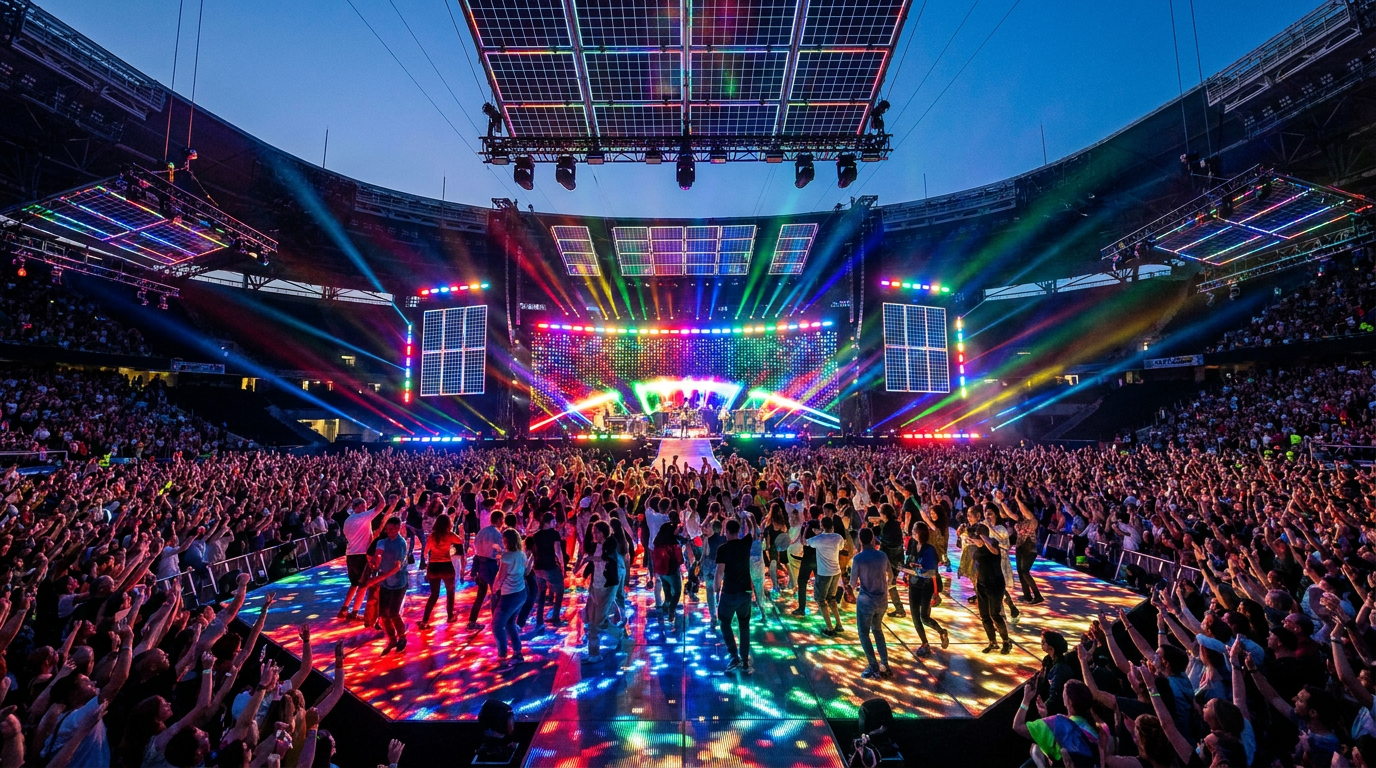
Coldplay partnered with the technology firm Energy Floors to install kinetic dance floors across the general admission areas of their stadium shows. As tens of thousands of fans jump, dance, and move to the music, their kinetic energy is captured and converted directly into electricity in real time. Combined with stationary power bikes pedaled by enthusiastic concertgoers and temporary solar panels installed around the venue perimeters, these kinetic systems generate an average of 17 kilowatt-hours of clean energy per show. While this localized power generation doesn't run the massive main stage audio and visual arrays, it is entirely sufficient to power the band's acoustic C-stage performances each night, creating a tangible connection between the audience and the show's sustainability.[2]

To tackle the heavy lifting of the main stage, the industry is rapidly moving away from the loud, polluting diesel generators that have long been the backbone of outdoor music festivals and stadium gigs. Companies like Showpower have developed massive, mobile SmartGrid battery systems designed specifically for the rigorous demands of live entertainment. These industrial-scale batteries, often built from repurposed electric vehicle cells like those salvaged from the BMW i3, can be charged via renewable grid energy before the show begins. During Coldplay's sprawling tour, these zero-emission battery systems successfully powered 18 entire stadium concerts without requiring a single drop of diesel fuel, proving that clean energy can handle arena-scale audio and lighting rigs.[2][5]
But powering the show itself is only a fraction of the battle. The Tyndall Centre for Climate Change Research at the University of Manchester notes that the vast majority of a tour's greenhouse gas emissions come from transportation—both the hauling of the stage gear and the travel footprint of the fans attending the shows. To address the freight emissions, artists are completely overhauling their logistical supply chains. Coldplay partnered with global logistics firm DHL to utilize Sustainable Aviation Fuel (SAF) for necessary cargo flights and deployed fleets of electric trucks for ground freight, successfully cutting their logistics-related emissions by a third.[1][2]

But powering the show itself is only a fraction of the battle.
However, the British trip-hop group Massive Attack took this decarbonization framework even further. Working directly with scientists at the Tyndall Centre, the band commissioned a comprehensive "Roadmap to Super Low Carbon Live Music" to establish scientifically backed, highly transferrable emission reduction targets for the entire live music sector. In August 2024, Massive Attack put their ambitious roadmap to the ultimate test with "Act 1.5," a massive outdoor festival in Bristol explicitly designed to be the lowest-carbon concert in history. The results of the Act 1.5 festival, analyzed in a comprehensive 2025 report, proved that radical decarbonization is entirely possible at a massive scale.[1][3]
By running the entire festival site on electric batteries charged exclusively by renewable energy sources, Massive Attack reduced on-site energy emissions by an astonishing 98 percent compared to a standard diesel-powered outdoor event. But their most aggressive and controversial interventions targeted fan behavior. Recognizing that audience travel often constitutes the largest slice of a concert's carbon pie, Massive Attack made the unprecedented decision to eliminate the festival car park entirely. Instead, they prioritized ticket sales for local residents and heavily incentivized train travel by offering VIP bar access and dedicated facilities to fans who arrived via public transit.[3]

The band also tackled the massive emissions associated with concert catering and agriculture. By mandating a strict 100 percent plant-based menu for all food vendors operating at the festival, they achieved an 89 percent reduction in food-related greenhouse gas emissions, saving over 26,000 kilograms of CO2 equivalent in a single weekend. Waste reduction has also seen massive improvements across the industry. The iconic glowing LED wristbands handed out to fans at Coldplay shows—once a symbol of single-use plastic waste—are now manufactured from fully compostable, plant-based materials. By actively encouraging fans to return the wristbands at the venue exits, the tour has achieved an impressive 86 percent recycling rate.[2][3]
These high-profile successes are beginning to force systemic, long-term changes across the broader live entertainment industry. Live Nation, the world's largest concert promoter, has expanded its Green Nation Touring Program to help artists and their production teams adopt these eco-friendly practices, while venue coalitions like the GOAL network are actively sharing sustainability blueprints. However, significant structural hurdles remain before the entire industry can claim to be truly green. While mega-stars playing sold-out stadiums can easily afford the upfront capital costs of kinetic dance floors, mobile battery grids, and sustainable aviation fuel, smaller independent venues and mid-tier touring artists often lack the financial resources to upgrade their aging infrastructure.[1][4][6]

The Tyndall Centre's roadmap emphasizes that the financial and logistical burden cannot rest solely on the shoulders of individual artists. It calls for the widespread adoption of "plug and play" models, where venues provide standardized, high-efficiency lighting and audio equipment in-house, completely eliminating the need for bands to haul heavy gear from city to city in fleets of trucks. What pioneers like Coldplay and Massive Attack have definitively proven is that audiences do not have to choose between a spectacular, immersive live experience and environmental responsibility. By turning sustainability into an interactive, communal part of the show, the live music industry is finally writing a new, greener setlist for the future, proving that the biggest spectacles on earth can also tread lightly on the planet.[1][6]
How we got here
2019
Coldplay pauses touring, vowing not to return until they can drastically reduce their environmental impact.
2021
Massive Attack and the Tyndall Centre publish the 'Roadmap to Super Low Carbon Live Music.'
March 2022
Coldplay launches the 'Music of the Spheres' tour, debuting kinetic floors and mobile battery grids.
August 2024
Massive Attack hosts 'Act 1.5' in Bristol, achieving the lowest carbon emissions for a concert of its scale.
2025
MIT verifies that Coldplay successfully reduced their direct tour emissions by 59 percent.
Viewpoints in depth
Climate-Conscious Artists
Artists argue that they have a moral obligation to use their platform and capital to force industry-wide environmental changes.
For artists at the apex of the industry, the conversation has shifted from awareness to operational ultimatums. Acts like Coldplay and Massive Attack realized that simply buying carbon offsets was insufficient and bordered on greenwashing. By refusing to tour until the technological infrastructure caught up with their environmental standards, they effectively forced production companies to innovate. Their massive tour budgets served as the necessary research and development funding to prove that kinetic floors and battery grids could survive the rigors of a global stadium tour.
Environmental Scientists
Researchers emphasize that true decarbonization requires systemic logistical changes, not just carbon offsetting.
Scientific bodies like the Tyndall Centre for Climate Change Research view the live music industry as a microcosm of global decarbonization challenges. Their analysis reveals that the most visible elements of a concert—the lights and sound—are actually the easiest to fix. The true challenge lies in 'Scope 3' emissions, specifically the logistics of moving freight and the travel habits of millions of fans. Scientists argue that without overhauling public transit access to venues and standardizing in-house equipment to reduce trucking, the industry will never reach its climate targets.
Live Event Producers
Promoters and production companies are focused on the practical challenges of scaling green technology across different markets.
For the companies actually building the stages and routing the tours, the green transition is a massive logistical puzzle. While a mobile SmartGrid battery system works flawlessly in London or Los Angeles, sourcing the necessary renewable grid power to charge it in emerging markets remains difficult. Furthermore, promoters note that the economics of sustainable touring currently only make sense at the stadium level. Until the cost of sustainable aviation fuel and electric freight trucks decreases, mid-tier tours will struggle to adopt these zero-emission blueprints.
What we don't know
- Whether mid-tier artists and independent venues will be able to afford the upfront costs of green touring infrastructure.
- How quickly local governments will improve public transit options to support car-free stadium events globally.
Key terms
- Kinetic Dance Floor
- A specialized flooring system that captures the physical energy of people dancing and converts it into usable electricity.
- Sustainable Aviation Fuel (SAF)
- A cleaner alternative to traditional jet fuel made from renewable resources like waste oils, which significantly reduces aviation carbon emissions.
- Greenwashing
- The practice of making misleading or unsubstantiated claims about the environmental benefits of a product, service, or initiative.
- Scope 3 Emissions
- Indirect greenhouse gas emissions that occur in a company's value chain, such as the carbon footprint of fans traveling to a concert.
Frequently asked
Do kinetic dance floors power the entire concert?
No. While they generate enough electricity (around 17 kWh per show) to power smaller acoustic stages, the massive main stage rigs are typically powered by large mobile battery grids.
Why did Massive Attack ban car parking at their festival?
Fan travel is often the largest source of a concert's carbon emissions. By eliminating parking, they forced attendees to use lower-carbon public transit like trains and buses.
Can smaller artists afford to tour sustainably?
Currently, it is difficult. The upfront costs of green technology are high, which is why experts are pushing for venues to install permanent high-efficiency equipment so bands don't have to haul it themselves.
Sources
Source coverage
6 outlets
3 viewpoints surfaced






[1]Tyndall Centre for Climate Change ResearchEnvironmental Scientists
Roadmap to Super Low Carbon Live Music
Read on Tyndall Centre for Climate Change Research →[2]Carbon CreditsClimate-Conscious Artists
Coldplay's Music of the Spheres Tour Proves Live Music Can Be Low-Carbon
Read on Carbon Credits →[3]Green QueenClimate-Conscious Artists
Massive Attack's Bristol Festival Produced Lowest Emissions of Any Concert Ever
Read on Green Queen →[4]PollstarLive Event Producers
Green Touring Guides & Riders: Sustainability in Live Entertainment
Read on Pollstar →[5]ShowpowerLive Event Producers
Powering The Future Of Live Events with SmartGrid Batteries
Read on Showpower →[6]Factlen Editorial TeamLive Event Producers
Synthesis by Factlen editorial team
Read on Factlen Editorial Team →


Every angle. Every day.
Get entertainment stories with full source coverage and perspective breakdowns delivered to your inbox.