
How Lab-Grown Diamonds Broke Into the Highest Echelons of Luxury Jewelry
Once relegated to accessible fashion, lab-grown diamonds are now being embraced by heritage luxury houses for their highest-end creations. Advances in plasma and high-pressure technology are unlocking unprecedented creative freedom and sustainable circularity.
By Factlen Editorial Team
- Sustainable Luxury Pioneers
- Advocates for circular luxury who view lab-grown stones as the ethical future of the industry.
- Heritage Maisons
- Historic jewelry houses utilizing the technology to unlock new creative possibilities.
- Natural Diamond Advocates
- Traditionalists who maintain that true luxury requires geological scarcity.
- Gemological Experts
- Scientists and graders focused on the technical identicality of the stones.
What's not represented
- · Artisanal diamond miners in developing nations whose livelihoods are threatened by the shift to lab-grown stones.
Why this matters
The integration of lab-grown diamonds into high jewelry proves that sustainability and cutting-edge technology can coexist with ultimate luxury. For consumers, it means access to previously impossible designs, flawless colored stones, and a guilt-free, traceable supply chain.
Key points
- LVMH's FRED unveiled an 8.88-carat lab-grown blue diamond, signaling a major shift in Haute Joaillerie.
- Lab-grown diamonds are chemically and optically identical to mined stones.
- They are created using either extreme pressure (HPHT) or plasma-activated gas (CVD).
- The technology allows designers to create flawless, rare colored diamonds on demand.
- Leading foundries now use 100% renewable energy, offering a zero-carbon alternative to mining.
- The natural diamond industry argues that lab-grown stones lack the scarcity required for true luxury.
For decades, the unwritten rule of Haute Joaillerie—the highest echelon of fine jewelry—was that only the earth's rarest geological anomalies belonged in its display cases. Lab-grown diamonds were largely relegated to the accessible fashion jewelry market, viewed by heritage brands as a technological novelty rather than a true luxury asset.
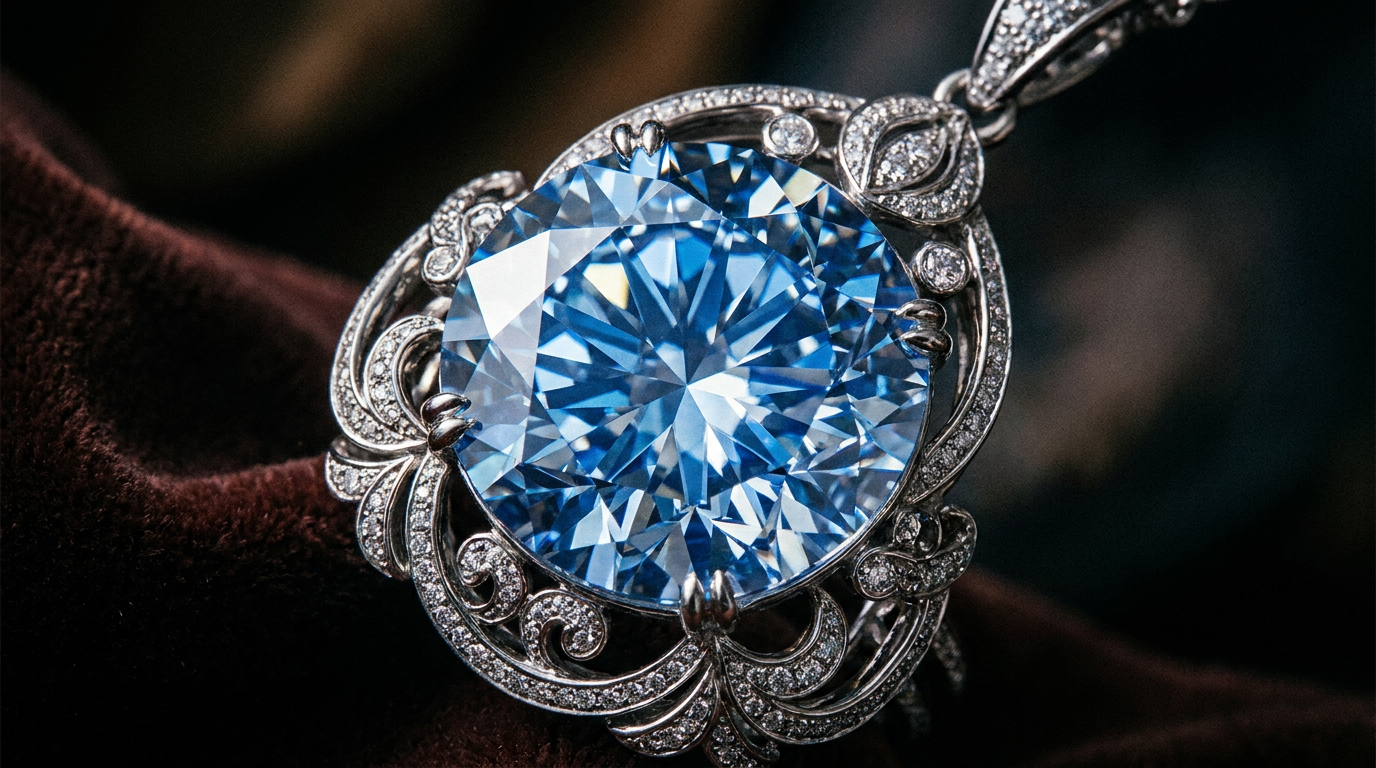
In 2026, that boundary has officially collapsed. The Parisian jeweler FRED, a historic maison operating under the LVMH luxury conglomerate, shattered industry norms by introducing the "FRED Audacious Blue"—an 8.88-carat lab-grown blue diamond.[1][2]
The stone, cut into a proprietary 36-facet "Hero Cut," serves as the centerpiece of a high jewelry collection that pairs the synthetic blue gem with natural white diamonds. By elevating a man-made stone to the pinnacle of its portfolio, LVMH signaled that the definition of luxury is shifting from geological scarcity to human ingenuity and sustainable craftsmanship.[1][3]
This transition is not happening in isolation. Across the luxury landscape, brands are recalibrating their relationship with lab-grown diamonds. Dedicated sustainable luxury houses like Paris-based Courbet and the Scandinavian brand AKIND have built their entire high-end propositions around lab-grown stones set exclusively in recycled solid gold.[6]
Even volume leaders like Pandora have completely pivoted, utilizing 100% recycled silver and gold alongside lab-grown diamonds to achieve massive sustainability milestones. The stigma has faded, replaced by a growing consumer demand for transparency, ethical sourcing, and environmental accountability.[7]

To understand why luxury houses are finally embracing these stones, one must look at the science of how they are created. Lab-grown diamonds are not simulated imitations like cubic zirconia or moissanite; they are pure carbon, crystallized in a laboratory to be chemically, physically, and optically identical to mined diamonds.[4][5]
The industry relies on two primary mechanisms to achieve this feat. The first is High Pressure High Temperature (HPHT), a process that essentially mimics the violent, crushing conditions found deep within the Earth's mantle.[4][5]
In an HPHT chamber, a tiny diamond seed is placed alongside a carbon source and a metal catalyst. The chamber is subjected to immense pressures of 5 to 6 gigapascals and searing temperatures between 1,300 and 1,600 degrees Celsius. Under these extreme conditions, the carbon dissolves and crystallizes onto the seed, growing a diamond layer by layer over several weeks.[4]
The second method, Chemical Vapor Deposition (CVD), takes a distinctly different approach, growing diamonds in a controlled plasma environment. A diamond seed is placed in a sealed vacuum chamber filled with carbon-rich gases, typically methane.[4][5]
The second method, Chemical Vapor Deposition (CVD), takes a distinctly different approach, growing diamonds in a controlled plasma environment.
Microwave energy is used to heat the gas into a glowing plasma, breaking the molecular bonds of the gas and allowing pure carbon atoms to rain down onto the seed. CVD operates at much lower pressures than HPHT and eliminates the need for metal catalysts, often resulting in Type IIa diamonds—the purest structural form of diamond, which accounts for less than 2% of naturally mined stones.[4][5]

Both methods produce stones that are graded on the exact same scale—Cut, Color, Clarity, and Carat—by prestigious institutions like the Gemological Institute of America (GIA) and the International Gemological Institute (IGI). To the naked eye, and even under a standard jeweler's loupe, a lab-grown diamond is indistinguishable from a mined one.[2][4]
For luxury designers, this technology unlocks unprecedented creative freedom. In the natural world, fancy colored diamonds—particularly vivid blues and pinks—are astronomically rare and prohibitively expensive, often fetching millions of dollars at auction.[8]
In the laboratory, scientists can introduce specific trace elements during the growth process to create bespoke colors on demand. Boron is introduced to create striking blue hues, while nitrogen yields vibrant yellows. This allows heritage brands to design collections around specific, uniform color palettes that would be virtually impossible to source consistently from the earth.[1][4]
Beyond aesthetics, the environmental argument for lab-grown diamonds has become a central pillar of modern luxury marketing. Traditional diamond mining involves moving massive amounts of earth, consuming significant water resources, and navigating complex geopolitical supply chains.[8]
By contrast, lab-grown diamonds offer a highly traceable, conflict-free alternative. Leading producers have aggressively decarbonized their operations to strengthen this claim. Companies like Diamond Foundry, the parent of luxury brand Vrai, now grow their diamonds using 100% renewable solar and wind power, achieving a zero-carbon footprint.[7]

When paired with the broader "circular luxury" movement—which emphasizes recycled precious metals and closed-loop supply chains—lab-grown diamonds allow luxury consumers to make high-ticket purchases without the associated ecological guilt.[6][8]
However, the integration of lab-grown stones into high jewelry is not without fierce debate. The natural diamond industry argues that the true value of a diamond lies in its billion-year geological history and inherent scarcity.[8]
Critics point out that as laboratory technology improves and production scales, the cost of growing diamonds will inevitably fall. Unlike natural diamonds, which have historically served as a store of value, lab-grown diamonds are technological products that depreciate on the resale market.[8]
For the heritage brands embracing the technology, this economic reality requires a shift in narrative. The value proposition of a piece like the FRED Audacious Blue is no longer just the raw material; it is the proprietary cut, the avant-garde design, the brand's heritage, and the ethical transparency of its creation.[1][8]
As 2026 unfolds, the line between technology and tradition continues to blur. Lab-grown diamonds have proven that they can deliver the fire, brilliance, and emotional resonance required of high jewelry, challenging the industry to redefine what makes a luxury object truly precious in the 21st century.[8]
How we got here
1950s
The first successful synthetic diamonds are created for industrial purposes using early HPHT technology.
1980s
Chemical Vapor Deposition (CVD) technology is developed, allowing for lower-pressure diamond growth.
2018
The US Federal Trade Commission rules that lab-grown diamonds are real diamonds, removing the word 'synthetic' from its recommended definition.
2021
Pandora, the world's largest jewelry brand by volume, announces it will exclusively use lab-grown diamonds.
2023
LVMH's FRED unveils the 'Audacious Blue', marking a major heritage brand's entry into lab-grown high jewelry.
Viewpoints in depth
Sustainable Luxury Pioneers
Advocates for circular luxury who view lab-grown stones as the ethical future of the industry.
This camp argues that the environmental and human costs of traditional diamond mining can no longer be justified in a modern luxury context. By pairing lab-grown diamonds with 100% recycled solid gold and silver, brands can create a 'closed-loop' circular economy. They view the laboratory origin not as a detriment, but as a badge of technological progress and ethical transparency that resonates with younger, climate-conscious consumers.
Heritage Maisons
Historic jewelry houses utilizing the technology to unlock new creative possibilities.
For heritage brands, lab-grown diamonds represent an unprecedented expansion of their creative palette. Because scientists can control the exact trace elements introduced during growth, designers can commission massive, flawless stones in specific, uniform colors—like vivid blues or pinks—that would be impossible to source consistently from nature. They argue that the true luxury lies in the proprietary cuts, the avant-garde design, and the artisanal craftsmanship of the final piece, rather than the geological origin of the carbon.
Natural Diamond Advocates
Traditionalists who maintain that true luxury requires geological scarcity.
The natural diamond industry and traditionalist collectors argue that a diamond's value is intrinsically tied to its billion-year geological history and finite supply. They point out that as laboratory technology scales, the cost of producing synthetic diamonds will continue to fall, making them a depreciating technological asset rather than a reliable store of value. From this perspective, infinite supply fundamentally contradicts the scarcity required for true luxury.
What we don't know
- How the resale market for lab-grown high jewelry will mature over the next decade.
- Whether ultra-luxury consumers will fully accept lab-grown stones as heirloom investments.
Key terms
- Haute Joaillerie
- The highest echelon of fine jewelry, characterized by exceptional craftsmanship, rare materials, and bespoke design.
- Chemical Vapor Deposition (CVD)
- A method of growing diamonds by heating carbon-rich gas into a plasma, allowing carbon atoms to deposit onto a seed layer by layer.
- High Pressure High Temperature (HPHT)
- A diamond growth method that mimics the extreme heat and crushing pressure found deep within the Earth's mantle.
- Type IIa Diamond
- The purest structural form of diamond with almost no nitrogen impurities, accounting for less than 2% of naturally mined stones but common in CVD growth.
- Circular Luxury
- An economic model in high-end fashion and jewelry that emphasizes recycled materials, zero waste, and closed-loop supply chains.
Frequently asked
Are lab-grown diamonds real diamonds?
Yes. Lab-grown diamonds are pure carbon and are chemically, physically, and optically identical to mined diamonds.
Can a jeweler tell the difference by looking at them?
No. To the naked eye and under a standard jeweler's loupe, they are indistinguishable. Specialized laboratory equipment is required to detect the distinct growth patterns.
Do lab-grown diamonds hold their resale value?
Generally, no. Because they can be manufactured in unlimited quantities, their price is tied to production costs, which tend to depreciate as technology improves.
How are colored lab-grown diamonds made?
Scientists introduce specific trace elements during the growth process; for example, adding boron creates blue diamonds, while nitrogen creates yellow ones.
Sources
Source coverage
8 outlets
4 viewpoints surfaced







[1]LVMHHeritage Maisons
FRED unveils Audacious Blue, the first lab-grown diamond from the Maison
Read on LVMH →[2]National JewelerHeritage Maisons
The First LVMH Lab-Grown Diamond High Jewelry Is Here
Read on National Jeweler →[3]RapaportHeritage Maisons
Paris-Based Jeweler Fred Launches Blue Lab-Grown Diamonds
Read on Rapaport →[4]Diamond AteliersGemological Experts
CVD vs HPHT Lab Grown Diamonds: A Practical Guide
Read on Diamond Ateliers →[5]Taylor & HartGemological Experts
How are lab grown diamonds made?
Read on Taylor & Hart →[6]Akind StoreSustainable Luxury Pioneers
Sustainable Fine Jewelry and Circular Luxury
Read on Akind Store →[7]Honho JewelrySustainable Luxury Pioneers
2026 Luxury Jewelry Trends: The Rise of Lab-Grown
Read on Honho Jewelry →[8]Factlen Editorial TeamGemological Experts
Synthesis by Factlen editorial team
Read on Factlen Editorial Team →
Every angle. Every day.
Get lifestyle stories with full source coverage and perspective breakdowns delivered to your inbox.