
Deep Atmospheric Gas Discovery Confirms Uranus is a True Ice Giant
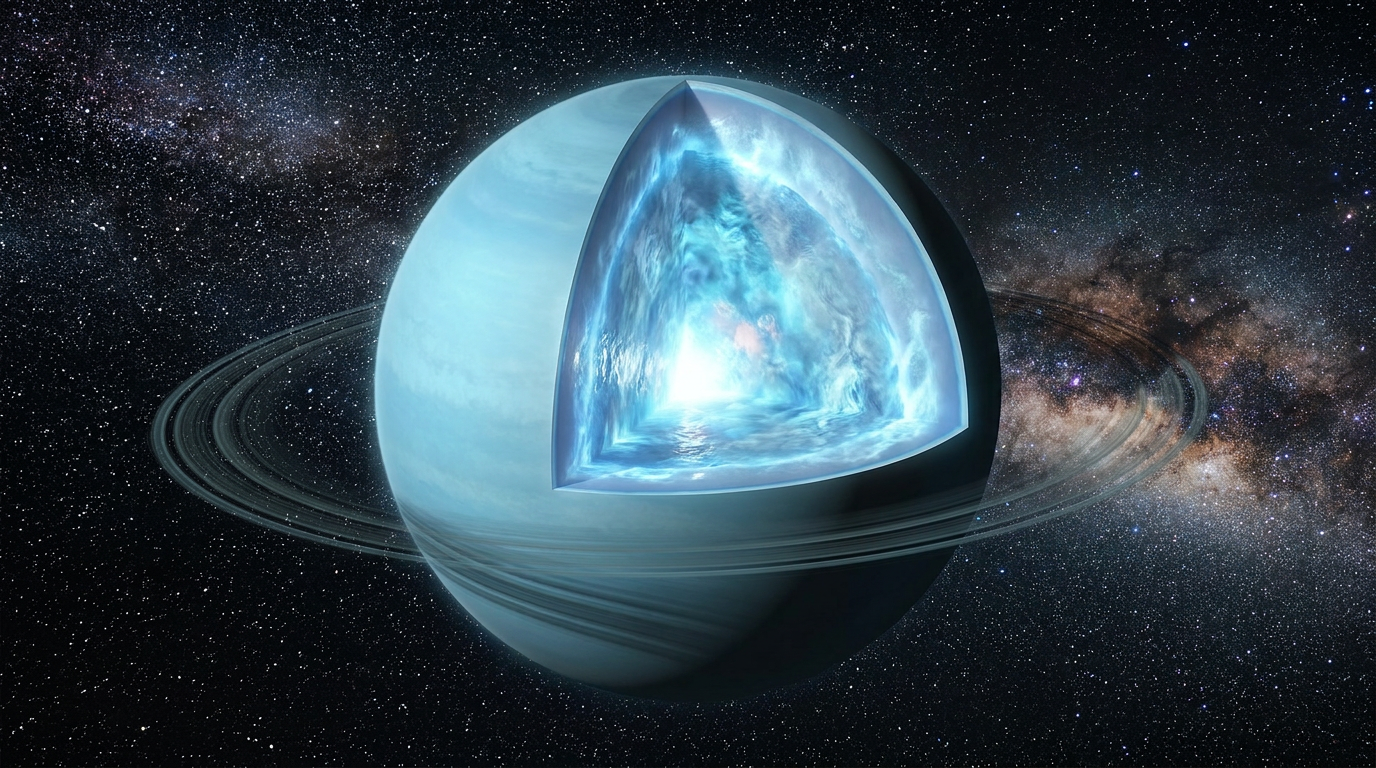
Astronomers using the ALMA telescope have detected carbon monoxide deep within Uranus's atmosphere for the first time. The discovery strongly suggests the planet harbors a massive interior ocean of water ice, resolving a long-standing debate about its composition.
By Factlen Editorial Team
- Planetary Formation Theorists
- Argue that the deep carbon monoxide confirms Uranus formed as an ice-rich world similar to Neptune.
- Composition Skeptics
- Emphasize that atmospheric gas readings require complex chemical models, leaving the exact rock-to-ice ratio uncertain.
- Future Mission Advocates
- View the discovery as the ultimate justification for sending a dedicated probe to the Uranian system.
What's not represented
- · Exoplanet researchers comparing Uranus to distant 'sub-Neptunes'
Why this matters
Understanding the true composition of Uranus solves a decades-old mystery about how our solar system formed and evolved. By confirming that Uranus is a true ice giant, scientists can better model the distribution of water in our cosmic neighborhood and design more effective instruments for future exploration missions.
Key points
- Astronomers detected carbon monoxide deep in Uranus's atmosphere for the first time using the ALMA telescope.
- The presence of the gas strongly indicates a massive reservoir of water ice beneath the planet's cloud tops.
- This discovery supports the model that Uranus is a true 'ice giant' rather than a rock-dominated planet.
- A separate layer of carbon monoxide in the upper atmosphere likely originated from an ancient comet impact.
- The findings help unify theories on how Uranus and Neptune formed in the early solar system.
Uranus has long stood as one of the most enigmatic and poorly understood worlds in the solar system. Orbiting at a harsh, freezing distance from the Sun, the seventh planet is shrouded in a featureless, cyan-colored atmosphere that effectively obscures its deep interior from optical telescopes. While astronomers broadly classify it as an 'ice giant,' the exact composition of the materials churning beneath its cloud tops has remained largely theoretical. For decades, scientists have been forced to rely on indirect measurements, mass calculations, and complex physical models to guess what lies beneath the opaque outer layers of this distant world.[7]
For decades, a fundamental question has divided planetary scientists and astrophysicists: Is Uranus truly an ice giant like its neighbor Neptune, or is it something else entirely? While Neptune has consistently shown chemical signatures indicative of a massive, water-rich interior, Uranus has stubbornly refused to yield the same data. This discrepancy led to a persistent mystery about its true nature. The two planets are nearly identical in size and mass, yet their atmospheric behaviors and internal heat emissions differ wildly, leaving researchers to wonder if their internal architectures are as similar as their outward appearances suggest.[5]
The crux of this planetary debate centered on a single, highly revealing molecule: carbon monoxide. In the extreme, high-pressure environments of the outer solar system, carbon monoxide acts as a crucial chemical proxy for planetary geologists. Its presence deep within a giant planet's atmosphere strongly indicates the existence of deep-seated, water-bearing materials—the very 'ices' that give ice giants their name. When water and methane interact under the crushing pressures of a planetary mantle, they produce carbon monoxide, which then slowly dredges up into the lower atmosphere where it can theoretically be detected.[1][5]
Because early observations and flyby data failed to detect any trace of carbon monoxide in the lower atmosphere of Uranus, some researchers proposed a radical alternative to the standard model. They suggested that Uranus might actually be a 'rock giant'—a planet composed predominantly of heavy silicates and rock rather than water ice. In this scenario, the lack of carbon monoxide was simply because the planet lacked the deep water reservoir necessary to produce it, making Uranus fundamentally different from the ice-rich Neptune.[5]

This proposed divergence posed a significant headache for theorists trying to model the formation and evolution of the early solar system. If two adjacent planets of similar mass and size formed with completely different bulk compositions, it would imply that the early solar nebula was vastly more chaotic and chemically segregated than current models suggest. A rock-heavy Uranus would require highly specific, localized anomalies in the protoplanetary disk to explain how it accreted so much rock while its twin, Neptune, swept up massive quantities of volatile ices.[1][6]
To finally resolve this lingering mystery, a team of astronomers led by Thibault Cavalié at the University of Bordeaux turned to one of the most powerful astronomical instruments on Earth: the Atacama Large Millimeter/submillimeter Array (ALMA). Located in the high-altitude, bone-dry deserts of northern Chile, ALMA's vast array of synchronized radio antennas is uniquely equipped to peer through opaque planetary atmospheres. By observing the universe in submillimeter wavelengths, ALMA can detect the faint thermal signatures of cold molecular gases that remain completely invisible to traditional optical telescopes.[2][3]
Between 2022 and 2024, Cavalié’s research team conducted three dedicated observation campaigns, carefully tuning ALMA to detect the specific submillimeter wavelengths emitted by carbon monoxide molecules. Their primary goal was to probe the Uranian troposphere—the deep, dense lower layer of the planet's atmosphere where internal gases might well up from the hidden mantle. Observing Uranus is notoriously difficult due to its extreme distance and cold temperatures, requiring unprecedented precision and long exposure times to separate faint chemical signals from the background noise of the cosmos.[1][4]
The results of these exhaustive observation campaigns, published in June 2026, delivered a definitive and highly anticipated answer. For the first time in the history of planetary science, researchers unambiguously detected carbon monoxide deep in the Uranian troposphere. The team measured the gas's concentration at roughly 5.8 parts per billion. While this might sound like an infinitesimally small amount, in the context of giant planet atmospheric chemistry, this faint but unmistakable signal changes everything we know about the planet's internal structure.[1][3]
The results of these exhaustive observation campaigns, published in June 2026, delivered a definitive and highly anticipated answer.
Finding carbon monoxide at these specific depths is a watershed moment for planetary science. It provides the long-missing chemical link, strongly suggesting that Uranus harbors a massive, churning reservoir of water ice beneath its crushing atmosphere, just as theoretical ice-giant models have long predicted. The presence of the gas confirms that the deep interior is rich in oxygen and water, effectively putting to rest the idea that the planet is a dry, rocky anomaly wandering the outer edges of our solar system.[2][4]
Following the groundbreaking detection, the research team ran extensive numerical simulations to understand exactly what the ALMA data meant for the planet's hidden core. They tested various hypothetical ratios of rock to ice, plugging different internal structures into their supercomputers to see which configurations would naturally produce the exact carbon monoxide levels observed by the telescope. These models had to account for the extreme temperatures, crushing pressures, and complex fluid dynamics that govern the deep interiors of giant planets.[3][4]
The results of the supercomputer simulations were striking in their clarity and consistency. Only the models dominated by a massive fraction of water ice successfully reproduced the observed atmospheric chemistry. Models that assumed a rock-heavy interior consistently fell short, failing to generate enough carbon monoxide to match the new ALMA readings. The data clearly showed that to have 5.8 parts per billion of carbon monoxide in the troposphere, the planet must possess a vast, deep-seated ocean of highly pressurized, supercritical water.[3]

The conclusion drawn by the researchers is unequivocal and reshapes our understanding of the outer solar system. 'We find that Uranus is more on the ice-giant side than on the rock-giant side,' Cavalié noted in the team's findings. This effectively realigns Uranus with Neptune, confirming that the two planets share a fundamentally similar internal architecture and ending years of speculation that they belonged to entirely different classes of planetary bodies.[3][4]
Interestingly, the ALMA observations also yielded a secondary, entirely unexpected discovery. While scanning the planet, the team detected carbon monoxide much higher up, in the planet's stratosphere. However, through careful thermochemical modeling, they determined that this high-altitude gas is completely disconnected from the deep-seated reservoir. The stratospheric carbon monoxide exhibits a different distribution pattern, indicating that it did not well up from the planet's watery mantle, but rather arrived from the outside.[1]
Researchers believe this stratospheric carbon monoxide has an entirely different, external origin. The prevailing theory, supported by the new data, is that a massive comet struck Uranus several centuries ago. This violent impact would have deposited a localized pocket of carbon monoxide and other exogeneous species in the upper atmosphere. Today, this gas remains suspended in the stratosphere as a lingering cosmic scar, providing a fascinating glimpse into the violent, impact-heavy history of the outer solar system.[1][3]
Despite the magnitude of the breakthrough, the scientific debate regarding the exact composition of Uranus is not entirely closed. Interpreting atmospheric gases from millions of miles away requires complex assumptions about how materials mix and circulate under extreme, unearthly pressures. Planetary atmospheres are highly dynamic, and the chemical pathways that transport gases from a planet's core to its visible cloud tops are fraught with variables that cannot be perfectly replicated in a laboratory on Earth.[4]
Some composition skeptics, including researchers at Leiden University, point out that the exact ratio of rock to ice remains an educated estimate rather than an absolute certainty. If Uranus possesses distinct compositional layers that inhibit the upward flow of heat and gas—a phenomenon known as double-diffusive convection—the chemistry at the cloud tops might not perfectly mirror the bulk composition of the deep core. Until a probe physically enters the atmosphere, a small margin of error will always remain.[4]

Nevertheless, the findings provide critical momentum for future exploration of the outer solar system. The planetary science community has heavily prioritized the proposed Uranus Orbiter and Probe (UOP) mission, arguing that an in-situ atmospheric entry probe is the only way to definitively ground-truth these remote observations. The ALMA data provides exactly the kind of foundational chemistry that a future probe will need to verify, giving mission planners a clear target to aim for when designing their instruments.[6]
By confirming that Uranus and Neptune share a common formation history, astronomers can now build more accurate models of how the giant planets migrated during the solar system's chaotic youth. Knowing that both worlds accreted massive amounts of water ice allows theorists to pinpoint exactly where in the primordial solar nebula they must have formed, shedding light on the origins of our cosmic neighborhood and the distribution of water across the solar system.[5][6]
Ultimately, the successful detection of deep carbon monoxide stands as a testament to human ingenuity and the rapid advancement of astronomical technology. It demonstrates how next-generation ground-based observatories like ALMA are peeling back the layers of distant worlds, solving decades-old mysteries without ever leaving Earth. As we look toward a future where spacecraft may once again visit the ice giants, these remote observations ensure we will arrive with a far deeper understanding of what lies beneath the clouds.[2][7]
How we got here
1986
NASA's Voyager 2 spacecraft performs the first and only close flyby of Uranus, providing baseline data on its atmosphere and magnetic field.
2010s
Astronomers debate whether the apparent lack of carbon monoxide on Uranus means it is a 'rock giant' rather than an ice giant.
2022–2024
A team led by Thibault Cavalié conducts three observation campaigns using the ALMA telescope to peer deep into the Uranian atmosphere.
June 2026
Researchers announce the definitive detection of deep atmospheric carbon monoxide, strongly supporting the ice-rich interior model.
Viewpoints in depth
Planetary Formation Theorists
Argue that the deep carbon monoxide confirms Uranus formed as an ice-rich world similar to Neptune.
For researchers modeling the early solar system, the new data is a relief. If Uranus had proven to be a rock giant, it would have required highly complex, localized anomalies in the protoplanetary disk to explain how it formed so differently from Neptune. By confirming an ice-heavy interior, theorists can maintain a more unified model of outer-planet migration, suggesting both worlds accreted their massive water reservoirs in similar, volatile-rich regions of the outer solar nebula.
Composition Skeptics
Emphasize that atmospheric gas readings require complex chemical models, leaving the exact rock-to-ice ratio uncertain.
While acknowledging the ALMA detection as a technical triumph, some planetary scientists urge caution. They argue that using carbon monoxide as a proxy for deep water relies on assumptions about how gases mix and circulate under the crushing pressures of the Uranian mantle. Because convection might be inhibited by compositional layers—potentially trapping heat and gases—the amount of CO at the cloud tops might not perfectly mirror the bulk composition of the core.
Future Mission Advocates
View the discovery as the ultimate justification for sending a dedicated probe to the Uranian system.
For the teams lobbying space agencies for the Uranus Orbiter and Probe (UOP) mission, these findings are vital ammunition. They argue that ground-based telescopes have reached the limit of what can be inferred from millions of miles away. To truly resolve the rock-versus-ice debate, map the planet's bizarre magnetic field, and understand its extreme axial tilt, advocates insist that an in-situ atmospheric entry probe is the only definitive solution.
What we don't know
- The exact ratio of rock to ice in the deepest parts of the Uranian core.
- Whether layered convection prevents some internal heat and gases from reaching the upper atmosphere.
- The precise size and timing of the ancient comet impact that deposited carbon monoxide in the stratosphere.
Key terms
- Ice Giant
- A class of planets composed primarily of elements heavier than hydrogen and helium, such as water, ammonia, and methane, which astronomers refer to as 'ices'.
- Carbon Monoxide (CO) Proxy
- In planetary science, the presence of carbon monoxide deep in an atmosphere is used as an indicator of hidden water-rich materials.
- Troposphere
- The lowest, densest layer of a planet's atmosphere where most weather occurs and deep internal gases can sometimes be detected.
- Submillimeter Astronomy
- A branch of astronomy that observes wavelengths of light between infrared and microwave, ideal for detecting cold molecular gases.
Frequently asked
Why is Uranus called an ice giant if it doesn't have a solid ice surface?
Astronomers use the term 'ice' to describe volatile elements like water, ammonia, and methane, which make up the bulk of the planet's interior in a highly pressurized, fluid state.
How did scientists find carbon monoxide on Uranus?
Researchers used the ALMA telescope in Chile to detect the specific submillimeter radio frequencies emitted by carbon monoxide molecules deep beneath the planet's cloud tops.
Does this mean Uranus and Neptune are identical?
While their internal compositions are more similar than previously thought, differences remain in their heat emission, atmospheric dynamics, and axial tilt, which future space missions will need to investigate.
Sources
Source coverage
7 outlets
3 viewpoints surfaced







[1]ResearchGatePlanetary Formation Theorists
Detection of stratospheric HCN and tropospheric CO in Uranus and the implication for their sources
Read on ResearchGate →[2]New ScientistPlanetary Formation Theorists
Gas from Uranus reveals it has an icy centre
Read on New Scientist →[3]BioSciencePlanetary Formation Theorists
ALMA Detects Deep Carbon Monoxide on Uranus, Hinting at Ice-Rich Interior
Read on BioScience →[4]Daily GalaxyComposition Skeptics
A newly detected signal in Uranus's atmosphere suggests the planet could contain much more ice than previously believed
Read on Daily Galaxy →[5]Royal Society PublishingComposition Skeptics
Neptune and Uranus: ice or rock giant?
Read on Royal Society Publishing →[6]Factlen Editorial TeamFuture Mission Advocates
Synthesis by Factlen editorial team
Read on Factlen Editorial Team →[7]WikipediaFuture Mission Advocates
Uranus - Internal Structure and Atmosphere
Read on Wikipedia →



Every angle. Every day.
Get science stories with full source coverage and perspective breakdowns delivered to your inbox.