
How Small Language Models Are Bringing AI Offline and Onto Your Phone
A new generation of highly compressed AI models is severing the cord to the cloud, allowing smartphones and laptops to run powerful assistants locally with zero latency and total privacy.
By Factlen Editorial Team
- Mobile & Edge Developers
- Value the elimination of API costs and network latency, focusing on optimizing models to fit strict device memory limits.
- Privacy & Security Advocates
- Argue that data sovereignty is paramount and that sensitive information should never be sent to cloud servers.
- AI Capability Realists
- Acknowledge the efficiency of local models but maintain that frontier cloud models are still required for complex reasoning and advanced math.
What's not represented
- · Cloud Infrastructure Providers
- · Hardware Manufacturers
Why this matters
By running AI directly on your device rather than in the cloud, you eliminate subscription fees, bypass internet requirements, and guarantee that your personal data is never uploaded to a corporate server.
Key points
- Small Language Models (SLMs) allow AI to run directly on phones and laptops without an internet connection.
- Local inference guarantees data privacy, as sensitive information never leaves the user's device.
- Techniques like quantization compress models to fit into standard consumer RAM with minimal quality loss.
- Apple's iOS 26 and tools like Ollama have made deploying local AI accessible to everyday users and developers.
- While excellent for routine tasks, SLMs still fall back to cloud models for highly complex reasoning.
For the past three years, interacting with artificial intelligence meant sending your thoughts, documents, and questions to a server farm hundreds of miles away. That cloud-dependent model brought us the generative AI boom, but it came with inherent compromises: noticeable network delays, monthly subscription fees, and the reality that a corporation was processing your private data.[3][6]
In 2026, the AI industry is undergoing a quiet but profound architectural shift. The intelligence is moving from the cloud directly into your pocket.[5]
This transition is being driven by the rapid maturation of Small Language Models (SLMs). Unlike their massive cloud-based counterparts—which boast hundreds of billions or even trillions of parameters and require warehouse-sized GPU clusters to run—SLMs are deliberately constrained. Typically ranging from 0.5 billion to 14 billion parameters, these compact models are engineered to run efficiently on the consumer hardware you already own.[2][5][7]

The appeal of local AI is immediate and practical. Because the model lives on your device, inference happens with zero network latency. Responses begin streaming instantly, making real-time voice conversations and live coding assistants feel genuinely fluid without the awkward pauses associated with cloud API calls.[3][4]
More importantly, on-device AI fundamentally solves the privacy problem. When you summarize a sensitive legal document, draft a personal email, or ask a medical question, the data never leaves your laptop or smartphone. For regulated industries like healthcare and finance, as well as privacy-conscious consumers, this data sovereignty is a mandatory feature, not just a perk.[3][6]
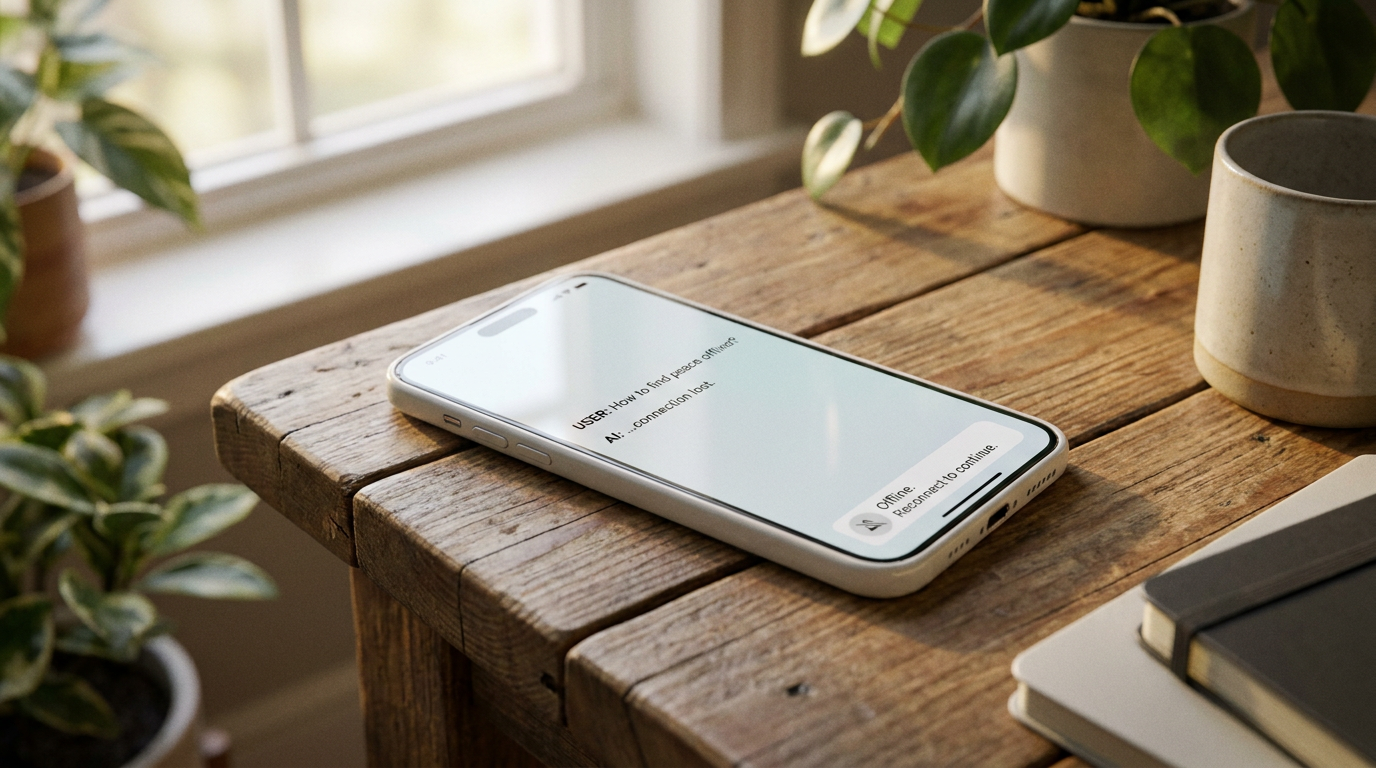
Furthermore, local models do not require a Wi-Fi connection. They function seamlessly on airplanes, in remote locations, or during network outages, transforming AI from a web service into a core, always-available utility.[3][5]

But how does an AI model get small enough to fit on a phone without losing its mind? The secret lies in two primary compression techniques: knowledge distillation and quantization.[5][7]
But how does an AI model get small enough to fit on a phone without losing its mind?
Knowledge distillation is essentially a teacher-student dynamic. Instead of training a small model from scratch on raw internet data, researchers use a massive, highly capable "teacher" model to generate high-quality, curated training examples. The smaller "student" model learns to mimic the teacher's reasoning patterns, absorbing the concentrated intelligence without needing the massive parameter count.[7]
Once trained, the model undergoes quantization. In standard AI development, neural network weights are stored as high-precision 16-bit floating-point numbers. Quantization mathematically rounds these values down to 8-bit or even 4-bit integers. This drastically shrinks the model's memory footprint—allowing a model that would normally require 14 gigabytes of RAM to squeeze into just 4 gigabytes—with surprisingly little loss in actual conversational quality.[3][5]

The 2026 SLM landscape is highly competitive. Microsoft's Phi-4-mini and Phi-3.5 families have proven that sub-4-billion parameter models can punch far above their weight in logic and coding. Meta's Llama 3.2 offers 1B and 3B variants specifically designed for edge devices, while Google's Gemma 3 and Alibaba's Qwen 3.5 provide robust, multi-lingual local options.[2][4][7]
Hardware and operating systems have evolved rapidly to host these models. Modern smartphones and laptops now feature dedicated Neural Processing Units (NPUs) designed specifically to run AI math efficiently without draining the battery.[3][5]
Apple's iOS 26, released this year, cemented this shift by introducing the Foundation Models framework. This native Swift API allows developers to easily plug their apps directly into Apple's on-device models, or bring their own SLMs, making local AI a first-class citizen on iPhones and Macs.[1]
Meanwhile, open-source software like Ollama has made running local AI on a laptop as simple as downloading a standard application. Mobile apps like Off Grid are pushing the boundaries further, offering fully offline AI suites that can analyze documents, transcribe voice, and generate text entirely on-device.[4][6]

Despite the breakthroughs, SLMs are not magic. They have a distinct capability ceiling. While a 3-billion parameter model is excellent at summarizing text, formatting data, or answering straightforward questions, it will struggle with complex mathematical reasoning, deep creative writing, or highly obscure trivia compared to a frontier cloud model.[2][3][7]
Because of this, the future of AI is not strictly local or strictly cloud, but a hybrid of the two. The emerging standard is "local-first": your device attempts to handle the request privately and instantly using an SLM. Only if the task requires heavy reasoning does the system—with your permission—securely route the prompt to a massive cloud model.[1][3][7]
How we got here
Early 2023
The leak of Meta's original LLaMA weights sparks a grassroots movement to run AI models locally on consumer hardware.
Mid 2024
Apple announces Apple Intelligence, signaling a major industry shift toward on-device AI processing.
Late 2025
Sub-4-billion parameter models like Microsoft's Phi-3 and Google's Gemma 2 achieve performance levels previously requiring massive cloud infrastructure.
June 2026
Apple's iOS 26 Foundation Models framework and mature open-source SLMs make local AI a standard feature across consumer devices.
Viewpoints in depth
Privacy & Security Advocates
Argue that data sovereignty is paramount and that sensitive information should never be sent to cloud servers.
For privacy advocates and regulated industries, the cloud-based AI model is fundamentally broken. Sending proprietary code, patient records, or personal journals to a third-party server introduces unacceptable risks of data breaches or unauthorized training usage. This camp views on-device SLMs not just as a convenience, but as a necessary evolution to ensure that users retain total ownership and control over their digital intelligence.
Mobile & Edge Developers
Value the elimination of API costs and network latency, focusing on optimizing models to fit strict device memory limits.
Developers building the next generation of applications are drawn to SLMs because they eliminate the two biggest bottlenecks in AI software: latency and cost. By running models locally, apps can offer instant, fluid interactions without racking up massive cloud API bills. However, this camp is highly focused on the engineering challenges of quantization and memory management, as they must ensure their AI features do not consume all of a device's RAM or drain its battery.
AI Capability Realists
Acknowledge the efficiency of local models but maintain that frontier cloud models are still required for complex reasoning and advanced math.
While celebrating the rise of SLMs, AI researchers caution against overestimating their capabilities. A 3-billion parameter model is a marvel of compression, but it lacks the vast world knowledge and deep multi-step reasoning of a trillion-parameter frontier model. This camp advocates for a hybrid architecture: using local models as a fast, private first pass for routine tasks, while seamlessly routing complex, high-stakes queries to the cloud.
What we don't know
- How quickly hardware manufacturers will increase baseline RAM in entry-level devices to better support local AI.
- Whether future compression techniques can bridge the reasoning gap between SLMs and frontier cloud models.
- How battery technology will evolve to handle the sustained power draw of continuous on-device inference.
Key terms
- Small Language Model (SLM)
- A compact AI model, typically under 14 billion parameters, designed to run efficiently on consumer hardware like laptops and phones.
- Quantization
- A compression technique that reduces the precision of an AI model's internal numbers (e.g., from 16-bit to 4-bit), drastically lowering its memory requirements.
- Knowledge Distillation
- A training method where a smaller AI model learns by mimicking the outputs and reasoning patterns of a much larger, more capable model.
- Neural Processing Unit (NPU)
- A specialized hardware chip inside modern devices designed specifically to accelerate artificial intelligence calculations efficiently.
- Inference
- The process of an AI model actively generating a response or analyzing data, as opposed to the initial training phase.
Frequently asked
Can I run a Small Language Model on my current phone?
Yes, if you have a relatively recent device. Models in the 1B to 3B parameter range typically require around 2GB to 4GB of free RAM, making them compatible with most flagship phones from the last few years.
Does running AI locally drain my battery faster?
It uses more power than a simple cloud API call, but modern devices feature Neural Processing Units (NPUs) specifically designed to run these calculations efficiently without severely impacting battery life.
Is a local model as smart as ChatGPT?
For everyday tasks like summarizing text, drafting emails, or answering basic questions, they perform very similarly. However, they lack the deep reasoning and expansive trivia knowledge of massive cloud models.
Do I need an internet connection to use an SLM?
No. Once the model is downloaded to your device, it runs entirely offline, making it usable on airplanes or in remote areas.
Sources
Source coverage
7 outlets
3 viewpoints surfaced







[1]AppleMobile & Edge Developers
Apple accelerates app development with new intelligence frameworks
Read on Apple →[2]BentoMLAI Capability Realists
The Best Open-Source Small Language Models (SLMs) in 2026
Read on BentoML →[3]AI MagicxPrivacy & Security Advocates
A practical guide to running AI models locally on consumer hardware in 2026
Read on AI Magicx →[4]Build5NinesMobile & Edge Developers
Run your own local ChatGPT-like app using Ollama
Read on Build5Nines →[5]MicrosoftMobile & Edge Developers
Part 2: How Small Language Models Bring AI to the Edge
Read on Microsoft →[6]GitHubPrivacy & Security Advocates
Off Grid — Your AI, your device, your data
Read on GitHub →[7]Factlen Editorial TeamAI Capability Realists
Synthesis by Factlen editorial team
Read on Factlen Editorial Team →

More in ai
See all 5 stories →Brain-Machine Interfaces
Northwestern Engineers Print Artificial Neurons That Communicate Directly With Living Brain Cells
8 sources

Machine Unlearning
How Researchers Are Teaching AI to Forget: The Rise of Machine Unlearning
8 sources
Bioelectronics
Northwestern Engineers Print Artificial Neurons That Communicate With Living Brain Cells
7 sources

Every angle. Every day.
Get ai stories with full source coverage and perspective breakdowns delivered to your inbox.