
How Enhanced Geothermal Systems Are Unlocking 24/7 Clean Energy
By borrowing drilling techniques from the oil and gas industry, next-generation geothermal technology is turning hot, dry rock into a scalable source of continuous carbon-free power.
By Factlen Editorial Team
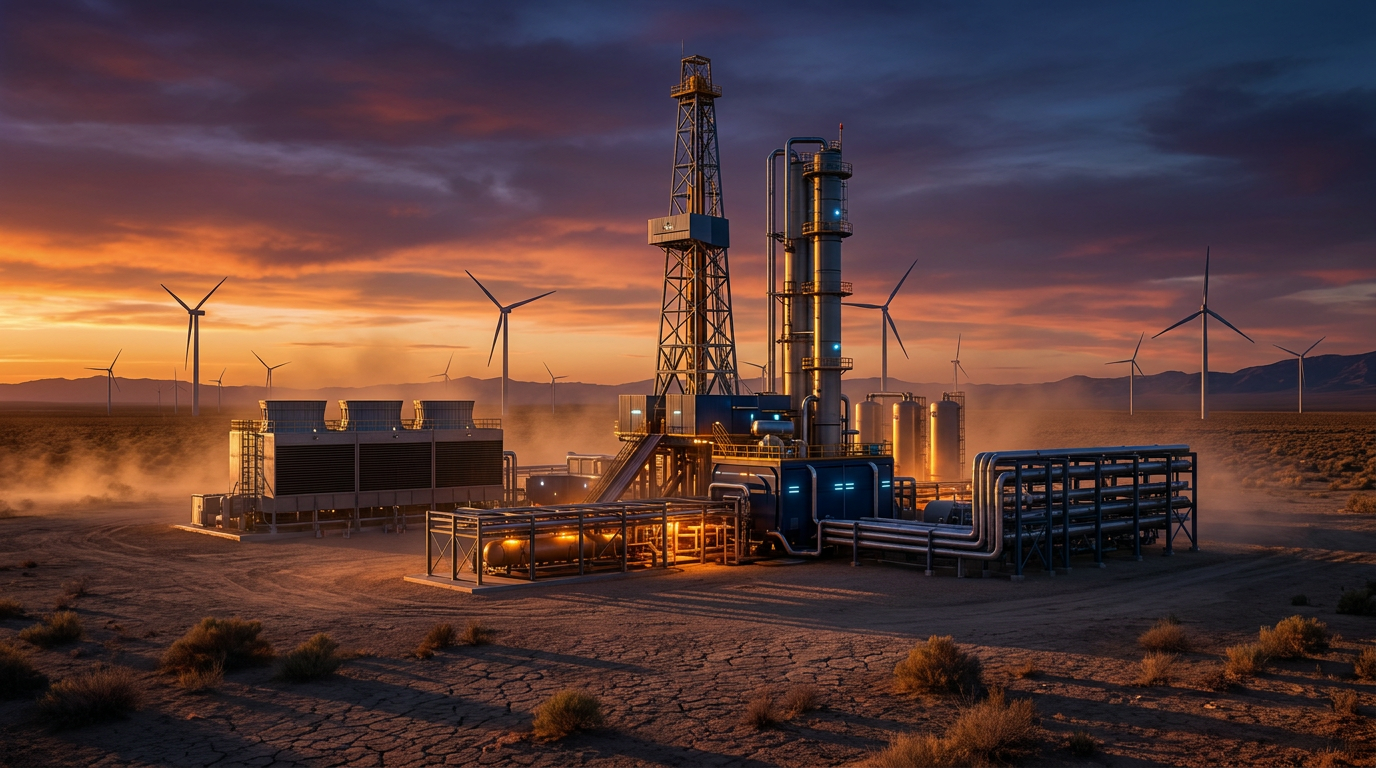
- Clean Energy Developers
- Focus on scaling firm power to complement wind and solar.
- Federal Researchers
- Focus on driving down costs and monitoring subsurface safety.
- Industrial Supply Chain
- Focus on transferring oil and gas drilling tech to renewable applications.
What's not represented
- · Local communities near proposed drilling sites
- · Wildlife conservationists monitoring public land use
Why this matters
As the world electrifies and power-hungry AI data centers expand, the grid desperately needs 'firm' clean energy that runs when the sun isn't shining and the wind isn't blowing. Enhanced geothermal could provide the missing baseload power to fully decarbonize the economy.
Key points
- Enhanced Geothermal Systems (EGS) use horizontal drilling and fracturing to create artificial underground heat reservoirs.
- The technology provides 24/7 'firm' clean power, solving the intermittency problems of solar and wind energy.
- Fervo Energy recently secured $421 million to expand its Utah project after reducing drilling times by 70 percent.
- The U.S. Department of Energy projects next-generation geothermal could reach 90 gigawatts of capacity by 2050.
- Berkeley Lab researchers recently achieved a breakthrough in continuous, high-temperature seismic monitoring for EGS sites.
The global transition to clean energy has a massive, widely acknowledged blind spot. While solar panels and wind turbines have plummeted in cost and deployed at record speeds, they remain fundamentally intermittent. When the sun sets or the wind dies down, grid operators must scramble to replace that lost generation. Historically, this has meant firing up carbon-heavy natural gas plants or keeping aging coal facilities online. The grid desperately needs "firm" power—electricity that flows continuously, twenty-four hours a day, seven days a week, regardless of the weather.[4]
For decades, geothermal energy was viewed as the ideal, albeit limited, solution to this baseload problem. Conventional geothermal power relies on a rare geological trifecta: intense underground heat, naturally occurring fluid, and highly permeable rock. Because it requires all three elements to exist naturally, development has historically been confined to regions with active hot springs or specific tectonic conditions, such as Iceland, Indonesia, or isolated pockets of the American West. As a result, geothermal currently supplies less than one percent of the world's electricity.[4][5]
That geographic limitation is now being shattered by a breakthrough known as Enhanced Geothermal Systems (EGS). Instead of hunting for rare natural reservoirs, EGS engineers them. Deep beneath the Earth's surface, almost everywhere on the planet, lies an inexhaustible supply of hot, dry rock. By artificially creating the missing permeability and introducing fluid, next-generation geothermal companies are turning this ubiquitous subsurface heat into a scalable, dispatchable power source that can be deployed far beyond traditional geothermal hotspots, unlocking a new era of energy.[5]
The profound irony of the Enhanced Geothermal Systems revolution is that its success relies entirely on technology pioneered by the fossil fuel industry. Over the past two decades, the shale oil and gas boom perfected the arts of horizontal drilling and hydraulic fracturing. Today, clean energy engineers are repurposing those exact same tools. By adapting rugged drill bits, directional steering, and high-pressure fluid injection, they can now access and manipulate the deep, crystalline basement rock that was previously considered impenetrable.[3][5]

The mechanical process of an EGS facility is straightforward in concept but technically daunting in execution. Operators drill a well thousands of feet straight down into the Earth's crust until they reach rock temperatures exceeding 300 degrees Fahrenheit. The drill path is then turned horizontally, cutting through the hot rock for thousands of feet. Once the wellbore is established, engineers inject water under immense pressure to create a vast network of millimeter-thick fractures, effectively shattering the rock to create artificial permeability.[3][5]
A second well, known as the production well, is then drilled to intersect this newly created fracture network. The system operates as a massive, closed-loop subterranean radiator. Cold water is pumped down the injection well and forced through the fractured rock, where it absorbs the intense, naturally occurring geothermal heat. The superheated water is then drawn up the production well to the surface, where it flashes into steam to spin a turbine and generate electricity before being cooled and recirculated.[5]
This technology is rapidly moving from theoretical research to commercial reality. Fervo Energy, a leading developer in the EGS space, recently achieved a major milestone by securing $421 million in financing to build and expand its Cape Station project in Utah. This massive influx of capital marks a critical turning point for the industry, demonstrating to Wall Street and utility markets that enhanced geothermal is transitioning from a speculative venture into a highly bankable, utility-scale asset class capable of delivering reliable returns.[6]
This technology is rapidly moving from theoretical research to commercial reality.
The economics of EGS are improving at a staggering pace, driven by steep learning curves in the field. Between its initial pilot project in Nevada and its commercial-scale wells at Cape Station, Fervo Energy demonstrated a 70 percent reduction in drilling times. Because drilling historically accounts for more than half of the capital costs associated with geothermal development, shaving weeks off the drilling schedule dramatically transforms the financial viability of these massive infrastructure projects, making them increasingly competitive with fossil fuels.[3][6]
The U.S. Department of Energy views this rapid cost compression as the catalyst for a nationwide geothermal renaissance. In its recent "Pathways to Commercial Liftoff" report, the agency projected that next-generation geothermal technologies could increase the country's geothermal capacity by a factor of twenty. If deployed at scale, EGS could provide 90 gigawatts of firm, carbon-free power to the U.S. grid by 2050, fundamentally altering the nation's energy landscape and providing a robust backbone for the clean energy transition.[1]

To realize that ambitious 90-gigawatt vision, the industry must continue to drive down upfront capital expenditures. The Department of Energy has launched the "Enhanced Geothermal Shot," an aggressive initiative aimed at reducing the levelized cost of EGS by 90 percent. The ultimate target is to reach $45 per megawatt-hour by 2035. Achieving this price point would make enhanced geothermal fully cost-competitive with natural gas and paired solar-plus-storage facilities, removing the final economic barriers to widespread, global adoption and grid integration.[1]
Beyond faster drilling, the industry is achieving critical breakthroughs in subsurface monitoring and safety. Because EGS relies on hydraulic stimulation to fracture rock, it inherently induces micro-seismicity. While these seismic events are typically far too small to be felt at the surface, mapping them in real-time is essential for optimizing the underground heat-exchange network and ensuring the structural integrity of the surrounding geology. Operating sensitive electronic equipment in extreme subterranean heat has long been a major engineering hurdle for developers.[2]
In April 2026, researchers from Lawrence Berkeley National Laboratory announced a landmark achievement in this domain. The team successfully deployed a custom-built seismometer nearly 7,000 feet underground at Fervo's Utah site, where ambient rock temperatures reached a blistering 338 degrees Fahrenheit. The sensor operated continuously for seven months, providing an unprecedented, high-resolution map of fracture formations. This durability breakthrough proves that operators can safely and accurately monitor deep reservoir behavior over long periods, mitigating one of the technology's primary operational risks.[2]

The environmental advantages of enhanced geothermal extend far beyond its zero-carbon emissions profile. Compared to sprawling utility-scale solar farms or massive wind installations, an EGS power plant has a remarkably small physical footprint. A facility capable of powering hundreds of thousands of homes can be built on just a few acres of land. Furthermore, unlike fossil fuel plants, geothermal facilities emit virtually no conventional air pollutants, such as particulate matter or sulfur dioxide, making them ideal neighbors for local communities.[4]
Crucially, the rise of enhanced geothermal offers a highly lucrative and direct transition path for the existing oil and gas workforce. The specialized skills required to operate heavy drilling rigs, manage high-pressure fluid injection, and engineer complex well casings are exactly what the EGS industry needs. This creates a unique "green drilling" paradigm, where petroleum engineers and roughnecks can seamlessly transfer their expertise to the renewable energy sector, ensuring that the clean energy transition creates high-paying, long-term industrial jobs.[5]
Despite the immense promise, significant hurdles remain before EGS can single-handedly balance the global grid. The upfront capital required to drill multiple deep wells into hard, crystalline rock is staggering, and early-stage projects still rely heavily on federal subsidies and premium power purchase agreements. Additionally, navigating the complex permitting processes on federal lands—where the vast majority of the highest-quality Western U.S. geothermal resources are located—can delay project timelines by several years, frustrating developers who are eager to deploy capital.[1][3]

Yet, the macroeconomic tailwinds pushing enhanced geothermal forward are undeniable. As the global economy rapidly electrifies and technology giants build massive, power-hungry data centers to support artificial intelligence, the demand for reliable, 24/7 clean electricity has reached a fever pitch. Solar and wind will continue to do the heavy lifting of decarbonization, but they cannot do it alone. By tapping into the limitless heat beneath our feet, enhanced geothermal systems are poised to become the ultimate clean energy battery.[1][4][6]
How we got here
2023
The U.S. Department of Energy launches the Enhanced Geothermal Shot to aggressively drive down costs.
2024
The DOE releases a commercial liftoff report projecting EGS could increase U.S. geothermal capacity twentyfold.
2025
Fervo Energy achieves a 70% reduction in drilling times at its Cape Station site, proving the technology can scale efficiently.
March 2026
Fervo secures $421 million in financing, marking a major milestone for EGS as a bankable asset class.
April 2026
Berkeley Lab researchers successfully operate high-temperature seismic monitors 7,000 feet underground for seven continuous months.
Viewpoints in depth
Grid Operators & Tech Companies
Desperate for 24/7 clean power to balance intermittent renewables and feed AI data centers, viewing EGS as the missing puzzle piece.
For utilities and major technology firms, the clean energy transition has created a reliability crisis. While solar and wind are cheap, their intermittency requires massive, expensive battery storage or reliance on natural gas peaker plants. Tech giants building gigawatt-scale AI data centers cannot afford power interruptions. They view enhanced geothermal as the holy grail: a power source that offers the zero-carbon profile of renewables with the 24/7 reliability of a nuclear or coal plant, making it worth the premium early-stage investment.
The Oil & Gas Workforce
Seeing a direct, lucrative transition path where their existing expertise in horizontal drilling is suddenly vital for a zero-carbon future.
The petroleum industry has historically viewed the renewable energy transition as an existential threat to its workforce. Enhanced geothermal flips that narrative. The exact skills required to extract shale gas—directional drilling, hydraulic fracturing, and high-pressure fluid management—are the core competencies needed to build EGS reservoirs. Industry advocates argue that geothermal offers a 'green drilling' boom, allowing roughnecks, petroleum engineers, and oilfield service companies to pivot their existing equipment and expertise directly into the clean energy economy without retraining.
Environmental & Seismic Monitors
Cautiously optimistic but heavily focused on ensuring that induced fracturing does not trigger problematic seismic events or contaminate aquifers.
While environmental groups broadly support geothermal's low surface footprint and zero-emissions profile, the mechanics of EGS raise localized concerns. Because the process relies on hydraulic stimulation to shatter deep rock, it inherently causes micro-seismicity. Monitors and geophysicists emphasize the absolute necessity of rigorous, real-time subsurface tracking to ensure these engineered fractures do not trigger larger, damaging earthquakes or interact with shallow groundwater aquifers. They advocate for strict regulatory oversight and transparent data sharing as the industry scales.
What we don't know
- Whether induced micro-seismicity can be safely managed at massive scale near more populated areas.
- If the specialized supply chain for high-temperature drilling components can scale fast enough to meet DOE targets.
- How quickly federal permitting on public lands can be streamlined to accelerate subsurface development.
Key terms
- Enhanced Geothermal Systems (EGS)
- A technology that creates artificial underground reservoirs by injecting fluid into hot, dry rock to extract heat for electricity generation.
- Baseload Power
- The minimum amount of electric power that must be continuously supplied to the electrical grid at any given time.
- Hydraulic Stimulation
- The process of injecting fluid under high pressure into subterranean rock formations to create or widen fractures, increasing permeability.
- Levelized Cost of Energy (LCOE)
- A metric that measures the lifetime costs of a power plant divided by its energy production, used to compare different energy sources.
Frequently asked
Is EGS the same as fracking for oil?
While EGS uses hydraulic stimulation techniques developed by the oil and gas industry, it injects water to create heat-exchange fractures in hot rock, rather than extracting hydrocarbons.
Can enhanced geothermal be built anywhere?
Theoretically yes, if drilled deep enough. However, current commercial efforts target regions where hot rock is relatively close to the surface to keep drilling costs manageable.
Does EGS cause earthquakes?
Creating fractures induces micro-seismicity, which is typically too small to be felt at the surface. Operators use advanced fiber-optic and seismic sensors to monitor and safely manage this activity.
Why is geothermal better than solar or wind?
It isn't necessarily better, but it is complementary. Solar and wind are cheaper but intermittent; geothermal provides 'firm' baseload power that runs 24/7 regardless of the weather.
Sources
Source coverage
7 outlets
3 viewpoints surfaced







[1]U.S. Department of EnergyFederal Researchers
Enhanced Geothermal Systems and the Pathways to Commercial Liftoff
Read on U.S. Department of Energy →[2]Lawrence Berkeley National LaboratoryFederal Researchers
Scientists Develop New Technology to Continuously Monitor Geothermal Energy Operations
Read on Lawrence Berkeley National Laboratory →[3]Information Technology and Innovation FoundationIndustrial Supply Chain
Accelerating Advanced Geothermal: EGS in Action
Read on Information Technology and Innovation Foundation →[4]World Resources InstituteClean Energy Developers
The Promise of Next-Generation Geothermal Energy
Read on World Resources Institute →[5]VallourecIndustrial Supply Chain
Next-Generation Geothermal systems are transforming geothermal energy
Read on Vallourec →[6]Carbon CreditsClean Energy Developers
Fervo Energy's $421M Breakthrough and The Rise of Geothermal Power
Read on Carbon Credits →[7]Factlen Editorial TeamIndustrial Supply Chain
Synthesis by Factlen editorial team
Read on Factlen Editorial Team →
Every angle. Every day.
Get energy stories with full source coverage and perspective breakdowns delivered to your inbox.