
The Science of Tangzhong and Yudane: How a Simple Water Roux Transforms Bread
By pre-gelatinizing starches with hot liquid, bakers can dramatically increase dough hydration, resulting in pillowy loaves that resist staling for days.
By Factlen Editorial Team
- Home Baking Advocates
- Values the tangzhong method for bringing bakery-quality softness and longevity to home kitchens without artificial additives.
- Commercial Baking Industry
- Prioritizes the yudane method for its ease of automation, cost-effectiveness, and structural resilience during mechanical slicing.
- Culinary Scientists
- Focuses on the underlying chemistry of starch gelatinization, dough rheology, and the mechanics of delayed retrogradation.
What's not represented
- · Gluten-free bakers
- · Historical European bakers
Why this matters
Understanding starch gelatinization allows home bakers to achieve bakery-quality, preservative-free bread that stays soft and fresh for nearly a week, fundamentally changing how dough handles and bakes.
Key points
- A water roux pre-cooks a small portion of flour and liquid to gelatinize the starches.
- Gelatinized starches can absorb up to twice as much water as raw flour, drastically increasing dough hydration.
- The trapped moisture prevents the dough from becoming sticky while yielding a remarkably soft crumb.
- The roux acts as a structural stabilizer, slowing down retrogradation (staling) so bread stays fresh for days.
The holy grail of bread baking is a loaf that emerges from the oven impossibly soft and remains exactly that way for days on end. For generations, traditional European and American bakers relied on heavy enrichments—such as copious amounts of butter, eggs, and sugar—to achieve a tender crumb, or they turned to artificial chemical preservatives to artificially extend a loaf's shelf life. But a fundamentally different approach, deeply rooted in Asian baking traditions, achieves vastly superior results using nothing more than standard flour, water, and applied heat. This elegant technique transforms the physical properties of the ingredients before the dough is even mixed.[2][6]
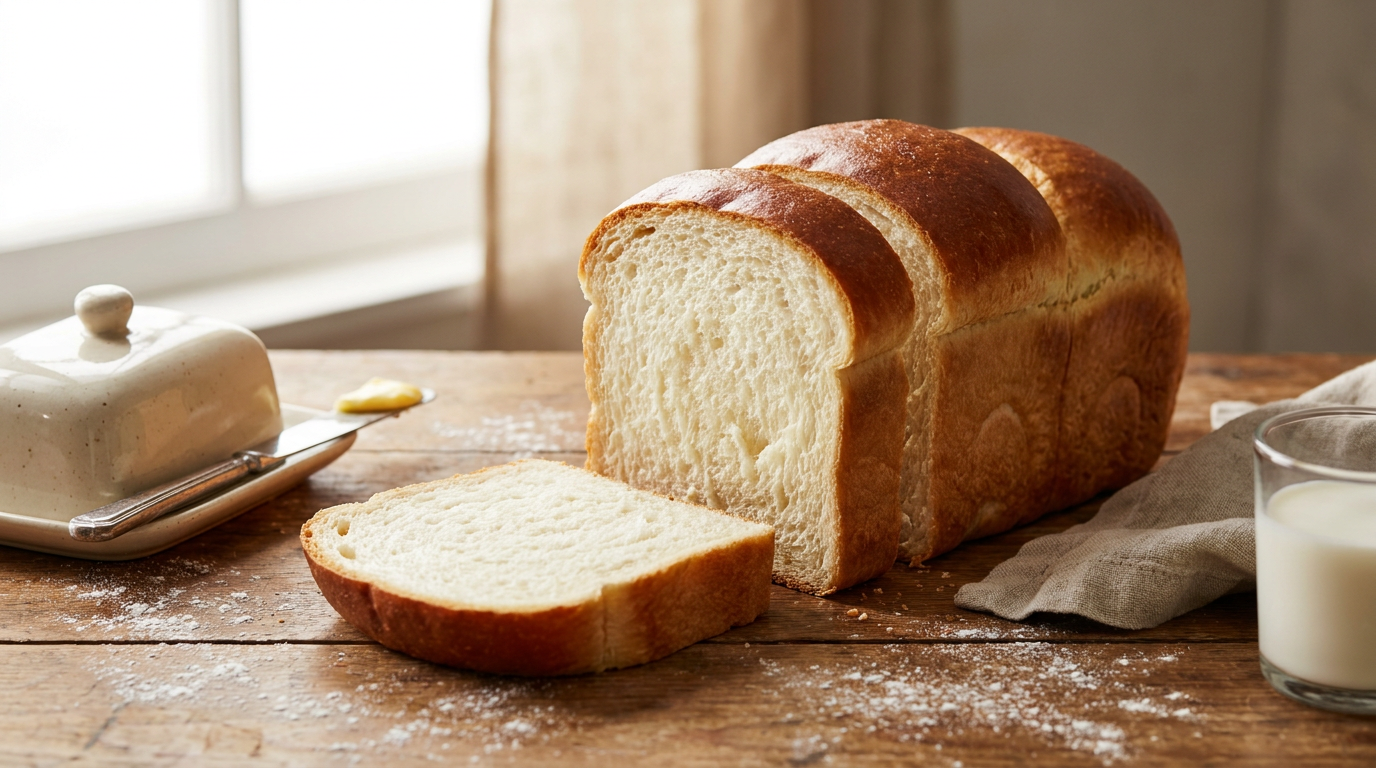
The secret to this enduring softness lies in a specialized technique known broadly as a water roux. By pre-cooking a small, calculated portion of a recipe's flour and liquid into a thick paste before adding it to the main dough, bakers can fundamentally alter the chemistry and moisture-retention capabilities of the bread. This specific method is the foundational secret behind Hokkaido milk bread, the feathery, cloud-like loaves found prominently in bakeries across Japan, Taiwan, and China. Today, the technique has transcended its regional origins, becoming an absolute staple in artisanal and home baking worldwide for everything from sweet cinnamon rolls to crusty sourdough hybrids.[1][2]
The underlying practice of "scalding" flour has actually existed for centuries, historically utilized in dense European rye breads and traditional Chinese steamed buns to improve texture. However, the modern application specifically engineered for soft, high-rising yeast breads evolved in Japan during the latter half of the 20th century. Japanese bakers developed a streamlined method called "yudane," which involves pouring boiling water directly over raw flour. Recognizing its immense commercial value for extending shelf life without chemicals, the Pasco Shikishima Corporation officially patented the yudane method for mass bread production in Japan in 2001, cementing its role in industrial baking.[1][4]
A few years after that patent, the technique reached a massive global audience under a slightly different name and methodology. In 2007, Taiwanese pastry chef Yvonne Chen published the highly influential cookbook "65°C Bread Doctor," which adapted the Japanese concept into a precise stovetop method she called "tangzhong"—a Chinese term roughly translating to "hot water seed." Chen's temperature-controlled approach popularized the water roux across Asia and eventually the Western hemisphere, making it highly accessible to everyday home bakers who desperately wanted bakery-tier softness without relying on commercial industrial dough conditioners.[1][2]

The complex science behind both the tangzhong and yudane methods relies entirely on a thermal process called starch gelatinization. Raw wheat flour is packed with microscopic starch granules, which are naturally hard and crystalline in their raw state. In cold or room-temperature water, these rigid granules absorb very little moisture, leaving the water free-floating in the dough. However, when the flour and liquid mixture is actively heated to approximately 150°F (65°C), the intermolecular bonds within the starch molecules begin to rapidly break down and restructure.[3][4]
As those internal bonds break, the starch granules swell like microscopic sponges, eagerly absorbing and trapping surrounding water molecules deep inside their structure. In fact, fully gelatinized flour can absorb up to twice as much liquid as raw, unheated flour. During this heating process, the mixture visibly transforms from a thin, milky liquid into a highly viscous, glossy, pudding-like gel. This thick gel is then allowed to cool to room temperature and is seamlessly incorporated into the main bread dough, carrying its massive, trapped payload of water securely along with it.[2][5]
As those internal bonds break, the starch granules swell like microscopic sponges, eagerly absorbing and trapping surrounding water molecules deep inside their structure.
This specific chemical transformation solves one of the most frustrating paradoxes in all of baking: the hydration limit. Generally speaking, adding more water to bread dough makes the final baked product softer and features a more open crumb, but it also makes the raw dough incredibly sticky, slack, and nearly impossible to knead or shape by hand. The water roux brilliantly bypasses this problem. Because the extra moisture is securely locked inside the gelatinized starch matrix rather than floating freely, the dough feels strong, cohesive, and easy to handle, even while boasting an exceptionally high overall hydration level.[2][3]

Beyond providing initial out-of-the-oven softness, the water roux tackles the inevitable, dreaded enemy of all baked goods: staling. Contrary to popular belief, bread does not go stale simply because it dries out and loses moisture to the air; it goes stale due to a chemical process called retrogradation. Over time, the starches in baked bread naturally attempt to recrystallize and return to their original hard, crystalline state, physically pushing water out of their structure and causing the surrounding crumb to become firm, dry, and crumbly.[1][4]
The gelatinized paste generated from the tangzhong or yudane method acts as a powerful structural stabilizer within the baked loaf. It effectively interrupts the recrystallization process, holding onto the trapped moisture tightly and drastically slowing down the rate of retrogradation. While a standard loaf of homemade white sandwich bread might become noticeably firm and stale within 24 to 48 hours, a loaf baked with a properly executed water roux can retain its pillowy, fresh-from-the-oven texture for up to a full week when stored properly at room temperature.[1][5]
While tangzhong and yudane share the exact same scientific goal of starch gelatinization, they differ significantly in their execution and ingredient ratios. Tangzhong typically utilizes a flour-to-liquid ratio of 1:5 by weight. The baker whisks the mixture over medium heat on a stovetop until it reaches the critical 65°C threshold and visibly thickens. Because it requires active, continuous cooking, tangzhong usually accounts for only 5% to 10% of the total flour in a given recipe, ensuring the baker does not accidentally evaporate too much necessary moisture during the heating phase.[2][3]

Yudane, conversely, uses a strict 1:1 ratio of flour to boiling water by weight. Instead of active stovetop cooking, the baker simply pours water heated to exactly 100°C directly over the raw flour, stirring it vigorously into a thick, pliable paste that closely resembles a piece of glutenous dough. Because there is no prolonged exposure to open heat and therefore minimal evaporation, yudane can safely incorporate a much larger percentage of the recipe's total flour—typically ranging from 15% to 20%, and occasionally pushed up to 30% in specialized commercial recipes.[3][5]
The ultimate choice between the two distinct methods often comes down to the scale of production and sheer convenience. Commercial bread manufacturers heavily favor the yudane method for its operational simplicity. As culinary scientists and industrial bakers note, it is vastly easier and more cost-effective to dump boiling water from an industrial tank over massive bins of flour than to carefully cook and continuously stir massive vats of slurry. Yudane also tends to produce a slightly chewier, more resilient crumb that holds up exceptionally well when passed through commercial mechanical slicing machines.[5][6]
For dedicated home bakers, tangzhong remains incredibly popular due to its exacting precision. Cooking the roux on the stove ensures that every single starch granule is fully and evenly gelatinized, which many artisanal bakers believe yields a slightly lighter, fluffier final product. Furthermore, because the water roux provides so much inherent tenderness to the crumb, bakers can significantly reduce the amount of butter, oil, or eggs required in a recipe. This makes the technique an invaluable tool for creating rich-tasting vegan breads or lightening up traditionally heavy, fat-laden doughs like brioche.[3][5]

Despite its near-magical properties, the water roux method does introduce a few variables that require careful management by the baker. The evaporation that occurs while cooking a tangzhong can be highly unpredictable depending on the specific stove and pan used, occasionally throwing off the final dough's delicate hydration balance if the water loss is not measured and accounted for. Additionally, incorporating a large percentage of pre-gelatinized flour can slightly dilute the dough's overall gluten structure and slow down yeast fermentation, meaning these enriched doughs often require a significantly longer proofing time to achieve their signature towering rise.[3][6]
How we got here
Centuries ago
European and Chinese bakers utilize early forms of "scalding" flour to improve the texture of dense rye breads and steamed buns.
20th Century
Japanese bakers develop the yudane method, using boiling water to pre-gelatinize starches for ultra-soft milk bread.
2001
The Pasco Shikishima Corporation officially patents the yudane method for commercial bread manufacturing in Japan.
2007
Taiwanese pastry chef Yvonne Chen publishes "65°C Bread Doctor," popularizing the stovetop tangzhong method across Asia and eventually the West.
Viewpoints in depth
Home Baking Advocates
Values the tangzhong method for bringing bakery-quality softness and longevity to home kitchens without artificial additives.
For artisanal and home bakers, the tangzhong method represents a democratization of baking science. Historically, achieving a feathery, long-lasting crumb required industrial dough conditioners or heavy enrichments like butter and eggs, which can weigh down a loaf. By simply utilizing a stovetop and a thermometer, home bakers can manipulate the physical properties of their flour to achieve professional-tier softness. Advocates emphasize that the tangzhong method allows for precise temperature control, ensuring complete starch gelatinization and a consistently lighter final product.
Commercial Baking Industry
Prioritizes the yudane method for its ease of automation, cost-effectiveness, and structural resilience during mechanical slicing.
At an industrial scale, efficiency and consistency are paramount. Commercial manufacturers heavily favor the yudane method because it eliminates the need for active cooking. Pouring boiling water from industrial tanks over massive bins of flour is vastly easier to automate than continuously stirring a thickening slurry over heat. Furthermore, industrial bakers note that yudane produces a crumb that is slightly chewier and more structurally sound than tangzhong, allowing the bread to pass through high-speed mechanical slicers without tearing or collapsing.
Culinary Scientists
Focuses on the underlying chemistry of starch gelatinization, dough rheology, and the mechanics of delayed retrogradation.
Food scientists view the water roux through the lens of dough rheology and water activity. They study how pre-gelatinized starches physically alter the gluten network, noting that while the roux locks in moisture, a high percentage of pre-cooked flour can dilute the dough's overall strength. Their research focuses heavily on retrogradation—the recrystallization of starches that causes staling. By mapping how the gelatinized gel stabilizes these starches, scientists can precisely calculate the optimal roux percentages needed to maximize shelf life without compromising the bread's structural integrity.
What we don't know
- The exact rate of evaporation during tangzhong cooking varies wildly by kitchen setup, making precise hydration calculations difficult.
- The long-term impact of high-percentage yudane on the fermentation speed of wild sourdough cultures remains a subject of debate among artisanal bakers.
Key terms
- Starch Gelatinization
- The process where starch granules are heated in liquid, causing them to swell, break their intermolecular bonds, and absorb large amounts of water to form a gel.
- Retrogradation
- The chemical process responsible for bread staling, where starches slowly recrystallize after baking and push moisture out of the crumb.
- Water Roux
- A generic term for a paste made by pre-cooking a portion of a recipe's flour and liquid, encompassing both the tangzhong and yudane methods.
- Hokkaido Milk Bread
- A remarkably soft, feathery Japanese bread style that relies on a water roux to achieve its signature cloud-like texture and extended shelf life.
Frequently asked
Can I use whole wheat flour for a water roux?
Yes, but the resulting bread will not be quite as pillowy soft as loaves made with refined white bread flour due to the bran cutting through the gluten network.
Do I have to use milk in a tangzhong?
No. While milk adds richness and flavor, water works perfectly for gelatinizing the starches and makes the resulting bread suitable for vegan diets.
Why is my tangzhong dough still sticky?
You may have experienced less evaporation than expected while cooking the roux, or your specific brand of flour may have a lower protein content, reducing its ability to absorb the remaining liquid.
Can I make the roux ahead of time?
Yes, both tangzhong and yudane can be prepared a day in advance and stored in the refrigerator, though they should be brought to room temperature before mixing into the dough.
Sources
Source coverage
6 outlets
3 viewpoints surfaced






[1]WikipediaCulinary Scientists
Tangzhong
Read on Wikipedia →[2]King Arthur BakingHome Baking Advocates
Introduction to tangzhong
Read on King Arthur Baking →[3]The Perfect LoafHome Baking Advocates
How to Make Tangzhong
Read on The Perfect Loaf →[4]BakerpediaCulinary Scientists
Tangzhong Method
Read on Bakerpedia →[5]Institute of Culinary EducationCommercial Baking Industry
Tangzhong Method: A Revolutionary Baking Technique
Read on Institute of Culinary Education →[6]Factlen Editorial TeamCulinary Scientists
Synthesis by Factlen editorial team
Read on Factlen Editorial Team →
Every angle. Every day.
Get food drink stories with full source coverage and perspective breakdowns delivered to your inbox.