
How Agrivoltaics is Merging Solar Power and Agriculture to Save Farmland
By elevating solar panels above active farmland, a rapidly growing practice known as agrivoltaics is creating a dual-income stream for farmers while solving the massive land-use requirements of renewable energy.
By Factlen Editorial Team
- Agricultural Producers
- Focuses on keeping land in active production, protecting soil health, and securing stable revenue to survive market volatility.
- Renewable Energy Developers
- Focuses on scaling solar capacity to meet climate goals, overcoming local zoning opposition, and maximizing megawatt output.
- Land Conservationists
- Focuses on preventing the permanent loss of prime topsoil to industrial development and preserving rural ecosystems and biodiversity.
- Systems Analysts
- Focuses on the structural trade-offs, capital expenditures, and microclimate data of dual-use infrastructure.
What's not represented
- · Local zoning board officials who evaluate and approve rural land-use permits
- · Consumers purchasing produce grown under agrivoltaic microclimates
Why this matters
As the world races to build renewable energy, massive land requirements threaten to displace vital food production. Agrivoltaics offers a rare win-win solution that protects the agricultural supply chain, stabilizes food prices, and accelerates clean energy deployment without forcing rural communities to choose between farming and power generation.
Key points
- Agrivoltaics co-locates agricultural production and solar energy generation on the same land, preventing the displacement of farms.
- Elevated solar panels create a microclimate that reduces soil evaporation by up to 30%, protecting crops from extreme heat.
- Crop transpiration cools the solar panels from below, which can increase their electrical efficiency by up to 3%.
- Virginia recently passed landmark legislation to formally define the practice and ensure projects prioritize agricultural productivity.
- While shade-tolerant crops thrive, commodity crops like corn experience slight yield reductions that are offset by energy revenue.
- The primary barrier to widespread adoption is the 10 to 20% higher upfront capital cost required for elevated steel racking.
The transition to a net-zero economy carries a hidden spatial cost. To meet global renewable energy targets, nations must deploy solar power at an unprecedented scale. In the United States alone, the Department of Energy projects that ground-based solar installations could require up to 10 million acres of land by 2050.[5]
This massive footprint has ignited a bitter land-use conflict. Traditionally, utility-scale solar development involves leasing prime farmland, stripping the topsoil, and mounting photovoltaic panels just a few feet off the ground. The land is effectively removed from the food supply for decades, pitting renewable energy goals directly against agricultural preservation and rural heritage.[6]
But a rapidly maturing approach is proving that this does not have to be a zero-sum game. Enter "agrivoltaics"—the intentional co-location of agricultural production and solar energy generation on the exact same plot of land.[6]
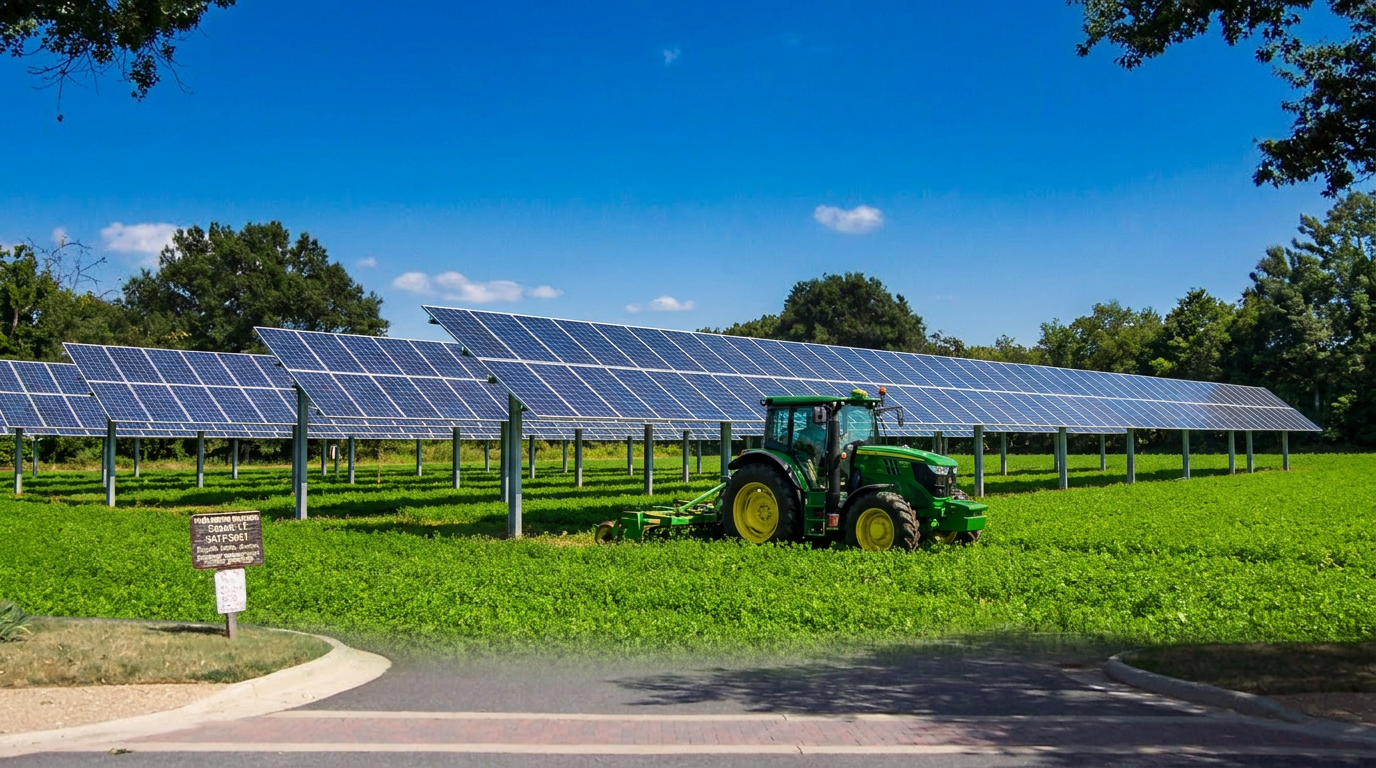
Rather than displacing the farmer, agrivoltaic systems are engineered to accommodate them. Panels are mounted on elevated racking systems, often 10 to 15 feet high, and spaced further apart. This allows sunlight to reach the ground while providing enough clearance for standard agricultural machinery, like tractors and harvesters, to operate freely underneath.[1]

The benefits of this dual-use system extend far beyond simple land efficiency. By placing a semi-permeable canopy of solar panels over a field, developers inadvertently create a highly controlled agricultural microclimate.[7]
During the peak heat of summer, the panels provide partial shade, which acts as a shield against extreme solar radiation. This shading reduces soil evaporation by 15 to 30 percent, allowing the ground to retain vital moisture. For farmers facing increasingly severe droughts and erratic rainfall, this translates to significantly lower irrigation costs and a buffer against climate shocks.[7]
The relationship is also reciprocal. Solar panels are notoriously sensitive to heat; as surface temperatures climb, their photovoltaic efficiency drops. However, the crops growing beneath the arrays continuously release moisture through a process called transpiration. This creates a localized evaporative cooling effect that lowers the operating temperature of the panels above, boosting their electrical output by up to 3 percent.[7]
Economically, agrivoltaics offers a lifeline to an industry plagued by volatile commodity prices and extreme weather. By stacking two distinct revenue streams—agricultural produce and renewable electricity—farmers can stabilize their income. Even in years where crop yields fluctuate, the steady lease payments or energy savings from the solar installation ensure the farm remains financially viable.[1]
However, the system is not a universal panacea, and outcomes depend heavily on the type of crop being cultivated. Shade-tolerant plants—such as leafy greens, broccoli, root vegetables, and certain berries—thrive under the panels, often exhibiting higher yields and better quality than those grown in open, sun-scorched fields.[6]
However, the system is not a universal panacea, and outcomes depend heavily on the type of crop being cultivated.
Conversely, shade-intolerant commodity crops present a more complex trade-off. A 2025 modeling study examining corn production found that every 1 percent increase in shading leads to a roughly 0.55 percent decrease in crop yield.[4]

While this confirms that heavy shading reduces corn harvests, the drop is notably less than a direct one-to-one loss. Researchers attribute this to the increased soil moisture retention, which partially offsets the deprivation of direct sunlight. For farmers, the calculation becomes a matter of balancing this slight agricultural dip against the lucrative energy revenue.[4]
Another popular variation of the practice bypasses crop cultivation entirely in favor of livestock. "Solar grazing" integrates sheep into traditional solar farms. Because sheep are relatively small and efficient grazers, they keep the vegetation trimmed beneath the panels, eliminating the need for fossil-fuel-powered mowers.[6]
This symbiotic arrangement saves solar companies thousands of dollars in landscape maintenance while providing local shepherds with an additional revenue stream. Furthermore, avoiding heavy mowing machinery protects nesting ground birds and promotes healthier, more biodiverse soil ecosystems.[6]

Recognizing the immense potential of dual-use solar, policymakers are beginning to establish formal guardrails to ensure the practice is implemented responsibly. In June 2026, Virginia Governor Abigail Spanberger signed landmark legislation creating the state's first legal definition of agrivoltaics.[2]
The Virginia law mandates that qualifying projects must prioritize agricultural productivity and keep the land in active production for the entire lifespan of the solar array. This legislative framework is designed to prevent developers from using token agricultural efforts—like planting a few vegetables—as a loophole to bypass zoning restrictions meant to protect rural land.[1]
Similar momentum is building globally. Across Europe, where land scarcity is even more acute, agrivoltaics has moved from an experimental niche to a recognized pillar of energy strategy. However, the European regulatory landscape remains fragmented, with only a handful of nations, including France and Germany, having established clear legal definitions for dual-use solar.[7]
Public perception is also proving to be a major tailwind for the movement. A May 2025 study conducted by the University of Bonn surveyed thousands of citizens and found that agrivoltaic projects enjoy significantly higher public acceptance than conventional, single-use solar parks.[3]
By preserving the agrarian character of the landscape and keeping local food systems intact, agrivoltaics effectively neutralizes much of the "Not In My Back Yard" (NIMBY) opposition that frequently stalls renewable energy infrastructure.[3]
Despite the overwhelming benefits, scaling agrivoltaics presents distinct engineering and financial hurdles. Elevating heavy solar arrays high enough to accommodate tractors requires substantially more steel, stronger foundations to withstand wind loads, and more complex permitting.[5]

These structural requirements can drive up the initial capital expenditure of a project by 10 to 20 percent compared to a standard solar farm. Success ultimately requires deep, early-stage collaboration between solar developers, who want to maximize megawatt output, and farmers, who need specific row spacing and light penetration to ensure their harvests succeed.[7]
How we got here
2010s
Early agrivoltaic pilot projects focus primarily on small-scale pollinator habitats and solar grazing with sheep.
2023
The U.S. Department of Energy launches the FARMS program to fund research optimizing megawatt-scale dual-use solar designs.
May 2025
University of Bonn publishes a large-scale study demonstrating that agrivoltaics enjoys significantly higher public acceptance than conventional solar parks.
June 2026
Virginia signs landmark legislation creating the state's first formal legal definition of agrivoltaics to protect farming productivity.
Viewpoints in depth
Agricultural Producers
Farmers view agrivoltaics as a vital tool for economic survival and climate resilience.
Agricultural advocates argue that volatile commodity markets and extreme weather make traditional farming increasingly precarious. By leasing vertical space to solar developers, farmers secure a guaranteed baseline income while the resulting microclimate protects their crops from drought. Their primary demand is that systems be designed around the machinery and sunlight needs of the farm, rather than treating agriculture as an afterthought.
Renewable Energy Developers
Energy companies see dual-use solar as the key to unlocking massive land reserves for decarbonization.
Developers face intense local opposition when attempting to build conventional solar parks on rural land. By integrating agriculture, they can bypass "NIMBY" blockades and secure permits faster. Furthermore, they cite data showing that the evaporative cooling from crops actually increases panel efficiency, making the higher upfront structural costs a worthwhile long-term investment.
Land Conservationists
Conservation groups view the practice as a necessary compromise to protect topsoil and biodiversity.
While they generally prefer untouched natural habitats, conservationists recognize the urgent need for renewable energy. They advocate for agrivoltaics—particularly solar grazing and pollinator habitats—because it prevents prime agricultural topsoil from being permanently stripped and paved over for industrial use. They heavily support legislation to ensure strict definitions prevent ecological exploitation.
What we don't know
- How long-term soil health and microbiome diversity will adapt to decades of partial shading.
- Whether the higher upfront capital costs will deter adoption in developing nations without heavy government subsidies.
- How the insurance industry will underwrite the combined risks of crop failure and solar infrastructure damage in a single location.
Key terms
- Agrivoltaics
- The intentional co-location of agricultural production and solar energy generation on the same plot of land.
- Microclimate
- A local set of atmospheric conditions that differ from those in the surrounding areas, often created beneath solar panels to retain moisture and regulate temperature.
- Solar grazing
- The practice of using livestock, typically sheep, to graze beneath solar panels, which manages vegetation naturally and eliminates the need for gas-powered mowers.
- Transpiration
- The process by which moisture is carried through plants from roots to small pores on the underside of leaves, where it changes to vapor and cools the surrounding air.
- Capital Expenditure (CAPEX)
- The upfront funds used by a company to acquire, upgrade, and maintain physical assets such as elevated steel racking for solar panels.
Frequently asked
What is the difference between agrivoltaics and a regular solar farm?
Regular solar farms mount panels close to the ground, taking the land out of agricultural production. Agrivoltaics elevates the panels and spaces them out, allowing crops to grow or livestock to graze underneath.
Can tractors and farm equipment still be used?
Yes. Agrivoltaic systems are engineered with elevated racking—often 10 to 15 feet high—and wider row spacing specifically to allow standard agricultural machinery to operate freely.
Do crops grow well in the shade of solar panels?
It depends on the crop. Shade-tolerant plants like leafy greens and root vegetables thrive and can see increased yields. Sun-dependent crops like corn experience slight yield reductions, though increased soil moisture offsets some of the loss.
Why do solar developers want to work with farmers?
Co-locating solar with agriculture reduces local opposition to renewable projects, saves money on landscape maintenance, and the cooling effect from the crops can actually make the solar panels more efficient.
Sources
Source coverage
7 outlets
4 viewpoints surfaced







[1]CleanTechnicaRenewable Energy Developers
Agrivoltaics Gets A Huge Thumbs-Up From A State Struggling To Conserve Its Agrarian Heritage
Read on CleanTechnica →[2]Rocktown NowAgricultural Producers
Gov. Spanberger signs bill defining 'agrivoltaics' in Virginia
Read on Rocktown Now →[3]ScienceDailyLand Conservationists
Agrivoltaics enjoys comparatively high acceptance
Read on ScienceDaily →[4]National Renewable Energy LaboratoryLand Conservationists
Modeling crop yield under agrivoltaic systems of common commodity crops
Read on National Renewable Energy Laboratory →[5]U.S. Department of EnergyRenewable Energy Developers
Agrivoltaics: Solar and Agriculture Co-Location
Read on U.S. Department of Energy →[6]U.S. Department of AgricultureAgricultural Producers
Agrivoltaics in the Northeast
Read on U.S. Department of Agriculture →[7]Factlen Editorial TeamSystems Analysts
Synthesis by Factlen editorial team
Read on Factlen Editorial Team →
Every angle. Every day.
Get environment stories with full source coverage and perspective breakdowns delivered to your inbox.