
SpaceX Acquires AI Coding Startup Cursor for $60 Billion Following Record IPO
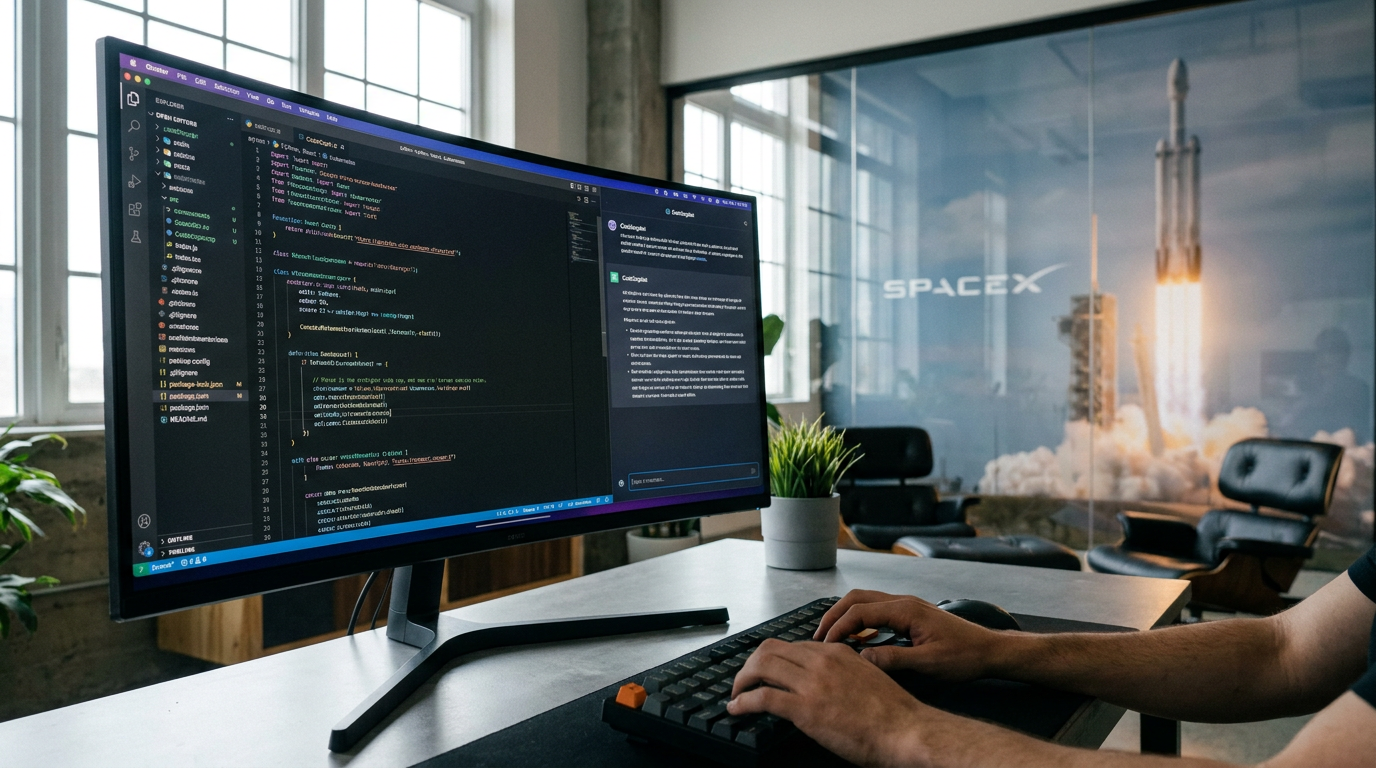
Just days after its historic public market debut, SpaceX has agreed to buy AI coding assistant Cursor in an all-stock deal, cementing its ambitions to dominate the software development layer.
By Factlen Editorial Team
- Enterprise Growth Analysts
- View the acquisition as a necessary strategic maneuver to capture the software production control layer.
- Market Skeptics
- Highlight the steep 15x revenue multiple and the fierce competition from foundation model providers.
- Developer Ecosystem
- Prioritize workflow independence and model-agnostic features over corporate synergy.
What's not represented
- · OpenAI and Anthropic executives
- · Enterprise IT procurement officers
Why this matters
This $60 billion acquisition signals a massive shift in how software is built, positioning SpaceX's xAI to control the primary interface developers use daily. For the broader market, it demonstrates how SpaceX is aggressively leveraging its new $1.77 trillion public valuation to dominate the enterprise AI landscape.
Key points
- SpaceX is acquiring AI coding startup Cursor for $60 billion in an all-stock transaction.
- The deal follows SpaceX's historic $1.77 trillion initial public offering on June 12.
- Cursor recently crossed $4 billion in annualized recurring revenue, driven by strong enterprise adoption.
- The acquisition provides Cursor with access to xAI's Colossus supercomputer to train its agentic models.
- Developers are watching closely to see if Cursor will maintain its model-agnostic approach under SpaceX ownership.
Just days after executing the largest initial public offering in history, SpaceX is already flexing its newfound public-market muscle. The aerospace and artificial intelligence giant has agreed to acquire AI coding startup Cursor in an all-stock transaction valued at $60 billion. The deal, expected to close in the third quarter of 2026, marks a seismic shift in the software development landscape and cements SpaceX's ambitions to dominate the enterprise AI sector.[3][7]
The acquisition arrives at a pivotal moment for Cursor. In recent months, the startup faced intense skepticism on social media, with some developers declaring the platform "dead" following the release of Anthropic's highly capable Claude Code and OpenAI's latest models. Critics argued that foundation model providers would inevitably subsume the coding interface layer, rendering standalone applications obsolete.[1][4]
However, Cursor's internal metrics painted a vastly different picture. Far from struggling, the company recently crossed a staggering $4 billion in annualized recurring revenue (ARR). This represents unprecedented hypergrowth, scaling from $100 million in ARR in mid-2024 to $1 billion by late 2025, and quadrupling again by June 2026.[2][7]

Industry observers noted that the figure suggests Cursor's business is still fast-growing, despite fearsome competition. The startup successfully pivoted from an individual developer tool to a massive enterprise platform. This revenue surge was partly driven by the launch of Cloud Agents, a tool that automates complex, multi-step coding tasks across entire codebases.[2]
For SpaceX, the strategic rationale extends far beyond software revenue. By bringing Cursor in-house, SpaceX's xAI subsidiary gains a critical distribution channel and a direct foothold in the developer workflow. While Anthropic and OpenAI have poured billions into their own coding models, Cursor owns the interface where developers actually spend their days.[3][4]
The pairing also solves Cursor's most pressing existential threat: compute constraints. Training state-of-the-art agentic coding models requires massive computational power. Through this acquisition, Cursor's engineering team will gain unfettered access to xAI's Colossus supercomputer infrastructure, allowing them to dramatically scale up the intelligence of their models without relying on third-party cloud providers.[6]
The pairing also solves Cursor's most pressing existential threat: compute constraints.
The $60 billion price tag has naturally sparked intense debate across Wall Street. At roughly 15 times its $4 billion ARR, the valuation is undeniably steep, representing a premium typically reserved for frontier AI labs rather than application-layer software.[4]
Yet, financial analysts argue the multiple is defensible if Cursor maintains its trajectory. If the startup reaches its projected $6 billion to $10 billion run-rate by the end of 2026, the valuation compresses to a much more standard enterprise multiple. As one market analysis noted, the cleanest way to read the valuation is not as a price for a coding app, but as a premium for a possible control layer in AI software production.[4]

The transaction is structured entirely in stock, leveraging SpaceX's newly minted $1.77 trillion public valuation. SpaceX shares have experienced volatile but upward momentum since their June 12 debut, driven heavily by retail investor enthusiasm and the impending forced buying from passive index funds.[5][8]
Major index providers, including Nasdaq and FTSE Russell, have rewritten their eligibility rules to accommodate SpaceX's massive market capitalization, paving the way for its inclusion in the Nasdaq-100 and Russell 1000 indexes by late June and early July. This index inclusion is expected to unlock billions of dollars in institutional demand, providing a stable foundation for the company's aggressive M&A strategy.[5][8]
Within the developer community, the acquisition has been met with a mix of excitement and trepidation. Cursor's primary appeal has long been its model-agnostic approach, allowing programmers to seamlessly switch between OpenAI, Anthropic, and Google models based on the task at hand.[1][7]

While SpaceX has not announced plans to restrict Cursor to xAI's Grok models, developers are closely watching to see if the platform becomes a "soft Grok-first" environment. Maintaining developer trust will be crucial; if Cursor's interface feels locked into a single ecosystem, it risks alienating the very user base that drove its historic rise.[3][7]
Ultimately, the Cursor acquisition signals that the battle for AI supremacy has moved from raw model performance to workflow integration. As the lines between writing code and managing AI agents continue to blur, SpaceX has secured the most valuable real estate in the programming world—ensuring that the rockets of tomorrow will be built on the software infrastructure it owns today.[1][4]
How we got here
2023
Cursor is launched by Anysphere, quickly gaining traction among developers.
Nov 2025
Cursor closes a $2.3 billion Series D funding round, crossing $1 billion in annualized revenue.
Apr 2026
SpaceX secures the right to acquire Cursor as part of a broader compute partnership.
Jun 12, 2026
SpaceX completes its historic initial public offering, achieving a $1.77 trillion valuation.
Jun 16, 2026
SpaceX officially exercises its option to acquire Cursor for $60 billion in stock.
Viewpoints in depth
Enterprise Growth Analysts
Viewing the acquisition as a necessary strategic maneuver to capture the software production control layer.
Financial analysts argue that while a 15x revenue multiple is steep for a traditional SaaS company, it is justifiable for a frontier AI platform. They view Cursor not merely as a coding application, but as the foundational control layer for future enterprise software development. By securing this interface, SpaceX ensures that its xAI models have a guaranteed, high-volume distribution channel, insulating it from the risk of being commoditized by competitors.
Valuation Skeptics
Highlighting the steep revenue multiple and the fierce competition from foundation model providers.
Skeptics point out that AI coding tools carry massive inference costs, meaning Cursor's $4 billion in revenue does not translate to traditional high-margin software profits. Furthermore, with Anthropic's Claude Code and OpenAI's continuous updates, the coding assistant market is brutally competitive. These observers warn that paying $60 billion for an application layer—when the underlying foundation models are advancing so rapidly—carries significant financial risk.
Developer Ecosystem
Prioritizing workflow independence and model-agnostic features over corporate synergy.
For the programmers who use Cursor daily, the primary concern is workflow independence. Cursor built its massive user base by allowing developers to seamlessly route different tasks to the best available model, whether that was from OpenAI, Anthropic, or Google. The community fears that under SpaceX's ownership, the platform could slowly degrade support for rival models in favor of xAI's Grok, potentially compromising the tool's utility.
What we don't know
- Whether Cursor will eventually restrict access to non-xAI foundation models.
- How quickly regulatory bodies will review and approve the $60 billion transaction.
- The exact margin profile of Cursor's $4 billion in annualized revenue given high inference costs.
Key terms
- Annualized Recurring Revenue (ARR)
- A metric showing the predictable and recurring revenue generated by a subscription-based business over a 12-month period.
- Agentic Coding
- AI systems that don't just autocomplete code, but autonomously plan, write, and test multi-step software changes.
- Inference Costs
- The computational expense required to run an artificial intelligence model when it generates responses or code.
- Free Float
- The portion of a company's shares that are available for trading by the general public, excluding locked-in shares held by insiders.
Frequently asked
Why is SpaceX buying an AI coding startup?
The acquisition gives SpaceX's xAI subsidiary a direct interface with developers, allowing it to compete more effectively with Anthropic and OpenAI.
How much revenue does Cursor make?
As of June 2026, Cursor reached $4 billion in annualized recurring revenue, driven by strong enterprise adoption.
Will Cursor stop supporting other AI models?
SpaceX has not announced any exclusivity plans, but developers are watching closely to see if the platform prioritizes xAI's Grok over competitors.
How is the deal being funded?
The $60 billion transaction is an all-stock deal, leveraging SpaceX's newly established $1.77 trillion public market valuation.
Sources
Source coverage
8 outlets
3 viewpoints surfaced








[1]MarketWatchMarket Skeptics
Social media declared Cursor dead. Then SpaceX handed the AI startup a $60 billion lifeline.
Read on MarketWatch →[2]ForbesEnterprise Growth Analysts
Cursor Hits $4 Billion Annualized Revenue Ahead Of SpaceX IPO
Read on Forbes →[3]AP NewsDeveloper Ecosystem
SpaceX buys AI coding startup Cursor for $60 billion in race for an edge over Anthropic and OpenAI
Read on AP News →[4]New Market PitchEnterprise Growth Analysts
Is Cursor really worth $60B?
Read on New Market Pitch →[5]The Motley FoolMarket Skeptics
SpaceX Has Successfully Completed Its IPO. Here Are All of the Key Dates Investors Should Be Aware of Over the Next 180 Days.
Read on The Motley Fool →[6]CursorDeveloper Ecosystem
Cursor partners with SpaceX on model training
Read on Cursor →[7]WikipediaDeveloper Ecosystem
Cursor (company)
Read on Wikipedia →[8]SpotGammaEnterprise Growth Analysts
SpaceX IPO Index Inclusion: How Rule Changes Force Index Funds to Buy SpaceX
Read on SpotGamma →

Every angle. Every day.
Get finance stories with full source coverage and perspective breakdowns delivered to your inbox.