
The Accessibility Revolution: How Gaming Finally Opened Its Doors to Everyone
Driven by adaptive hardware and software-level inclusive design, the video game industry has transformed from an exclusive club into a model for digital accessibility.
By Factlen Editorial Team
- Accessibility Advocates
- Focus on the human impact of inclusive design and the ongoing push to eliminate digital barriers.
- Platform Holders
- Prioritize the development of modular hardware ecosystems to reduce the financial burden of custom setups.
- Game Developers & Researchers
- Focus on the technical challenges and triumphs of implementing software-level inclusive design.
- Industry Analysts
- View accessibility as a standardizing force that expands the market and improves overall user experience.
What's not represented
- · Independent Game Developers
- · Disabled Gamers in Developing Nations
Why this matters
For decades, video games were inaccessible to millions of people with physical or cognitive disabilities. The recent standardization of adaptive hardware and inclusive software design not only empowers a massive underserved demographic, but proves that complex digital environments can be engineered for everyone.
Key points
- The gaming industry has shifted from treating accessibility as an afterthought to embracing inclusive design.
- Modular hardware like the Xbox Adaptive Controller and PlayStation Access Controller allow for highly personalized setups.
- Software features like navigational assists and spatial audio cues enable blind players to play complex titles autonomously.
- Industry-wide guidelines now provide developers with concrete checklists for implementing accessibility.
- While AAA studios lead the charge, indie developers still face resource constraints in building complex accessibility suites.
For decades, the video game industry operated on a rigid, unspoken assumption: players had two hands, ten fingers, perfect vision, and precise motor control. If a player could not hold a standard gamepad or read small text on a screen, the medium simply left them behind.[6]
That assumption excluded millions of people from one of the modern era's most vital social and cultural touchstones. But over the past few years, a quiet revolution has transformed the landscape, turning gaming from an exclusive club into a pioneering model for digital accessibility.[6]
The shift began in earnest with a fundamental rethinking of hardware. In 2018, Microsoft released the Xbox Adaptive Controller, a device that completely deconstructed how players interact with a console.[1]
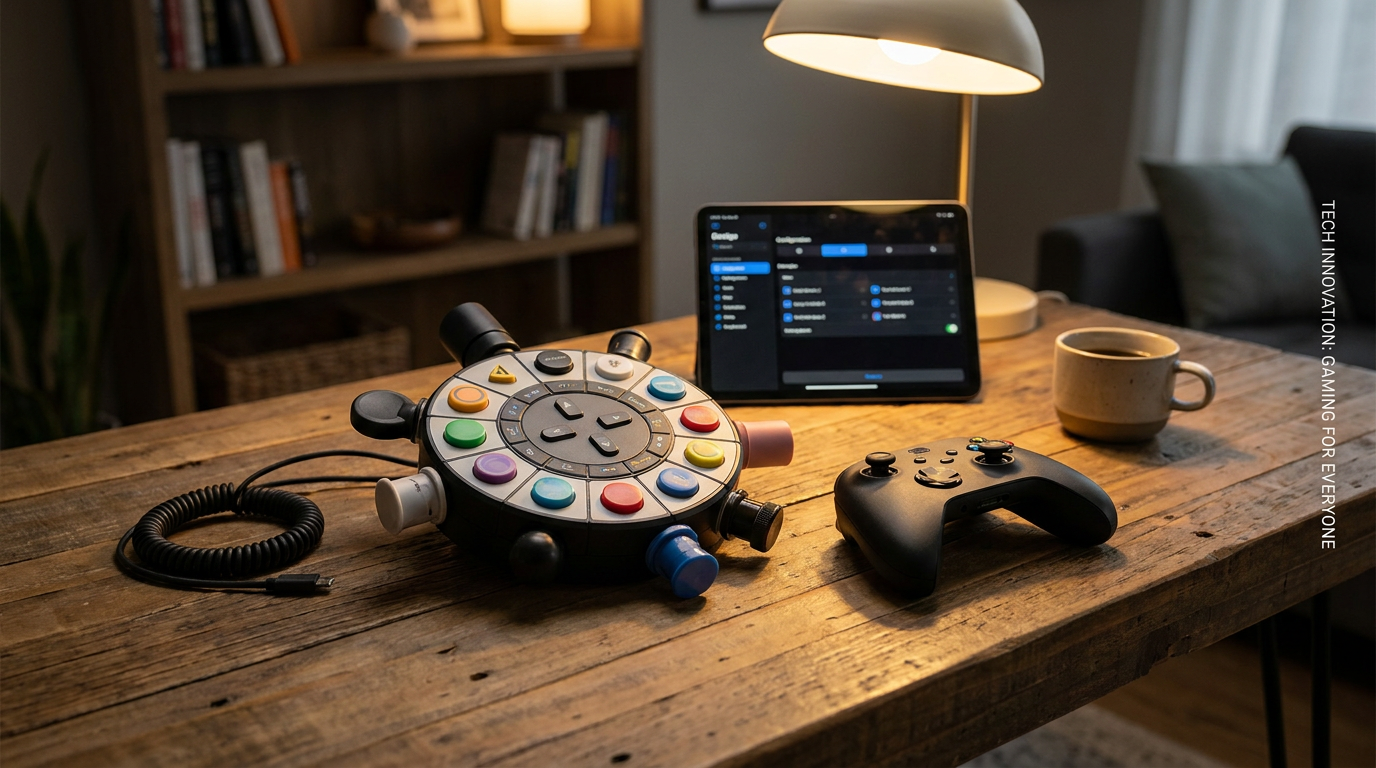
Rather than forcing a player to adapt to a rigid piece of plastic, the Xbox Adaptive Controller acts as a modular hub. It features nineteen 3.5mm ports, allowing users to plug in an array of external switches, foot pedals, and custom joysticks tailored to their specific mobility needs.[1][4]

Recently, that hardware ecosystem expanded further with the introduction of the Xbox Adaptive Joystick. Designed as a purpose-built, plug-and-play companion device, it eliminates the need for players to rely on expensive, custom-built third-party peripherals just to navigate a virtual world.[1]
Sony followed suit with the PlayStation Access Controller, originally developed under the codename Project Leonardo. Released in late 2023, the highly customizable circular kit allows players to swap out button caps, adjust stick distances, and orient the device 360 degrees to accommodate limited ranges of motion.[2]
Hardware, however, only solves half the equation. If a game's software requires rapid button mashing, relies entirely on visual cues, or features unreadable text, a custom controller cannot bridge the gap.[6]
This realization spurred the widespread adoption of inclusive design—a methodology where accessibility is baked into the software development process from day one, rather than patched in as an afterthought post-launch.[3][6]
Naughty Dog's 'The Last of Us Part II' set a new high-water mark for software accessibility. The game features over 60 distinct accessibility options, including high-contrast visual modes that strip away background textures to highlight enemies and items in bright, solid colors.[5]

Naughty Dog's 'The Last of Us Part II' set a new high-water mark for software accessibility.
Crucially, the studio introduced a robust navigational assist that automatically orients the player toward their next objective, paired with comprehensive audio cues. Every action—from picking up ammunition to dodging an incoming attack—has a distinct sound, allowing blind and low-vision players to complete the game entirely autonomously.[5][7]
The racing genre, long considered impossible for visually impaired players due to its reliance on high-speed visual processing, saw a similar breakthrough with Turn 10 Studios' 'Forza Motorsport'.[1]
The developers integrated Blind Driving Assists, a complex system of audio cues that communicate track position, upcoming turns, and precise braking points. By translating visual telemetry into a spatial audio language, the game allows blind players to compete at high speeds.[1][7]
These milestones were not achieved in a vacuum. They are the direct result of deep collaboration between major studios and accessibility consultants—gamers with disabilities who test early builds and provide critical, lived-experience feedback.[4][5]
Organizations like AbleGamers and SpecialEffect have spent years advocating for these changes, ensuring that the engineering process is guided by the people who actually rely on these features to play.[4]
To standardize these practices across the industry, comprehensive frameworks have been established, such as the Xbox Accessibility Guidelines and the independent Game Accessibility Guidelines.[1][3]

These living documents provide developers with concrete, actionable checklists for everything from minimum color contrast ratios and subtitle sizing to cognitive load reduction and motor-control alternatives.[3]
Despite this massive progress, systemic challenges remain. While AAA studios backed by platform holders have the budgets to implement sweeping accessibility suites, smaller independent developers often lack the resources to build complex features like full audio description or custom haptics.[6][7]
Yet, the trajectory of the industry is undeniable. Accessibility is no longer viewed as a niche charity effort, but as a fundamental pillar of game design that improves the user experience for everyone.[6]
By dismantling the physical and sensory barriers to entry, the video game industry is finally delivering on the medium's core promise: that play truly has no limits.[2][6]

How we got here
2018
Microsoft releases the Xbox Adaptive Controller, establishing a new hardware standard for accessibility.
2020
Naughty Dog releases The Last of Us Part II, setting a benchmark for software accessibility with over 60 options.
2023
Turn 10 Studios launches Forza Motorsport, introducing Blind Driving Assists for visually impaired players.
Late 2023
Sony launches the highly customizable PlayStation Access Controller, originally codenamed Project Leonardo.
2025
Microsoft expands its ecosystem with the plug-and-play Xbox Adaptive Joystick.
Viewpoints in depth
Accessibility Advocates
Focus on the human impact of inclusive design and the ongoing push to eliminate digital barriers.
Advocacy groups and disabled gamers argue that accessibility is not a luxury, but a fundamental right to participate in modern culture. They emphasize that for decades, players were forced to adapt to rigid hardware and software, often resulting in physical pain or total exclusion. By consulting directly with studios, advocates have successfully shifted the industry's mindset from 'retrofitting' to 'inclusive design,' ensuring that the lived experiences of disabled players guide the engineering process from day one.
Platform Holders
Prioritize the development of modular hardware ecosystems to reduce the financial burden of custom setups.
Companies like Microsoft and Sony view accessibility as both a moral imperative and a massive market expansion. Their strategy centers on creating modular, first-party hardware—like the Xbox Adaptive Controller and PlayStation Access Controller—that serves as a foundation for players to build upon. By offering these devices at standard retail prices, platform holders aim to eliminate the 'disability tax,' where players previously had to spend hundreds of dollars on bespoke, third-party peripherals just to play.
Game Developers
Focus on the technical challenges and triumphs of implementing software-level inclusive design.
For software engineers and designers, accessibility presents complex technical puzzles. Translating a highly visual, high-speed racing game into a spatial audio language, or building a navigational assist that doesn't break the game's pathfinding logic, requires significant resources and innovation. Developers rely heavily on standardized frameworks like the Game Accessibility Guidelines to implement these features efficiently, though they acknowledge that the financial cost of robust accessibility suites remains a hurdle for smaller independent studios.
What we don't know
- How quickly smaller independent studios will be able to adopt complex accessibility features given their limited budgets.
- Whether emerging technologies like VR and AR will introduce new accessibility barriers or offer novel solutions.
- How the industry will standardize accessibility features across cross-platform multiplayer environments.
Key terms
- Inclusive Design
- A design methodology that learns from people with a range of perspectives to create products that are accessible to as many people as possible.
- Audio Description (AD)
- An additional audio track or system of cues that narrates visual information, crucial for blind or low-vision players.
- Navigational Assist
- A software feature that automatically orients a player's camera or character toward the next objective, reducing the need for complex spatial mapping.
- Cognitive Load
- The amount of mental effort required to process information in a game; accessibility guidelines often aim to reduce this to help players with cognitive disabilities.
Frequently asked
What is the Xbox Adaptive Controller?
It is a customizable hardware hub that allows players to plug in external switches, buttons, and joysticks to create a personalized control setup tailored to their mobility needs.
Can blind people play modern video games?
Yes. Modern titles like 'The Last of Us Part II' and 'Forza Motorsport' include comprehensive audio cues, screen readers, and navigational assists that allow fully blind playthroughs.
What is inclusive design in gaming?
Inclusive design is a methodology where accessibility features are integrated into the game's development from the very beginning, rather than being added as an afterthought.
Do accessibility features give players an unfair advantage?
No. Accessibility features are designed to remove barriers and level the playing field. In competitive multiplayer, matchmaking and specific feature toggles ensure fairness.
Sources
Source coverage
7 outlets
4 viewpoints surfaced







[1]MicrosoftPlatform Holders
Xbox Accessibility Guidelines and Adaptive Hardware
Read on Microsoft →[2]Sony Interactive EntertainmentPlatform Holders
The Impact of the PlayStation Access Controller
Read on Sony Interactive Entertainment →[3]Game Accessibility GuidelinesGame Developers & Researchers
A straightforward reference for inclusive game design
Read on Game Accessibility Guidelines →[4]AbleGamersAccessibility Advocates
Creating Opportunities That Enable Play
Read on AbleGamers →[5]Can I Play That?Accessibility Advocates
Accessibility reviews and news for gamers with disabilities
Read on Can I Play That? →[6]Factlen Editorial TeamIndustry Analysts
Synthesis by Factlen editorial team
Read on Factlen Editorial Team →[7]ResearchGateGame Developers & Researchers
Audio Description in Video Games: A Review of Current Implementations
Read on ResearchGate →
Every angle. Every day.
Get gaming esports stories with full source coverage and perspective breakdowns delivered to your inbox.