
How Pay-As-You-Go Solar is Powering Africa's Off-Grid Revolution
A surge in decentralized solar technology and mobile-money financing has connected 50 million people to electricity, bypassing traditional power grids.

Across Sub-Saharan Africa, a quiet revolution is bypassing the traditional power grid. For decades, the lack of reliable electricity has bottlenecked economic growth, leaving nearly 600 million people reliant on expensive, polluting kerosene or diesel generators.[2]
But a convergence of plunging solar panel costs, mobile money networks, and innovative financing is rapidly changing the landscape. In June 2026, the World Bank and the African Development Bank announced a major milestone: their "Mission 300" initiative has successfully connected 50 million people to electricity, operating at double its historical pace.[1]
The driving force behind this surge is not massive, centralized coal or gas plants, but decentralized, off-grid solar technology. From individual home systems to village-scale mini-grids, distributed renewable energy is allowing African nations to leapfrog traditional infrastructure, much like mobile phones bypassed landlines two decades ago.[1]
The core mechanism unlocking this growth is the Pay-As-You-Go (PAYGo) financing model. Historically, the upfront cost of a solar panel and battery system was insurmountable for rural households living on irregular agricultural incomes.
PAYGo solves this by treating energy as a service. Customers pay a small deposit to receive a solar kit—often including lights, a phone charger, and sometimes a radio or fan. They then make micro-payments, sometimes as little as a few cents a day, using mobile money platforms.
These payments are managed by embedded software. If a payment is made, the system unlocks and provides power; if a payment is missed, it temporarily locks until the balance is topped up. Once the total cost is paid off—usually over 12 to 24 months—the customer owns the system outright, securing free electricity for the lifespan of the hardware.
The impact of this model is staggering. According to industry data, Sub-Saharan Africa accounted for over 90% of global off-grid solar sales in 2025, moving 9.26 million units. While traditional cash sales actually declined, PAYGo sales surged by 45% in East Africa and 55% in West Africa.
Private operators are scaling rapidly to meet this demand. Sun King, the world's largest off-grid solar company, reported installing 330,000 products per month by the end of 2025—a massive leap from 100,000 in 2020.
For communities with higher energy needs, the focus shifts from individual home systems to mini-grids. These localized networks generate and distribute power to an entire village or commercial hub, operating entirely independently of the national grid.
Companies like ENGIE Energy Access are aggressively expanding this footprint. In Zambia, the company recently launched the construction of 15 new solar mini-grids, targeting 60 operational sites by the end of the year. These grids provide enough reliable power to support "productive uses"—running refrigerators for clinics, milling machines for farmers, and power tools for carpenters.
The economic ripple effects are immediate. With reliable evening lighting, small businesses can extend their operating hours, children can study after dark, and households save money previously burned on kerosene. In Malawi, the government's Ngwee Ngwee Ngwee Fund has subsidized these systems, noting that roughly 10% of new home solar setups are actively used to generate income.
Sustaining this momentum requires massive capital, and the sector is undergoing a financial maturation. Historically reliant on grants, off-grid solar is increasingly attracting mainstream debt capital. Sun King notes that one in three of its products is now backed by sustainable financing instruments, including local-currency securitizations that protect against exchange-rate volatility.
At the institutional level, the World Bank and AfDB have committed nearly $15 billion to the Mission 300 agenda, attracting an additional $4.5 billion in co-financing. This blended finance approach uses public money to de-risk projects, encouraging private investors to enter markets they might otherwise avoid.[1]
Yet, severe financial bottlenecks remain. Despite the commercial viability of individual solar projects, international financing rules often artificially inflate their costs. A key hurdle is the "sovereign ceiling"—a financial convention dictating that a private project cannot receive a better credit rating than the country in which it operates.[2]
Because only two African nations currently hold investment-grade sovereign ratings, commercially sound solar projects inherit the perception of national risk. As a result, renewable energy projects in Africa face financing costs two to four times higher than identical projects in Europe or North America, stranding billions of dollars in pledged climate finance.[2]
Furthermore, while PAYGo has expanded access, the poorest demographics remain priced out. The World Bank estimates that even with micro-financing, only 22% of households currently lacking electricity can afford a basic Tier 1 solar kit. Reaching the remaining population will require targeted, ongoing subsidies rather than purely commercial solutions.
As the off-grid market matures, a new environmental challenge is emerging: electronic waste. Millions of solar panels and lithium-ion batteries deployed over the last decade are approaching the end of their lifecycles.
Without proper recycling infrastructure, this green solution risks creating a toxic legacy. Sustainability advocates are pushing for Extended Producer Responsibility (EPR) schemes, requiring manufacturers to design modular, repairable systems and manage the collection of dead batteries.
Despite these hurdles, the trajectory is clear. The combination of distributed solar generation and digital finance has cracked a development puzzle that stumped centralized governments for decades.[1]
By turning the sun's abundant energy into a decentralized, pay-as-you-go utility, Africa is not just electrifying its rural communities—it is writing a new, sustainable blueprint for global development.[1]
Key points
- The World Bank and AfDB's Mission 300 initiative has successfully connected 50 million people to electricity.
- Sub-Saharan Africa accounted for over 90% of global off-grid solar sales in 2025, driven by Pay-As-You-Go (PAYGo) financing.
- PAYGo allows customers to unlock solar kits via micro-payments on mobile money platforms, removing upfront capital barriers.
- Despite commercial viability, African solar projects face financing costs two to four times higher than in Europe due to sovereign credit ratings.
Unanswered questions
- How quickly rural recycling infrastructure can be developed to handle the impending wave of degraded lithium-ion batteries and solar panels.
- Whether international financial institutions will reform the 'sovereign ceiling' rule to lower borrowing costs for commercially viable green projects.
How we got here
2017–2020
Early Pay-As-You-Go (PAYGo) solar models gain traction, leveraging the widespread adoption of mobile money platforms like M-Pesa.
2023
The World Bank and AfDB launch 'Mission 300', an ambitious initiative to connect 300 million Africans to electricity by 2030.
2025
Sub-Saharan Africa accounts for over 90% of global off-grid solar sales, driven by a 45-55% surge in PAYGo financing.
June 2026
Mission 300 announces it has successfully connected 50 million people, doubling the historical pace of electrification.
- Private Solar Operators
- Emphasize commercial viability, technological innovation, and market expansion.
- Global Development Institutions
- Focus on scaling access through blended finance and macroeconomic initiatives.
- Financial Risk Analysts
- Highlight systemic barriers like sovereign credit ratings and the cost of capital.
- Sustainability Advocates
- Focus on the lifecycle of solar products and the looming e-waste challenge.
Perspectives this story doesn't cover
- Traditional fossil fuel utility operators facing grid defection.
- Unbanked rural citizens who cannot access mobile money platforms.
Sources
Source coverage
2 outlets
4 viewpoints surfaced


- [1]African Development BankGlobal Development Institutions
Mission 300 connects over 50 million people to electricity across 40 countries
Read on African Development Bank → - [2]The Washington PostFinancial Risk Analysts
Billions pledged for Africa's clean energy transition face financing hurdles
Read on The Washington Post →
More in World
See all →Energy Access
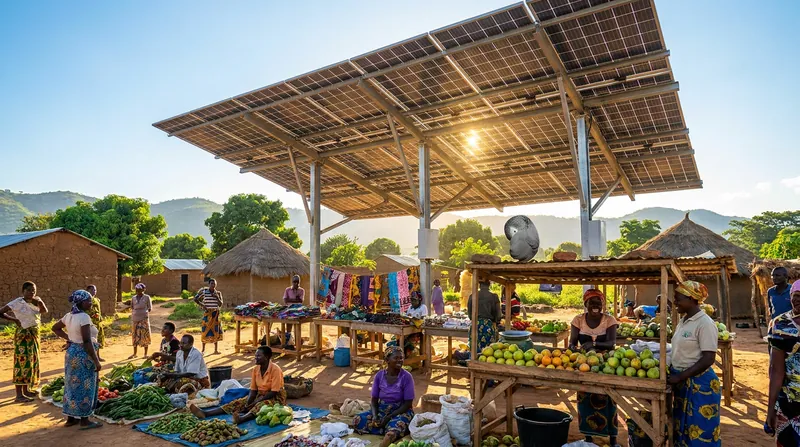
How Off-Grid Solar is Bypassing Africa's National Power Grids
5 sources
Malaria Vaccines
How Africa's Historic Malaria Vaccine Rollout is Reshaping Child Health
5 sources
Border Governance
Why 34 African Nations Locked 80,000 Kilometers of Colonial Borders in 1964
7 sources
Horn of Africa Diplomacy
Egypt, Eritrea, Somalia, and Sudan Sign El-Alamein Declaration to Coordinate Red Sea and Nile Security
4 sources

Comments
Every angle. Every day.
Get World stories with full source coverage and perspective breakdowns, free every day.