
How Agrivoltaics is Solving the Land War Between Farming and Solar Energy
By elevating solar panels above agricultural fields, a rapidly growing industry is proving that farmland can simultaneously produce high-yield crops and utility-scale renewable energy.
By Factlen Editorial Team
- Agrivoltaic Researchers & Developers
- Advocates who view dual-use solar as a critical breakthrough for land efficiency and climate resilience.
- Traditional Farmers
- Agricultural operators who are cautiously optimistic but concerned about operational disruptions and costs.
- Energy Policymakers
- Government officials focused on hitting aggressive decarbonization targets without triggering rural zoning wars.
What's not represented
- · Rural Community Residents
- · Ecological Conservationists
Why this matters
As the world races to build clean energy, rural communities are increasingly fighting solar farms that consume prime agricultural land. Agrivoltaics solves this zero-sum conflict, offering a blueprint to generate massive amounts of renewable electricity while simultaneously protecting crops from extreme heat and saving millions of gallons of irrigation water.
Key points
- Agrivoltaics combines solar energy generation and agriculture on the same land, resolving conflicts over rural land use.
- The global market reached 18.4 gigawatts by mid-2025 and is projected to hit $20 billion in 2026.
- The shade from solar panels reduces soil evaporation, cutting irrigation water needs by 20 to 35 percent.
- Shade-tolerant crops like lettuce and berries see yield increases of up to 18 percent, while sun-intensive crops see declines.
- Plant transpiration cools the air, boosting the solar panels' energy generation efficiency by roughly 2 percent.
- Initial construction costs are 10 to 20 percent higher than traditional solar farms due to the elevated steel structures required.
The global transition to renewable energy has a fundamental land problem. To hit ambitious net-zero targets by 2050, the world needs millions of acres for utility-scale solar farms. But placing vast arrays of photovoltaic panels often means taking prime agricultural land out of production, sparking fierce zoning battles and pitting clean energy advocates against rural farming communities.
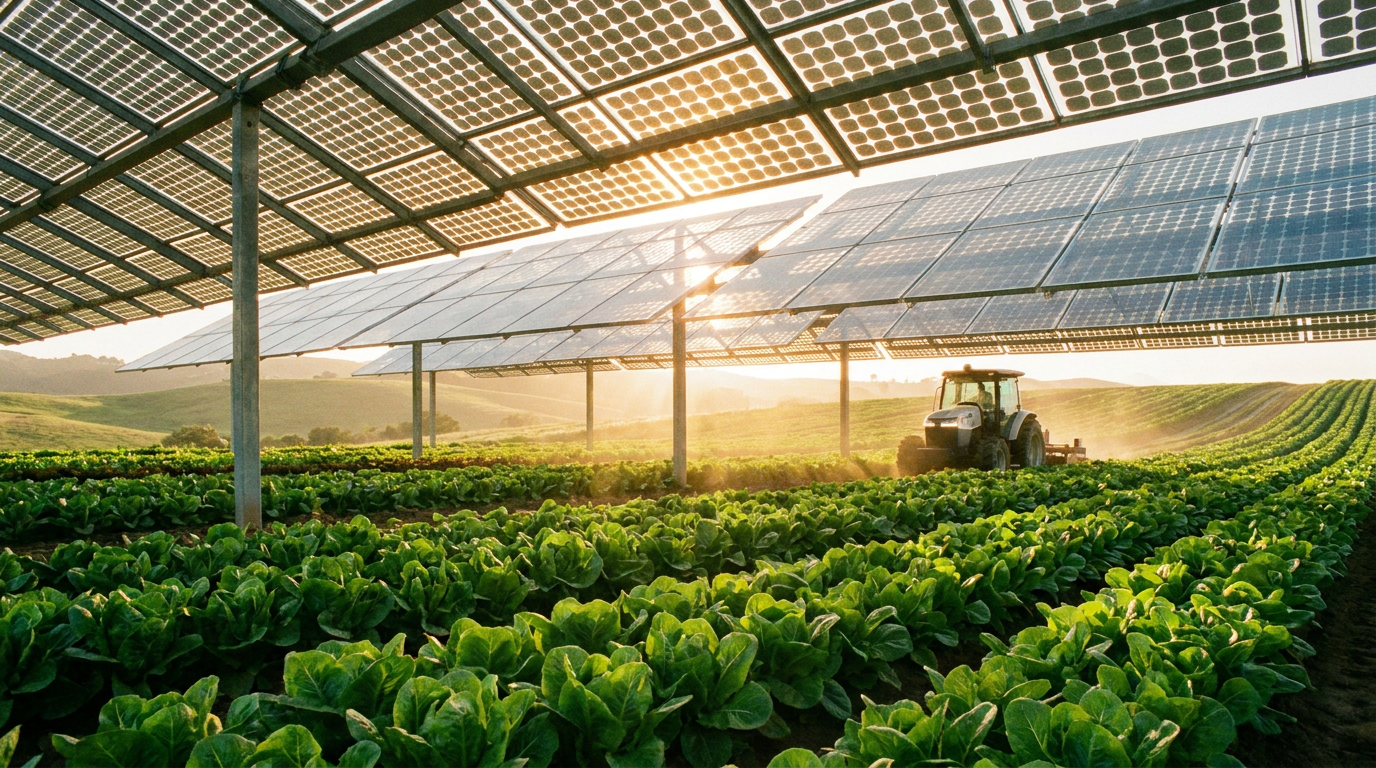
Enter agrivoltaics—the deliberate co-location of agriculture and solar power on the exact same plot of land. Instead of clear-cutting fields to install ground-hugging solar arrays, developers are elevating panels on heavy steel structures, allowing tractors to pass underneath and crops to grow in the dappled partial shade.
What began as a niche academic concept has rapidly matured into a commercial powerhouse. By mid-2025, global agrivoltaic capacity surpassed 18.4 gigawatts, driven by massive commercial deployments in Europe, East Asia, and the United States. The global market is projected to reach roughly $20 billion in 2026, transforming how policymakers and investors view the future of rural land use.[1][2]
The core appeal of agrivoltaics lies in its synergistic effect on the food-energy-water nexus. When executed correctly, the system does not merely compromise between two competing land uses; it actively improves the efficiency of both. The secret to this mutual benefit lies in the unique microclimate created beneath the silicon canopy.[3]

In traditional open-field farming, crops are entirely exposed to the sun's radiation. While plants inherently need sunlight for photosynthesis, they have a strict biological saturation point. Beyond that threshold, excess sunlight and heat cause plants to become severely stressed, forcing them to consume massive amounts of water just to survive the afternoon heat.
Elevated solar panels act as a protective shield, absorbing the brunt of midday radiation. This partial shading dramatically reduces evapotranspiration—the process by which water evaporates from the soil and transpires from plant leaves. Agronomic studies show this microclimate can cut irrigation water needs by 20 to 35 percent in arid and semi-arid regions.[6]
The shading effect has a profound impact on crop yields, though the results are highly species-dependent. Shade-tolerant crops—such as lettuce, spinach, tomatoes, strawberries, and root vegetables like potatoes—thrive in these moderated environments. Recent trials have recorded yield increases of 8 to 18 percent for these specific crops under solar arrays, as they are spared the stunting effects of extreme heat stress.[5][6]
The shading effect has a profound impact on crop yields, though the results are highly species-dependent.
Conversely, sun-intensive staple crops like wheat and corn struggle under the canopy, often seeing yield reductions of 25 to 40 percent. Consequently, agrivoltaic developers are carefully matching crop selection to the specific light environment, focusing on high-value horticulture, root vegetables, and livestock grazing pastures rather than broad-acre cereal crops.[6]

The benefits of this microclimate flow in both directions. Solar panels have a well-documented engineering weakness: they lose electrical efficiency as their physical temperature rises. A traditional solar farm built in a barren desert bakes in the ambient heat, steadily reducing its megawatt output as the day gets hotter.[3]
In an agrivoltaic system, the crops growing beneath the panels continuously release moisture through transpiration. This latent heat loss cools the surrounding air, effectively air-conditioning the solar panels from below. Research demonstrates that this biological cooling effect can boost the solar array's energy generation efficiency by up to 2 percent annually.[3]
The sheer scale of the opportunity is staggering for grid planners. According to research from the European Commission's Joint Research Centre, installing agrivoltaic systems on just 1 percent of the European Union's utilized agricultural land could generate approximately 950 gigawatts of solar capacity. That single initiative would easily exceed the EU's entire 2030 solar energy target.[4]
To maximize these dual yields, the industry is rapidly shifting away from static infrastructure. In 2026, dynamic panel systems—which use single or dual-axis motorized trackers to follow the sun—dominate the market, accounting for nearly 88 percent of new installations.[5]

These dynamic systems are programmed with sophisticated algorithms that balance the needs of the electrical grid with the biological needs of the crop. During a severe heatwave, the panels can flatten out to provide maximum protective shade to the plants below. On a cloudy day, they can tilt vertically to let every available photon reach the soil.[5]
Despite the clear agronomic and environmental benefits, widespread adoption faces significant financial hurdles. Elevating solar panels three to four meters off the ground and spacing them widely enough to accommodate heavy agricultural machinery requires substantially more steel, deeper foundations, and specialized engineering.[6]
This structural requirement drives the initial capital expenditure 10 to 20 percent higher than a traditional utility-scale solar farm. While massive energy corporations and institutional investors can easily absorb these upfront costs, small and medium-sized family farmers often struggle to secure the necessary specialized financing.[6]

Recognizing this bottleneck, governments are stepping in to bridge the gap. Italy recently deployed a €1.7 billion program to support agrivoltaic development, while South Korea revised its zoning ordinances to allow solar installations on rice paddies without triggering land-use conversion penalties. In the United States, the Department of Energy has aggressively funded pilot programs to prove the financial viability of dual-use systems.[1][2]
Ultimately, agrivoltaics represents a rare paradigm shift where environmental conservation and industrial energy production are not locked in a zero-sum game. By mimicking the natural canopy structures of forest ecosystems, engineers and agronomists have found a way to harvest the sun twice—once for the grid, and once for the plate.[7]
How we got here
Early 2010s
Academic researchers begin small-scale pilot studies testing crop viability beneath solar panels.
2019
Landmark studies in Nature Sustainability prove the mutual cooling benefits of co-locating crops and solar arrays.
2023
European nations begin drafting specific zoning frameworks to distinguish agrivoltaics from traditional solar farms.
2025
Global installed agrivoltaic capacity surpasses 18 gigawatts as commercial-scale adoption accelerates.
2026
Dynamic tracking systems become the industry standard, accounting for nearly 88 percent of new installations.
Viewpoints in depth
Agrivoltaic Researchers & Developers
Advocates who view dual-use solar as a critical breakthrough for land efficiency and climate resilience.
This camp emphasizes the synergistic effects of the food-energy-water nexus. They point to data showing that the microclimate beneath solar panels not only saves massive amounts of irrigation water but actually boosts the electrical efficiency of the panels themselves. For developers, agrivoltaics is the ultimate solution to the growing public backlash against solar farms consuming prime agricultural land.
Traditional Farmers
Agricultural operators who are cautiously optimistic but concerned about operational disruptions and costs.
While farmers appreciate the prospect of a diversified, drought-resistant income stream, they remain wary of the practical realities. Their primary concerns revolve around the 10 to 20 percent higher upfront capital costs and the physical obstacles the steel structures pose to heavy machinery. They argue that without targeted government subsidies or specialized financing, agrivoltaics will remain a tool only accessible to massive corporate agribusinesses.
Energy Policymakers
Government officials focused on hitting aggressive decarbonization targets without triggering rural zoning wars.
For policymakers, agrivoltaics is a political pressure-release valve. As grid electrification demands millions of new acres for solar deployment, rural communities have increasingly blocked projects to protect their farmland. Policymakers view dual-use systems as a way to achieve massive gigawatt targets—such as the EU's finding that just 1 percent of farmland could yield 950 GW—while keeping local agricultural economies intact.
What we don't know
- How the long-term presence of heavy steel infrastructure will affect deep soil compaction and microbiome health over decades.
- Whether smallholder farmers will be able to access the specialized financing required to afford the higher upfront capital costs.
- How extreme weather events, such as unprecedented hail or hurricane-force winds, will impact the elevated dynamic tracking systems at scale.
Key terms
- Agrivoltaics
- The simultaneous use of areas of land for both solar photovoltaic power generation and agriculture.
- Evapotranspiration
- The combined process of water evaporating from the soil and transpiring from the leaves of plants.
- Latent Heat Loss
- The cooling effect produced when plants release moisture into the air, which absorbs heat as it evaporates.
- Dynamic Tracking Panels
- Solar panels mounted on motorized axes that automatically tilt throughout the day to follow the sun or manage shade.
- Food-Energy-Water Nexus
- The complex, interconnected relationship between agricultural production, energy generation, and water conservation.
Frequently asked
Do solar panels block too much light for plants to grow?
It depends entirely on the crop. Shade-tolerant plants like lettuce, tomatoes, and berries actually thrive and see yield increases, while sun-intensive crops like wheat and corn experience reduced yields.
How do tractors fit under the solar panels?
Agrivoltaic systems are built on elevated steel structures, typically 3 to 4 meters high, with wide spacing specifically designed to allow standard agricultural machinery to operate freely underneath.
Does the moisture from the plants damage the solar panels?
No, the moisture released by the plants through transpiration actually cools the ambient air. This helps the solar panels operate more efficiently, as extreme heat typically degrades solar performance.
Is agrivoltaics more expensive to build than a normal solar farm?
Yes, the initial capital expenditure is roughly 10 to 20 percent higher due to the extra steel, deeper foundations, and specialized engineering required to elevate the panels.
Sources
Source coverage
7 outlets
3 viewpoints surfaced







[1]PV MagazineTraditional Farmers
France agrivoltaics trials show early crop and livestock gains
Read on PV Magazine →[2]Fortune Business InsightsTraditional Farmers
Agrivoltaics Market Size & Future Outlook 2026-2034
Read on Fortune Business Insights →[3]Nature SustainabilityAgrivoltaic Researchers & Developers
Agrivoltaics provide mutual benefits across the food–energy–water nexus in drylands
Read on Nature Sustainability →[4]European CommissionEnergy Policymakers
Agrivoltaics: a powerful tool for decarbonisation
Read on European Commission →[5]Coherent Market InsightsAgrivoltaic Researchers & Developers
Agrivoltaics Market Analysis & Forecast - 2026 to 2033
Read on Coherent Market Insights →[6]Energy SolutionsTraditional Farmers
Agrivoltaics 2026: Farming & Solar Dual Income
Read on Energy Solutions →[7]Factlen Editorial TeamAgrivoltaic Researchers & Developers
Synthesis by Factlen editorial team
Read on Factlen Editorial Team →
Every angle. Every day.
Get environment stories with full source coverage and perspective breakdowns delivered to your inbox.