
Intermittent Fasting vs. Caloric Restriction: What the Latest Clinical Trials Actually Show
A new wave of year-long clinical trials has finally pitted intermittent fasting against traditional calorie counting, revealing exactly which diet works best and who should use it.
By Factlen Editorial Team
- Fasting Advocates
- Argue that fasting protocols offer a simpler, math-free approach to weight loss that provides psychological relief by allowing days off from dieting.
- Traditional Dietitians
- Maintain that consistent daily caloric restriction provides the most flexible and metabolically stable path to weight loss, allowing patients to eat what they want.
- Clinical Researchers
- Emphasize that the best diet is entirely dependent on a patient's psychological profile and their ability to sustain the specific burdens of the regimen over years.
What's not represented
- · Eating Disorder Specialists
- · Sports Nutritionists
Why this matters
For decades, choosing a diet meant guessing which biological theory was correct. New gold-standard evidence replaces that guesswork with a clear trade-off map, empowering you to choose a weight-loss strategy based on your psychological preferences rather than metabolic myths.
Key points
- A 2025 trial found 4:3 intermittent fasting produced 7.6% weight loss compared to 5% for daily calorie restriction.
- Popular 16:8 time-restricted eating produces nearly identical results to traditional calorie counting.
- Alternate-day fasting succeeds largely because taking 'days off' from dieting reduces behavioral fatigue.
- Continuous restriction is best for steady energy, while fasting is best for those who hate counting calories.
For years, the debate over the most effective way to lose weight has resembled a religious war. On one side, fasting advocates argue that restricting when you eat fundamentally reshapes your metabolism and insulin response. On the other, traditional dietitians maintain that weight loss ultimately comes down to a simple mathematical reality: burning more calories than you consume.
Until recently, both camps relied on short-term studies, animal models, and observational data to make their case. But between 2024 and 2025, a wave of gold-standard clinical trials finally pitted intermittent fasting against continuous caloric restriction in rigorous, year-long human studies. The results offer a definitive look at what actually works, stripping away the dogma to reveal a more nuanced reality.[1][2][3]
When evaluating continuous caloric restriction, the arguments for the approach center on flexibility and metabolic stability. This traditional method involves calculating a patient's baseline energy needs and prescribing a daily deficit, typically 300 to 500 calories. Patients can eat at any time of day and theoretically consume any type of food, provided they stay under their daily energy ceiling.[3][5]
However, the primary argument against daily restriction is the severe behavioral fatigue it induces. Counting calories, weighing portions, and logging meals every single day creates a relentless mental burden. By the six-month mark of many dietary interventions, compliance plummets as the administrative work of constant calculation becomes exhausting for the average person.[5]

Despite the fatigue, the clinical evidence supporting continuous restriction is rock solid. In a landmark 12-month trial published in the New England Journal of Medicine, researchers tracked 139 patients and found that those who simply restricted their daily calories lost an average of 6.3 kilograms. It remains the gold standard for predictable, steady weight loss.[3]
Conversely, the arguments for intermittent fasting focus on simplicity and the psychological relief of a rule-based system. By shifting the focus from what or how much to eat to exactly when to eat, fasting protocols offer a binary framework that requires zero math. You are either in your eating window, or you are not.[4][5]
Conversely, the arguments for intermittent fasting focus on simplicity and the psychological relief of a rule-based system.
The argument against fasting highlights the intense episodic discomfort and social friction it creates. Fasting days or strict eating windows require enduring significant hunger that can disrupt social events, family dinners, and intense exercise routines. It demands a high tolerance for short-term physical discomfort.[4]
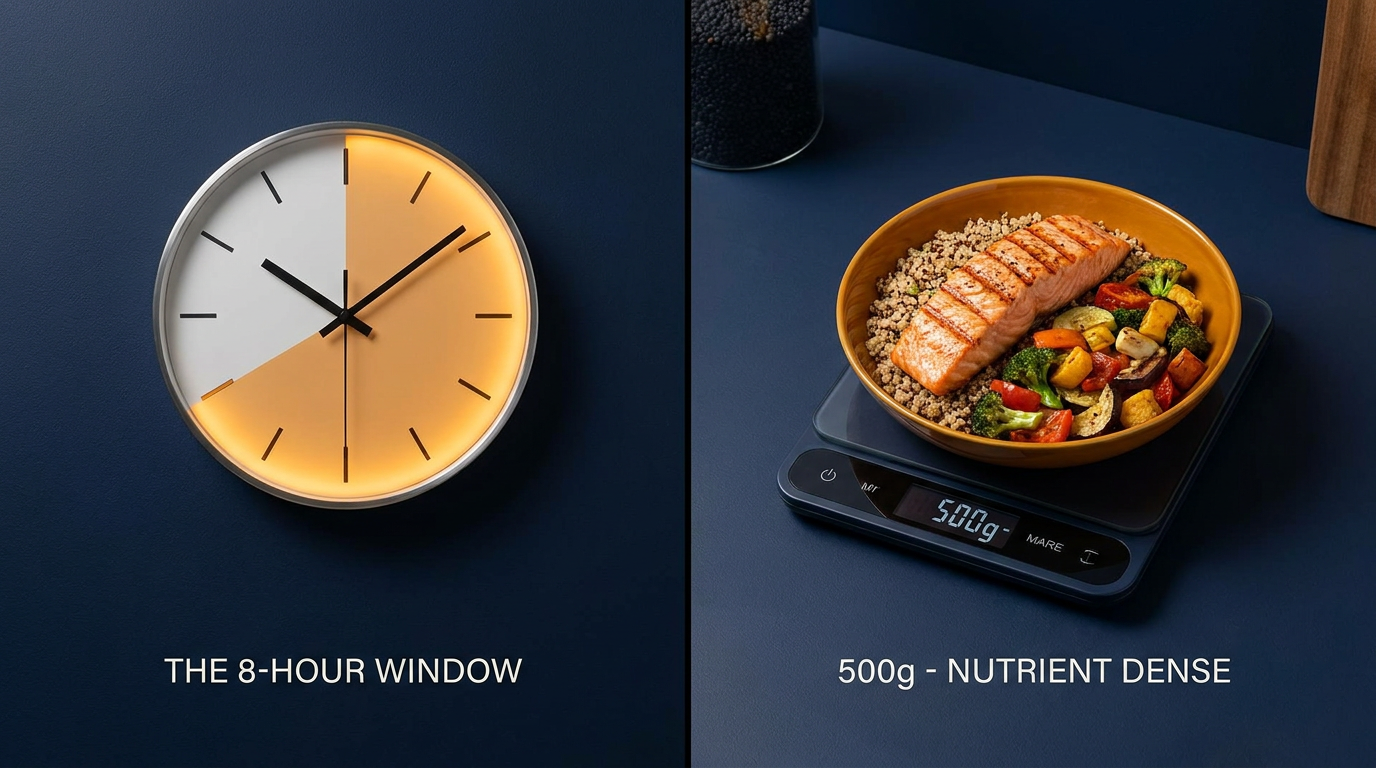
When looking at the clinical evidence for popular time-restricted eating—like the 16:8 method—the results show a dead heat with traditional dieting. A 2024 study from the University of Illinois Chicago found that 16:8 fasting produced nearly identical weight loss to traditional calorie counting, roughly 5 percent of baseline body weight. Time-restricted eating works primarily because squeezing meals into a shorter window naturally causes people to eat less, not because of a magical metabolic switch.[5]
But the evidence shifts dramatically when looking at more intense fasting protocols. A major 2025 randomized clinical trial published in the Annals of Internal Medicine tested a 4:3 fasting model, where participants ate normally for four days and slashed calories by 80 percent on the other three. After a year, the 4:3 fasting group lost an average of 7.6 percent of their body weight, significantly outperforming the 5 percent lost by the daily calorie-restriction group.[1][4]

The superiority of alternate-day fasting was corroborated by a massive 2025 meta-analysis published in The BMJ. Reviewing 99 randomized clinical trials involving over 6,500 adults, researchers found that alternate-day fasting was the only fasting strategy to statistically outperform continuous caloric restriction. The review also noted slight additional improvements in lipid profiles and blood pressure.[2]
Clinical researchers point to the psychological relief of "days off" to explain why the 4:3 model succeeds where 16:8 merely ties. In the University of Colorado trial, participants only endured the hardship of severe restriction three days a week. On the other four days, they were freed from the mental tax of dieting, which appears to combat the diet fatigue that typically derails continuous calorie counters.[1][4]
Ultimately, the new wave of clinical evidence provides a clear trade-off map. Continuous caloric restriction fits well when an individual prefers steady energy levels, enjoys grazing throughout the day, and tolerates the daily administrative work of tracking food. It does not fit well when a person experiences diet fatigue quickly, finds food logging psychologically triggering, or struggles with portion control.[3][6]

On the other hand, alternate-day or 4:3 fasting fits well when an individual can tolerate intense, short-term hunger in exchange for days of complete dietary freedom. It does not fit well when a person has a history of disordered eating, requires steady caloric intake for high-level athletic training, or has medical conditions like diabetes that require strict blood sugar management.[1][6]
As the clinical consensus solidifies, the medical community is moving away from prescribing a single, universal diet. The most effective strategy is no longer a question of which biological mechanism is superior, but which psychological burden a patient is most willing to carry for the long haul.[6]
Viewpoints in depth
Fasting Advocates
Argue that fasting protocols offer a simpler, math-free approach to weight loss that provides psychological relief.
Proponents of intermittent fasting emphasize that the modern food environment makes continuous moderation nearly impossible for many people. By shifting the focus from 'what' to eat to 'when' to eat, fasting provides a binary, rule-based system that eliminates the daily mental tax of logging food and weighing portions. They point to the 2025 data showing that allowing patients to take days off from dieting entirely improves long-term adherence and results in superior overall weight loss.
Traditional Dietitians
Maintain that consistent daily caloric restriction provides the most flexible and metabolically stable path to weight loss.
Advocates for continuous caloric restriction argue that fasting protocols are often too extreme for sustainable, lifelong habit formation. They emphasize that daily restriction allows patients to eat at any time and participate normally in social events, family dinners, and athletic training without the disruption of severe hunger days. They view the 16:8 data as proof that fasting is simply a different way to achieve a calorie deficit, rather than a metabolic magic bullet.
Clinical Researchers
Emphasize that the best diet is entirely dependent on a patient's psychological profile and lifestyle.
The clinical research community has largely moved past the debate of which diet is biologically superior. Instead, they focus on the trade-offs of adherence. Researchers note that the 4:3 fasting model works brilliantly for individuals who can tolerate short bursts of intense hunger, but fails spectacularly for those who cannot. Their consensus is that medical professionals must stop prescribing one-size-fits-all diets and instead help patients choose the psychological burden they are most willing to carry.
What we don't know
- Whether the slight cardiovascular benefits seen in alternate-day fasting are due to the fasting itself or simply the greater total weight loss.
- How intermittent fasting impacts long-term muscle mass retention compared to continuous restriction over a multi-year period.
Key terms
- Intermittent Fasting (IF)
- A dietary pattern that cycles between periods of normal eating and periods of severe calorie restriction or complete fasting.
- Time-Restricted Eating (TRE)
- A specific form of intermittent fasting where all daily calories are consumed within a set window, typically 8 to 10 hours.
- Continuous Caloric Restriction (CR)
- The traditional dieting method of reducing daily energy intake by a set amount, usually 300 to 500 calories, every single day.
- Alternate-Day Fasting (ADF)
- A fasting protocol that alternates between days of normal eating and days of severe calorie restriction, such as the 4:3 or 5:2 methods.
Frequently asked
Does 16:8 time-restricted eating work better than counting calories?
No. Recent clinical trials show that 16:8 fasting produces nearly identical weight loss to continuous caloric restriction, working primarily by naturally reducing the amount of food consumed.
What is the 4:3 intermittent fasting method?
The 4:3 method involves eating normally without restrictions for four days a week, and severely restricting calories (by about 80%) on the remaining three non-consecutive days.
Do you lose muscle mass with intermittent fasting?
Studies show that both intermittent fasting and daily caloric restriction result in similar changes to body composition, meaning muscle loss is comparable across both methods unless paired with resistance training.
Sources
Source coverage
6 outlets
3 viewpoints surfaced






[1]Annals of Internal MedicineFasting Advocates
4:3 Intermittent Fasting Shows Modestly Greater Weight Loss Than Daily Caloric Restriction
Read on Annals of Internal Medicine →[2]The BMJClinical Researchers
Intermittent fasting versus continuous energy restriction for cardiometabolic risk
Read on The BMJ →[3]New England Journal of MedicineTraditional Dietitians
Calorie Restriction with or without Time-Restricted Eating in Weight Loss
Read on New England Journal of Medicine →[4]Harvard HealthFasting Advocates
4:3 Intermittent Fasting Outperforms Daily Calorie Restriction
Read on Harvard Health →[5]University of Illinois ChicagoClinical Researchers
Time Restricted Eating versus Daily Calorie restriction for Weight Loss
Read on University of Illinois Chicago →[6]Factlen Editorial TeamClinical Researchers
Synthesis by Factlen editorial team
Read on Factlen Editorial Team →


Every angle. Every day.
Get fitness stories with full source coverage and perspective breakdowns delivered to your inbox.