
The Evidence on Ranked-Choice Voting: Does It Actually Reduce Polarization?
As more municipalities and states adopt ranked-choice voting, decades of election data reveal its true impact on campaign tone, voter turnout, and political extremism.
By Factlen Editorial Team
- Electoral Reform Advocates
- Argue that RCV is essential for breaking the two-party duopoly, eliminating the spoiler effect, and forcing candidates to build broad coalitions.
- Election Administrators
- Focus on the practical realities of implementation, emphasizing the need for new software, voter education funding, and clear auditing standards.
- Political Scientists
- Analyze the empirical data to test RCV's claims, finding strong evidence for reduced polarization but mixed results regarding voter turnout.
What's not represented
- · Incumbent politicians who benefit from the traditional plurality system
- · Voters in jurisdictions that recently voted to repeal RCV
Why this matters
Understanding the mechanics and outcomes of alternative voting systems empowers citizens to make informed decisions about how their local and state elections are run, directly impacting the quality of their representation.
Key points
- Ranked-choice voting requires candidates to secure second-choice votes, mathematically disincentivizing toxic, negative campaign strategies.
- Empirical data shows RCV successfully prevents extreme, highly polarizing candidates from winning crowded races with small pluralities.
- Despite early claims, evidence suggests RCV does not significantly increase overall voter turnout on a national scale.
- Without robust voter education, a small percentage of ballots become 'exhausted' when voters fail to rank multiple candidates.
- Implementing the system requires substantial upfront investment in tabulation software and poll worker training.
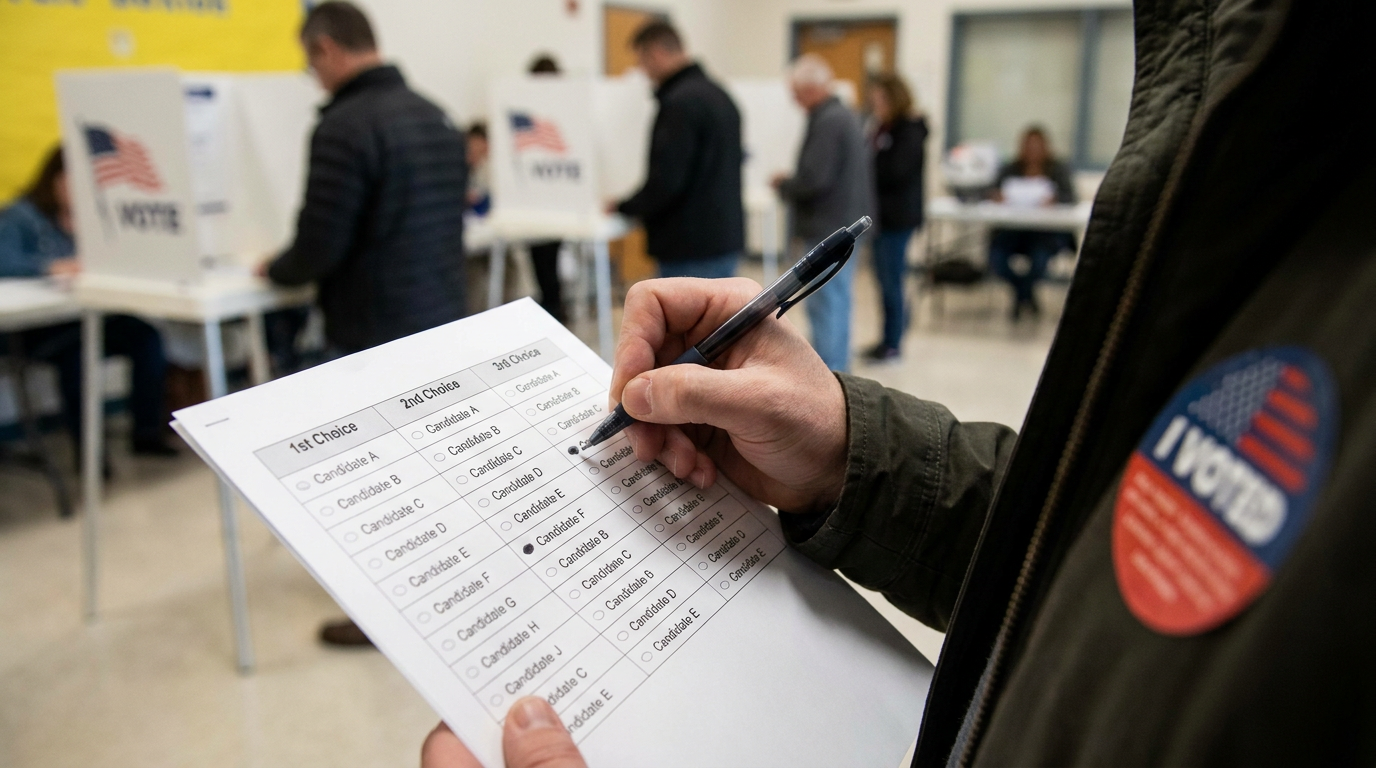
Over the past decade, a quiet revolution has been reshaping how Americans cast their ballots. Ranked-choice voting (RCV), once a niche academic proposal, has been adopted by more than fifty jurisdictions across the United States, including statewide implementations in Maine and Alaska. The system asks voters to rank candidates in order of preference rather than selecting just one. If no candidate wins an outright majority of first-choice votes, the lowest vote-getter is eliminated, and their supporters' votes are redistributed to their second choices. This process repeats until a single candidate crosses the fifty-percent threshold.[3]
The core promise driving this rapid expansion is that RCV can cure some of the most toxic elements of modern politics. Proponents argue that it reduces negative campaigning, curtails the viability of extreme candidates, and ensures that winners actually possess a broad mandate from the electorate. However, as the sample size of RCV elections has grown from a handful of city council races to high-stakes federal contests, political scientists and election administrators finally have enough hard data to separate the system's genuine benefits from its theoretical hype.[6]
The most robust evidence supporting RCV centers on its ability to change campaign tone. In a traditional plurality election, candidates often benefit from tearing down their opponents to suppress turnout or peel away a narrow slice of undecided voters. Ranked-choice voting fundamentally alters this calculus. Because a candidate might need the second- or third-choice votes of their rivals' supporters to survive later elimination rounds, alienating those voters with vicious attack ads becomes a mathematically losing strategy.[2]

Researchers at the National Bureau of Economic Research analyzed campaign communications across dozens of mayoral and legislative races, comparing cities that use RCV with those that do not. They found a quantifiable drop in negative messaging in RCV jurisdictions. Candidates in these races were roughly fifteen to twenty percent less likely to use attack ads, instead focusing their rhetoric on broad, unifying themes designed to make them an acceptable second choice to a wide swath of the electorate.[2][3]
Beyond campaign tone, the data suggests RCV acts as a structural guardrail against extreme candidates who benefit from crowded fields. In traditional primaries, a highly polarizing figure with a dedicated but small base can win a multi-candidate race with just thirty percent of the vote if the moderate majority splinters its support among several mainstream alternatives. Under RCV, that splintering is neutralized. The moderate votes eventually consolidate in the later rounds of tabulation, ensuring that the ultimate winner is palatable to the median voter.[5]

Alaska's recent election cycles serve as the premier case study for this moderating effect. After implementing a top-four open primary followed by an RCV general election, the state saw several races where candidates who appealed to the ideological center triumphed over more extreme challengers who had initially led in first-choice preferences. Election administrators noted that the system successfully rewarded coalition-building over base-pandering, producing representatives whose voting records more closely mirrored the overall electorate.[3][5]
Alaska's recent election cycles serve as the premier case study for this moderating effect.
However, the evidence is much weaker when it comes to RCV's impact on voter turnout. Early advocates frequently claimed that giving voters more choices and eliminating the "spoiler effect" would drive a massive surge in civic participation. Data compiled by the MIT Election Data and Science Lab paints a more complicated picture. While some local jurisdictions saw marginal turnout increases immediately following RCV adoption, there is no statistically significant evidence of a sustained, nationwide turnout boom directly attributable to the voting method itself.[1]
Instead, researchers found that turnout remains overwhelmingly driven by the competitiveness of the race and the amount of money spent on voter mobilization. RCV does not magically make apathetic voters care about an uncompetitive city council race. Furthermore, the MIT data indicates that the complexity of the ballot can occasionally deter low-information voters, offsetting some of the gains made by enthusiastic voters who appreciate the expanded choices.[1][6]
This complexity introduces the most significant critique of RCV: the "exhausted ballot" phenomenon. An exhausted ballot occurs when a voter does not rank all available candidates, and all the candidates they did rank are eliminated before the final round. In these cases, the voter's ballot does not factor into the final, deciding tally between the last two candidates. Critics argue this effectively disenfranchises voters who fail to fully utilize the ranking system.[4]
Studies from the Stanford Center on Democracy show that the exhausted ballot rate averages around four and a half percent in major RCV elections, though it can spike higher in races with exceptionally long lists of candidates. The research indicates that older voters and those with lower levels of formal education are disproportionately likely to cast ballots that eventually become exhausted, raising equity concerns among civil rights groups and election watchdogs.[4][5]

To combat this, election administrators emphasize the critical need for robust voter education campaigns prior to rolling out RCV. When cities invest heavily in public service announcements, mailers, and community outreach explaining exactly how to fill out the new ballots, error rates and exhausted ballot numbers drop significantly in subsequent election cycles. The learning curve is real, but the data suggests it is temporary and manageable with proper funding.[4][5]
Behind the scenes, the transition to RCV also requires substantial administrative heavy lifting. The Bipartisan Policy Center notes that jurisdictions must often purchase new tabulation software, redesign their physical ballots, and develop entirely new protocols for post-election audits. These upgrades require upfront capital and extensive training for poll workers, which can be a daunting hurdle for underfunded county election offices.[5]
Despite these administrative challenges, the overarching consensus from the evidence pack is largely positive. Ranked-choice voting is not a utopian fix for all democratic ailments—it will not single-handedly solve voter apathy or eliminate partisan disagreements. But the data confirms it is a highly effective mechanical tweak for disincentivizing toxic campaign behavior and ensuring that elected officials actually represent a majority of their constituents.[2][6]
As more states consider ballot measures to adopt alternative voting systems in the coming years, the debate is shifting from theoretical arguments to empirical realities. The evidence is now clear enough to guide policymakers: RCV works as intended to cool the political temperature, provided that governments are willing to invest the necessary resources into educating voters and upgrading their electoral infrastructure.[3][6]
How we got here
2004
San Francisco becomes the first major modern US city to implement ranked-choice voting for municipal elections.
2018
Maine becomes the first state to use ranked-choice voting for federal congressional elections.
2021
New York City utilizes ranked-choice voting for its highly contested mayoral primary, exposing millions of new voters to the system.
2022
Alaska holds its first elections under a new system combining open top-four primaries with ranked-choice general elections.
Viewpoints in depth
Electoral Reform Advocates
Argue that RCV is the most practical tool available to fix a broken, hyper-partisan political culture.
Organizations like FairVote view the traditional plurality system as the root cause of political dysfunction, arguing it rewards extremism and punishes compromise. They point to the data showing reduced negative campaigning as proof that changing the mathematical incentives of an election directly changes the behavior of the politicians running in it. For advocates, the temporary confusion of learning a new ballot is a small price to pay for ensuring that every elected official actually has the mandate of a majority of their constituents.
Election Administrators
Focus on the logistical hurdles, emphasizing that electoral reform is only as good as its execution.
County clerks and state election directors generally support systems that accurately capture voter intent, but they caution against rushing RCV implementations. The Bipartisan Policy Center highlights that changing a voting system requires entirely new software, redesigned ballots that can span multiple pages, and complex new auditing procedures to ensure trust in the results. Administrators stress that without millions of dollars dedicated specifically to voter education and poll-worker training, the introduction of RCV can lead to long lines, delayed results, and decreased trust in the electoral process.
Political Scientists
Take a measured, data-driven approach, validating RCV's impact on polarization while debunking claims about turnout.
Researchers from institutions like MIT and NBER serve as the neutral arbiters of the RCV debate. Their studies confirm the core promise of the system: it genuinely moderates candidate behavior and prevents extreme factions from hijacking crowded primaries. However, they push back against the more utopian claims of RCV advocates, noting that the system does not magically cure voter apathy or drive massive turnout surges. They also closely monitor the 'exhausted ballot' rate, warning that if the system is too complex for low-information voters, it risks inadvertently silencing the very citizens it was designed to empower.
What we don't know
- Whether the moderating effects of RCV will persist long-term, or if political operatives will eventually find new ways to game the ranking system.
- The exact financial cost of rolling out ranked-choice voting nationwide, given the vastly different voting machines used across thousands of US counties.
Key terms
- Ranked-Choice Voting (RCV)
- An electoral system where voters rank candidates by preference, and votes are reallocated from eliminated candidates until one secures a majority.
- Exhausted Ballot
- A ballot that can no longer be counted in the final rounds of an RCV election because all the candidates the voter ranked have been eliminated.
- Plurality Voting
- The traditional voting system where the candidate with the most votes wins, even if they receive less than 50% of the total vote.
- Spoiler Effect
- A phenomenon in plurality elections where a third-party candidate draws votes away from a major candidate with similar views, often causing the opposing major candidate to win.
Frequently asked
Does ranked-choice voting benefit one political party over another?
No. Data shows RCV does not inherently favor Democrats or Republicans; rather, it favors moderate candidates within both parties who can appeal to a broader coalition of voters.
What happens if I only vote for one candidate on an RCV ballot?
Your vote will count for that candidate in the first round. If they are eliminated, your ballot becomes 'exhausted' and will not be transferred to anyone else in subsequent rounds.
Does RCV increase voter turnout?
The evidence is mixed. While it doesn't suppress turnout, studies show it doesn't cause a massive surge either; turnout remains largely driven by how competitive and well-funded the specific race is.
Is ranked-choice voting the same as open primaries?
Not necessarily, though they are often paired. RCV is a tabulation method, while an open primary determines who gets on the ballot. Alaska uses both together, but a state can have RCV with closed, partisan primaries.
Sources
Source coverage
6 outlets
3 viewpoints surfaced






[1]MIT Election Data and Science LabPolitical Scientists
Ranked-Choice Voting: What the data says about voter turnout and ballot errors
Read on MIT Election Data and Science Lab →[2]National Bureau of Economic ResearchPolitical Scientists
The Causal Effects of Ranked-Choice Voting on Polarization and Campaign Tone
Read on National Bureau of Economic Research →[3]FairVoteElectoral Reform Advocates
RCV in Practice: Case Studies from Alaska, Maine, and Beyond
Read on FairVote →[4]Stanford Center on DemocracyPolitical Scientists
Voter Comprehension and the 'Exhausted Ballot' Phenomenon in RCV Elections
Read on Stanford Center on Democracy →[5]Bipartisan Policy CenterElection Administrators
Assessing the Impact of Alternative Voting Methods on Election Administration
Read on Bipartisan Policy Center →[6]Factlen Editorial Team
Synthesis by Factlen editorial team
Read on Factlen Editorial Team →

More in news politics
See all 5 stories →Strait of Hormuz
Iran Halts Strait of Hormuz Traffic as Regional Tensions Escalate Over US-Brokered Deal
8 sources

4-Day Workweek
Fact-Checking the 4-Day Workweek: What the 2026 Evidence Actually Shows
7 sources

US-Iran Deal
Trump Administration Faces Bipartisan Blowback Over Concessions in U.S.-Iran Peace Deal
8 sources

Every angle. Every day.
Get news politics stories with full source coverage and perspective breakdowns delivered to your inbox.