
Smart Rings vs. Smartwatches: Which Health Tracker Wins in 2026?
As wearable technology splits into two distinct camps, choosing between a smart ring and a smartwatch comes down to whether you need a passive health observer or an active fitness companion.
By Factlen Editorial Team
- The Sleep Optimizers
- Users who prioritize overnight comfort, HRV tracking, and readiness scores over active workout data.
- The Active Athletes
- Fitness enthusiasts who require real-time pacing, GPS, and visible heart rate zones during exercise.
- The Digital Minimalists
- Consumers seeking to reduce screen time and notification fatigue while still collecting health data.
What's not represented
- · Medical professionals evaluating clinical utility
- · Traditional watch enthusiasts
Why this matters
With the wearable market expanding rapidly in 2026, consumers are spending hundreds of dollars on devices that track their most intimate health data. Understanding the fundamental trade-offs between finger-based and wrist-based tracking prevents costly mismatches between your lifestyle and your technology.
Key points
- Smart rings excel at passive health monitoring, offering superior comfort for sleep tracking and 5-to-8-day battery life.
- Smartwatches dominate active fitness, providing real-time workout metrics, built-in GPS, and on-demand ECG readings.
- Finger-based sensors capture highly accurate resting data, but wrist-based sensors maintain better contact during intense exercise.
- Many smart rings require monthly subscription fees, making their long-term cost higher than a one-time smartwatch purchase.
- Choosing between the two depends entirely on whether you want a distraction-free background tracker or an interactive digital companion.
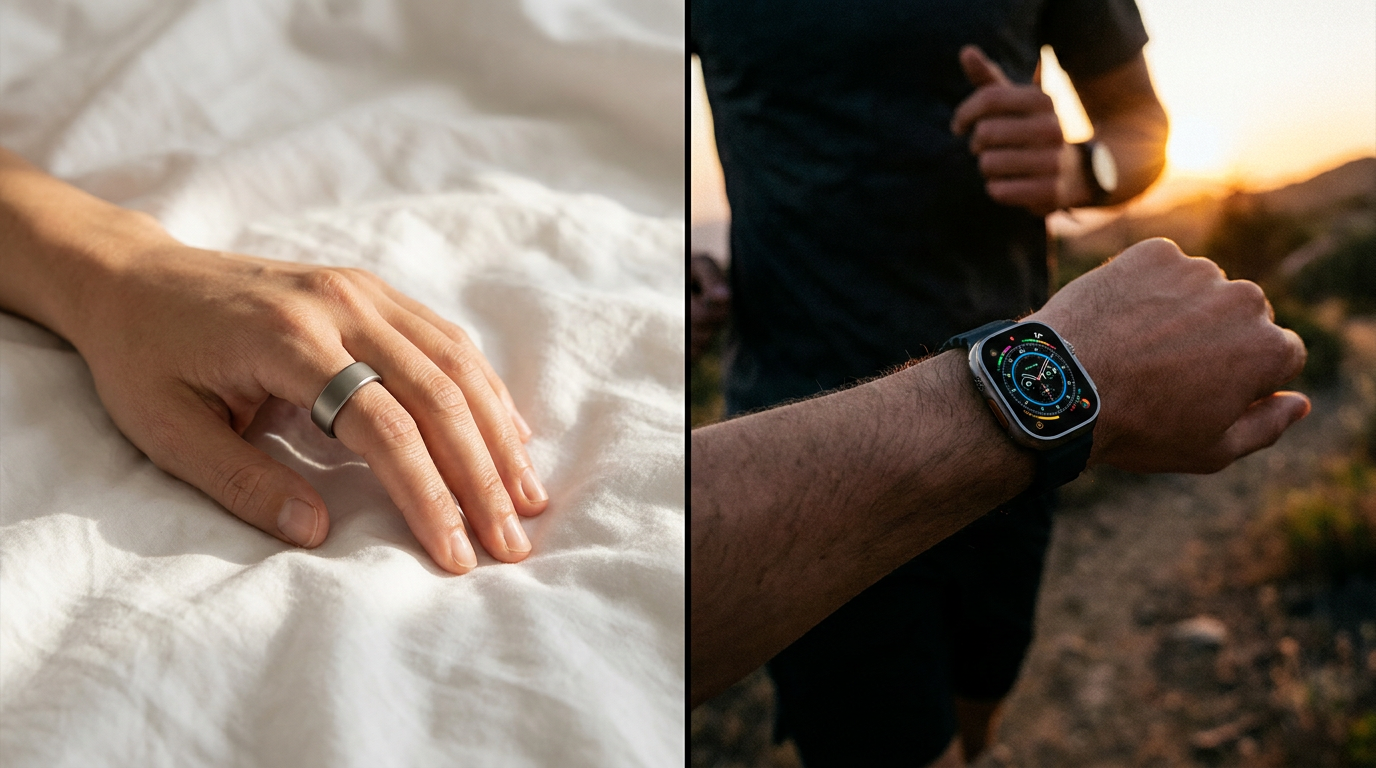
The wearable technology landscape in 2026 has definitively bifurcated into two distinct form factors: the wrist and the finger. Devices like the Apple Watch Series 11 and Samsung Galaxy Watch 7 continue to dominate the smartwatch category, offering wrist-mounted command centers. Meanwhile, the Oura Ring 4 and Samsung Galaxy Ring lead a surging smart ring market that promises invisible health monitoring. For consumers looking to invest in their personal wellness, the choice is no longer just about brand loyalty; it is about fundamentally different philosophies of data collection.[1][5][6]
The core philosophical difference lies in how these devices interact with the user. A smartwatch is an active companion, demanding attention with a high-resolution display, haptic notifications, and real-time data streams. A smart ring, by contrast, is a passive observer. It collects biometric data quietly in the background, sending the information to a smartphone for later review without adding to daily screen time or digital distraction.[1][3][5]
The case for smart rings centers heavily on sleep and recovery tracking. Weighing just three to seven grams, rings are significantly more comfortable for overnight wear than bulky 40-to-80-gram watches. This physical comfort drives much higher compliance rates, meaning users actually wear them to bed consistently rather than leaving them on a nightstand. For tracking long-term health trends, consistent data collection is far more valuable than sporadic, highly detailed snapshots.[2][3]

The evidence for ring accuracy during rest is compelling and clinically validated. The arteries in the finger are closer to the skin surface and feature a denser capillary network than the wrist. Independent validation studies, including those from Brigham and Women's Hospital, show that finger-based photoplethysmography sensors achieve 92 to 95 percent accuracy for sleep staging and resting heart rate variability when compared to medical-grade polysomnography.[2][4]
The case against smart rings emerges the moment the user starts exercising. Because they lack a display, rings cannot provide real-time pacing, heart rate zones, or interval timers during a run. Furthermore, the physical realities of exercise—such as gripping heavy dumbbells or holding bicycle handlebars—can disrupt the ring's sensor contact with the skin, leading to dropped data or inaccurate readings during high-intensity workouts.[3][5]
The case for smartwatches is built entirely on active performance and daily utility. For runners, cyclists, and gym-goers, the watch serves as an indispensable dashboard. Built-in GPS tracks exact routes and distances without requiring a tethered phone, while the bright screen delivers the immediate visual feedback that athletes need to adjust their effort and pacing mid-workout.[3][7]
The case for smartwatches is built entirely on active performance and daily utility.
The evidence for smartwatch superiority in active scenarios is well-documented across the industry. During moderate to high-intensity exercise, where heart rates exceed 120 beats per minute, wrist-based optical sensors maintain 88 to 97 percent accuracy. Additionally, smartwatches remain the only consumer wearables cleared by regulatory bodies for electrocardiogram readings and atrial fibrillation screening, offering a layer of proactive medical utility that rings simply cannot match.[2][3]

The case against smartwatches revolves around battery life and the friction of daily charging. Even the most efficient flagship smartwatches in 2026 require charging every one to two days. This creates an inevitable data gap, often forcing users to choose between tracking their sleep overnight or tracking their morning workout. Smart rings, unburdened by power-hungry displays, comfortably last five to eight days on a single charge.[2][3][7]
Cost structures also diverge sharply between the two categories, requiring buyers to look beyond the initial retail price. While smartwatches typically demand a higher upfront investment of $200 to $500, they rarely require ongoing fees to access your own data. Conversely, while a smart ring might cost $300 upfront, market leaders often lock their most valuable health insights behind a $10 to $20 monthly subscription, adding hundreds of dollars to the total cost of ownership over a few years.[1][3]

Ultimately, the decision requires quantifying your personal health goals and your tolerance for digital noise. Many serious health optimizers in 2026 have adopted a hybrid approach, wearing a mechanical watch or going bare-wristed during the day while relying on a ring for 24/7 passive data, and only strapping on a dedicated sports watch during specific exercise windows.[1][5]
A smart ring fits well when your primary goals are sleep optimization, recovery tracking, and long-term health awareness. It is the ideal choice if you want a device that disappears into your daily life, collects data passively without buzzing your finger, and only requires charging once a week while you shower.[1][3]
A smart ring does not fit well when you train regularly and need real-time feedback during workouts. It will frustrate users who want on-wrist GPS tracking for outdoor runs, the convenience of smartphone notifications, or the ability to control music and apps without pulling a phone out of their pocket.[1][3][5]
A smartwatch fits well when you want an all-in-one digital companion that bridges communication and fitness. It is perfect for serious athletes who need glanceable metrics, tech enthusiasts who value rich app ecosystems, and individuals who want medical-grade features like on-demand ECG readings.[1][2][7]
A smartwatch does not fit well when you suffer from notification fatigue or find wrist-worn devices uncomfortable to sleep in. If the friction of daily charging will cause you to leave the device on your nightstand for days at a time, the smartwatch's advanced sensors become entirely useless, making the passive smart ring a far better investment.[1][3][7]
Viewpoints in depth
The Sleep Optimizers
Users who prioritize overnight comfort, HRV tracking, and readiness scores over active workout data.
For this camp, the primary value of a wearable is understanding how the body recovers. Sleep optimizers argue that a tracker is only useful if you actually wear it to bed, and the bulky nature of smartwatches leads to poor compliance. By focusing on the finger—which offers excellent capillary density for accurate resting heart rate and temperature readings—smart rings provide a frictionless way to gather long-term baseline data without disrupting the sleep they are trying to measure.
The Active Athletes
Fitness enthusiasts who require real-time pacing, GPS, and visible heart rate zones during exercise.
Active athletes view wearables as training tools rather than passive medical charts. This perspective emphasizes the necessity of real-time feedback: a runner needs to see their split times, and a cyclist needs to monitor their heart rate zones mid-effort. Because smart rings lack screens and often lose sensor contact during grip-heavy exercises like weightlifting, athletes argue that smartwatches remain the only viable option for serious fitness tracking.
The Digital Minimalists
Consumers seeking to reduce screen time and notification fatigue while still collecting health data.
Digital minimalists are pushing back against the 'notification economy.' This group values the smart ring specifically because it lacks a screen, haptic buzzes, and app ecosystems. They argue that smartwatches, by mirroring smartphone notifications on the wrist, increase daily anxiety and distraction. For minimalists, the ideal technology is invisible—quietly collecting health data in the background and only presenting it when the user actively chooses to open an app.
What we don't know
- Whether smart rings will eventually achieve FDA clearance for medical-grade ECG readings.
- If the industry will standardize health data to allow seamless integration between different brands of rings and watches.
- How long the subscription-based business model for smart rings will survive against fee-free competitors.
Key terms
- Photoplethysmography (PPG)
- The optical sensor technology used in wearables that shines light into the skin to measure changes in blood flow and calculate heart rate.
- Heart Rate Variability (HRV)
- The variation in time between consecutive heartbeats, used by wearables as a key indicator of physical recovery and nervous system stress.
- Polysomnography
- A comprehensive, medical-grade sleep study used as the gold standard to test the accuracy of consumer sleep trackers.
- Electrocardiogram (ECG)
- A medical test that records the electrical signal from the heart to check for different conditions, available on premium smartwatches but not smart rings.
Frequently asked
Are smart rings as accurate as smartwatches?
During sleep and rest, smart rings are often more accurate because the finger provides a clearer pulse signal and moves less. During exercise, smartwatches are more accurate because wrist straps keep the sensors firmly in place.
Do all smart rings require a monthly subscription?
No. While market leaders like Oura require a subscription to access detailed health insights, newer competitors like RingConn and the Samsung Galaxy Ring offer their full feature sets with no ongoing fees.
Can a smart ring track my running route?
Most smart rings do not have built-in GPS. To track a route, you must carry your smartphone with you, whereas many smartwatches have independent GPS built directly into the device.
Can I wear both a ring and a watch?
Yes. Many users adopt a hybrid approach, wearing a ring 24/7 for continuous health and sleep data, and only wearing a smartwatch during dedicated workout sessions.
Sources
Source coverage
7 outlets
3 viewpoints surfaced







[1]Factlen Editorial TeamThe Digital Minimalists
Synthesis by Factlen editorial team
Read on Factlen Editorial Team →[2]JointCorpThe Digital Minimalists
Smart Ring vs Fitness Tracker vs Smartwatch: Ultimate Comparison 2026
Read on JointCorp →[3]SmartRingHQThe Sleep Optimizers
Smart ring vs smartwatch: The evidence-based 2026 guide
Read on SmartRingHQ →[4]LiveWorkSleepThe Sleep Optimizers
Oura ring vs Apple watch sleep tracking accuracy comparison
Read on LiveWorkSleep →[5]TechRadarThe Active Athletes
Smart ring vs smart watch: Screens, apps and smartphone features
Read on TechRadar →[6]ZDNETThe Digital Minimalists
Samsung Galaxy Ring review: Smarter than my Apple Watch
Read on ZDNET →[7]WareableThe Active Athletes
Samsung Galaxy Ring vs Galaxy Watch: What's the difference?
Read on Wareable →
Every angle. Every day.
Get shopping stories with full source coverage and perspective breakdowns delivered to your inbox.