
Trump Administration Faces Bipartisan Blowback Over Concessions in U.S.-Iran Peace Deal
The White House is defending the newly signed Islamabad Memorandum as a diplomatic triumph, but lawmakers and allies are sounding the alarm over immediate sanctions relief and a potential $300 billion reconstruction fund for Tehran.
By Factlen Editorial Team
- Trump Administration
- Argues the agreement is a victory of 'Peace Through Strength' that ends the war and reopens global commerce.
- Congressional Skeptics
- Question the upfront economic concessions and demand strict oversight over the $300 billion reconstruction fund.
- Israeli Leadership
- Furious at the deal, feeling betrayed that the agreement leaves Hezbollah and Iranian proxies intact.
- Foreign Policy Analysts
- Warn that Iran secured major economic relief upfront while delaying the hardest nuclear negotiations.
What's not represented
- · Iranian Civilians
- · Lebanese Civilians
- · European Energy Importers
Why this matters
This preliminary agreement pauses a devastating 110-day global conflict and reopens critical oil shipping lanes, but the massive economic concessions granted to Iran could reshape Middle Eastern power dynamics and trigger a fierce constitutional clash over war powers and spending in Washington.
Key points
- The U.S. and Iran signed the Islamabad Memorandum to end their 110-day military conflict.
- The deal establishes a 60-day window to negotiate a permanent end to Iran's nuclear program.
- Iran receives immediate waivers for crude oil exports and the unfreezing of certain assets.
- Bipartisan lawmakers are demanding oversight over a potential $300 billion reconstruction fund.
- Israel has condemned the deal and continued military strikes against Hezbollah in Lebanon.
- Formal negotiations for the comprehensive nuclear framework begin Sunday in Switzerland.
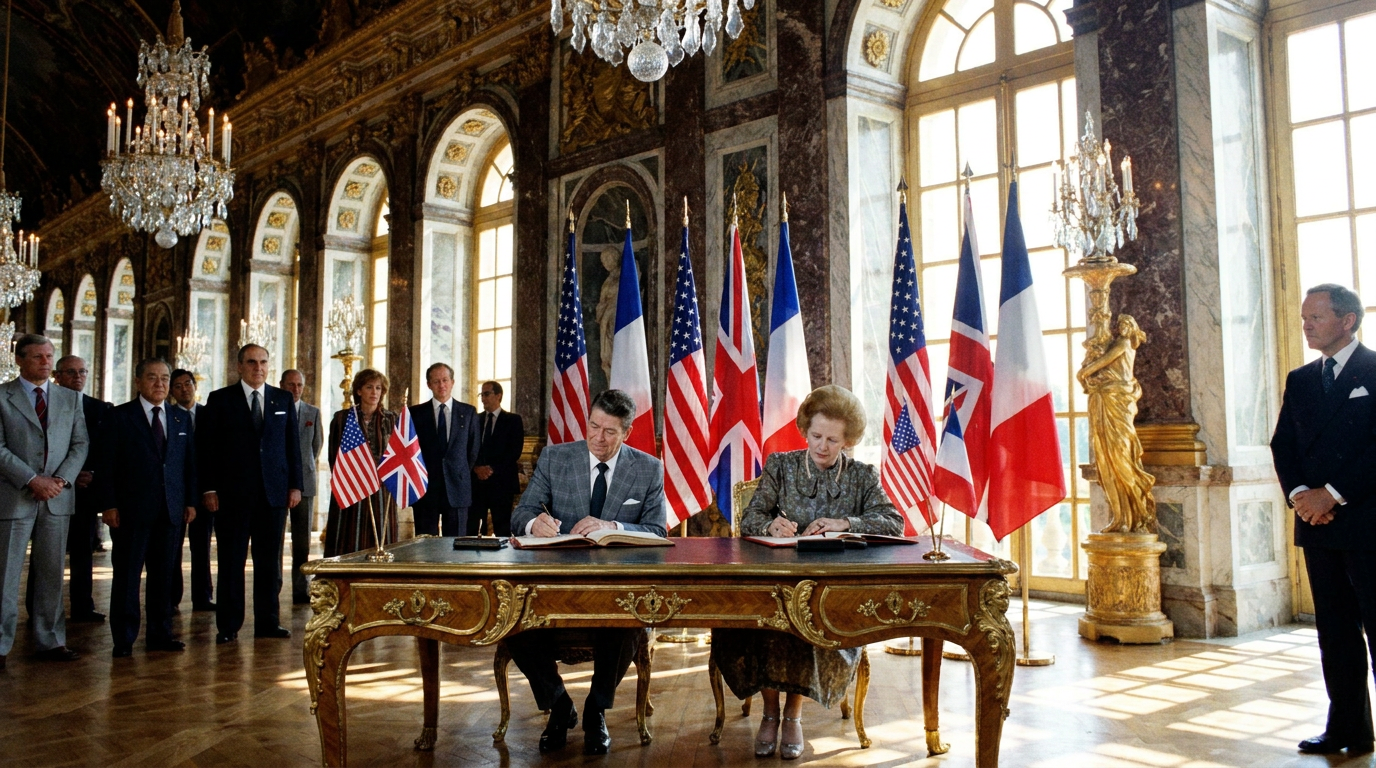
The United States and Iran have officially signed a preliminary peace agreement to end their 110-day military conflict, but the Trump administration is immediately facing fierce domestic and international blowback over the deal's concessions. Brokered primarily by Pakistan, the "Islamabad Memorandum" was signed remotely by President Donald Trump at the Palace of Versailles and Iranian President Masoud Pezeshkian in Tehran. The pact halts military operations, lifts the U.S. naval blockade, and establishes a 60-day window to negotiate a permanent end to Iran's nuclear program.[2][3]
The White House is aggressively defending the memorandum as a historic diplomatic triumph. Vice President JD Vance and administration officials have branded the agreement as "America First in Action," arguing that months of decisive U.S. military strength forced a desperate, weakened Tehran to the negotiating table. The administration emphasizes that the deal secures the reopening of the Strait of Hormuz—a critical artery for global energy markets—without the "appeasement" policies of previous administrations.[1][6]
However, the actual text of the memorandum has alarmed foreign policy hawks and bipartisan lawmakers alike. To secure the 60-day negotiation window, the United States agreed to issue immediate waivers for Iranian crude oil exports and petroleum products. The U.S. Treasury Department is mandated to allow associated banking services the moment the document is signed, effectively providing Tehran with an instant economic lifeline while the most difficult nuclear negotiations are postponed.[2][3]

Regional experts and former diplomats have expressed deep skepticism about the sequencing of the deal. David Schenker, a former U.S. Assistant Secretary of State for Near Eastern Affairs, noted that the agreement delivers massive economic benefits to Iran upfront. Analysts warn that by granting sanctions relief and unfreezing assets before a final nuclear framework is locked in, the United States has surrendered its primary leverage, allowing Tehran to claim a significant diplomatic victory despite the military toll of the 110-day war.[6]
On Capitol Hill, the reaction has been characterized by profound unease. Lawmakers who supported the initial military action are now questioning the ultimate strategic gain. Republican Senator Mike Rounds of South Dakota, who serves on the Armed Services Committee, commended the pursuit of a peaceful solution but publicly stated that Congress has "a lot of questions" about the terms. The overarching sentiment among many senators is a demand for rigorous oversight over how the next 60 days of negotiations will be conducted.[4]
On Capitol Hill, the reaction has been characterized by profound unease.
The most explosive revelation for Congress is a tentative provision outlining a potential $300 billion fund for the "reconstruction and economic development" of Iran, contingent upon a final comprehensive agreement. Lawmakers are demanding clarity on whether U.S. taxpayer dollars or unfrozen Iranian assets would capitalize this fund. The sheer scale of the proposed economic package has sparked outrage among conservative hardliners who view it as a massive reward for a state sponsor of terrorism.[4]

In response to the sudden diplomatic pivot, the Senate is moving to establish strict guardrails on the administration's defense and diplomatic apparatus. Lawmakers are attempting to block a portion of Defense Secretary Pete Hegseth's travel funding until the Pentagon delivers comprehensive after-action reports on the conflict. Congress is particularly focused on securing an investigation into a U.S. strike on an Iranian elementary school that killed 165 people—a tragedy that served as a major flashpoint early in the war.[4]
The domestic political friction is mirrored by intense outrage from America's closest Middle Eastern ally. The Israeli government and public have reacted with fury to the Islamabad Memorandum, feeling entirely sidelined by the Trump administration. Israeli officials have condemned the deal as a "terrible" mistake that leaves Iran's proxy network, particularly Hezbollah in Lebanon, largely intact and capable of launching future attacks.[5]
The text of the memorandum explicitly includes Lebanon in the cessation of hostilities, effectively requiring Iran to rein in Hezbollah. However, Israel was not a signatory to the pact and has explicitly retained its right to conduct military operations against Hezbollah to secure its northern border. This fundamental disconnect has already pushed the fragile peace agreement to the brink of collapse within days of its signing.[3][5]

The durability of the memorandum is already being severely tested on the ground. Over the weekend, Israel launched a series of strikes into Lebanon, targeting Hezbollah infrastructure and openly defying the spirit of the U.S.-Iran ceasefire. In immediate retaliation for the Israeli operations, Tehran announced it was temporarily shutting the Strait of Hormuz once again, demonstrating how easily the core achievements of the Trump administration's deal can be unraveled by regional actors.[8]
Despite the immediate violations and soaring tensions, formal negotiations are scheduled to kick off on Sunday in Switzerland. Pakistani officials, who played a central role in brokering the initial ceasefire, confirmed that U.S. and Iranian delegations will meet to begin hammering out the comprehensive nuclear framework. The talks will have to navigate not only the complex technical details of uranium enrichment but also the volatile reality of ongoing proxy warfare.[7]
The 60-day clock is now ticking, and the stakes for the Trump administration are astronomically high. U.S. officials have warned that the memorandum is highly fragile and that either side can walk away at any time. If the talks in Switzerland collapse, the White House has signaled it is prepared to immediately snap back all economic sanctions and reinstate the naval blockade, potentially plunging the region back into a devastating and unpredictable war.[3]
How we got here
Early 2026
A major escalation leads to a 110-day military conflict between the United States and Iran, including a U.S. naval blockade.
June 12, 2026
U.S. and Iranian negotiators agree on the final text for a preliminary peace deal, brokered heavily by Pakistan.
June 17, 2026
President Trump signs the Islamabad Memorandum at the Palace of Versailles, officially halting military operations.
June 20, 2026
Israel continues strikes in Lebanon, testing the MoU, which prompts Iran to temporarily shut the Strait of Hormuz.
June 21, 2026
Formal 60-day nuclear negotiations are scheduled to begin between U.S. and Iranian delegations in Switzerland.
Viewpoints in depth
The White House's view
The administration frames the deal as a masterclass in coercive diplomacy.
Vice President JD Vance and administration surrogates argue that the 110-day military campaign successfully broke Tehran's resolve, forcing them to the table out of sheer desperation. By securing the immediate reopening of the Strait of Hormuz, the White House claims it has stabilized global energy markets and protected American economic interests. They view the 60-day window not as a concession, but as a strict probationary period where the U.S. holds all the cards, ready to snap back the naval blockade if Iran fails to dismantle its nuclear program.
Congressional Skeptics' view
Lawmakers fear the U.S. gave up its leverage for a temporary pause.
Bipartisan members of the Armed Services and Foreign Relations committees are deeply alarmed by the sequencing of the memorandum. They argue that granting immediate waivers for Iranian crude oil exports and unfreezing assets removes the very economic pressure that brought Iran to the table. Furthermore, the prospect of a $300 billion reconstruction fund has outraged fiscal conservatives and defense hawks alike, who are demanding immediate hearings and threatening to withhold Pentagon funding until the administration provides a transparent accounting of the war's costs and the deal's true obligations.
Israel's view
Israeli leadership views the agreement as a dangerous betrayal that ignores regional proxies.
For Jerusalem, the Islamabad Memorandum represents a catastrophic strategic misstep by the United States. Israeli officials are furious that the deal focuses heavily on uranium enrichment and the Strait of Hormuz while effectively leaving Iran's 'Ring of Fire'—particularly Hezbollah in Lebanon—intact. Viewing the ceasefire as a shield for Iranian proxies to regroup, Israel has explicitly refused to be bound by the memorandum, continuing its strikes in Lebanon and risking a broader regional unraveling to secure its northern border.
What we don't know
- Whether the $300 billion reconstruction fund would be capitalized by U.S. taxpayers or unfrozen Iranian assets.
- How the U.S. will respond if Israel's continued strikes in Lebanon cause Iran to permanently walk away from the table.
- If Iran will actually agree to dismantle its nuclear infrastructure during the 60-day negotiation window.
Key terms
- Islamabad Memorandum
- The preliminary 10-point agreement signed by the U.S. and Iran to halt military operations and begin a 60-day negotiation period.
- Strait of Hormuz
- A critical maritime chokepoint between the Persian Gulf and the Gulf of Oman through which a significant portion of the world's oil supply passes.
- Sanctions Waiver
- A temporary exemption granted by the U.S. government allowing a country to bypass specific economic sanctions, in this case permitting Iran to sell crude oil.
- Snapback
- A mechanism allowing the United States to immediately reinstate all previous economic sanctions if Iran violates the terms of the agreement.
Frequently asked
What is the Islamabad Memorandum?
It is a preliminary peace agreement between the U.S. and Iran, brokered by Pakistan, designed to end their 110-day military conflict and establish a 60-day window for nuclear negotiations.
What did Iran get in the deal?
Iran secured an immediate halt to the U.S. naval blockade, waivers to export crude oil, and the unfreezing of certain assets, alongside a potential $300 billion reconstruction fund if a final deal is reached.
Why is Israel angry about the agreement?
Israeli officials feel betrayed because the deal does not dismantle Hezbollah or other Iranian proxy forces, prompting Israel to continue its military strikes in Lebanon despite the ceasefire.
What happens if the 60-day talks fail?
U.S. officials have stated that either side can walk away at any time. If negotiations collapse, the U.S. is prepared to immediately reinstate economic sanctions and resume the naval blockade.
Sources
Source coverage
8 outlets
4 viewpoints surfaced






[1]The White HouseTrump Administration
President Trump's Iran Agreement Is America First in Action
Read on The White House →[2]AxiosForeign Policy Analysts
READ: Full text of U.S.-Iran memorandum of understanding
Read on Axios →[3]The GuardianForeign Policy Analysts
US-Iran deal takeaways: reopening the strait of Hormuz, waived oil sanctions and Lebanon
Read on The Guardian →[4]Associated PressCongressional Skeptics
Congress wonders as the Iran war draws to a close: Was it worth it?
Read on Associated Press →[5]Al JazeeraIsraeli Leadership
‘You could’ve been the greatest’: Trump faces Israeli anger over Iran deal
Read on Al Jazeera →[6]Iran InternationalForeign Policy Analysts
Trump says Iran is 'finished', experts say Tehran won big
Read on Iran International →US-Iran talks to kick off Sunday in Switzerland, says Pakistan
Read on Al Jazeera →Iran shuts Strait of Hormuz as Israel tests MOU with Lebanon strikes
Read on Al Jazeera →

Every angle. Every day.
Get news politics stories with full source coverage and perspective breakdowns delivered to your inbox.