
Supreme Court Strikes Down Federal Gun Ban for Marijuana Users
The Supreme Court unanimously ruled that prosecuting marijuana users for possessing firearms violates the Second Amendment, invalidating a long-standing federal statute.
By Factlen Editorial Team
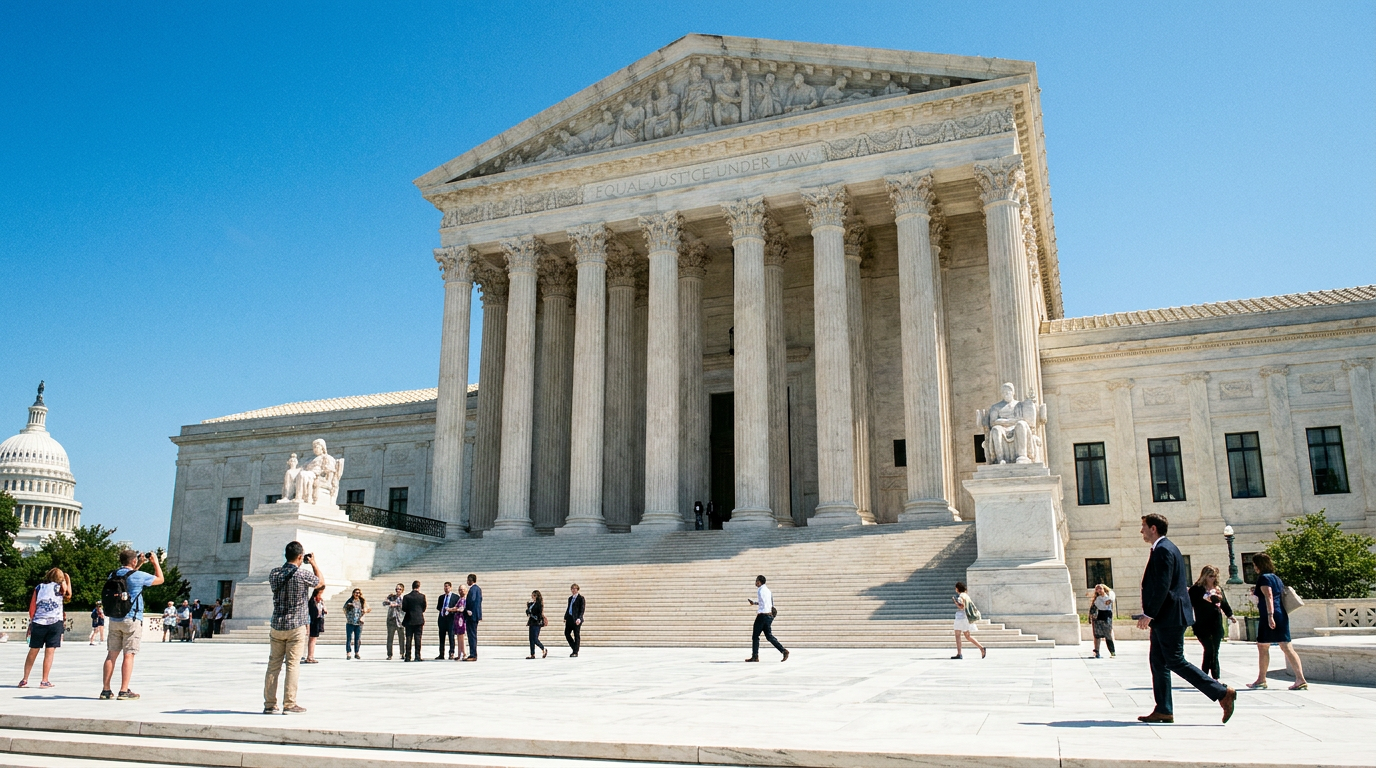
- Second Amendment Advocates
- Argue that constitutional rights cannot be stripped for non-violent behavior.
- Civil Liberties Groups
- View the ruling as a necessary dismantling of discriminatory drug war policies.
- Government & Law Enforcement
- Warn that the ruling removes a tool for preventing gun violence and prosecuting suspected criminals.
- Neutral Analysts
- Provide objective legal and historical context on the ruling's implications.
What's not represented
- · State-level law enforcement officials who must now navigate conflicting federal and state gun regulations regarding marijuana.
- · Medical marijuana patients who have historically been denied concealed carry permits.
Why this matters
This ruling dismantles a major pillar of federal gun control, ensuring that millions of Americans who use marijuana—even in states where it is legal—can no longer be automatically stripped of their Second Amendment rights or face felony charges simply for owning a firearm.
Key points
- The Supreme Court unanimously ruled that prosecuting marijuana users for gun possession violates the Second Amendment.
- The case involved a Texas man charged solely for possessing a gun while admitting to occasional marijuana use.
- Justice Gorsuch wrote that the government cannot categorically designate all drug users as dangerous.
- The ruling does not strike down bans for convicted felons or individuals who are presently intoxicated.
- The decision unites gun rights advocates and civil liberties groups against federal drug war policies.
The Supreme Court unanimously ruled on Thursday that the federal government cannot automatically strip Americans of their Second Amendment rights solely because they use marijuana, striking down a key provision of federal gun law. The decision in United States v. Hemani marks a historic intersection of gun rights and drug policy, invalidating the application of 18 U.S.C. § 922(g)(3)—a statute that makes it a felony for an "unlawful user" of a controlled substance to possess a firearm—for habitual marijuana users. By dismantling this long-standing prohibition, the Court has effectively restored the constitutional right to keep and bear arms for millions of Americans who consume cannabis, even in states where the drug remains heavily regulated or federally prohibited.[1][2]
The case centered on Ali Hemani, a Texas man and dual U.S.-Pakistani citizen whose life was upended by a federal investigation in 2022. The FBI initially searched Hemani's home over suspected terrorism links—a probe that his legal team at CUNY CLEAR argued was rooted in discriminatory profiling of his Shia Muslim identity rather than any actionable intelligence. Agents ultimately found no evidence of terrorism or violent extremism. However, Hemani cooperated fully during the search, voluntarily surrendering a legally owned handgun and directing agents to a small amount of marijuana on the property. During an interview, he admitted to law enforcement that he used marijuana "about every other day."[1][6]

Six months after the initial search cleared him of any terrorism ties, the Justice Department indicted Hemani on a single charge: possessing a firearm as an unlawful drug user. Under the strict parameters of 18 U.S.C. § 922(g)(3), Hemani faced a staggering maximum penalty of 15 years in federal prison and lifetime disarmament. He immediately challenged the charge, arguing that punishing him for non-violent drug use violated his constitutional right to self-defense. The district court agreed and dismissed the indictment, a decision that was later affirmed by the Fifth Circuit Court of Appeals before the government escalated the battle to the Supreme Court.[1][3]
Writing the majority opinion for a unanimous Court, Justice Neil Gorsuch systematically dismantled the government's argument that regular marijuana use categorically renders a person violent and dangerous without any further showing of risk. Gorsuch noted that affording the government the "broad power to designate any group as dangerous and thereby disqualify its members from having a gun" would risk allowing federal authorities to "quickly swallow" the Second Amendment entirely. The opinion emphasized that constitutional rights cannot be suspended based on broad, administrative classifications of behavior that do not inherently involve violence or a direct threat to public safety.[1][2]
To satisfy the Court's modern Second Amendment framework, which requires modern gun laws to align with the nation's historical tradition of firearm regulation, the Justice Department had attempted to compare the modern drug statute to 18th-century laws that disarmed "habitual drunkards." The Court found this historical analogy intellectually unworkable and fundamentally flawed. Gorsuch pointed out that early American laws required a showing of actual, active incapacitation or a demonstrable danger to others before disarming a citizen, rather than relying on the mere private consumption of an intoxicating substance. Because Hemani was not accused of handling his weapon while intoxicated, the historical precedent did not support his disarmament.[1][3][5]

Because Hemani was not accused of handling his weapon while intoxicated, the historical precedent did not support his disarmament.
Despite the sweeping implications for marijuana users, the ruling remains notably narrow in its legal scope. Gorsuch explicitly clarified that the decision does not address or invalidate efforts to ban individuals who are presently intoxicated from handling firearms. Furthermore, the ruling does not strike down the disarmament of convicted felons, nor does it protect individuals who are proven to be severe drug "addicts" rather than mere "users." This careful parsing ensures that the government retains the authority to disarm individuals who pose an immediate, demonstrable risk, while protecting the rights of casual or habitual consumers of marijuana who otherwise lead law-abiding lives.[1][2]
The decision has united an unusual, cross-partisan coalition of Second Amendment originalists and progressive civil liberties groups. Conservative and libertarian organizations, including the Cato Institute and the NRA, filed briefs backing Hemani, arguing that non-violent drug use should never force an American to forfeit their fundamental constitutional rights. Meanwhile, the ACLU celebrated the ruling as a vital blow to the legacy of the War on Drugs. "With nearly half of Americans reporting marijuana use at some point in their lives, this ruling protects the rights of millions and curbs the government's ability to impose arbitrary and discriminatory penalties," said ACLU legal director Cecillia Wang.[2][4]

For federal law enforcement, the ruling represents the loss of a highly utilized prosecutorial tool. The Justice Department estimates that roughly 300 people are charged under the unlawful user provision each year, often using the statute as leverage to secure plea deals in broader drug or gang-related investigations where primary charges are difficult to prove. The statute gained intense national prominence recently when Hunter Biden was convicted under its adjacent "addict" clause—a conviction that was ultimately erased by a presidential pardon. Legal experts now anticipate that the Hemani ruling will trigger a massive wave of appeals from individuals previously convicted under the user provision, forcing lower courts to re-evaluate thousands of past cases.[2][3][5][7]
How we got here
2022
The FBI searches Ali Hemani's home, finding a legally owned gun and marijuana, but no evidence of terrorism.
Early 2023
The Justice Department indicts Hemani under 18 U.S.C. § 922(g)(3) for possessing a firearm as an unlawful drug user.
Feb 2024
A federal district court dismisses the indictment, ruling the charge violates the Second Amendment.
Oct 2025
The Supreme Court grants the government's petition to review the case after the Fifth Circuit affirms the dismissal.
March 2, 2026
The Supreme Court hears oral arguments in United States v. Hemani.
June 18, 2026
The Supreme Court unanimously rules that prosecuting Hemani under the statute is unconstitutional.
Viewpoints in depth
Second Amendment Advocates
Gun rights groups argue that constitutional rights cannot be stripped for non-violent behavior.
Organizations like the NRA and the Cato Institute argued that the Second Amendment is a fundamental right that should not be forfeited simply because an individual engages in the private use of marijuana. They contended that the government's attempt to classify all drug users as inherently dangerous was a vast overreach that lacked historical precedent, noting that early American laws only disarmed individuals who were actively incapacitated or proven to be a direct threat to public safety.
Civil Liberties & Drug Reformers
Advocates view the ruling as a necessary dismantling of discriminatory drug war policies.
Groups such as the ACLU and CUNY CLEAR celebrated the decision for curbing arbitrary government power. They highlighted that the law was often used selectively to target minorities—as seen in Ali Hemani's initial terrorism probe—and criminalized a behavior that nearly half of all Americans have engaged in. For these advocates, the ruling is less about firearms and more about preventing the state from using outdated drug classifications to incarcerate non-violent citizens.
Federal Prosecutors
The government warns that the ruling removes a tool for preventing gun violence.
The Justice Department defended the statute as a common-sense measure to keep firearms out of the hands of individuals whose judgment may be impaired by illegal substances. While the statute was only the primary charge in about 300 cases a year, it was frequently used by federal prosecutors as leverage in broader investigations or to disarm individuals suspected of other crimes when primary charges were difficult to prove.
What we don't know
- How federal courts will handle appeals from individuals previously convicted under the unlawful user provision.
- Whether the Justice Department will attempt to pivot to prosecuting marijuana users under the 'addict' clause of the same statute.
- How this ruling will impact state-level laws that restrict gun ownership for medical marijuana patients.
Key terms
- 18 U.S.C. § 922(g)(3)
- A federal statute that makes it a felony for anyone who is an 'unlawful user of or addicted to any controlled substance' to possess a firearm.
- Second Amendment
- The provision of the U.S. Constitution that protects the right of the people to keep and bear arms.
- Historical Analogue
- A legal standard requiring modern gun control laws to be consistent with the nation's historical tradition of firearm regulation from the 18th or 19th centuries.
- As-Applied Challenge
- A legal claim arguing that a law is unconstitutional in the specific context of the defendant's case, rather than unconstitutional in all circumstances.
Frequently asked
Can anyone who uses drugs now own a gun?
The ruling specifically protects occasional marijuana users from being automatically banned from gun ownership. It does not protect individuals who are proven 'addicts' or those who handle firearms while actively intoxicated.
Does this ruling legalize marijuana?
No. Marijuana remains a Schedule I controlled substance under federal law. The ruling only addresses the constitutionality of stripping gun rights based on that drug use.
How does this affect Hunter Biden's conviction?
Hunter Biden was convicted under the 'addict' portion of the same statute, which the Court explicitly noted was not addressed by this ruling. Furthermore, he received a presidential pardon, rendering his specific legal jeopardy moot.
Was the ruling divided along partisan lines?
No, the decision was unanimous, though several justices wrote separate concurring opinions to explain their specific legal reasoning.
Sources
Source coverage
7 outlets
4 viewpoints surfaced







[1]Supreme Court of the United StatesGovernment & Law Enforcement
Slip Opinion: United States v. Hemani
Read on Supreme Court of the United States →[2]CBS NewsNeutral Analysts
Supreme Court rules in favor of Texas man who challenged federal law barring drug users from having firearms
Read on CBS News →[3]The NationCivil Liberties Groups
The Supreme Court Expanded Gun Rights and Drug Rights in the Same Ruling
Read on The Nation →[4]Cato InstituteSecond Amendment Advocates
United States v. Hemani Amicus Brief
Read on Cato Institute →[5]Federalist SocietySecond Amendment Advocates
United States v. Hemani: Second Amendment and Drug Users
Read on Federalist Society →[6]CUNY CLEARCivil Liberties Groups
Ali Hemani Supreme Court Case
Read on CUNY CLEAR →[7]Factlen Editorial TeamNeutral Analysts
Synthesis by Factlen editorial team
Read on Factlen Editorial Team →



Every angle. Every day.
Get news politics stories with full source coverage and perspective breakdowns delivered to your inbox.