
Trail Running Shoes vs. Hiking Boots: The Science and Trade-Offs of Backcountry Footwear
The outdoor industry is deeply divided over whether lightweight trail runners or traditional hiking boots offer the best performance for backpackers. Biomechanical evidence reveals stark trade-offs between energy conservation, ankle support, and moisture management.
By Factlen Editorial Team
- Ultralight Backpackers
- Prioritize weight savings, speed, and quick-drying mesh over traditional durability.
- Traditional Hikers & Hunters
- Prioritize durability, environmental armor, and load-bearing support for rugged terrain.
- Footwear Biomechanists
- Focus on foot strength, proprioception, and the mechanics of the fulcrum effect.
What's not represented
- · Casual day-hikers who prioritize budget over specialized performance.
- · Trail maintenance crews who require steel-toe safety compliance.
Why this matters
Choosing the wrong footwear is the leading cause of trip-ending blisters, fatigue, and joint pain for backpackers. Understanding the biomechanical trade-offs between boots and trail runners allows you to match your gear to your specific terrain, saving massive amounts of energy and preventing injury on the trail.
Key points
- Trail runners save massive amounts of energy because weight on the feet is exponentially more taxing than weight on the back.
- Hiking boots offer superior durability, lasting over 1,000 miles compared to the 400-500 mile lifespan of trail runners.
- Non-waterproof trail runners dry out quickly after river crossings, while waterproof boots can trap sweat and cause blisters.
- The ankle support debate is split: boots restrict inversion, but their stiff soles can create a dangerous 'fulcrum effect.'
- Trail runners excel on established paths with light loads; boots are necessary for off-trail travel, heavy loads, and snow.
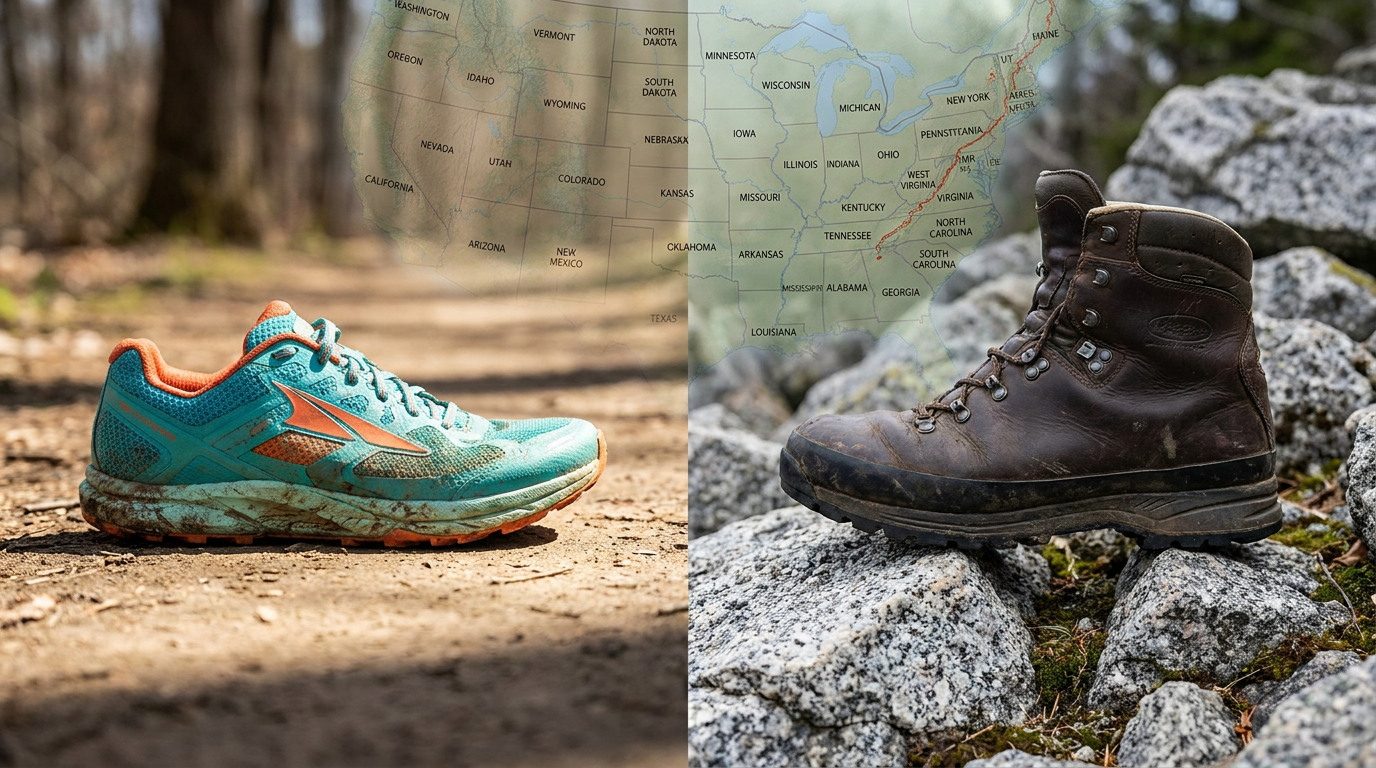
Spend enough time at any major trailhead, and you will eventually witness the divide: a traditional backpacker grinding uphill in heavy, rigid leather boots, passing a thru-hiker practically floating over the same terrain in lightweight mesh trail runners. For decades, outdoor conventional wisdom dictated that carrying a heavy pack required heavy footwear to protect the feet and support the ankles. But as gear has evolved and the ultralight movement has gone mainstream, the consensus has fractured. Today, the debate between trail running shoes and hiking boots is the most fiercely contested topic in outdoor recreation, fundamentally altering how millions of people prepare for the backcountry.[1]
The case for trail runners centers entirely on energy conservation and out-of-the-box comfort. Built originally for mountain runners navigating dirt paths at high speeds, these shoes utilize breathable mesh uppers, soft EVA foam midsoles, and aggressive rubber lugs. Because they are constructed like athletic sneakers, they require zero break-in period, eliminating the agonizing weeks of blister management traditionally associated with new hiking boots. For modern backpackers, the appeal is simple: less weight on the feet means less energy expended with every single step, allowing hikers to cover more miles with significantly less lower-body fatigue.[6][8]
The case against trail runners focuses on their inherent fragility and lack of environmental protection. Mesh uppers tear easily when scraped against sharp scree, and the soft EVA foam compresses permanently under heavy pack loads. Furthermore, trail runners offer zero armor against snake bites, thorny brush, or freezing temperatures. When navigating off-trail alpine environments or kicking steps into early-season snow, the flexible toe box of a trail runner becomes a distinct liability, leaving the foot vulnerable to bruising and cold exposure.[5][7]
The evidence regarding the weight disparity is rooted in established biomechanics. A widely cited physiological rule of thumb states that one pound of weight on the foot requires the same energy expenditure as carrying four to six pounds on the back. Because a pair of trail runners typically weighs around twenty ounces, while a pair of traditional leather boots can easily exceed three pounds, the energy savings compound massively over a twenty-mile day. By swapping boots for trail runners, a hiker effectively removes the energetic equivalent of ten pounds from their backpack, explaining why the footwear has become ubiquitous on long-distance routes like the Appalachian Trail.[4][5]

Conversely, the case for traditional hiking boots is built on durability, load-bearing stability, and absolute weather protection. Constructed from full-grain leather or heavy-duty synthetics, a quality boot acts as armor for the lower leg. The rigid shank embedded in the midsole prevents the foot from wrapping around sharp rocks, saving the plantar fascia from bruising over jagged terrain. When carrying expedition-level loads exceeding forty pounds, the stiff structure of a boot prevents the foot from collapsing inward, providing a stable platform that soft running shoes simply cannot match.[5][7]
The case against hiking boots highlights their cumbersome weight, the dreaded break-in period, and their tendency to trap moisture. While waterproof membranes like Gore-Tex excel at keeping morning dew and shallow puddles out, they also prevent sweat from escaping. During strenuous climbs in warm weather, a waterproof boot becomes a sauna, softening the skin and creating the perfect friction environment for severe blisters. Furthermore, if water overtops the collar during a deep river crossing, a waterproof boot will take days to dry in the backcountry, forcing the hiker to walk in heavy, waterlogged footwear.[6][7]
The case against hiking boots highlights their cumbersome weight, the dreaded break-in period, and their tendency to trap moisture.
The evidence on moisture management strongly favors the non-waterproof trail runner for three-season hiking. Thru-hikers have widely adopted the philosophy that feet will inevitably get wet, whether from sweat, rain, or river crossings. A breathable mesh trail runner will pump water out with every step and can dry completely within a few hours of hiking in the sun. In contrast, a soaked leather boot acts as a bucket, retaining water and significantly increasing the risk of trench foot and friction blisters over multi-day trips.[6]
The ankle support debate is where the two camps clash most violently. For generations, retailers have sold high-top boots on the promise that lacing leather tightly above the ankle prevents sprains. Some biomechanical studies support this, showing that high-top footwear can reduce the maximum rate of ankle inversion during a misstep. For hikers with pre-existing joint laxity or those carrying massive loads that alter their center of gravity, the physical restriction of a rigid boot collar provides a genuine mechanical backstop against a catastrophic roll.[7][8]
However, the counter-evidence regarding ankle support introduces the concept of the "fulcrum effect." Sports podiatrists and ultralight hikers argue that boots generally have a higher stack height and a rigid, unforgiving sole. If a hiker steps awkwardly on a rock, that stiff sole cannot conform to the obstacle; instead, it tilts the entire foot. The elevated heel acts as a fulcrum, potentially creating a more severe lever-action sprain than if the foot had been closer to the ground. Trail runners, with their lower profile and flexible soles, allow the foot to bend and adapt to the terrain, relying on the body's natural proprioception rather than external bracing.[4][6]

The financial evidence reveals a stark trade-off between upfront investment and replacement frequency. A premium pair of leather hiking boots may cost two hundred and fifty dollars but can easily survive a thousand miles of rugged use, and many can be resoled for years of continued service. Trail runners, while slightly cheaper at around one hundred and fifty dollars, are consumable items. The soft rubber lugs wear down and the foam midsoles lose their rebound after roughly four hundred to five hundred miles. A thru-hiker completing the Pacific Crest Trail will burn through five pairs of trail runners, making them significantly more expensive over the long term.[5][8]
Ultimately, trail runners fit well when hikers are tackling established, well-maintained paths, carrying base weights under thirty pounds, and prioritizing daily mileage and speed. They are the optimal choice for warm-weather backpacking, environments with frequent river crossings, and hikers who have developed strong lower-leg muscles. They do not fit well when the temperature drops below freezing, when the route requires extensive off-trail bushwhacking through sharp vegetation, or when the hiker is carrying an expedition-sized load that demands a rigid platform.[1][8]

Traditional hiking boots fit well when the itinerary involves heavy hauling, such as carrying a week's worth of winter gear or packing out heavy loads on a hunting trip. They excel in snowy, muddy, or freezing conditions where thermal protection is paramount, and in jagged alpine scree fields where a soft shoe would be shredded in hours. They do not fit well when moving fast and light in the middle of summer, when navigating trails with constant deep-water crossings, or for hikers who are highly prone to friction blisters from trapped sweat.[5][7]
For those unwilling to commit to either extreme, the outdoor industry has developed a hybrid middle ground: the mid-height trail runner and the lightweight hiking shoe. These options take the flexible, cushioned midsole of a running shoe and pair it with a slightly higher collar and more durable upper materials. While they do not offer the bombproof armor of a traditional boot or the featherlight freedom of a racing shoe, they provide a versatile compromise for weekend backpackers who want a touch more protection without feeling like they have anvils strapped to their feet.[4][7]

The great footwear debate will likely never be permanently settled, because the definition of a successful hike varies wildly from person to person. The modern consensus is no longer about finding the objectively superior shoe, but rather matching the tool to the specific demands of the environment and the biomechanics of the wearer. By understanding the explicit trade-offs between weight, durability, moisture management, and support, backpackers can finally step off the trailhead with confidence, regardless of what is laced onto their feet.[1]
How we got here
1970s–1980s
Heavy, rigid leather boots dominate the backpacking industry as mandatory equipment for all terrain.
Early 2000s
The ultralight backpacking movement gains traction, with early adopters experimenting with standard running shoes.
2014
Medical studies begin comparing ankle impact between high-top boots and low-cut runners, finding nuanced results.
2020s
Trail runners become the dominant footwear on major long-distance routes, worn by over 50% of Appalachian Trail thru-hikers.
Viewpoints in depth
Ultralight Thru-Hikers
Prioritize weight savings, speed, and quick-drying mesh over traditional durability.
This camp views traditional hiking boots as archaic energy-drains. They argue that the best way to protect the body is to carry less weight, pointing to the biomechanical reality that heavy footwear accelerates joint fatigue over long distances. For ultralight hikers, wet feet are an accepted reality of the wilderness; they prefer a mesh shoe that gets wet instantly but dries in two hours over a waterproof boot that stays dry initially but takes three days to dry once breached.
Traditional Mountaineers & Guides
Prioritize durability, environmental armor, and load-bearing support for rugged terrain.
Traditionalists argue that the ultralight community's obsession with trail runners ignores the realities of off-trail travel and heavy hauling. When carrying a 50-pound pack or navigating jagged scree fields, they maintain that the rigid shank and thick leather of a boot are non-negotiable safety features. They view trail runners as disposable, fragile footwear that leaves hikers dangerously exposed to snake bites, rolled ankles, and hypothermia in deteriorating weather conditions.
Biomechanics & Podiatry Experts
Focus on foot strength, proprioception, and the mechanics of the fulcrum effect.
Medical and biomechanical experts take a nuanced view, noting that neither shoe is inherently 'safer' without context. They emphasize that a hiker's natural foot strength and proprioception are the primary defenses against injury. While acknowledging that high-top boots can limit the maximum angle of an inversion, they also warn of the 'fulcrum effect'—where a stiff, high-stack boot acts as a lever that can exacerbate a sprain on uneven ground. Their consensus leans toward matching the footwear to the individual's joint laxity and the specific load being carried.
What we don't know
- Whether long-term use of rigid boots weakens natural ankle ligaments over a lifetime of hiking.
- Exactly how much pack weight serves as the absolute tipping point where a trail runner becomes biomechanically unsafe for the average hiker.
Key terms
- Thru-hiking
- Hiking a long-distance trail, such as the Pacific Crest Trail, from end to end in a single continuous journey.
- Proprioception
- The body's subconscious ability to sense its location and movement, crucial for instinctive foot placement on uneven terrain.
- Fulcrum effect
- A mechanical disadvantage where a shoe's thick, stiff sole acts as a pivot point, potentially exacerbating an ankle roll.
- EVA foam
- Ethylene-vinyl acetate, a lightweight, shock-absorbing material commonly used in the midsoles of running shoes.
- Lugs
- The deep rubber indentations on the outsole of a shoe designed to provide traction in dirt, mud, and snow.
Frequently asked
Can you wear trail runners for backpacking?
Yes. Trail runners are highly popular for backpacking on established trails, provided your total pack weight is relatively light (typically under 30 pounds).
Do hiking boots actually prevent ankle sprains?
It is heavily debated. While high collars can reduce the rate of ankle inversion, the stiff, high soles of boots can also create a 'fulcrum effect' that worsens a roll if you step awkwardly.
Why do thru-hikers prefer non-waterproof shoes?
Non-waterproof mesh shoes breathe better, preventing blister-causing sweat buildup, and they dry out in hours after a river crossing, whereas waterproof boots can stay wet for days.
How long do trail running shoes last on the trail?
Trail runners typically last 400 to 500 miles before the foam compresses and the tread wears out, whereas traditional leather boots can last over 1,000 miles.
Sources
Source coverage
8 outlets
3 viewpoints surfaced






[1]Factlen Editorial Team
Synthesis by Factlen editorial team
Read on Factlen Editorial Team →[2]Unplug MagazineFootwear Biomechanists
Trail Running Shoes vs. Hiking Boots: The Debate
Read on Unplug Magazine →[3]Expedition Detroit
The Great Trail Debate: Trail Runners vs. Hiking Boots
Read on Expedition Detroit →[4]Boots GuruFootwear Biomechanists
Trail Running Shoes vs Hiking Boots (2026): The Research-Backed Guide
Read on Boots Guru →[5]Section HikerTraditional Hikers & Hunters
Trail Runners vs Hiking Boots: Pros and Cons
Read on Section Hiker →[6]The TrekUltralight Backpackers
Why Trail Runners are Superior to Hiking Boots
Read on The Trek →[7]Paddy PallinTraditional Hikers & Hunters
Hiking Boots vs Trail Runners: The Best Footwear for Hiking
Read on Paddy Pallin →[8]Ultralight GearUltralight Backpackers
The Great Debate: Trail Runners vs Hiking Boots
Read on Ultralight Gear →



Every angle. Every day.
Get shopping stories with full source coverage and perspective breakdowns delivered to your inbox.