
How Veterans Treatment Courts Are Shifting the Justice System from Punishment to Healing
By replacing adversarial prosecution with collaborative rehabilitation, specialized courts are helping justice-involved veterans overcome trauma and dramatically reducing recidivism rates.
By Factlen Editorial Team
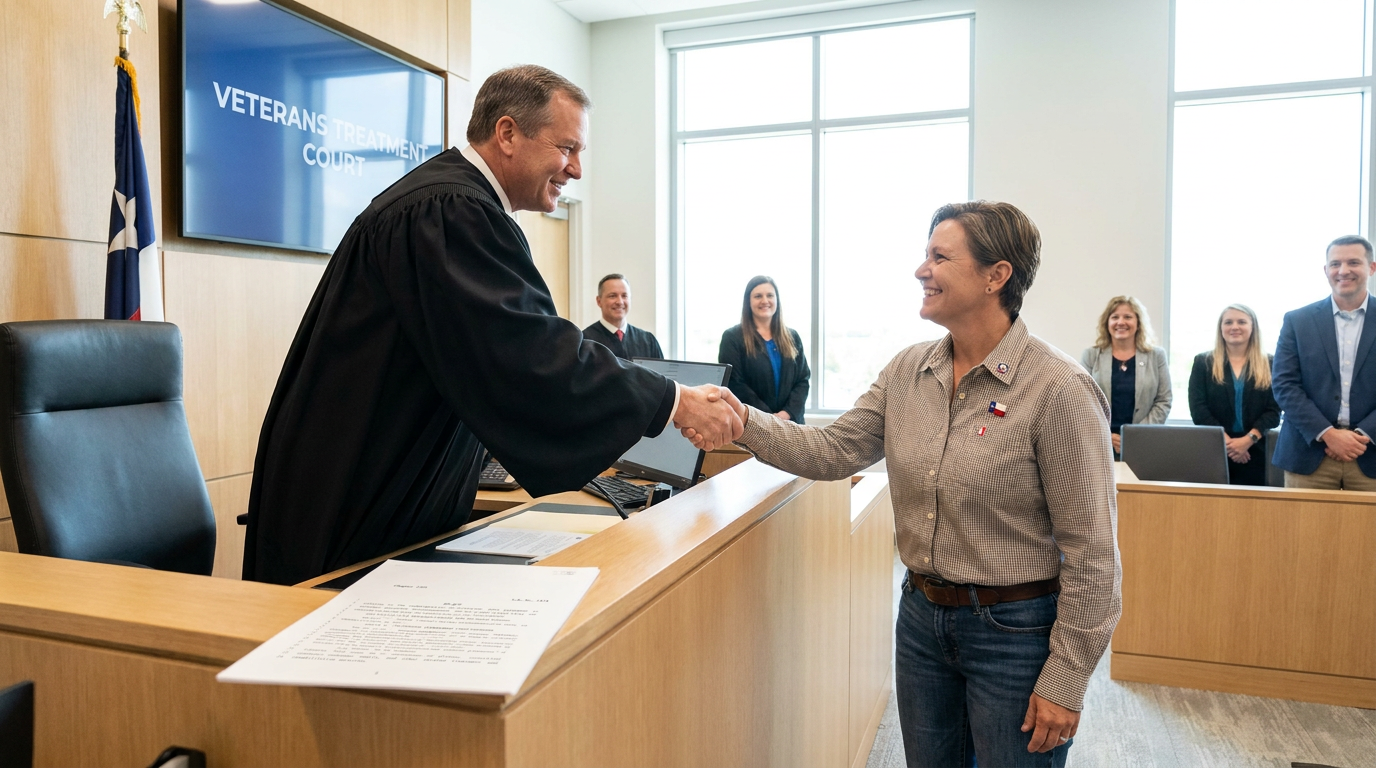
- Rehabilitative Justice Advocates
- Argue that traditional courts fail by ignoring the root causes of crime, pointing to VTCs as proof that treating trauma reduces recidivism better than prison.
- Veterans Support Organizations
- Emphasize the moral obligation to help those whose invisible wounds stem from military service, highlighting peer mentorship as the crucial ingredient.
- Fiscal & Judicial Pragmatists
- Focus on the bottom line, supporting VTCs because they cost a fraction of incarceration and free up court dockets for more serious offenders.
- Public Safety Traditionalists
- Support helping veterans but caution against expanding eligibility to violent offenders, arguing that community safety must remain the primary concern.
What's not represented
- · Victims of crimes committed by veterans
- · Civilian offenders denied access to similar diversion programs
Why this matters
Traditional courts often trap individuals with untreated trauma in a revolving door of incarceration. The success of Veterans Treatment Courts proves that treating the root causes of crime—rather than just punishing the symptoms—makes communities safer, saves taxpayer money, and restores broken lives.
Key points
- Veterans Treatment Courts (VTCs) divert justice-involved veterans from traditional punitive sentencing into specialized rehabilitative programs.
- The model replaces the adversarial courtroom dynamic with a collaborative team including judges, prosecutors, and VA specialists.
- Participants are paired with volunteer veteran mentors who provide crucial peer support and accountability.
- VTC graduates have a recidivism rate of roughly 14%, compared to 23-46% for veterans in traditional courts.
- The programs generate significant cost savings, averaging $7,000 per participant versus $22,000 for annual incarceration.
- Despite their success, access remains limited, with only about 15% of U.S. counties currently operating a VTC.
Each year, roughly 200,000 military personnel transition back to civilian life. While many reintegrate seamlessly, a significant subset returns carrying the "invisible wounds" of war—post-traumatic stress disorder, traumatic brain injuries, and severe depression. Without adequate support, these untreated traumas frequently metastasize into substance abuse as a mechanism for self-medication. This downward spiral often culminates in a collision with the criminal justice system, transforming individuals who once wore the nation's uniform into defendants standing before a judge. For decades, the standard legal apparatus treated these veterans exactly like any other civilian offender, processing them through a punitive machinery that addressed the crime but entirely ignored the catalyst.[4][5]
The statistical footprint of this systemic failure is staggering. According to census and justice data, while veterans comprise roughly 6.5 percent of the United States population, nearly 31 percent of them have been arrested at least once in their lifetimes. For many, a minor offense—a DUI, a drug possession charge, or a public altercation—is the first visible symptom of a profound, unaddressed psychological crisis. When these individuals are routed through traditional courts, they are typically handed fines, probation, or jail time, and then released back into the community with their underlying conditions completely untreated.[5]
This cycle of incarceration and release does little to improve public safety and actively accelerates the veteran's decline. Incarceration frequently exacerbates PTSD, severs ties to family and employment, and makes it exponentially harder to access earned military benefits. Recognizing that the adversarial, punishment-first model was failing both the veterans and the communities they lived in, a quiet revolution began to take root within the judiciary. Legal professionals began asking a fundamental question: what if the courtroom could be used to heal rather than merely to punish?[1][5][7]
The answer emerged in the form of "problem-solving courts," a radical departure from traditional jurisprudence. Rather than focusing exclusively on the facts of a specific offense and dispensing a corresponding penalty, problem-solving courts seek to identify and treat the root causes of criminal behavior. Built on the philosophy of "therapeutic jurisprudence," these specialized dockets prioritize rehabilitation over retribution. The model had already shown promise in the 1990s with the advent of drug courts, but it wasn't until the late 2000s that the justice system realized the military veteran population required a highly tailored approach of its own.[1][7]

The breakthrough occurred in 2008 in Buffalo, New York. Judge Robert Russell, who was presiding over local drug and mental health dockets, noticed a distinct pattern: military veterans were responding poorly to standard civilian interventions, but they responded remarkably well when they were connected with other veterans. Recognizing the unique cultural bonds forged in military service, Judge Russell established the nation's first Veterans Treatment Court (VTC). The concept was simple but transformative: isolate justice-involved veterans onto a single docket, surround them with military-specific resources, and leverage the camaraderie of the armed forces to enforce accountability and drive recovery.[4][7]
To understand why VTCs are so effective, one must look at how they fundamentally alter the architecture of the courtroom. In a traditional setting, the prosecutor and the defense attorney are locked in an adversarial battle, with the judge acting as a detached, neutral referee. In a Veterans Treatment Court, that adversarial posture is entirely dismantled. The judge, prosecutor, and defense counsel form a collaborative, multidisciplinary team. Their shared objective is no longer to secure a conviction or an acquittal, but to guide the veteran toward sobriety, mental stability, and lawful behavior.[1][7]
This collaborative team extends far beyond legal professionals. A crucial component of every VTC is the integration of a Veterans Justice Outreach (VJO) specialist. Employed by the Department of Veterans Affairs, the VJO specialist sits directly in the courtroom, serving as a bridge between the local justice system and the sprawling federal VA apparatus. Instead of a judge ordering a defendant to find a private therapist they cannot afford, the VJO specialist immediately enrolls the veteran in VA healthcare, securing them access to psychiatric care, substance abuse counseling, and housing assistance.[2][6]
This collaborative team extends far beyond legal professionals.
The role of the judge also undergoes a profound transformation. Rather than looking down from the bench to deliver a sentence, VTC judges act as active, engaged mentors. They speak directly to the veterans during frequent status hearings, asking about their therapy sessions, their sobriety, and their family lives. This ongoing, personal interaction builds a level of trust and rapport that is virtually nonexistent in traditional criminal courts. When a veteran succeeds, the judge leads the courtroom in applause; when a veteran stumbles, the judge applies graduated sanctions designed to correct the behavior rather than simply throwing them in a jail cell.[1][4]
However, the most universally praised innovation of the VTC model is the volunteer veteran mentor program. Every participant is paired with a peer mentor—a fellow veteran from the community who has navigated the transition to civilian life. These mentors sit with the participants in court, meet with them over coffee, and provide a sympathetic but firm sounding board. Because they share a common military background, mentors can cut through excuses and build trust in ways that a civilian judge or social worker simply cannot. They are widely considered the "secret weapon" of the VTC framework.[4][7]

Despite the emphasis on support and healing, Veterans Treatment Courts are not a "get out of jail free" card. In fact, participants often find the VTC requirements far more demanding than standard probation. A typical program lasts between 12 and 24 months. During that time, veterans must submit to frequent, randomized drug and alcohol testing, attend weekly court sessions, complete intensive therapy regimens, and maintain strict curfews. The program demands total accountability, and participants who repeatedly fail to comply can be terminated from the program and returned to the traditional docket to face their original sentences.[3][6]
The rigorous nature of the program yields extraordinary results. Empirical studies consistently demonstrate that VTCs dramatically reduce recidivism. While veterans processed through traditional courts reoffend at rates ranging from 23 to 46 percent, data indicates that only about 14 percent of VTC participants experience a new incarceration. By addressing the psychological and chemical drivers of criminal behavior, these courts effectively break the cycle of arrest and release, transforming liabilities into productive, law-abiding citizens.[3][6]
The benefits extend well beyond crime reduction. A comprehensive national study of over 7,900 VTC participants found measurable improvements across multiple quality-of-life metrics. From the time of their admission to their graduation, participants saw a 10 percent increase in independent housing and a 12 percent increase in the receipt of earned VA benefits. By stabilizing their living situations and connecting them with the financial and medical resources they earned through their service, the courts help prevent the tragic outcomes of chronic homelessness and veteran suicide.[6]

These human successes also translate into massive financial savings for local municipalities. Incarcerating an individual in a state or county facility costs taxpayers an average of $22,000 annually. In contrast, the comprehensive treatment and supervision provided by a specialty court costs approximately $7,000 per participant. By diverting thousands of veterans away from expensive jail cells and into community-based treatment, VTCs free up vital public funds while simultaneously reducing the backlog of cases choking the traditional court system.[8]
Despite their proven efficacy, access to Veterans Treatment Courts remains highly uneven, creating a "postcode lottery" for justice-involved veterans. As of late 2023, only about 15 percent of counties in the United States had an operational VTC, and several states lacked them entirely. A veteran arrested in Buffalo or Austin might be offered a life-saving diversion program, while a veteran arrested for the exact same offense a few counties over might be sent straight to a concrete cell. Expanding access to rural and underserved areas remains one of the movement's most pressing challenges.[5][7]
There is also an ongoing, complex debate regarding eligibility. Currently, many VTCs restrict participation to veterans charged with non-violent misdemeanors. However, clinical experts point out that the symptoms of severe PTSD—hypervigilance, aggression, and dissociation—often manifest in behaviors that result in felony charges, including altercations with law enforcement. Some advocates argue that excluding these higher-risk veterans defeats the purpose of the court, while prosecutors and public safety officials maintain that violent offenses must be handled with stricter punitive measures to protect the community.[5][6]

Furthermore, researchers caution against the unintended consequences of "net-widening." Because VTCs subject participants to intense, hyper-vigilant monitoring, veterans are sometimes penalized for minor technical violations—such as a missed appointment or a late arrival—that would have gone entirely unnoticed in a traditional probation setting. Ensuring that the courts remain focused on major rehabilitative milestones rather than punishing minor administrative infractions is an ongoing area of refinement for court administrators.[6][7]
Ultimately, the rapid proliferation of Veterans Treatment Courts—from a single docket in 2008 to over 600 nationwide today—serves as a powerful proof of concept for the broader justice system. They demonstrate that when the legal system prioritizes human dignity, leverages community resources, and treats the underlying causes of crime, the outcomes improve for everyone. As lawmakers and judges look for ways to reform a deeply flawed penal system, the veterans who successfully navigate these courts stand as living proof that rehabilitation is not just an ideal, but a highly achievable reality.[1][4][7]
How we got here
1990s
The broader problem-solving court model gains traction with the introduction of drug courts.
2008
Judge Robert Russell establishes the nation's first Veterans Treatment Court in Buffalo, New York.
2013
The Justice for Vets initiative launches the Veteran Mentor Corps to standardize peer support.
2023
The number of operational VTCs surpasses 600 nationwide, though access remains geographically uneven.
Viewpoints in depth
Rehabilitative Justice Advocates
Argue that traditional courts fail by ignoring the root causes of crime.
Proponents of therapeutic jurisprudence argue that the traditional justice system is fundamentally ill-equipped to handle offenders whose crimes stem from trauma or addiction. They point to the stark difference in recidivism rates—14 percent for VTC graduates versus up to 46 percent for traditional defendants—as empirical proof that treating the underlying psychological drivers of crime is far more effective at protecting public safety than simply locking people in cells.
Veterans Support Organizations
Emphasize the moral obligation to help those whose "invisible wounds" stem from military service.
Veterans advocacy groups stress that society has a unique moral contract with those who served in the armed forces. Because the traumas that lead to justice involvement were often sustained in service to the country, these organizations argue that the government has a duty to provide specialized rehabilitation. They heavily emphasize the volunteer peer mentor model, noting that the shared experience of military service allows mentors to break through emotional barriers that civilian court personnel cannot.
Fiscal & Judicial Pragmatists
Focus on the cost-efficiency of diversion programs and reducing court backlogs.
For many local governments, the appeal of Veterans Treatment Courts is purely mathematical. Incarcerating an individual costs taxpayers tens of thousands of dollars annually, while community-based treatment costs a fraction of that amount. Pragmatists argue that by diverting non-violent veterans out of the traditional system, municipalities can save millions of dollars, alleviate severe jail overcrowding, and free up prosecutors and judges to focus on violent, high-level offenses.
What we don't know
- Whether expanding eligibility to include veterans charged with violent felonies would yield the same low recidivism rates.
- How the long-term success rates of VTC graduates compare to those who drop out or fail the program over a 10-year horizon.
- Whether the VTC model can be successfully scaled to address the needs of other specific demographics within the justice system without losing its effectiveness.
Key terms
- Problem-Solving Courts
- Specialized dockets within the justice system that seek to address the root causes of criminal behavior, such as addiction or mental illness, through rehabilitation.
- Veterans Justice Outreach (VJO)
- A Department of Veterans Affairs program that embeds specialists in local courts to connect justice-involved veterans with VA healthcare and benefits.
- Recidivism
- The tendency of a convicted criminal to reoffend and return to the justice system.
- Therapeutic Jurisprudence
- A legal philosophy that focuses on the law's impact on emotional life and psychological well-being, prioritizing healing over punishment.
Frequently asked
What is a Veterans Treatment Court?
A specialized court docket designed to treat the underlying causes of a veteran's criminal behavior, such as PTSD or substance abuse, rather than simply incarcerating them.
Who is eligible to participate?
Eligibility varies by jurisdiction, but most courts accept veterans charged with non-violent misdemeanors or felonies who have a diagnosed mental health or substance use disorder.
Do participants avoid a criminal record?
Often, yes. If a veteran successfully completes the rigorous 12-to-24-month program, their charges may be reduced or dismissed entirely.
Are these courts soft on crime?
No. Participants undergo intense supervision, frequent drug testing, and mandatory treatment. The recidivism rate for graduates is significantly lower than for those in traditional courts.
Sources
Source coverage
8 outlets
4 viewpoints surfaced








[1]National Institute of JusticeRehabilitative Justice Advocates
Problem-Solving Courts
Read on National Institute of Justice →[2]Department of Veterans AffairsVeterans Support Organizations
Veterans Justice Outreach Program
Read on Department of Veterans Affairs →[3]American Addiction CentersVeterans Support Organizations
Statistics and Effectiveness of Veterans Treatment Court
Read on American Addiction Centers →[4]All RiseVeterans Support Organizations
Justice for Vets
Read on All Rise →[5]National Conference of State LegislaturesPublic Safety Traditionalists
Veterans in the Justice System
Read on National Conference of State Legislatures →[6]National Institutes of HealthRehabilitative Justice Advocates
A National Study of Veterans Treatment Court Participants
Read on National Institutes of Health →[7]Factlen Editorial TeamFiscal & Judicial Pragmatists
Synthesis by Factlen editorial team
Read on Factlen Editorial Team →[8]University of Texas at AustinFiscal & Judicial Pragmatists
Veterans Treatment Courts Save Lives and Money
Read on University of Texas at Austin →
Every angle. Every day.
Get law justice stories with full source coverage and perspective breakdowns delivered to your inbox.