
Solid-State Batteries Move from Lab to Factory in 2026: How the EV 'Holy Grail' Actually Works
After a decade of development, solid-state batteries are entering pilot production in 2026, promising to double electric vehicle range, cut charging times to 12 minutes, and virtually eliminate fire risks.
By Factlen Editorial Team
- Rapid Commercializers
- Automakers pushing aggressive timelines to deploy solid-state technology by 2026 and 2027 to capture market dominance.
- Scale-Focused Incumbents
- Legacy automakers prioritizing manufacturing reliability and scale, targeting mass production closer to 2030.
- Pure-Play Innovators
- Specialized battery technology firms focused on perfecting the chemistry and licensing it to major automakers.
- Manufacturing Realists
- Industry analysts emphasizing the immense difficulty and cost of scaling lab breakthroughs into profitable mass production.
What's not represented
- · Raw material mining sector
- · Independent auto mechanics
Why this matters
Solid-state batteries solve the three biggest hurdles to mass EV adoption: range anxiety, long charging stops, and cold-weather performance. As this technology hits the market, it will fundamentally change how far we can drive and how quickly we can refuel, making electric vehicles practical for virtually every driver.
Key points
- Solid-state batteries replace flammable liquid electrolytes with stable solid materials.
- The technology aims to double energy density, significantly increasing vehicle range.
- Fast-charging times can be reduced to roughly 12 minutes without damaging the battery.
- Major pilot production lines from companies like QuantumScape and Toyota are launching in 2026.
- Early commercial vehicles featuring the technology are expected between late 2026 and 2028.
For over a decade, the solid-state battery has been the automotive industry's white whale—a theoretical "holy grail" promising to solve every major anxiety associated with electric vehicles. In 2026, that narrative is definitively shifting from laboratory science fiction to factory-floor reality. Across the globe, major automakers and specialized battery startups are spinning up pilot production lines, transitioning from testing single prototype cells to manufacturing automotive-grade battery packs.[4][5]
The stakes for this transition are monumental. Current lithium-ion technology has powered the first wave of the electric vehicle revolution, but it is approaching its chemical and physical limits. The push for longer range has largely meant packing heavier, larger battery packs into vehicles, yielding diminishing returns. The solid-state breakthrough fundamentally rewrites this equation, offering a pathway to cars that can drive further, charge in a fraction of the time, and operate safely in extreme environments.[5][6]
To understand why this technology is so transformative, one must look inside the cell itself. Traditional lithium-ion batteries rely on a liquid electrolyte—a chemical soup that shuttles lithium ions back and forth between the anode and the cathode during charging and discharging. While effective, this liquid is inherently flammable. Under severe stress, such as a crash or extreme overcharging, it can ignite, leading to a dangerous chain reaction known as thermal runaway.[5]
Furthermore, liquid electrolytes are vulnerable to the formation of dendrites. These are microscopic, needle-like metallic structures that can grow from the anode over repeated fast-charging cycles. If a dendrite grows long enough to pierce the separator dividing the cell, it causes a short circuit. This physical limitation is the primary reason current electric vehicles throttle their charging speeds to protect the battery's lifespan.[5]

Solid-state batteries eliminate these vulnerabilities by replacing the liquid electrolyte with a stable solid material, typically a specialized ceramic, sulfide, or polymer. Because the solid electrolyte is non-flammable, the safety profile of the battery improves dramatically. Comparative testing shows that thermal events in solid-state systems do not begin until temperatures reach approximately 247 degrees Celsius, a massive improvement over the 90-degree threshold of conventional lithium-ion cells.[5]
Beyond safety, the solid electrolyte unlocks the use of a pure lithium-metal anode, rather than the heavier graphite anodes used today. This substitution is the key to a massive leap in energy density—the measure of how much power a battery can hold relative to its weight. While today's best lithium-ion cells hover between 200 and 300 watt-hours per kilogram (Wh/kg), the solid-state cells entering pilot production in 2026 are targeting between 400 and 600 Wh/kg.[5][6]
For the consumer, this energy density translates directly into freedom. Automakers can choose to double the range of a vehicle without increasing the battery's physical size, or they can maintain a standard 300-mile range while cutting the battery's weight and volume in half. This weight reduction creates a virtuous cycle, requiring less energy to move the car, reducing wear on tires, and allowing for more dynamic vehicle designs.[4][6]
For the consumer, this energy density translates directly into freedom.
Charging speeds are also seeing a paradigm shift. Because solid electrolytes are highly resistant to dendrite formation, these batteries can accept massive amounts of current without degrading. QuantumScape, a leading solid-state developer backed by Volkswagen, recently demonstrated its "QSE-5" cells, which can fast-charge from 10 percent to 80 percent in just 12.2 minutes.[2][8]

Extreme weather performance, long a pain point for electric vehicle owners, is another area where solid-state chemistry excels. Traditional liquid electrolytes become sluggish in freezing temperatures, severely reducing range and charging capabilities. In contrast, automakers testing early solid-state prototypes are reporting reliable operation and minimal range loss even at temperatures plunging to minus 30 degrees Celsius, unlocking EV viability in the harshest winter climates.[4]
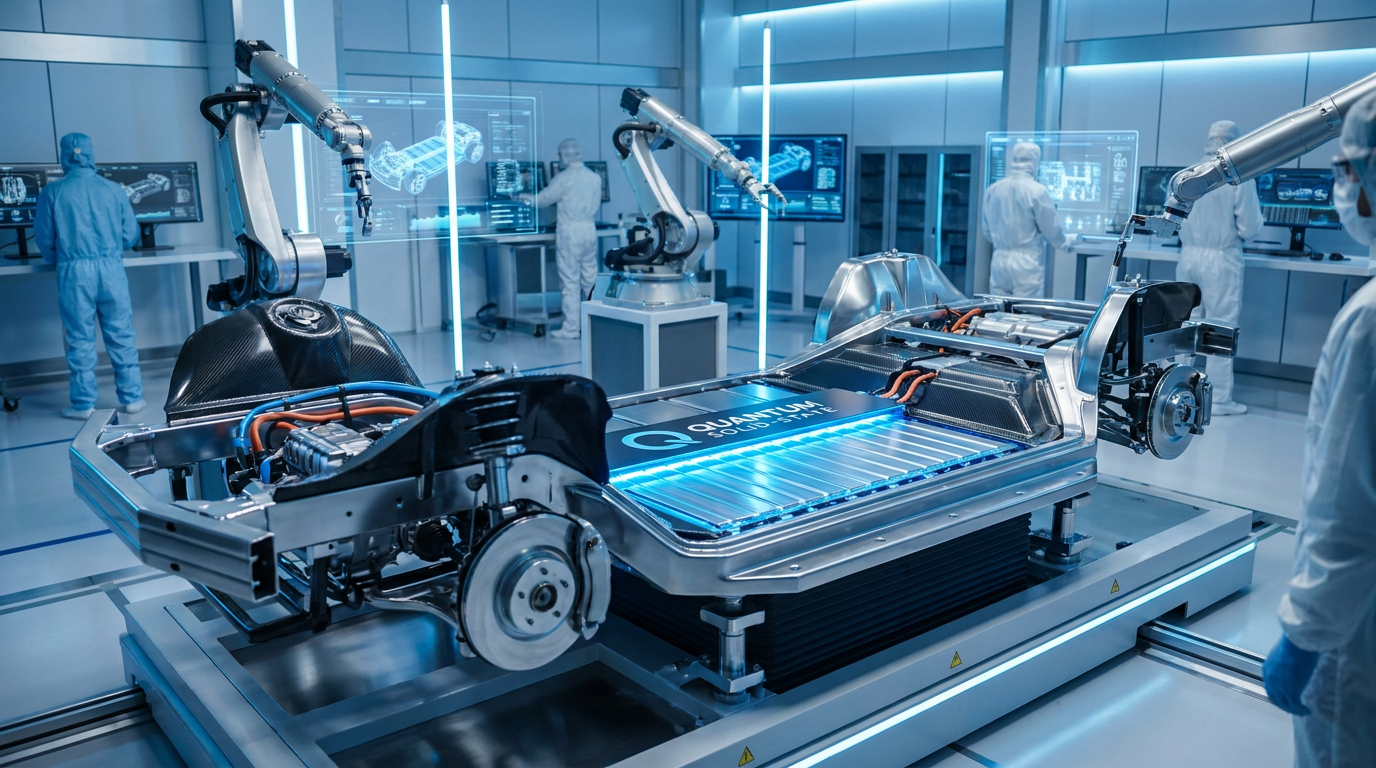
The race to commercialize these benefits has accelerated dramatically in 2026. In the United States, QuantumScape officially launched its "Eagle Line" pilot production facility in California, transitioning to automated manufacturing of its cells. The company recently expanded its footprint by signing a major joint research agreement with Honda, which plans to integrate the technology into its vehicles and potentially its motorcycle lineup.[2][3]
Meanwhile, Chinese automakers are aggressively pushing the timeline forward. Dongfeng Motor has announced plans to begin mass production of a solid-state battery for its eπ007 sedan by the second half of 2026, claiming a staggering 1,000-kilometer range. Geely, the parent company of Volvo and Polestar, has also confirmed it will finish manufacturing its first all-solid-state battery packs this year for real-world vehicle verification.[4]

The rapid influx of claims has prompted regulatory action to ensure consumer transparency. Recognizing the blur between "semi-solid" batteries—which still contain a small percentage of liquid—and true "all-solid-state" systems, China's National Automotive Standardization Technical Committee is set to release the world's first official solid-state EV battery standard in July 2026. This framework will strictly categorize batteries by their electrolyte type and liquid content.[1]
Legacy automakers are taking a more methodical approach, prioritizing manufacturing scale and long-term reliability over immediate deployment. Toyota, which holds more solid-state battery patents than any other company, recently received approval from the Japanese government to begin its initial production ramp-up in 2026. Working alongside petrochemical giants to secure solid electrolyte materials, Toyota is targeting limited vehicle batches in 2027 and 2028, with full mass production slated for the end of the decade.[6][7]
Despite the immense progress, the industry still faces significant engineering hurdles before these batteries become ubiquitous. Manufacturing solid electrolytes at scale requires entirely new factory equipment and pristine cleanroom environments. Ensuring perfect contact between the solid layers—minimizing what engineers call "interfacial resistance"—is incredibly difficult when producing millions of cells at high speed.[5]

Cost also remains a formidable barrier. The advanced materials and novel manufacturing processes mean that early solid-state batteries will carry a significant premium. Industry analysts expect the first wave of these batteries to debut exclusively in high-end luxury vehicles and flagship sports cars, where the higher sticker price can absorb the cost of the new technology.[7]
Nevertheless, the milestones achieved in 2026 mark a point of no return. The fundamental science has been proven, the pilot factories are built, and the first vehicles are preparing to hit the road. While it may take until the early 2030s for solid-state batteries to reach mass-market economy cars, the transition has officially begun, promising an electric future that is safer, lighter, and vastly more capable.[4][7]
How we got here
Early 2020s
Automakers and startups demonstrate successful solid-state single-cell prototypes in laboratory settings.
Early 2026
QuantumScape launches its 'Eagle Line' pilot production facility for automated cell manufacturing.
July 2026
China introduces the world's first official standard categorizing solid-state and semi-solid EV batteries.
Late 2026
Select Chinese automakers plan to deploy the first commercial vehicles equipped with solid-state batteries.
2027-2028
Legacy automakers like Toyota and Honda target limited-batch releases of solid-state electric vehicles.
Viewpoints in depth
Rapid Commercializers
Automakers pushing aggressive timelines to deploy solid-state technology by 2026 and 2027.
Several Chinese automakers view solid-state technology as the ultimate lever to secure global EV dominance. By moving aggressively from prototype to production in late 2026, companies like Dongfeng and Chery aim to establish a first-mover advantage. They argue that even initial, expensive iterations of the technology will serve as a powerful halo product, proving that range anxiety and cold-weather degradation are problems of the past.
Scale-Focused Incumbents
Legacy automakers prioritizing manufacturing reliability and scale over immediate deployment.
Automotive giants like Toyota and Honda are taking a distinctly measured approach. While they hold vast patent portfolios in solid-state chemistry, their focus is on ensuring the technology can be manufactured reliably at a massive scale with minimal defect rates. These incumbents argue that rushing a novel battery chemistry to market risks catastrophic recalls, preferring to target 2028 to 2030 for broad commercialization once the supply chain for solid electrolytes is fully mature.
Pure-Play Innovators
Specialized battery technology firms focused on perfecting the chemistry and licensing it.
Companies like QuantumScape operate purely as technology developers rather than vehicle manufacturers. Their strategy relies on proving the chemistry works at a pilot scale—such as the newly launched Eagle Line—and then forming joint ventures with major automakers like Volkswagen and Honda. These firms emphasize that the true bottleneck is not vehicle integration, but rather the fundamental materials science required to prevent dendrite formation and reduce interfacial resistance.
What we don't know
- The exact premium consumers will have to pay for the first generation of solid-state vehicles.
- How quickly the global supply chain can scale the production of specialized solid electrolyte materials.
- The real-world degradation rates of these batteries after a decade of daily consumer use.
Key terms
- Electrolyte
- The medium inside a battery that allows ions to flow between the anode and cathode during charging and discharging.
- Dendrite
- Microscopic, needle-like metallic structures that can grow inside liquid batteries and cause short circuits.
- Energy Density
- A measure of how much energy a battery can store relative to its weight, typically expressed in watt-hours per kilogram (Wh/kg).
- Lithium-metal anode
- An advanced battery component made of pure lithium that stores more energy than traditional graphite anodes, enabled by solid electrolytes.
- Thermal runaway
- An uncontrollable, self-heating chain reaction in a battery that can lead to fires or explosions.
Frequently asked
What makes a solid-state battery different?
It replaces the flammable liquid electrolyte found in traditional lithium-ion batteries with a stable solid material, such as a ceramic or polymer.
Will solid-state batteries charge faster?
Yes. Because they are highly resistant to internal damage from fast charging, prototypes are currently demonstrating 10% to 80% charge times in roughly 10 to 12 minutes.
When can I buy a car with a solid-state battery?
Early models from Chinese automakers are slated for late 2026, while legacy brands like Toyota and Honda are targeting limited releases in 2027 and 2028, with mass production expected by 2030.
Will these batteries make electric cars cheaper?
Not initially. The advanced materials and new manufacturing processes mean early solid-state batteries will be expensive and likely reserved for luxury vehicles until production scales up.
Sources
Source coverage
8 outlets
4 viewpoints surfaced








[1]ElectrekManufacturing Realists
China prepares to introduce its first solid-state EV battery standard in July 2026
Read on Electrek →[2]EV Infrastructure NewsPure-Play Innovators
QuantumScape announces joint research agreement with Honda to advance solid-state batteries
Read on EV Infrastructure News →[3]ElectrivePure-Play Innovators
QuantumScape signs Honda as solid-state battery partner
Read on Electrive →[4]ArenaEVRapid Commercializers
2026 is when Geely will start making them
Read on ArenaEV →[5]BatteryTech OnlineManufacturing Realists
Solid-state battery EV timeline 2026: Why solid-state matters and why scaling is hard
Read on BatteryTech Online →[6]CBT NewsScale-Focused Incumbents
Toyota to launch solid-state battery production by 2026
Read on CBT News →[7]Green Car ReportsScale-Focused Incumbents
Toyota will ramp up EV production to at least one million units in 2026
Read on Green Car Reports →[8]QuantumScapePure-Play Innovators
QuantumScape Announces Agreement with Honda on Solid-State Battery Technology
Read on QuantumScape →
Every angle. Every day.
Get automotive stories with full source coverage and perspective breakdowns delivered to your inbox.