
How Electric Hydrofoil Boats Are Rewriting the Rules of Marine Transit
By lifting their hulls out of the water, a new generation of electric hydrofoil ferries is reducing energy consumption by 80 percent, enabling long-range, high-speed, zero-emission coastal travel.
By Factlen Editorial Team
- Marine Technologists
- Focuses on the physics breakthrough of hydrodynamic lift to overcome water density and battery weight limitations.
- Coastal Transit Operators
- Prioritizes the economic viability, route flexibility, and reduced infrastructure costs of deploying highly efficient vessels.
- Environmental Conservationists
- Emphasizes the critical importance of eliminating shoreline-eroding wakes and underwater noise pollution in fragile marine ecosystems.
What's not represented
- · Traditional diesel engine manufacturers
- · Commercial fishermen requiring heavy towing capacity
- · Grid operators managing coastal power loads
Why this matters
By dramatically reducing the energy required to move across water, hydrofoil technology makes zero-emission boating economically viable, paving the way for quieter, cleaner coastal transit without the need for massive infrastructure overhauls.
Key points
- Hydrofoil technology lifts the boat's hull out of the water, reducing drag by 80 percent.
- The efficiency gains allow vessels to travel up to 40 nautical miles at 25 knots on a single charge.
- Smaller battery requirements mean the boats can use standard DC fast chargers instead of expensive marine grid upgrades.
- Major fleets are being deployed in Sweden, Norway, and the Maldives in 2026.
- The technology eliminates shoreline-eroding wakes and significantly reduces underwater noise pollution.
Water is an incredibly dense medium—roughly 800 times denser than air. For decades, this simple fact of physics has acted as a formidable barrier to the electrification of the marine industry. Pushing a traditional displacement hull through water requires an enormous amount of energy, creating a frustrating paradox for engineers. To make an electric boat travel fast and far, designers had to install massive, heavy battery packs. However, adding that weight pushed the hull deeper into the water, which in turn increased the drag and demanded even more power. This vicious cycle kept electric boats confined to slow speeds, short distances, and highly restricted routes, leaving the vast majority of the maritime world dependent on heavily polluting diesel engines.
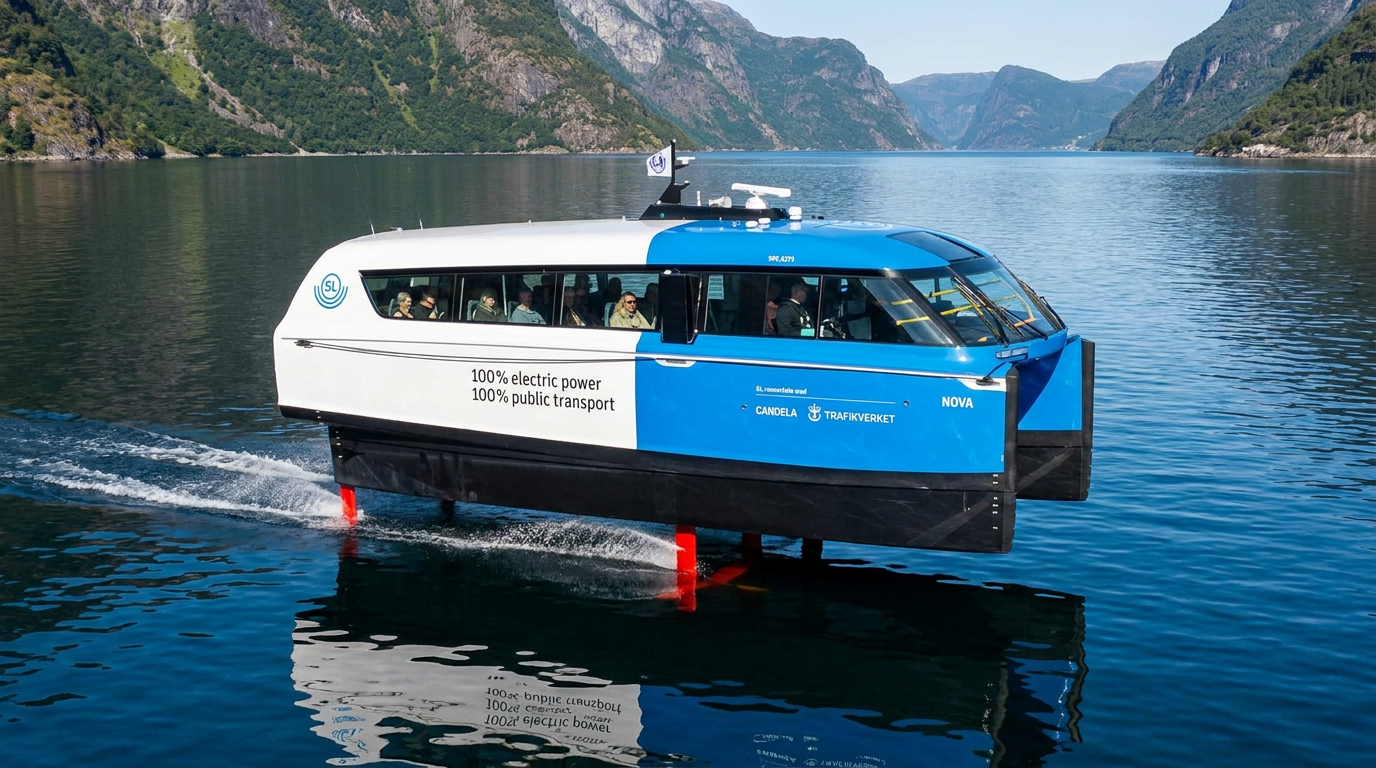
The solution to this physics problem, it turns out, was not to build a better battery, but to stop fighting the water entirely. Enter the electric hydrofoil. By utilizing submerged, computer-controlled wings, a new generation of vessels is literally rising above the friction that has held the industry back. Leading this charge is the Swedish-built Candela P-12, the world's first serial-production electric hydrofoiling passenger ferry. Instead of plowing through the waves, the P-12 is designed to fly over them, fundamentally rewriting the operational limits of zero-emission waterborne transport and proving that electric boats can match or exceed the performance of their fossil-fuel counterparts.[1][4]
The mechanism behind this breakthrough is both elegant in its concept and highly complex in its execution. Beneath the sleek hull of the vessel sit carbon-fiber struts attached to horizontal wings, operating on the exact same aerodynamic principles as an airplane. As the boat accelerates and reaches a critical speed—typically around 18 knots—the water flowing over these submerged foils generates intense upward hydrodynamic lift. This force pushes the entire hull of the boat completely out of the water, leaving only the thin struts and the torpedo-shaped electric propulsion pods gliding beneath the surface.[1][2]
The efficiency gains achieved by lifting the hull out of the water are nothing short of staggering. By eliminating the immense friction of hull drag, hydrofoiling reduces the vessel's energy consumption by up to 80 percent compared to a traditional displacement boat of the same size. This 80 percent reduction is the magic number that makes high-speed electric boating economically and practically viable. It means the vessel can travel significantly faster and much farther while relying on a battery pack that is a fraction of the size and weight of those used in conventional electric ferries.[1][2][3]

These efficiency metrics translate into unprecedented real-world performance. The Candela P-12 cruises comfortably at a service speed of 25 knots and has exceeded 30 knots during sea trials, making it the fastest electric passenger vessel currently in operation. More importantly, it can maintain these high speeds for up to 40 nautical miles on a single charge. To definitively prove that electric passenger vessels are no longer confined to short, fixed routes, the P-12 recently completed a record-breaking 160-nautical-mile journey from Gothenburg, Sweden, to Oslo, Norway—the longest electric sea journey ever made by a passenger ship.[1][2][4]
That historic voyage highlighted a crucial secondary benefit of hydrofoil technology: the simplification of charging infrastructure. Because the vessel's extreme efficiency allows it to operate on a relatively small battery, it does not require the massive, specialized charging stations that plague traditional electric ferries. Instead, the P-12 can be fully recharged in roughly an hour using standard DC fast chargers—the exact same technology used to charge electric cars on the highway. This flexibility allows operators to deploy the boats in remote areas without undertaking multi-million-dollar grid upgrades.[2][4]
"Charging infrastructure is the hidden cost of electrifying conventional vessels," explained Gabriele De Mattia, a lead engineer for the record-setting Sweden-to-Norway voyage. He noted that in many coastal regions, building megawatt-scale marine chargers can cost as much as the vessels themselves, especially where the local electrical grid is weak or undeveloped. By utilizing existing, scalable automotive-style charging technology, hydrofoil ferries bypass this massive capital expenditure, making the transition to zero-emission transit financially accessible for a much wider range of municipalities and private operators.[1][4]

Armed with this compelling economic case, the commercial rollout of electric hydrofoils is accelerating rapidly in 2026. In Sweden, the P-12 has been officially selected to operate passenger services within Stockholm's sprawling archipelago. Trials on the city's commuter routes demonstrated that the flying ferries could offer significantly shorter travel times than conventional diesel vessels, largely because their minimal wake allows them to maintain high speeds in urban waterways where traditional boats are strictly speed-limited to prevent shoreline damage.[1][6]
Armed with this compelling economic case, the commercial rollout of electric hydrofoils is accelerating rapidly in 2026.
The technology is also scaling up to meet the demands of larger transit networks. In a landmark deal for the industry, Norwegian transport operator Boreal AS recently placed an order for 20 Candela P-12 vessels. This massive procurement represents the largest electric passenger vessel fleet ever commissioned and signals a major leap forward for Norway's ambitious decarbonization goals. The fleet will be deployed along the country's famous fjord-lined coast, replacing aging diesel ferries and drastically reducing both travel times and greenhouse gas emissions for coastal communities.[2]
Beyond urban commuting, hydrofoil technology is proving uniquely suited to ecologically sensitive environments where traditional boating causes severe collateral damage. In the Maldives, local operator Ego Shuttle is preparing to launch a fleet of 10 hydrofoil ferries to transport visitors between Malé International Airport and the outer atolls. While the elimination of diesel exhaust is a primary goal for the climate-vulnerable island nation, the physical characteristics of the hydrofoil offer an equally important environmental benefit: the near-total elimination of the boat's wake.[3]

Traditional heavy ferries displace massive amounts of water, generating large, powerful wakes that crash against the shore. In the Maldives, these artificial waves accelerate coastal erosion and severely damage the fragile coral reef ecosystems that form the foundation of the islands. Because a hydrofoil flies above the surface and displaces almost no water at cruising speed, it creates a wake that is less than 10 centimeters high. This allows the vessels to operate at high speeds through narrow, shallow channels without disturbing the delicate marine habitats below.[3]
The passenger experience aboard these flying vessels is also fundamentally different from traditional maritime travel. Anyone who has ridden a high-speed ferry is familiar with the jarring, nauseating sensation of a hull slamming into choppy waves. To counteract this, modern hydrofoils are equipped with sophisticated digital flight control systems. An onboard computer continuously analyzes the water surface and adjusts the angle of the submerged foils hundreds of times per second, actively absorbing the impact of the waves and ensuring a remarkably smooth, stable ride even in rough conditions.[2][3]
This stability is paired with an unprecedented level of acoustic comfort. Without the roar of massive diesel engines or the constant crashing of water against a hull, the cabin environment is exceptionally serene. Acoustic tests conducted during the Stockholm trials recorded interior noise levels at just 64 decibels. This makes the hydrofoil quieter than a standard passenger train, a commercial aircraft cabin, and virtually every conventional ferry on the market, allowing commuters to hold normal conversations or work in peace while flying across the water at 30 miles per hour.[2]

The rapid adoption of hydrofoil technology is serving as a major catalyst for the broader marine electrification movement. According to recent industry analyses, the global electric boat market is experiencing explosive growth, expanding from a valuation of approximately $4 billion in 2024 to a projected $8.3 billion by 2030. While early electric boats were largely confined to small, slow-moving recreational craft, the advent of efficient, long-range hydrofoils has finally opened the door to the electrification of heavy-duty commercial transit and high-speed coastal transport.[5]
As battery energy density continues to improve and production scales up, the marine industry is standing on the precipice of a generational shift. The success of vessels like the Candela P-12 proves that decarbonizing the oceans does not require a compromise in speed, range, or comfort. By combining the aerodynamics of aviation with the zero-emission promise of electric propulsion, hydrofoil technology has provided a definitive blueprint for the future of waterborne transport, turning the dream of silent, flying ferries into an everyday reality for coastal cities around the world.[1][2][5]
How we got here
2024
The global electric boat market is valued at approximately $4 billion.
Late 2025
Stockholm selects the Candela P-12 for public transit integration in its archipelago.
Early 2026
A production hydrofoil completes a record-breaking 160-nautical-mile voyage from Sweden to Norway.
April 2026
Norway commissions a 20-vessel fleet, the largest electric passenger boat order to date.
Viewpoints in depth
The Engineering Perspective
How hydrofoiling solves the fundamental physics problem of marine electrification.
For marine engineers, the density of water has always been the ultimate enemy of electrification. Traditional displacement hulls require exponential increases in power to achieve higher speeds, which in an electric paradigm means adding massive, heavy batteries that only further increase drag. By utilizing hydrodynamic lift to remove the hull from the water entirely, engineers have bypassed this vicious cycle. This 80 percent reduction in energy consumption is viewed not just as an incremental improvement, but as the foundational physics breakthrough required to make high-speed, long-range electric boating possible.
The Operator's Perspective
The economic and logistical advantages of deploying highly efficient electric ferries.
Transit authorities and private fleet operators evaluate new technology primarily through the lens of capital expenditure and operational flexibility. The traditional approach to marine electrification required installing multi-million-dollar, megawatt-scale charging infrastructure at specific docks, effectively tethering vessels to fixed, short-distance routes. Because hydrofoil ferries require significantly smaller batteries to achieve the same range, they can utilize standard automotive DC fast chargers. Operators view this as a game-changer, allowing them to electrify remote coastal routes and island archipelagos without waiting for massive government-funded grid upgrades.
The Conservationist Perspective
The ecological benefits of zero-wake and low-noise marine transport.
While the reduction of greenhouse gas emissions is universally celebrated, environmental groups point to the localized ecological benefits of hydrofoiling as equally transformative. In fragile environments like the Maldives or narrow coastal fjords, the physical wake generated by heavy diesel ferries accelerates shoreline erosion and damages shallow coral reefs. Furthermore, the acoustic pollution from traditional propellers severely disrupts marine life communication and navigation. Conservationists argue that by flying above the water—creating a wake of less than 10 centimeters and operating at a whisper-quiet 64 decibels—these vessels represent the first truly non-invasive form of motorized marine transit.
What we don't know
- How well the delicate hydrofoil struts will withstand long-term exposure to heavy marine debris or submerged logs.
- Whether the technology can be scaled up to accommodate massive roll-on/roll-off car ferries.
- How quickly developing coastal nations can adopt the technology given the upfront capital costs of the vessels.
Key terms
- Hydrofoil
- A submerged wing-like structure that lifts a boat's hull out of the water as it gains speed, drastically reducing drag.
- Displacement Hull
- A traditional boat design that pushes water out of the way as it moves, creating significant friction and requiring high energy.
- DC Fast Charging
- High-power electrical charging technology, commonly used for electric cars, that allows vessels to recharge in roughly an hour.
- Wake
- The wave created by a vessel moving through water, which can cause erosion and disrupt marine ecosystems.
Frequently asked
Why are traditional electric boats so limited?
Pushing a heavy hull through water requires immense energy, meaning conventional electric boats need massive batteries that are heavy, expensive, and slow to charge.
How does a hydrofoil handle rough waves?
An onboard computer continuously adjusts the angle of the submerged wings hundreds of times per second, allowing the boat to fly smoothly over choppy water without slamming.
Do these boats require special charging stations?
No. Because hydrofoils are so efficient, they use smaller batteries that can be recharged using standard DC fast chargers, avoiding the need for specialized megawatt marine infrastructure.
Are hydrofoil boats entirely silent?
While not perfectly silent, they are exceptionally quiet. Cabin noise is around 64 decibels, which is quieter than a standard passenger train or a conventional diesel ferry.
Sources
Source coverage
6 outlets
3 viewpoints surfaced






[1]ElectrekMarine Technologists
Candela's hydrofoil ferry just rewrote the limits of electric boats
Read on Electrek →[2]Electric Cars ReportCoastal Transit Operators
Norway Orders 20 Candela P-12 Electric Hydrofoil Ferries for Zero-Emission Coastal Travel
Read on Electric Cars Report →[3]Cruise & FerryEnvironmental Conservationists
Candela to supply 10 P-12 electric ferries for operations in Maldives
Read on Cruise & Ferry →[4]Ocean NewsMarine Technologists
Candela P-12 Completes Record-Breaking Electric Voyage
Read on Ocean News →[5]Fortune Business InsightsEnvironmental Conservationists
Electric Boat Market Overview
Read on Fortune Business Insights →[6]Future Transport-NewsCoastal Transit Operators
Candela P-12 Selected for 2026 Service in Stockholm's Archipelago
Read on Future Transport-News →
Every angle. Every day.
Get automotive stories with full source coverage and perspective breakdowns delivered to your inbox.