
How Hydrogen Trains Work: The Tech Replacing Diesel on the Railways
Hydrogen-powered trains, or 'hydrail', use onboard fuel cells to convert hydrogen into electricity, emitting only water vapor. As rail networks look to decarbonize routes without overhead wires, this technology is rapidly moving from prototype to commercial reality.
By Factlen Editorial Team
- Rail Manufacturers & Operators
- Hydrogen is the only viable zero-emission alternative for long, non-electrified routes.
- Energy Efficiency Analysts
- Direct electrification is vastly superior to hydrogen wherever economically feasible.
- Green Energy Advocates
- Hydrail only delivers climate benefits if powered by green hydrogen.
- Neutral Industry Observers
- Hydrogen fills a specific niche in the broader transit decarbonization toolkit.
What's not represented
- · Local communities living near proposed hydrogen production and storage facilities
- · Fossil fuel executives monitoring the decline of diesel demand in the rail sector
Why this matters
As governments push to eliminate diesel from public transit, hydrogen trains offer a way to decarbonize rural and regional rail lines without spending billions on overhead wires. Understanding this technology reveals how the next generation of long-distance travel will operate.
Key points
- Hydrogen trains use onboard fuel cells to generate electricity, emitting only water vapor.
- They are designed to replace diesel locomotives on rural routes where overhead wires are too expensive.
- Modern designs pair fuel cells with batteries to handle peak power demands and capture braking energy.
- Stadler's FLIRT H2 recently set a world record by traveling 2,803 km on a single tank.
- Widespread adoption faces hurdles, including the high cost of green hydrogen and specialized refueling depots.
For decades, rail has been the poster child for clean, efficient mass transportation. Yet, a surprisingly large share of regional rail services across Europe and North America still relies heavily on diesel locomotives. These are typically rural, long-distance, or low-traffic lines that were never electrified because stringing continuous overhead catenary wires costs millions of dollars per kilometer. For transit agencies operating on tight budgets, the math of full electrification on these sprawling regional networks simply never penciled out, leaving them dependent on fossil fuels even as the rest of the transportation sector pushes toward a zero-emission future.[3][8]
That is the specific infrastructure gap that hydrogen trains—often referred to in the industry as "hydrail"—are designed to close. By carrying their own fuel and generating electricity on the fly, hydrogen trains offer the smooth, quiet, and emission-free performance of a traditional electric train without the need for expensive overhead wires. They serve as a drop-in replacement for diesel, allowing operators to decarbonize challenging routes without undertaking massive, decade-long civil engineering projects to rebuild the tracks. As climate mandates tighten globally, this technology is rapidly moving from a conceptual prototype to a commercial reality on railways around the world.[3][4]
At the heart of a hydrogen train is the fuel cell, a technology that fundamentally differentiates it from older propulsion methods. Most hydrogen trains are not traditional combustion engines retrofitted to burn hydrogen gas; instead, they are fully electric trains that generate their own power onboard. The fuel cell acts as a mobile power plant, continuously producing the electricity needed to drive the train's heavy traction motors while it rolls down the track. This electrochemical approach avoids the mechanical inefficiencies and heavy maintenance requirements of internal combustion, offering a cleaner and more elegant engineering solution.[1][4]
Inside the fuel cell, hydrogen stored in high-pressure carbon-fiber tanks is fed into a specialized stack where it reacts electrochemically with oxygen drawn from the ambient air. This controlled reaction forces electrons through a circuit, producing a steady electrical current. Because there is no actual burning or combustion taking place, the only direct byproducts of this chemical process are heat and pure water vapor. Passengers standing on the platform simply see a harmless wisp of steam venting from the roof, rather than a cloud of toxic diesel exhaust.[1][4]

The electricity generated by the fuel cell is then fed directly into the electric traction motors that drive the train's wheels. Because the propulsion system is entirely electric, the ride experience is virtually silent and incredibly smooth. It eliminates the heavy, vibrating rumble, the sluggish acceleration, and the noxious exhaust plumes that have long been associated with traditional diesel locomotives. For communities living near the tracks, the transition to hydrail brings an immediate and drastic reduction in localized noise and air pollution.[1][5]
However, a fuel cell alone is rarely enough to handle the dynamic and unpredictable demands of a heavy passenger train. Rail traction requires massive, instantaneous surges of power to accelerate hundreds of tons of metal from a standstill, or to climb steep gradients. Conversely, the train requires very little power when coasting downhill or cruising at a steady speed on flat terrain. A fuel cell operates most efficiently when it provides a steady, continuous output, making it poorly suited for these extreme peaks and valleys in energy demand.[3][8]
To manage this fluctuating power requirement, modern hydrogen trains utilize a sophisticated hybrid architecture. The onboard fuel cell is paired with a high-capacity battery system, typically utilizing advanced lithium-titanate or lithium-ion battery packs. In this hybrid setup, the fuel cell runs steadily at its optimal efficiency rate, continuously generating power to charge the battery. The battery then acts as a buffer, instantly deploying massive amounts of stored electricity to the motors during acceleration, and absorbing excess power when the train's demand drops.[3][4]
This hybrid battery setup also unlocks the ability to use regenerative braking, a crucial feature for maximizing the train's efficiency. When the train needs to slow down for a station stop, the electric traction motors run in reverse, acting as massive generators. They capture the train's kinetic energy and convert it back into electricity, which is fed directly into the onboard battery packs. This recuperated energy significantly extends the train's operational range, allowing it to run a full day of passenger service on a single tank of hydrogen.[2][6]
This hybrid battery setup also unlocks the ability to use regenerative braking, a crucial feature for maximizing the train's efficiency.
Packaging this complex technology into a sleek passenger train requires highly clever engineering. Different manufacturers have taken distinct approaches to housing the bulky, high-pressure hydrogen tanks, the fuel cell stacks, and the heavy battery packs while maximizing the interior space available for paying passengers. The primary challenge is ensuring that the highly volatile hydrogen fuel is stored safely, completely isolated from the passenger cabins, while maintaining the train's aerodynamic profile and weight distribution. Engineers must balance the need for maximum fuel capacity with the strict axle-load limits imposed by regional railway infrastructure.[8]
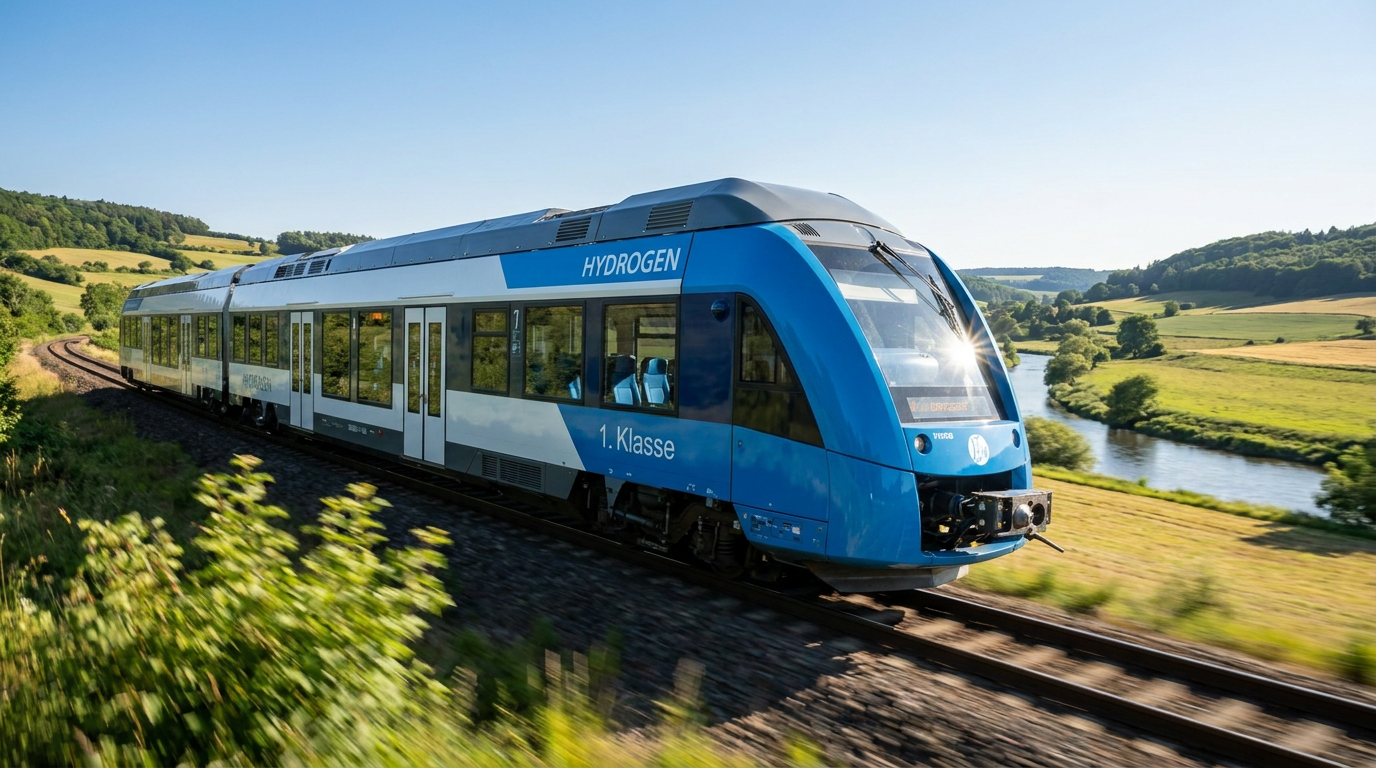
France's Alstom, which pioneered the modern hydrail movement with its Coradia iLint model, opted to mount the hydrogen tanks and fuel cell modules directly on the roof of the train. This design keeps the volatile gas outside and above the passenger compartment, allowing any potential leaks to safely vent upward into the atmosphere. The Coradia iLint proved the viability of this concept when it became the world's first hydrogen-powered passenger train to enter commercial service in Germany in 2018, eventually covering hundreds of thousands of kilometers.[1][5]
Switzerland's Stadler took a markedly different engineering route with its highly successful FLIRT H2 model. Instead of roof-mounting the volatile components, Stadler engineered a central, heavily reinforced modular unit it calls the "PowerPack." Sandwiched securely between two electrically driven passenger cars, this central box houses the hydrogen tanks, the fuel cells, and the traction batteries. This layout completely walls off the hydrogen storage from the passenger areas and allows the train to maintain a lower, more traditional roofline, which is crucial for navigating older tunnels and bridges.[2][6]
The real-world capabilities of these hydrogen trains have rapidly advanced beyond early proof-of-concept trials. In March 2024, Stadler's FLIRT H2 shattered industry expectations by setting a Guinness World Record at a specialized test track in Pueblo, Colorado. The train ran continuously for over 46 hours, covering a staggering 2,803 kilometers (1,741 miles) on a single tank of hydrogen without needing to stop for refueling or recharging. This milestone proved definitively that hydrail possesses the endurance required to replace diesel on even the longest regional transit routes.[2][6]

Despite these highly impressive range figures and successful commercial deployments, the widespread global adoption of hydrail still faces significant logistical and economic hurdles. Chief among them is the reality of fuel production. Hydrogen is an energy carrier, not a primary energy source that can be pumped out of the ground; it must be manufactured. The environmental integrity of a hydrogen train depends entirely on how its fuel is sourced, a factor that varies wildly depending on the region and the operator.[3][7]
If the hydrogen is produced via steam methane reforming—a process that extracts hydrogen from natural gas—it still carries a substantial carbon footprint, rendering the "zero-emission" label somewhat misleading. True zero-emission operation requires the use of "green hydrogen." This is produced by splitting water molecules via electrolysis, a process powered entirely by renewable energy sources like wind, solar, or hydroelectric power. Currently, green hydrogen remains an expensive and energy-intensive commodity, limiting its widespread availability for transit networks. Scaling up the production of green hydrogen to meet the daily demands of a national railway fleet will require massive investments in renewable energy infrastructure.[4][5]
Furthermore, the fundamental thermodynamics of hydrogen present an efficiency challenge. Converting renewable electricity into hydrogen via electrolysis, compressing it for transport, and then converting it back into electricity onboard the train results in significant energy losses. The round-trip energy efficiency of the hydrogen cycle is roughly 30%. In contrast, a traditional electric train drawing power directly from overhead catenary wires operates at over 80% efficiency. For energy analysts, this disparity makes hydrogen a less attractive option wherever direct electrification is economically viable.[3][4]

Refueling infrastructure represents another major bottleneck for transit agencies looking to adopt hydrail. Rail operators cannot simply pump hydrogen using existing diesel equipment; they must build specialized, high-pressure hydrogen refueling stations at their maintenance depots. These facilities require massive capital investment, complex cryogenic cooling systems, and stringent safety protocols to handle compressed gaseous hydrogen safely. Building out this bespoke infrastructure adds a significant upfront premium to the cost of transitioning a rail fleet away from fossil fuels. Without heavy government subsidies or partnerships with industrial hydrogen producers, many cash-strapped regional transit authorities simply cannot afford the initial capital expenditure required to build these advanced depots.[7]

Because of these economic and thermodynamic realities, transit planners and railway engineers do not view hydrogen as a universal, silver-bullet replacement for all diesel trains. On busy, high-frequency mainlines that carry heavy commuter traffic or massive freight loads, stringing overhead electrical wires remains the most efficient, reliable, and cost-effective long-term solution. Direct electrification will continue to be the backbone of modern, high-capacity railway networks around the globe. Hydrogen is simply too inefficient to justify its use on routes where a train passes every ten minutes and the cost of overhead wires can be easily amortized over millions of passenger journeys.[3][8]
Instead, hydrogen is increasingly viewed as a highly targeted, specialized tool within the broader decarbonization toolkit. It is the ideal, and perhaps only, zero-emission solution for long, lightly used regional routes where electrification will never make financial sense, and where current battery-only trains lack the endurance to complete a full day of service. By deploying hydrail strategically on these specific routes, operators can eliminate their reliance on diesel without bankrupting their infrastructure budgets. It fills a crucial gap in the transit ecosystem, offering a pragmatic bridge between the dirty legacy of fossil fuels and the clean future of electric mobility.[3][4]
As governments worldwide implement strict mandates to phase out diesel entirely by the 2030s and 2040s, the hydrail sector is poised for massive, sustained growth. With new orders rolling in from transit authorities across Europe and North America, the technology has proven its viability. In the coming decades, the sight of a sleek passenger train gliding silently through the countryside, emitting nothing but a wisp of water vapor, is set to become a standard feature of the global railway network.[5][8]
How we got here
2003
The term 'hydrail' is first introduced at a US Department of Transportation presentation.
2016
Alstom debuts the Coradia iLint, the world's first hydrogen passenger train, at InnoTrans in Berlin.
2018
The Coradia iLint enters commercial passenger service in Germany.
March 2024
Stadler's FLIRT H2 sets a Guinness World Record, traveling 2,803 km on a single tank in Colorado.
2026
Hydrogen trains continue to secure commercial orders across Europe and North America as regional diesel replacements.
Viewpoints in depth
Rail Manufacturers & Operators
Hydrogen is the only viable zero-emission alternative for long, non-electrified routes.
Companies like Alstom and Stadler argue that battery technology simply cannot store enough energy for heavy passenger trains to complete all-day regional services. For these operators, hydrogen fuel cells are a necessary drop-in replacement for diesel, allowing them to meet strict government decarbonization mandates without demanding impossible infrastructure budgets for overhead wires.
Energy Efficiency Analysts
Direct electrification is vastly superior to hydrogen wherever economically feasible.
Thermodynamic experts point out the inherent inefficiency of the hydrogen cycle. Converting renewable electricity into hydrogen, compressing it, and then converting it back into electricity onboard the train wastes roughly 70% of the original energy. These analysts argue that while hydrogen has a niche, transit agencies should prioritize stringing overhead wires on as many routes as possible to maximize grid efficiency.
Green Energy Advocates
Hydrail only delivers climate benefits if powered by green hydrogen.
Environmental groups strongly support the phase-out of diesel locomotives, but they warn against 'blue' or 'grey' hydrogen produced from natural gas. They argue that unless the hydrogen is generated via electrolysis powered by wind, solar, or hydro, hydrogen trains are merely shifting emissions from the tailpipe to the power plant.
What we don't know
- Whether the cost of 'green hydrogen' produced via renewable electrolysis will drop enough to make hydrail economically competitive with diesel.
- How quickly rail operators can build out the specialized, high-pressure refueling infrastructure required at maintenance depots.
- If rapid advancements in solid-state battery technology will eventually render hydrogen trains obsolete for regional routes.
Key terms
- Hydrail
- A generic term for any rail vehicle powered by onboard hydrogen fuel cells.
- Fuel Cell
- A device that converts the chemical energy of hydrogen and oxygen into electricity and water without combustion.
- Green Hydrogen
- Hydrogen produced by splitting water via electrolysis using renewable electricity, resulting in zero carbon emissions.
- Regenerative Braking
- A system where electric motors act as generators during deceleration, capturing kinetic energy to recharge onboard batteries.
- Electrolysis
- The process of using electricity to split water molecules into hydrogen and oxygen gases.
Frequently asked
Do hydrogen trains burn fuel like diesel engines?
No. Most hydrogen trains use fuel cells that trigger an electrochemical reaction between hydrogen and oxygen to generate electricity, with no combustion involved.
What comes out of the exhaust of a hydrogen train?
The only direct byproducts of a hydrogen fuel cell are water vapor and heat, making them completely emission-free at the tailpipe.
Are hydrogen trains dangerous or explosive?
While hydrogen is highly flammable, modern trains use heavily reinforced, crash-tested carbon-fiber tanks and isolate the fuel systems entirely from passenger compartments to ensure safety.
Why not just use battery-powered trains?
Battery trains are excellent for short routes, but they struggle with the range and rapid refueling times required for long, all-day regional services, which is where hydrogen excels.
Sources
Source coverage
8 outlets
4 viewpoints surfaced







[1]AlstomRail Manufacturers & Operators
Coradia iLint: The world's first hydrogen-powered train
Read on Alstom →[2]Railway PRORail Manufacturers & Operators
Second Guinness Book for Stadler's train
Read on Railway PRO →[3]IlluminemEnergy Efficiency Analysts
Hydrogen trains are a tool, not a silver bullet
Read on Illuminem →[4]TWI GlobalGreen Energy Advocates
How Do Hydrogen Powered Trains Work?
Read on TWI Global →[5]SlashGearGreen Energy Advocates
Hydrogen Trains Explained: The Future Of Rail Travel?
Read on SlashGear →[6]Railway Technology MagazineRail Manufacturers & Operators
Stadler's FLIRT H2 sets Guinness World Record
Read on Railway Technology Magazine →[7]Power ProgressEnergy Efficiency Analysts
Hydrogen Rail Projects Face Infrastructure Challenges
Read on Power Progress →[8]Factlen Editorial TeamNeutral Industry Observers
Synthesis by Factlen editorial team
Read on Factlen Editorial Team →
Every angle. Every day.
Get automotive stories with full source coverage and perspective breakdowns delivered to your inbox.