
How Hydrofoiling is Making Electric Boating Viable (and Wake-Free)
By lifting hulls above the water, hydrofoil technology reduces drag by up to 80%, solving the range constraints of electric boats while eliminating noise and wake.
By Factlen Editorial Team
- Marine Tech Innovators
- Silicon Valley-style startups view hydrofoiling as the only viable path to electrifying the water.
- Environmental Advocates
- Conservationists champion foiling boats for their zero-emission drivetrains and wake-free operation.
- Traditional Boating Industry
- Established marine giants are prioritizing incremental electrification and autonomous features over full hydrofoiling.
- Commercial Operators
- Municipalities and ferry operators see hydrofoils as a tool to decarbonize public transit without slowing it down.
What's not represented
- · Marina Owners
- · Marine Wildlife Biologists
Why this matters
Traditional electric boats struggle with range because pushing water requires massive amounts of energy. Hydrofoiling solves this physics problem, paving the way for silent, zero-emission marine transit that doesn't erode shorelines.
Key points
- Water is 800 times denser than air, making traditional electric boats highly inefficient due to drag.
- Hydrofoil technology lifts the hull out of the water, reducing drag by up to 80% and extending battery range.
- Advanced AI sensors adjust the underwater wings up to 100 times per second to ensure a smooth, stable ride.
- Because the hull doesn't displace water, foiling boats produce zero wake, protecting sensitive shorelines.
- Commercial operators are adopting hydrofoil ferries to decarbonize urban water transit while maintaining high speeds.
The electrification of transportation has hit a stubborn wall at the water's edge. While electric vehicles dominate roads, boats face a fundamental physics problem: water is roughly 800 times denser than air. Pushing a traditional boat hull through this dense medium requires a massive amount of continuous energy.[3][6]
When powered by internal combustion, the solution was simply to burn more fuel. But with electric propulsion, the heavy batteries required to overcome water drag end up adding more weight, which in turn creates more drag. This vicious cycle has historically limited electric boats to slow speeds or impractically short ranges, making them a tough sell for the average consumer.[3][6]
The solution to this marine engineering paradox isn't a better battery; it's a better hull. Or rather, removing the hull from the water entirely. Enter the electric hydrofoil, a technology that is rapidly transforming what is possible on the water.[3][7]
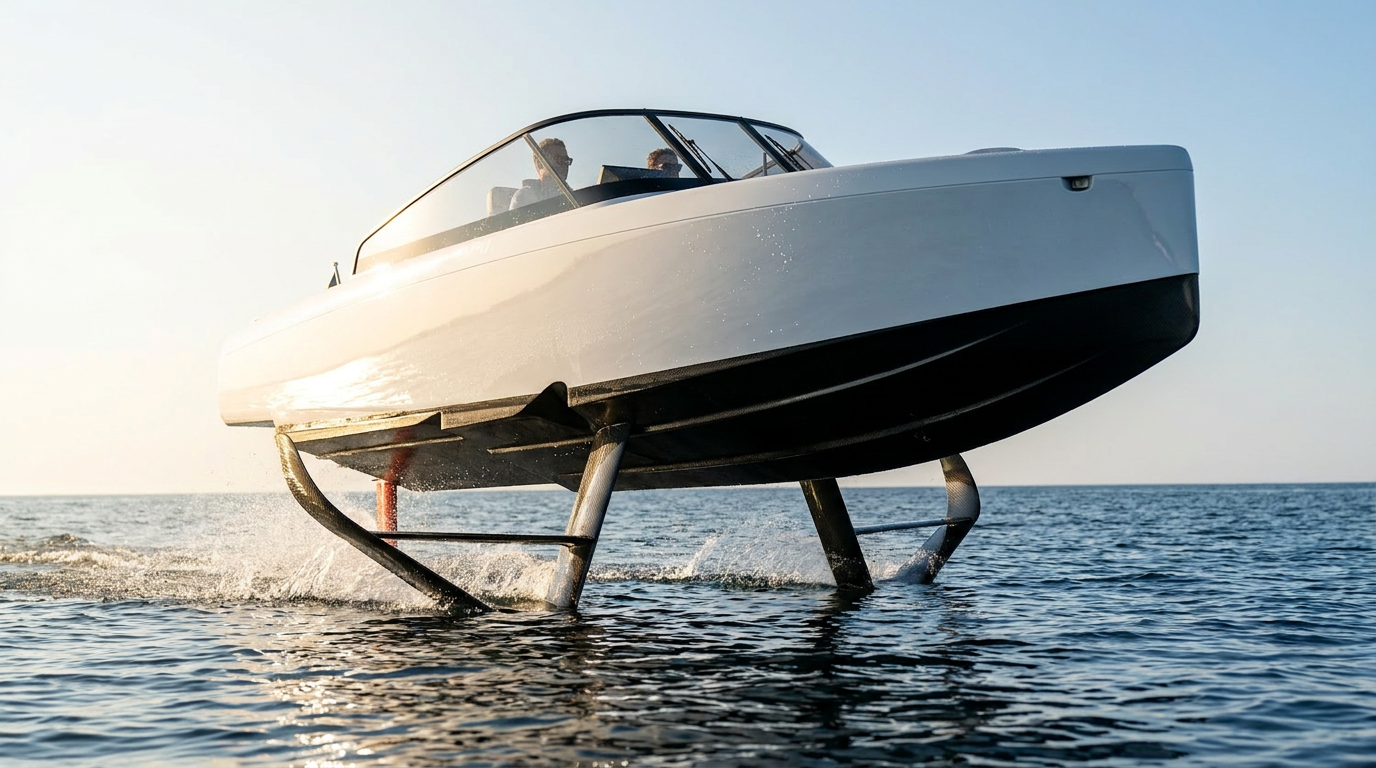
Hydrofoil technology borrows heavily from aviation. Submerged wings, or foils, are attached to struts beneath the boat. As the vessel accelerates, water flows over these wings, generating upward lift. Once the boat reaches a certain speed, the entire hull rises above the surface, leaving only the thin struts in the water.[3][7]

The efficiency gains are staggering. By flying above the water, hydrofoils reduce hydrodynamic drag by up to 80 percent compared to conventional planing hulls. This drastic reduction in friction changes the entire mathematical equation of electric boating, allowing vessels to achieve long ranges and high speeds on relatively modest battery packs.[3][7]
But modern hydrofoiling isn't just a mechanical feat; it is a software triumph. Water conditions are inherently chaotic, and keeping a boat balanced on underwater wings requires constant micro-adjustments that a human pilot could never manage manually.[1][7]
Companies like California-based Navier and Sweden's Candela rely on advanced flight control systems. Sensors read the water ahead and feed data into algorithms that adjust the foils up to 100 times per second. This active stabilization manages roll, pitch, and yaw, ensuring the boat remains perfectly level even when cutting through choppy seas.[1]
The resulting passenger experience is unlike anything in traditional boating. Because the hull never slams into the waves, the ride is remarkably smooth. Furthermore, the electric drivetrain makes the journey virtually silent, allowing passengers to converse at normal volumes while traveling at 30 knots.[2]
The resulting passenger experience is unlike anything in traditional boating.
Beyond passenger comfort, hydrofoiling solves a major environmental issue: wake. Traditional powerboats displace massive amounts of water, creating wakes that erode shorelines, damage docks, and disrupt marine ecosystems. Because a foiling boat only has its thin struts in the water, it produces almost zero wake, making it ideal for environmentally sensitive waterways and narrow canals.[3][7]

While early adopters have been wealthy tech enthusiasts buying luxury recreational models, the technology's most profound impact is emerging in the commercial sector. Municipalities are realizing that hydrofoils can solve urban transit bottlenecks.[2][4]
Cities with extensive waterways are looking to hydrofoils to decarbonize public transit. In Stockholm, Candela is deploying its P-12 shuttle, a 30-passenger electric catamaran designed to replace diesel ferries. Because it produces no wake, the P-12 is allowed to travel at high speeds through the city's archipelago, significantly cutting commute times while eliminating emissions.[1][2]
The economics of commercial foiling are highly attractive. Although the upfront capital cost is high, the operational expenses are a fraction of traditional ferries. Operators save massively on fuel, and the electric drivetrains require far less maintenance than heavy-duty marine diesel engines.[4][7]
Meanwhile, legacy marine giants are approaching electrification from a different angle, focusing on software and incremental integration. Brunswick Corporation, a dominant force in recreational boating, has acknowledged that current battery technology cannot yet support offshore fishing trips that require hours of high-speed running.[2]
Instead, Brunswick is investing heavily in its ACES strategy—Autonomy, Connectivity, Electrification, and Shared access. At recent technology showcases, the company debuted its AutoCaptain system, which uses machine vision and artificial intelligence to autonomously navigate and dock the boat.[6]
Docking is widely considered the most stressful part of recreational boating. By solving this specific pain point with advanced sensors and intelligent power management, legacy builders are making boating more accessible while laying the groundwork for fully electrified, autonomous vessels in the future.[5][6]
The broader electric hydrofoil market is expanding rapidly. Industry analysts project the sector will grow from under $1 billion today to roughly $4.6 billion by 2034, driven by battery cost reductions and municipal zero-emission mandates.[4]

Challenges remain, primarily regarding infrastructure. While marinas are beginning to install high-capacity marine chargers, the network is still sparse compared to automotive EV charging. Additionally, the high purchase price of foiling boats keeps them out of reach for the average consumer, though costs are expected to fall as manufacturing scales.[3][4]
How we got here
2019
Swedish startup Candela releases the C-7, proving that electric hydrofoiling is viable for luxury recreational boats.
2021
Candela introduces the longer-range C-8 model, partnering with automotive brand Polestar for battery technology.
2023
Silicon Valley-based Navier debuts its N30 electric hydrofoil, integrating advanced aerospace software into marine tech.
2025
Major coastal cities begin enforcing stricter zero-emission mandates, accelerating the adoption of electric ferries.
2026
The electric hydrofoil market expands rapidly, with commercial shuttles entering service in European and US transit networks.
Viewpoints in depth
Marine Tech Startups
Silicon Valley-style startups view hydrofoiling as the only viable path to electrifying the water.
Companies like Navier and Candela approach boatbuilding more like aerospace engineering. They argue that traditional boat hulls are fundamentally incompatible with the weight of lithium-ion batteries. By focusing heavily on software, flight-control algorithms, and carbon-fiber construction, these startups believe they can disrupt the marine industry the same way Tesla disrupted automotive—starting with premium recreational models and scaling down to mass-market transit.
Legacy Boatbuilders
Established marine giants are prioritizing incremental electrification and autonomous features over full hydrofoiling.
Industry leaders like Brunswick Corporation acknowledge the appeal of foiling but caution that the technology is currently too expensive and fragile for rugged offshore use. Instead, they are focusing on hybrid systems, intelligent power management, and autonomous docking features. Their view is that solving immediate pain points—like the stress of maneuvering a boat in a crowded marina—will drive consumer adoption faster than radically redesigning the hull.
Commercial Transit Operators
Municipalities and ferry operators see hydrofoils as a tool to decarbonize public transit without slowing it down.
For cities like Stockholm and San Francisco, the appeal of electric hydrofoils is purely economic and environmental. Traditional diesel ferries are massive polluters, but conventional electric ferries are often too slow to maintain commuter schedules. Hydrofoil shuttles offer a zero-emission alternative that can travel at highway speeds without generating destructive wakes, allowing them to operate in narrow urban waterways where speed limits normally apply.
What we don't know
- How quickly the high manufacturing costs of carbon-fiber hydrofoils will drop to make them affordable for average consumers.
- Whether marine charging infrastructure can expand fast enough to support widespread adoption outside of major urban hubs.
Key terms
- Hydrofoil
- A wing-like structure mounted on struts below a boat hull that lifts the vessel out of the water at speed.
- Hydrodynamic Drag
- The physical resistance a boat experiences as it pushes through water, which requires significant energy to overcome.
- Flight Control System
- The software and sensors that constantly adjust the angle of the hydrofoils to keep the boat balanced and stable.
- Wake
- The waves created by a boat displacing water as it moves, which can cause shoreline erosion and disturb other vessels.
Frequently asked
What exactly is a hydrofoil?
A hydrofoil is an underwater wing attached to a boat's hull. As the boat speeds up, water flowing over the wing generates lift, raising the hull entirely out of the water to reduce drag.
Why do electric boats need hydrofoils?
Water creates massive drag, which drains heavy electric batteries very quickly. By lifting the boat out of the water, hydrofoils reduce drag by up to 80%, allowing electric boats to achieve practical ranges and speeds.
Are electric hydrofoil boats completely silent?
Yes, they are virtually silent. Because the electric motor produces no exhaust noise and the hull doesn't slam against the waves, passengers can converse at normal volumes even at high speeds.
Can a hydrofoil boat handle rough water?
Yes, up to a point. Modern hydrofoils use AI sensors to adjust the wings 100 times per second, keeping the boat stable over moderate chop. In severe weather, they can retract the foils and operate like a normal boat.
Sources
Source coverage
7 outlets
4 viewpoints surfaced







[1]ForbesMarine Tech Innovators
Summer Travel: AI Takes Flight With High Speed Electric Hydrofoil Boats
Read on Forbes →[2]The IndependentMarine Tech Innovators
CES showcases electric hydrofoil boats
Read on The Independent →[3]EV WorldCommercial Operators
The electric boat industry has entered a decisive new phase
Read on EV World →[4]Strategic Market ResearchCommercial Operators
Global Electric Hydrofoil Boats Market
Read on Strategic Market Research →[5]EngadgetTraditional Boating Industry
The future of boating is here, but it ain't cheap
Read on Engadget →[6]ElectrekTraditional Boating Industry
Brunswick’s ACES strategy aims to meet expectations for electrified boating
Read on Electrek →[7]Factlen Editorial TeamEnvironmental Advocates
Synthesis by Factlen editorial team
Read on Factlen Editorial Team →
Every angle. Every day.
Get automotive stories with full source coverage and perspective breakdowns delivered to your inbox.