
The Rise of the Trackless Tram: How 'Virtual Rails' Are Reshaping Public Transit
A crossover between a bus and a light rail, the trackless tram promises to revolutionize urban transit at a fraction of the cost. But as cities worldwide adopt the technology, engineers are weighing its true capacity and impact on infrastructure.
By Factlen Editorial Team
- Urban Planners & Advocates
- Focus on the cost savings, rapid deployment, and urban regeneration potential of the technology.
- Transit Skeptics
- Focus on the physical limitations, road wear, and misleading marketing of the vehicles.
- Municipal Governments
- Focus on finding affordable, politically viable transit solutions that avoid disruptive construction.
What's not represented
- · Local business owners who benefit from avoiding years of light rail construction
- · Bus drivers and transit union members adapting to the new semi-autonomous technology
Why this matters
As traffic congestion worsens globally, mid-sized cities are desperate for affordable transit solutions. Trackless trams offer a way to build high-capacity, rail-like networks without the billion-dollar price tags and years of disruptive construction, potentially transforming how millions of people commute.
Key points
- Trackless trams combine the high capacity and smooth ride of light rail with the flexibility and lower cost of a bus.
- The vehicles use LiDAR and optical sensors to follow a virtual track painted on the road, eliminating the need for steel rails.
- Proponents estimate the systems cost $6 million to $8 million per kilometer, compared to $50 million or more for traditional light rail.
- Critics warn that the 51-tonne vehicles can cause severe road rutting, requiring expensive concrete reinforcement that negates initial savings.
- Despite the 'autonomous' branding, current models still require human drivers to navigate mixed urban traffic safely.
- Realistic Western capacity estimates place the vehicles at roughly 170 passengers, significantly lower than the manufacturer's crush-load claims.
Cities around the world are choking on traffic, but municipal governments face a paralyzing dilemma when trying to solve the problem. Building traditional light rail networks offers high capacity and a smooth ride, but it requires a decade of disruptive construction, torn-up streets, and billions of dollars in capital expenditure. On the other hand, deploying standard bus fleets is cheap and fast, but buses often fail to attract choice riders due to jerky movements, lower capacity, and the stigma of sitting in the same traffic as cars. For decades, urban planners have searched for a "mid-tier" transit solution that bridges this gap—something that offers the permanence and ride quality of a train, but the flexibility and affordability of a bus. That search has increasingly led them to a novel technology that is quietly spreading across the globe.
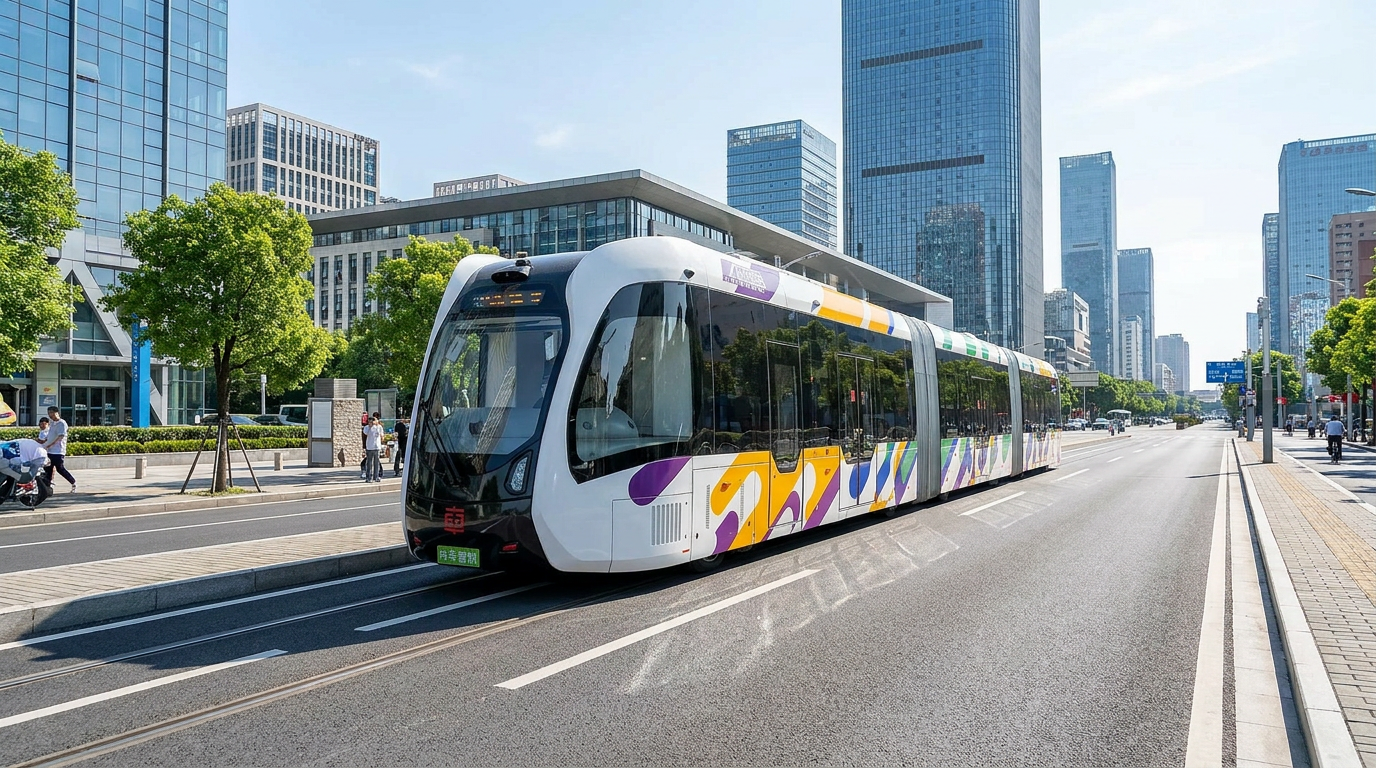
Enter the "trackless tram," formally known in the transit industry as Autonomous Rapid Transit (ART). Developed by China's state-owned rail manufacturer, the China Railway Rolling Stock Corporation (CRRC), these sleek, multi-carriage vehicles look exactly like modern light rail trains. They feature aerodynamic noses, low-floor boarding, and articulated gangways connecting the cabins. However, they hide a crucial, defining difference: they run on rubber tires rather than steel wheels. First unveiled in 2017 and put into commercial operation in the Chinese city of Zhuzhou in 2018, the ART system was designed from the ground up to mimic the passenger experience of a train without requiring the heavy, expensive infrastructure that typically accompanies urban rail projects.[2]
Instead of following physical steel tracks embedded in the road, ART systems rely on a sophisticated suite of digital sensors to navigate. The vehicles use a combination of LiDAR, optical cameras, and GPS to trace a "virtual track"—usually represented by double dashed lines painted directly onto the asphalt. The onboard computer reads these lines and automatically steers the vehicle along the precise path, ensuring that the tram's multiple carriages follow exactly in the footprint of the lead car. This optical guidance system allows the vehicle to glide through tight urban corridors with millimeter precision, maintaining a dedicated lane without the need for physical rails or concrete guideways.[2]
The primary appeal of this hybrid technology is overwhelmingly financial. Traditional light rail systems are notoriously expensive, often costing upwards of $50 million per kilometer to install in dense urban environments. The bulk of that cost does not come from the trains themselves, but from the massive civil engineering required to prepare the route. Cities must dig up main roads, relocate underground utilities, lay heavy steel tracks, and string overhead electrified catenary wires. This process not only drains municipal budgets but also causes years of severe disruption, often bankrupting local businesses that are cut off by construction barricades during the prolonged installation phase.[1]
In stark contrast, researchers at Australia's Curtin University, who have extensively studied the technology, estimate that trackless trams can be deployed for roughly $6 million to $8 million per kilometer. Because the vehicles utilize existing road surfaces, a new transit corridor can theoretically be established in a fraction of the time. If a city already has a suitable dedicated lane, the physical installation of a trackless tram route primarily involves painting the virtual track lines and building the passenger stations. This rapid deployment model spares local communities from years of construction fatigue and allows politicians to deliver major infrastructure upgrades within a single election cycle.[1]

Beyond the dramatic cost savings, proponents argue that trackless trams offer a vastly superior passenger experience compared to standard articulated buses. By borrowing stabilization technology, active suspension systems, and bogey designs directly from high-speed rail engineering, the vehicles effectively eliminate the jerkiness, swaying, and sudden braking typically associated with bus travel. The optical guidance system ensures a perfectly smooth trajectory, allowing passengers to read or work comfortably without being thrown off balance. This rail-like ride quality is crucial for attracting commuters who might otherwise choose to drive, elevating the system above the perception of a standard bus route.[2]
The environmental credentials of the trackless tram are another major selling point for cities looking to decarbonize their transport networks. The vehicles are entirely electric and produce zero tailpipe emissions. Rather than relying on a continuous overhead wire—which is expensive to maintain and visually clutters the streetscape—the trams are powered by onboard lithium-titanate batteries. These advanced batteries are designed for rapid replenishment; they can flash-charge in just 30 to 60 seconds via an overhead pantograph while passengers board and alight at solar-powered stations. This brief burst of energy provides enough juice for the tram to reach the next stop, ensuring continuous operation throughout the day.[1][2]
Given these advantages, the technology has rapidly expanded beyond its initial proving grounds in China. In recent years, cities across the globe have launched trials, feasibility studies, and commercial routes, eager to capture the benefits of rail on a bus budget. From the Middle East to Southeast Asia, transit authorities are evaluating whether the virtual track can solve their localized congestion crises. The technology has proven particularly attractive to mid-sized cities that have outgrown their legacy bus networks but lack the population density or tax base to justify a multi-billion-dollar subway or light rail excavation.
Given these advantages, the technology has rapidly expanded beyond its initial proving grounds in China.
In Australia, the push for trackless trams has gained significant momentum. The City of Stirling, a major suburban hub in Perth, recently took delivery of a 30-meter trackless tram for a comprehensive trial along a seven-kilometer stretch of Scarborough Beach Road. Backed by federal funding and academic support from Curtin University, the trial aims to prove that the vehicles can operate seamlessly in Australian traffic conditions. Meanwhile, the technology has attracted interest across Asia; India has proposed running trackless trams through the heritage corridors of Old Delhi to reduce pollution, and Malaysia has aggressively pursued the technology, conducting extensive pilot programs in Putrajaya.[1][7][9]

However, as the technology proliferates and transitions from controlled test tracks to messy urban realities, a vocal contingent of transit engineers and urban planners has begun to push back against the hype. These critics argue that the "trackless tram" is merely a triumph of marketing over physics, masking the inherent limitations of heavy, rubber-tired vehicles. They caution city councils against viewing the technology as a magical cure-all, warning that the promised cost savings often evaporate once the hidden infrastructure requirements of running a massive, multi-carriage vehicle on standard city streets become apparent.[4]
Skeptics frequently deploy the term "gadgetbahn"—a pejorative used in urban planning circles for unnecessarily complex transit technologies that solve problems better addressed by conventional buses or trains. When Pakistan launched its first ART system in Lahore in late 2025, social media users widely mocked the grand unveiling. Observers pointed out that a train without tracks is, by definition, just a bus, and questioned why the government was celebrating a rebranded vehicle instead of investing in broader, systemic transit improvements. The viral reaction highlighted a growing public skepticism toward transit solutions that prioritize futuristic aesthetics over practical utility.[4][6]
The nomenclature of the system is also highly misleading. Despite the "Autonomous" in Autonomous Rapid Transit, the vehicles currently require human drivers to operate safely in mixed urban environments. While the optical sensors can steer the tram along the painted lines, a driver must be present to control the speed, brake for unpredictable pedestrians, and navigate around obstacles that block the virtual track. When Indonesia tested an ART unit for its new capital city, Nusantara, in 2024, officials ultimately returned the vehicle to China after a month of trials, citing the fact that the system could not function without manual intervention.[4][5]
Then there is the unavoidable issue of weight, which threatens to undermine the primary financial advantage of the trackless tram. A fully loaded three-carriage unit weighs roughly 51 tonnes—about twice the legal weight limit for a standard articulated bus. Because the optical guidance system is so precise, the tram's heavy rubber tires roll over the exact same narrow strip of asphalt on every single trip. Over time, this concentrated, repetitive stress causes severe "rutting," a rapid deterioration and grooving of the road surface that can make the lane dangerous for other vehicles and damage the tram itself.[2][4]
To prevent the roads from buckling under the immense weight, cities often have to dig up the designated transit lanes and reinforce them with thick, heavy-duty concrete. This requirement quietly erases much of the promised infrastructure savings and reintroduces the very construction disruption that the trackless tram was supposed to avoid. Critics point out that if a city has to excavate the road to pour a deep concrete foundation anyway, they might as well lay steel tracks, which offer far less rolling resistance, consume less energy, and last significantly longer than rubber tires on pavement.[4]
The manufacturer's capacity claims have also faced intense scrutiny from international transit authorities. CRRC advertises that a standard three-car trackless tram can carry over 300 passengers, a figure that rivals some light rail systems. However, that calculation assumes a passenger density of eight people per square meter—a crush-load standard that is typical of a Chinese rush hour but entirely unacceptable in most Western transit networks. At that density, passengers are packed shoulder-to-shoulder with virtually no room to move, which undermines the promise of a comfortable, premium ride experience.[3]
When Auckland Transport evaluated the ART system for a proposed transit corridor in New Zealand, their engineers recalculated the vehicle's capacity using a standard Western density metric of four passengers per square meter. The revised math yielded a realistic capacity of just 170 passengers. At that level, the trackless tram carries only marginally more people than a standard high-capacity articulated bus or a double-decker bus, raising questions about whether the bespoke technology and specialized charging infrastructure are truly worth the investment compared to simply buying a fleet of off-the-shelf electric buses.[3]

Even with these physical and mathematical limitations, the trackless tram is finding a legitimate, evolving niche in the global transit ecosystem. Cities are learning to adapt the technology to their specific needs rather than accepting the marketing claims at face value. For example, in May 2026, Malaysia's federal government approved a restructured $2.1 billion (RM10 billion) Elevated Autonomous Rapid Transit (E-ART) system for the state of Johor. By moving the rubber-tired trams onto dedicated concrete viaducts, the project bypasses ground-level traffic congestion entirely and solves the asphalt rutting issue, creating a bespoke medium-capacity skyway.[10]
Ultimately, the trackless tram is neither a magical, zero-cost cure for urban congestion nor a mere marketing gimmick designed to sell fancy buses. It represents a highly capable "mid-tier" transit option—one that genuinely bridges the gap between the flexibility of a bus network and the permanence of a train line. When deployed thoughtfully, with a clear understanding of its weight limitations and realistic passenger capacities, the technology offers a smoother, greener, and more attractive ride than legacy diesel buses, helping to pull commuters out of their private cars.[8]
For mid-sized cities that cannot justify the staggering capital costs and decade-long construction timelines of traditional light rail, but desperately need to upgrade their public transit networks to meet climate and growth targets, the virtual track offers a compelling path forward. As battery technology improves and the autonomous driving features mature, the trackless tram is poised to become a familiar sight on city streets—proving that sometimes, the best way to move forward is to reinvent the wheel.[8]
How we got here
June 2017
China's CRRC unveils the first Autonomous Rapid Transit (ART) vehicle.
2018
The first commercial trackless tram route begins operation in Zhuzhou, China.
2021
Auckland Transport evaluates the technology, raising questions about realistic passenger capacity.
2024
Indonesia tests an ART unit for its new capital, Nusantara, but returns it due to a lack of full autonomy.
August 2025
Pakistan launches a trackless tram in Lahore, sparking viral debates over whether it is simply a bus.
May 2026
Malaysia approves a $2.1 billion elevated ART system for Johor to bypass ground-level traffic.
Viewpoints in depth
Transit Innovators & Planners
Advocates who see trackless trams as a cost-effective catalyst for urban regeneration.
This camp, heavily represented by researchers at institutions like Curtin University, argues that the trackless tram is a genuine breakthrough. By eliminating the need for steel tracks and overhead wires, cities can deploy rail-quality transit at a fraction of the cost and time. They emphasize that the smooth ride quality and permanent stations attract private investment and land-value capture just like traditional light rail, making it a powerful tool for revitalizing suburban corridors without bankrupting municipal governments.
Transit Skeptics & Engineers
Critics who argue the technology is overhyped and masks the physical realities of heavy vehicles.
Skeptics view the 'trackless tram' as a classic 'gadgetbahn'—a flashy rebranding of an articulated bus. They point out that a 51-tonne vehicle running on the exact same wheel path every day will inevitably destroy standard asphalt, requiring cities to build expensive reinforced concrete lanes anyway. Furthermore, they argue that the 'autonomous' branding is misleading since the vehicles still require human operators, and that the capacity claims are artificially inflated by using unrealistic passenger density metrics.
Municipal Governments
City officials looking for pragmatic, politically viable transit solutions.
For local governments, the appeal of the trackless tram is largely political and financial. Digging up main roads for years to lay light rail tracks often destroys local businesses and drains political capital. The promise of installing a high-capacity transit system 'over a weekend' is incredibly attractive to mayors and councils. Even if the long-term maintenance costs of road rutting are higher than advertised, the low upfront capital expenditure allows cities to secure funding and launch routes within a single election cycle.
What we don't know
- How the long-term maintenance costs of road reinforcement will compare to the upkeep of traditional steel light rail tracks over a 30-year lifecycle.
- Whether fully autonomous, driverless operation will ever be approved for mixed-traffic urban environments.
- How well the optical guidance sensors will perform in cities with heavy snowfall or frequent road-obscuring weather conditions.
Key terms
- Autonomous Rapid Transit (ART)
- The formal industry name for trackless trams, developed by China's CRRC, which use optical sensors to follow a virtual path.
- Gadgetbahn
- A critical term used by urban planners for a transit technology that is unnecessarily complex or proprietary, often reinventing the bus or train.
- LiDAR
- A remote sensing method that uses light in the form of a pulsed laser to measure ranges, used by the tram to map its surroundings.
- Rutting
- The permanent deformation or grooving of asphalt caused by the repeated passage of heavy vehicle tires over the exact same path.
- Mid-tier transit
- Public transportation options that sit between standard local buses and heavy underground subway systems in terms of capacity and cost.
Frequently asked
Does a trackless tram need a driver?
Yes. Despite being called 'Autonomous Rapid Transit,' current models require a human driver to navigate mixed traffic and handle emergencies, though the vehicle steers itself along the virtual track.
How is the tram powered?
It is fully electric, powered by lithium-titanate batteries. It flash-charges in about 30 to 60 seconds at designated stations while passengers board and alight.
Why not just build traditional light rail?
Light rail requires laying steel tracks and installing overhead wires, which can cost over $50 million per kilometer and cause years of disruptive road construction.
Does it damage the roads?
It can. Because the 51-tonne vehicle follows the exact same path every time, it can cause 'rutting' in standard asphalt, often requiring cities to reinforce the transit lanes with concrete.
Sources
Source coverage
10 outlets
3 viewpoints surfaced










[1]Curtin UniversityUrban Planners & Advocates
Could trackless trams replace light rail? - Research
Read on Curtin University →[2]Journal of Transportation Technologies
The Trackless Tram: Is It the Transit and City Shaping Catalyst We Have Been Waiting for?
Read on Journal of Transportation Technologies →[3]Auckland TransportTransit Skeptics
Trackless Tram Overview and Capacity Analysis
Read on Auckland Transport →[4]ReinvantageTransit Skeptics
Reinventing the wheel: The innovation inflation of trackless trams
Read on Reinvantage →[5]Asia Research InstituteMunicipal Governments
Smart Nusantara: Technological Worlding and the Overlooked Citizens?
Read on Asia Research Institute →[6]Dhaka TribuneTransit Skeptics
Pakistan's Maryam Nawaz launches 'trackless tram'; internet says, 'that's just a bus'
Read on Dhaka Tribune →[7]Hindustan TimesMunicipal Governments
Trackless trams proposed in Old Delhi
Read on Hindustan Times →[8]Factlen Editorial Team
Synthesis by Factlen editorial team
Read on Factlen Editorial Team →[9]SwitchedOnUrban Planners & Advocates
It's electric and smart - Australia's first trackless tram arrives
Read on SwitchedOn →[10]The StarMunicipal Governments
Cabinet approves RM10bil Elevated Autonomous Rapid Transit for Johor
Read on The Star →
Every angle. Every day.
Get automotive stories with full source coverage and perspective breakdowns delivered to your inbox.