
The Science of Aquafaba: How Chickpea Water Revolutionized Egg-Free Cooking
Once discarded as waste, the starchy liquid from cooked chickpeas has become a culinary staple. Food science reveals how its unique blend of proteins and saponins perfectly mimics the properties of eggs.
By Factlen Editorial Team
- Plant-Based Chefs & Bakers
- Value aquafaba as a revolutionary, accessible ingredient that unlocked previously impossible vegan desserts.
- Food Scientists & Chemists
- Focus on the molecular interactions of saponins, proteins, and starches that allow legume water to mimic the functional properties of eggs.
- Zero-Waste Advocates
- Emphasize the environmental and economic benefits of upcycling a highly functional byproduct.
What's not represented
- · Commercial egg producers
- · Industrial food manufacturers
Why this matters
Understanding the chemistry of aquafaba empowers home cooks to bake more inclusively and sustainably. It transforms a free, everyday byproduct into a highly functional ingredient for allergy-friendly and plant-based diets.
Key points
- Aquafaba is the starchy liquid leftover from cooking legumes, most commonly chickpeas.
- It perfectly mimics the foaming and emulsifying properties of egg whites, unlocking complex vegan desserts.
- Its unique functionality is driven by a combination of water-soluble proteins, carbohydrates, and soap-like saponins.
- Two tablespoons of aquafaba replaces one egg white, while three tablespoons replaces a whole egg.
- While excellent for meringues and mayonnaise, it lacks the fat and dense protein needed for heavy doughs or sponge cakes.
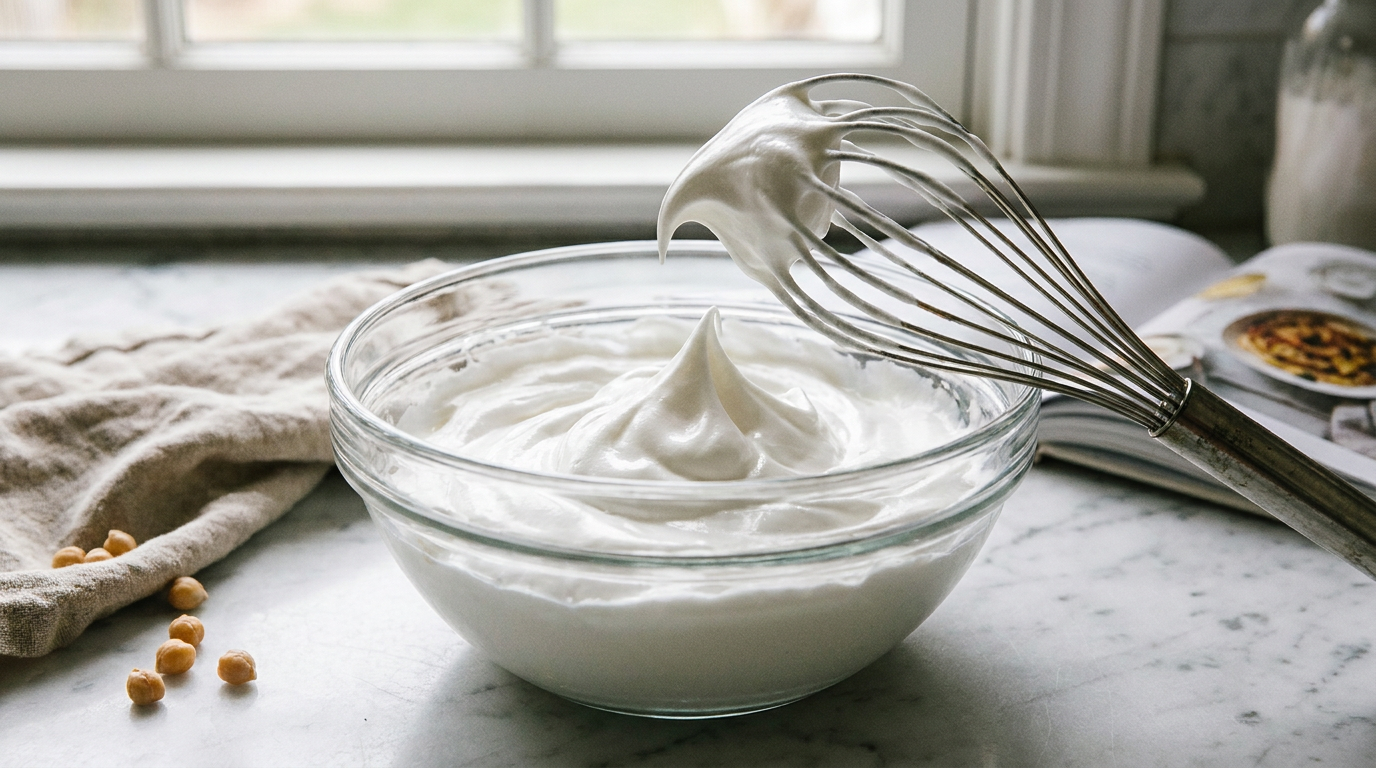
For generations, home cooks and professional chefs alike poured the cloudy, viscous liquid from canned chickpeas straight down the drain. It was considered a useless, slightly unappetizing byproduct of legume preparation. But over the last decade, that discarded liquid has undergone a radical rebranding. Today, it is known as aquafaba, and it has fundamentally transformed the landscape of allergy-friendly and plant-based cooking. By perfectly mimicking the complex chemical properties of egg whites, this humble bean water has unlocked a vast menu of previously impossible recipes, from delicate French macarons to towering lemon meringue pies.[1][5]
The culinary breakthrough did not originate in a high-tech food laboratory, but rather through crowdsourced internet experimentation. In 2014, a French tenor named Joël Roessel began experimenting with the water from canned beans in an attempt to create a vegan meringue, noting its unique ability to foam. A year later, an American software engineer named Goose Wohlt perfected the technique. Wohlt discovered that the liquid could be whipped into stiff, glossy peaks without any additional commercial stabilizers, and he coined the term "aquafaba"—a portmanteau of the Latin words for water (aqua) and bean (faba).[1][3][6]
The discovery sent immediate shockwaves through the plant-based culinary world. For decades, vegan bakers and those with severe egg allergies had relied on mashed bananas, ground flaxseeds, and silken tofu to replace eggs in their recipes. While these alternatives worked adequately as moisture-rich binders in dense baked goods like muffins or brownies, they completely failed to replicate the airy, foaming capabilities of egg whites. Aquafaba solved this decades-old problem overnight, providing a cheap, accessible ingredient that could trap air and build delicate, gravity-defying structures.[5][6]
But what exactly is happening on a molecular level when chickpea water hits a whisk? The secret lies in a complex matrix of compounds that leach out of the legumes during the cooking process. Food scientists and chemists have extensively analyzed the liquid to understand its unique behavior. They have identified three primary actors responsible for the magic: proteins, carbohydrates, and a specialized class of plant chemicals known as saponins.[2][4]

When dried chickpeas are soaked and subsequently boiled or pressure-cooked, the heat and water cause the cellular walls of the beans to soften. During this process, approximately five percent of the legume's initial dry weight dissolves directly into the surrounding water. This dissolved material includes albumins and globulins—specific types of water-soluble proteins that happen to behave remarkably similarly to the proteins found in traditional chicken eggs.[3]
In a raw egg white, proteins exist in tightly folded, microscopic bundles. When a baker vigorously whips the egg whites, the mechanical action forces these proteins to unfold, stretch out, and bond with one another. This creates a microscopic, flexible net that traps tiny air bubbles, resulting in a voluminous foam. The albumins and globulins present in aquafaba undergo a nearly identical physical transformation when subjected to the sheer force of a stand mixer or immersion blender.[2][4]
However, there is a significant chemical discrepancy: aquafaba only contains about one percent protein by volume, compared to the ten percent protein density found in standard egg whites. On its own, this low protein concentration would not be enough to create a stable, long-lasting foam. To compensate for this deficit, aquafaba relies heavily on its concentration of saponins. Saponins are naturally occurring phytochemicals that possess distinct soap-like properties—in fact, they are the exact reason chickpea water often looks slightly bubbly straight out of the can.[2][3]
On its own, this low protein concentration would not be enough to create a stable, long-lasting foam.
These saponins act as highly effective natural surfactants. In chemistry, a surfactant is a compound that lowers the surface tension between a liquid and a gas. By reducing the surface tension of the bean water, saponins make it incredibly easy to whip air into the mixture. When combined with the structural support of the unfolded proteins, the saponins help stabilize the resulting foam, preventing the trapped air bubbles from popping and causing the meringue to collapse.[2][5]
The third crucial component of the aquafaba matrix is its carbohydrate content. As the chickpeas cook, they release complex starches and oligosaccharides into the water. These carbohydrates significantly increase the viscosity of the liquid, giving it a thick, gel-like consistency that perfectly mimics the physical texture of raw egg whites. In baked goods, these starches gelatinize under the heat of the oven, providing essential crumb structure and helping the final product retain moisture.[2][3]
While aquafaba is most famous for its starring role in sweet, airy desserts, its chemical makeup also makes it an exceptional tool for savory applications. Beyond its foaming capabilities, aquafaba is a highly effective emulsifier. In culinary applications like mayonnaise, aioli, or creamy salad dressings, the primary goal is to force two inherently unmixable liquids—typically oil and water—to blend smoothly into a single, cohesive sauce.[5][6]

The proteins and saponins in aquafaba are uniquely suited for this task because they possess both hydrophilic (water-loving) and lipophilic (fat-loving) properties. When aquafaba is blended with a neutral oil and an acidic ingredient like lemon juice or vinegar, these compounds physically coat the microscopic oil droplets. This protective coating prevents the oil droplets from clumping together and separating from the water base. The result is a thick, creamy, and entirely plant-based emulsion that rivals traditional egg-yolk mayonnaise.[2][4]
Despite its incredible versatility, food scientists note that aquafaba is not a perfect, universal one-to-one replacement for eggs in every single culinary scenario. Because it entirely lacks the high fat and cholesterol content of an egg yolk, aquafaba cannot provide the same richness, flavor, or tenderizing effect in heavy doughs. Bakers adapting traditional recipes often need to supplement the aquafaba with additional fats, such as vegan butter or neutral oils, to achieve the correct mouthfeel and crumb texture.[6]
Furthermore, because its overall protein content is relatively low, aquafaba struggles to provide the rigid, heat-set structural support required for certain highly specific baked goods. For example, sponge cakes and angel food cakes rely almost entirely on the rapid coagulation of dense egg proteins to hold their towering shapes in the oven. Aquafaba foams, while stable at room temperature, can sometimes collapse under intense heat if they are not bolstered by additional starches or flours.[3]
For home cooks looking to experiment with this ingredient, the extraction process is remarkably simple and accessible. The easiest and most common method is to simply drain a standard can of low-sodium or unsalted chickpeas. A typical fifteen-ounce can yields about half a cup to three-quarters of a cup of ready-to-use aquafaba. Because canned beans sit in their liquid for months, the starches and proteins are heavily concentrated, making canned aquafaba highly reliable for immediate whipping.[1][6]
For those who prefer cooking dried beans from scratch, the process requires a bit more precision but yields excellent results. Dried chickpeas must be soaked overnight, then simmered or pressure-cooked until completely tender. The leftover cooking liquid is then strained out. If the resulting homemade aquafaba is too thin and watery, cooks simply return the liquid to the stove and simmer it until it reduces and thickens to the exact viscous consistency of raw egg whites.[2][5]

Once extracted, the standard culinary conversion ratio is easy for bakers to memorize: two tablespoons of aquafaba replaces one egg white, while three tablespoons replaces one whole egg. When whipping aquafaba for meringues or mousses, adding a small pinch of an acidic stabilizer—such as cream of tartar, lemon juice, or apple cider vinegar—helps the foam reach stiff peaks much faster and hold its shape significantly longer.[3][6]
What began as a niche internet experiment has now become a celebrated staple of modern gastronomy and food science. Aquafaba represents a rare, unqualified culinary triumph: it is a zero-cost, zero-waste ingredient that perfectly solves one of the oldest structural challenges in plant-based cooking. By understanding the chemistry of the humble chickpea, cooks around the world are turning what was once literal garbage into culinary gold.[4][5]
How we got here
Pre-2014
Vegan bakers rely on dense binders like flaxseeds and bananas, unable to replicate the airy foam of egg whites.
2014
French tenor Joël Roessel discovers that the water from canned beans can be whipped into a foam.
2015
Software engineer Goose Wohlt perfects the whipping technique, creates the first vegan meringue, and coins the term 'aquafaba'.
Present
Aquafaba is widely adopted in both home kitchens and commercial food science as a standard, reliable egg replacer.
Viewpoints in depth
Food Scientists & Chemists
Focus on the molecular interactions of saponins, proteins, and starches that allow legume water to mimic the functional properties of eggs.
For food chemists, aquafaba represents a fascinating study in plant-based functional ingredients. They emphasize that while aquafaba mimics eggs, the mechanism is entirely different. Eggs rely on dense protein coagulation, whereas aquafaba relies on the synergistic relationship between low-dose proteins and high-power saponin surfactants. Researchers are currently exploring how to isolate and commercialize these specific chickpea compounds to create shelf-stable, industrial-scale egg replacers for large food manufacturers.
Plant-Based Chefs & Bakers
Value aquafaba as a revolutionary, accessible ingredient that unlocked previously impossible vegan desserts.
Within the vegan culinary community, aquafaba is viewed as nothing short of a revolution. Prior to 2015, creating a plant-based meringue, macaron, or airy mousse was considered the holy grail of vegan baking—often requiring expensive, hard-to-source commercial replacers that yielded mixed results. Chefs celebrate aquafaba because it democratized advanced pastry techniques, allowing anyone with a cheap can of beans to execute delicate, foam-based recipes that were previously off-limits to those avoiding animal products.
Zero-Waste Advocates
Emphasize the environmental and economic benefits of upcycling a highly functional byproduct.
Sustainability advocates highlight aquafaba as a prime example of functional upcycling. For decades, the canning industry and home cooks poured millions of gallons of nutrient-dense legume water into the wastewater system. By reframing this 'waste' as a premium ingredient, zero-waste proponents argue that aquafaba reduces food waste, maximizes the caloric and functional yield of agricultural land, and provides a free, sustainable alternative to resource-intensive commercial egg production.
What we don't know
- Exactly how different chickpea cultivars and growing conditions alter the specific protein-to-saponin ratio of the resulting aquafaba.
- Whether the functional compounds in aquafaba can be efficiently extracted and dried into a shelf-stable commercial powder at a mass industrial scale.
Key terms
- Aquafaba
- The viscous water in which legume seeds, such as chickpeas, have been cooked, widely used as a plant-based egg replacement.
- Saponins
- Naturally occurring plant compounds that produce a soap-like foam when shaken, acting as powerful natural surfactants.
- Surfactant
- A substance that reduces the surface tension of a liquid, allowing it to foam or emulsify more easily when mixed with air or oil.
- Emulsion
- A stable, cohesive mixture of two or more liquids that normally do not mix, such as oil and water.
- Gelatinization
- The process where starch granules absorb water and swell when heated, thickening the surrounding liquid and providing structure to baked goods.
Frequently asked
Can I use water from beans other than chickpeas?
Yes. White beans, like cannellini or navy beans, work exceptionally well and have a neutral flavor. Darker beans, like black or kidney beans, will function similarly but may tint your recipe and impart a stronger, earthier taste.
Does aquafaba make desserts taste like chickpeas?
Raw aquafaba does have a mild bean aroma, but the flavor completely dissipates once it is baked or mixed with strong ingredients like sugar, chocolate, or vanilla extract.
Can I freeze leftover aquafaba?
Yes, aquafaba freezes exceptionally well without losing its foaming properties. Many cooks freeze it in ice cube trays, with each cube measuring exactly one tablespoon for easy portioning later.
Sources
Source coverage
6 outlets
3 viewpoints surfaced






[1]The Daily MealPlant-Based Chefs & Bakers
What Is Aquafaba And How Was It Discovered?
Read on The Daily Meal →[2]National Institutes of HealthFood Scientists & Chemists
Evaluation of different processes for obtaining aquafaba and their impact on nutritional and technological characteristics
Read on National Institutes of Health →[3]WikipediaFood Scientists & Chemists
Aquafaba
Read on Wikipedia →[4]Factlen Editorial Team
Synthesis by Factlen editorial team
Read on Factlen Editorial Team →[5]Gentle WorldZero-Waste Advocates
The Magic of Aquafaba
Read on Gentle World →[6]Aegean DelightPlant-Based Chefs & Bakers
What is Aquafaba and How Can You Use It?
Read on Aegean Delight →
Every angle. Every day.
Get food drink stories with full source coverage and perspective breakdowns delivered to your inbox.