
The Science of the Perfect Steak: How the Reverse Sear Revolutionized Grilling
By flipping the traditional cooking order, the reverse sear uses thermodynamics and chemistry to deliver edge-to-edge doneness and a superior crust.
By Factlen Editorial Team
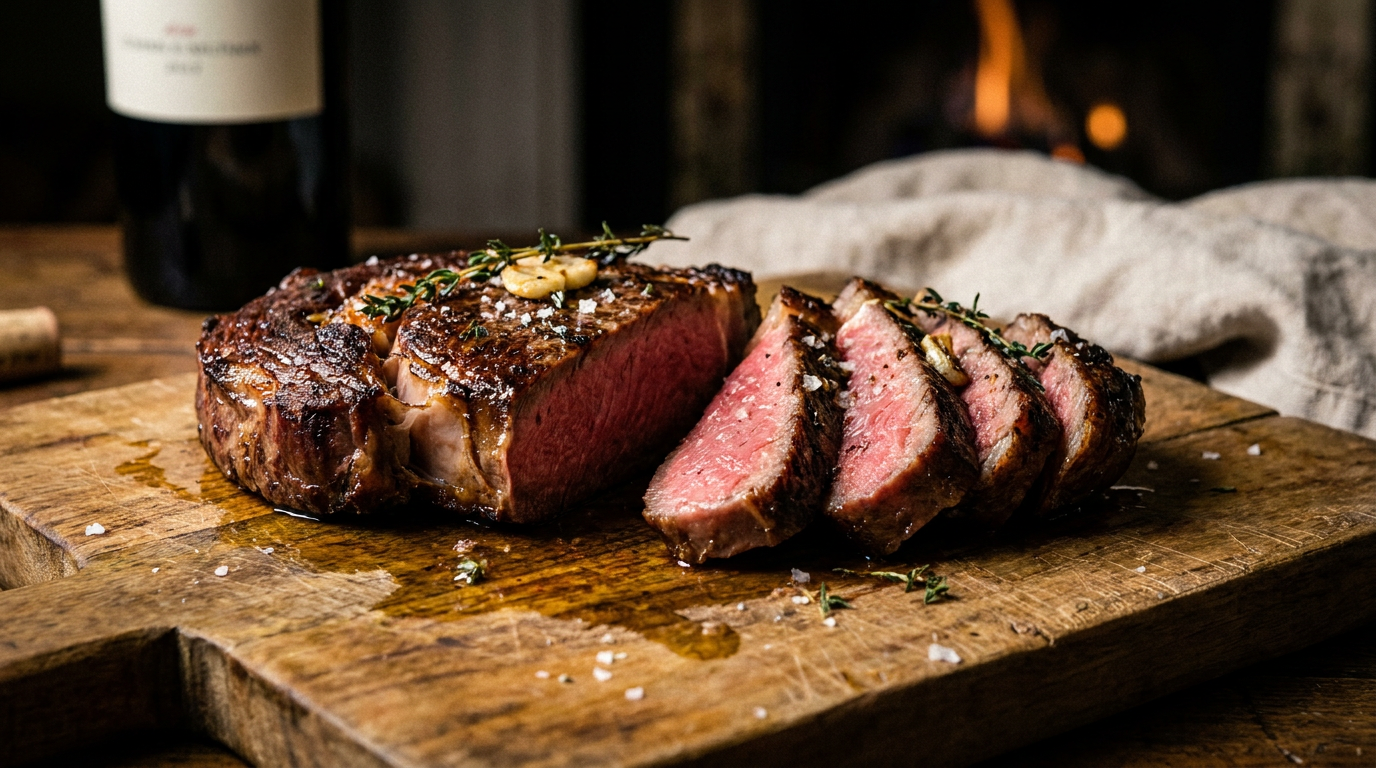
- Culinary Scientists
- Focus on the measurable data—temperature gradients, enzymatic breakdown, and the precise chemistry of the Maillard reaction.
- Barbecue Pitmasters
- Value how the low-and-slow phase allows woodsmoke to penetrate the meat before the pores seal up during the final sear.
- Home Cooks
- Appreciate the foolproof nature of the method, which removes the anxiety of overcooking an expensive cut of meat.
What's not represented
- · Commercial Steakhouse Chefs
Why this matters
Understanding the science of heat transfer and the Maillard reaction removes the guesswork from cooking expensive cuts of meat. The reverse sear empowers home cooks to achieve foolproof, restaurant-quality results without specialized equipment.
Key points
- The reverse sear starts meat in a low-temperature oven before finishing with a high-heat sear.
- This method eliminates the overcooked grey band found in traditionally seared steaks.
- Low-and-slow cooking allows natural enzymes to break down proteins, tenderizing the meat.
- The low oven dries the surface of the steak, accelerating the Maillard reaction for a superior crust.
- Reverse-seared steaks do not need to rest after the final sear and can be served immediately.
- The technique is only recommended for thick cuts of meat measuring 1.5 inches or more.
The traditional steakhouse method—searing meat over a raging fire to "lock in the juices," then finishing it in the oven—has been the undisputed gospel of the grill for generations. It is a technique passed down through culinary schools and backyard barbecues alike, built on the assumption that a fast, hot sear creates an impermeable barrier that traps moisture inside the meat.[8]
But modern culinary science has thoroughly dismantled this dogma. The "sear-then-roast" method often yields a frustrating bullseye effect: a charred exterior, a thick band of overcooked, dry grey meat, and only a tiny center of the desired doneness. Furthermore, scientists have proven that searing does absolutely nothing to seal in juices; moisture loss is dictated entirely by the internal temperature of the muscle fibers.[1][2]
Enter the "reverse sear." Pioneered in the mid-2000s by test kitchens and barbecue pitmasters, this technique flips the traditional script. Instead of starting with high heat, you place the meat in a low-temperature environment—usually an oven or the cool zone of a grill—and finish it with a blistering, brief sear just before serving.[1][3]
The result is a steak with edge-to-edge perfection, a deeply caramelized crust, and a remarkably wide margin for error. But to understand why the reverse sear has become the gold standard for thick cuts of meat, we have to look closely at the thermodynamics of cooking and how heat interacts with animal protein.[4][6]

The first scientific principle at play is the temperature gradient. When a cold steak hits a 500-degree pan, the exterior temperature skyrockets while the center remains cold. By the time the center reaches a medium-rare 130°F, the outer layers have been exposed to extreme heat for far too long, causing the muscle fibers to tighten violently and squeeze out their moisture.[6][8]
The reverse sear mitigates this harsh gradient by utilizing a low-temperature environment, typically between 200°F and 250°F. In this gentle heat, the thermal energy transfers into the meat slowly and evenly, preventing the outer fibers from contracting prematurely.[1][3]
This slow thermal transfer means the center of the steak and the outer layers rise in temperature at roughly the exact same rate. When the center hits its target temperature, the outer layers are only marginally hotter, virtually eliminating the dreaded grey band and maximizing the volume of perfectly cooked meat.[2][6]
Beyond precise temperature control, the low-and-slow phase triggers a distinct biological advantage: enzymatic tenderization. Beef contains naturally occurring enzymes, primarily calpains and cathepsins, which act as biological scissors to break down tough muscle proteins and connective tissue.[1][8]
Beyond precise temperature control, the low-and-slow phase triggers a distinct biological advantage: enzymatic tenderization.
These enzymes are most active at warm temperatures, specifically in the window between 100°F and 120°F. By slowly bringing the meat up to temperature, the reverse sear keeps the steak in this optimal enzymatic zone for a significantly longer period, resulting in meat that is measurably more tender than a steak cooked rapidly over high heat.[1][5]

But the true magic of the reverse sear lies in how it prepares the meat for the final step: the crust. A great steak crust is the product of the Maillard reaction, a complex chemical process where amino acids and reducing sugars brown and create hundreds of new, highly savory flavor compounds.[5][7]
The Maillard reaction requires high heat—typically above 300°F—and, crucially, a dry environment. Moisture is the absolute enemy of browning. If you put a wet steak into a hot pan, the heat energy is wasted boiling away the surface water (which evaporates at 212°F) before any browning can even begin to occur.[5][6]
Traditional searing fights a losing battle against this surface moisture. But the reverse sear solves the problem elegantly. As the steak sits in the low-temperature oven for an hour or more, the gently circulating warm air acts as a dehydrator, completely drying out the surface of the meat.[6][7]

When this perfectly dry steak finally hits a screaming-hot cast-iron skillet or a blazing charcoal fire, the Maillard reaction happens almost instantaneously. Instead of taking three to four minutes to build a crust—which would inevitably overcook the interior—the reverse-seared steak achieves a deep, dark, flavorful sear in just 45 to 60 seconds per side.[3][4]
Another busted culinary myth is the mandatory resting period. Conventional wisdom dictates that a steak must rest for 10 to 15 minutes after cooking to allow the muscle fibers to relax and the juices to redistribute. Cut into a traditionally cooked steak too soon, and the juices bleed out rapidly onto the cutting board.[2][8]
With the reverse sear, the resting phase actually happens before the final sear. Because the meat is cooked so gently, the temperature gradient is already minimal, and the juices are perfectly distributed. After the quick final sear, the steak can be sliced and served immediately, ensuring it hits the dining table piping hot.[1][4]

Despite its overwhelming advantages, the reverse sear is not a universal solution for all grilling. It is explicitly designed for thick cuts of meat—ideally 1.5 to 2 inches thick, such as a bone-in ribeye, a tomahawk, a thick pork chop, or a center-cut filet mignon.[3][7]
For steaks thinner than an inch, the reverse sear is actually counterproductive. The meat is simply too thin to survive the low-and-slow phase without overcooking during the final high-heat sear. For those thinner cuts, the traditional hot-and-fast method remains the best and most practical approach.[3][5]
Ultimately, the reverse sear represents a triumph of culinary science over kitchen folklore. By understanding exactly how heat, moisture, and enzymes interact with animal protein, home cooks can achieve steakhouse-quality results with unprecedented consistency, turning a daunting culinary task into a reliable science.[4][8]
Viewpoints in depth
Culinary Scientists
View the reverse sear as a triumph of thermodynamics over kitchen tradition.
For food scientists and test kitchen developers, the reverse sear is a matter of measurable data. By tracking internal temperatures with precise probes, they demonstrate that traditional searing creates an unavoidable and harsh temperature gradient. They advocate for the reverse sear because it maximizes the enzymatic tenderization window (between 100°F and 120°F) and creates the perfectly dry surface required to trigger the Maillard reaction without wasting thermal energy on evaporating surface moisture.
Barbecue Pitmasters
Value the technique for its ability to integrate woodsmoke flavor before the crust forms.
In the outdoor cooking community, the reverse sear is often affectionately called 'Redneck Sous Vide.' Pitmasters favor the method because cold, raw meat absorbs smoke far better than hot, seared meat. By starting a thick ribeye or tri-tip on the cool side of a charcoal grill, the meat takes on a deep, complex smoky flavor profile during the low-and-slow phase. Once the pores of the meat seal up during the final high-heat sear, that smoke flavor is locked in alongside the caramelized crust.
Home Cooks
Appreciate the method for removing the stress and guesswork from cooking expensive cuts of meat.
For the everyday culinary enthusiast, the primary appeal of the reverse sear is its wide margin for error. Cooking a $40 thick-cut steak using the traditional hot-and-fast method requires split-second timing to avoid overcooking. The reverse sear slows the entire process down, allowing the cook to monitor the internal temperature casually over an hour. It transforms a high-stress culinary tightrope walk into a predictable, foolproof process that guarantees restaurant-quality results.
What we don't know
- Whether commercial steakhouses will ever adopt the reverse sear at scale, given the time constraints of restaurant service.
- Exactly how much moisture is lost during the low-and-slow phase compared to the resting phase of traditional cooking.
Key terms
- Maillard Reaction
- A chemical reaction between amino acids and reducing sugars that gives browned food its distinctive flavor and crust.
- Temperature Gradient
- The difference in temperature between the hot exterior of the meat and the cooler interior during the cooking process.
- Enzymatic Tenderization
- The process where naturally occurring enzymes in meat break down tough muscle proteins when exposed to warm temperatures.
- Dry Brining
- Salting meat and leaving it uncovered in the refrigerator to draw out moisture, season the interior, and dry the surface for better browning.
Frequently asked
Does searing meat lock in the juices?
No. Searing creates flavor through the Maillard reaction, but it does not create an impermeable barrier to seal in moisture. Moisture loss is determined by the internal temperature of the meat.
Can I reverse sear a thin steak?
It is not recommended. Steaks thinner than one inch will overcook during the final high-heat searing phase; they are better suited for traditional hot-and-fast grilling.
Do I need to rest a reverse-seared steak?
No. Because the meat is cooked gently and rested before the final sear, the juices are already evenly distributed. You can slice and serve it immediately after searing.
Can I reverse sear on a gas or charcoal grill?
Yes. Set up a two-zone fire, cook the steak on the cool side until it reaches your target temperature, then move it directly over the hot coals or burners for the final sear.
Sources
Source coverage
8 outlets
3 viewpoints surfaced








[1]Serious EatsCulinary Scientists
The Reverse Sear Is the Best Way to Cook a Steak, Period
Read on Serious Eats →[2]America's Test KitchenCulinary Scientists
The Best Way To Cook Steak? | Techniquely with Lan Lam
Read on America's Test Kitchen →[3]AmazingRibs.comBarbecue Pitmasters
Reverse Sear, a.k.a. Redneck Sous Vide, to the rescue
Read on AmazingRibs.com →[4]The KitchnHome Cooks
We Tried J. Kenji Lopez-Alt's Reverse-Seared Steak
Read on The Kitchn →[5]Bearded ButchersBarbecue Pitmasters
Explaining the Maillard Reaction and Reverse Searing
Read on Bearded Butchers →[6]Asador Bar & GrillHome Cooks
The Science Behind Reverse Searing
Read on Asador Bar & Grill →[7]Slickhorn RanchBarbecue Pitmasters
Science behind the perfect crust
Read on Slickhorn Ranch →[8]Factlen Editorial TeamCulinary Scientists
Synthesis by Factlen editorial team
Read on Factlen Editorial Team →
Every angle. Every day.
Get food drink stories with full source coverage and perspective breakdowns delivered to your inbox.