
How Intergenerational Homesharing is Solving Dual Housing Crises
Programs pairing older homeowners with students seeking affordable rent are scaling globally, offering a community-driven solution to senior loneliness and the student housing crisis.
By Factlen Editorial Team
- Intergenerational Advocates
- Focuses on the societal value of breaking down age segregation and restoring community fabric.
- Public Health Researchers
- Focuses on the measurable medical benefits of reducing social isolation among older adults.
- Civic Planners & Platforms
- Focuses on the logistical execution, safety, and economic viability of the homesharing model.
What's not represented
- · Traditional landlords and property managers
- · Professional in-home caregivers
Why this matters
As housing costs soar and loneliness becomes a recognized public health crisis, intergenerational homesharing offers a scalable, community-driven solution that keeps seniors safely in their homes while providing students with affordable rent.
Key points
- Intergenerational homesharing pairs older adults who have spare bedrooms with younger tenants seeking affordable housing.
- Tenants typically receive below-market rent in exchange for providing basic household assistance and regular companionship.
- The model addresses two distinct crises: the financial barriers to 'aging in place' for seniors, and the severe housing affordability crisis for students.
- Research indicates that intentional, structured interaction is required to combat loneliness; merely living in a mixed-age neighborhood is insufficient.
The demographic collision is quietly reshaping communities across the globe. Aging populations are overwhelmingly expressing a desire to stay in their own homes—up to 90 percent, according to industry surveys—but they face mounting barriers, including rising property taxes, physical maintenance challenges, and profound social isolation. Meanwhile, younger generations are colliding with a crippling housing affordability crisis and record-high student debt.[4][6]
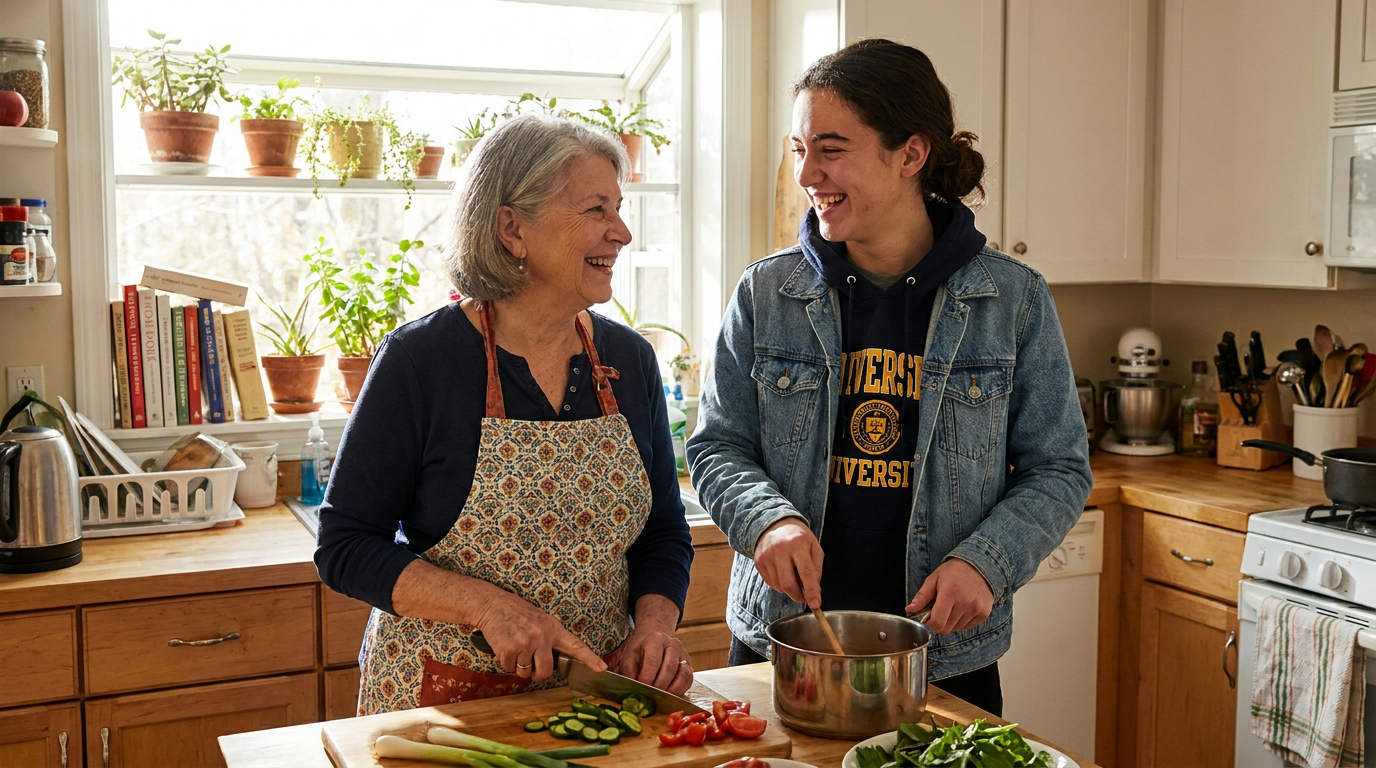
Enter intentional intergenerational homesharing. It is a deceptively simple housing innovation that places two generations under one roof to solve both demographic challenges simultaneously, utilizing resources that already exist within the community.[7]
The mechanism is straightforward: an older adult with a spare bedroom rents it to a younger person, typically a university student or young professional, at a significantly below-market rate. In exchange, the younger tenant agrees to provide basic household assistance—such as grocery shopping, dog walking, or tech support—and, crucially, regular companionship.[4][5]
The economic efficiency of this model is staggering. In the United States alone, researchers estimate there are more than 3.6 million unoccupied rooms that could potentially be rented out. For a graduate student in a major metropolitan area, opting for a homeshare instead of a traditional one-bedroom apartment can yield up to $24,000 in annual savings.[4]

Civic pilot programs have proven the concept's viability on a municipal level. The city of Boston partnered with the technology platform Nesterly to test homesharing among its residents. The pilot revealed that the average homeshare rent settled around $700 per month, with guests saving an additional $100 to $150 by taking on basic household chores.[4]
The success of these early urban pilots has spurred broader, statewide expansions. In 2024, Maine launched a first-of-its-kind statewide homesharing initiative to address its acute housing shortage, recognizing that over 100,000 older adult households in the state are burdened by housing costs and utility maintenance.[5]
Beyond the immediate financial relief, the public health implications are profound. Loneliness is increasingly recognized by the medical community as a severe health crisis for older adults, correlated with a rapid decline in daily functioning, higher rates of clinical depression, and increased overall mortality.[6]
Beyond the immediate financial relief, the public health implications are profound.
The scale of this isolation is vast; the Canadian National Seniors Council estimates that approximately 50 percent of people over the age of 80 report feelings of loneliness. By embedding younger people into the daily lives of seniors, homesharing acts as a direct intervention against this isolation, providing a built-in, daily social safety net.[6]

However, researchers caution that simply placing different age groups in the same zip code does not automatically cure loneliness. A 2023 study published in Innovation in Aging analyzed multigenerational neighborhoods across England and Wales and found that the mere presence of different generations in a community had a weak and non-significant association with reducing loneliness among older adults.[3]
The key differentiator between a mixed-age neighborhood and a successful homeshare is intentionality. For intergenerational living to yield tangible health benefits, the relationships must be structured, reciprocal, and deliberately nurtured.[3][7]
This need for deliberate design was the focal point of a major 2024 report, "Healthier Lives Across Generations," co-authored by Generations United and the Harvard Joint Center for Housing Studies. The blueprint emphasized that successful intergenerational housing requires thoughtful site planning, dedicated programming, and shared spaces that naturally encourage daily interaction.[1][2]
Scaling this model widely requires overcoming significant logistical and psychological hurdles. Opening one's home to a stranger requires a massive leap of trust, and the adult children of older homeowners often express hesitation regarding safety, privacy, and the potential for financial exploitation.[4][7]

To mitigate these risks, successful homesharing programs rely heavily on "agency facilitation." Platforms and civic programs utilize trained social workers to conduct rigorous background checks, interview participants for lifestyle compatibility, and mediate the drafting of highly customized living agreements.[4][5]
These agreements explicitly outline boundaries, privacy expectations, and the exact nature of the chores to be exchanged for rent reduction. This formalization is vital to prevent the younger tenant from being treated as a full-time medical caregiver—a role they are neither trained nor legally permitted to fulfill.[7]
As zoning laws slowly adapt and civic awareness grows, intergenerational homesharing is transitioning from a niche social experiment to a formalized pillar of urban planning. By leveraging existing, underutilized housing stock, communities are finding a practical way to foster empathy across generational divides while keeping their most vulnerable populations safely housed.[1][2][7]

How we got here
2017
The Boston Housing Innovation Lab pilots the Nesterly homesharing platform.
2021
Canada HomeShare expands its intergenerational housing model nationally.
2023
Academic studies confirm that intentionality, not just proximity, is required to combat senior loneliness.
Early 2024
Maine launches a first-of-its-kind statewide homesharing initiative to combat housing shortages.
Fall 2024
Harvard and Generations United publish the Blueprint for Intergenerational Living.
Viewpoints in depth
Public Health Researchers
Focuses on the measurable medical benefits of reducing social isolation.
This camp views homesharing primarily as a healthcare intervention. They point to data showing that loneliness accelerates cognitive decline and increases mortality rates among older adults. For these researchers, the financial exchange of homesharing is secondary to the "social safety net" it creates, arguing that daily, incidental interactions—like sharing a cup of coffee or asking about someone's day—are critical preventative medicine.
Civic Planners & Platforms
Focuses on the logistical execution, safety, and economic viability of the model.
Municipal leaders and platform operators view homesharing as an efficient way to unlock existing, underutilized housing stock without the need for new construction. Their primary concern is scaling the model safely. They emphasize the necessity of rigorous background checks, legal frameworks, and social worker mediation to protect vulnerable seniors from exploitation and ensure students are not burdened with inappropriate caregiving duties.
Intergenerational Advocates
Focuses on the societal value of breaking down age segregation.
Advocacy groups argue that modern society has unnaturally segregated people by age, placing students in dormitories and seniors in care facilities. They champion intentional intergenerational living as a way to restore the natural fabric of communities. This perspective emphasizes mutual empathy, arguing that younger people gain valuable life perspective and mentorship, while older adults regain a sense of purpose and civic engagement.
What we don't know
- How the model will adapt to older adults with advancing medical needs, as students are not equipped to provide professional healthcare.
- Whether zoning laws in strictly single-family neighborhoods will be universally updated to allow for formal homesharing agreements.
- The long-term retention rate of these matches once students graduate and enter the professional workforce.
Key terms
- Aging in place
- The ability of an older adult to remain living safely and independently in their own home or community as they age.
- Homesharing
- An exchange-based housing model where a homeowner rents a spare room to a seeker, often at a discount in exchange for household help.
- Intentional community
- A planned residential setting designed from the start to have a high degree of social cohesion and intergenerational interaction.
- Agency facilitation
- The use of third-party organizations or social workers to vet, match, and support participants in a homesharing arrangement.
Frequently asked
How do homesharing programs ensure safety?
Programs use 'agency facilitation,' involving background checks, reference calls, and trained social workers to vet both hosts and guests before matching.
Do students act as medical caregivers?
No. Students provide basic household help like grocery shopping or dog walking, but they are not expected or permitted to provide medical or personal care.
Does living in a mixed-age neighborhood reduce loneliness?
Research shows that merely living near younger people does not significantly reduce senior loneliness; the interactions must be intentional and structured.
How much money can a student save?
Depending on the city and the amount of household help provided, students can save hundreds of dollars a month, with some estimates suggesting up to $24,000 annually in high-cost areas.
Sources
Source coverage
7 outlets
3 viewpoints surfaced







[1]Generations UnitedIntergenerational Advocates
Healthier Lives Across Generations: A Blueprint for Intergenerational Living
Read on Generations United →[2]Harvard Joint Center for Housing StudiesIntergenerational Advocates
A Blueprint for Intergenerational Living
Read on Harvard Joint Center for Housing Studies →[3]Innovation in AgingPublic Health Researchers
The Impact of Living in Multigenerational Neighbourhoods on Loneliness in Later Life
Read on Innovation in Aging →[4]City of BostonCivic Planners & Platforms
Nesterly Homeshare Pilot Results
Read on City of Boston →[5]National Council of State Housing AgenciesCivic Planners & Platforms
Nesterly’s Online Home-Sharing Platform Open to New Hosts in Maine
Read on National Council of State Housing Agencies →[6]British Columbia Medical JournalPublic Health Researchers
Intergenerational housing as a model for improving older-adult health
Read on British Columbia Medical Journal →[7]Factlen Editorial TeamCivic Planners & Platforms
Synthesis by Factlen editorial team
Read on Factlen Editorial Team →
Every angle. Every day.
Get culture stories with full source coverage and perspective breakdowns delivered to your inbox.