
The Revival of the 'Third Place': How Communities Are Rebuilding Real-World Connection
Driven by digital fatigue and a craving for authentic connection, a new generation is revitalizing physical community hubs—from listening bars to library maker spaces—to combat the modern loneliness epidemic.
By Factlen Editorial Team
- Civic & Public Health Advocates
- Argue that third places are essential public health and democratic infrastructure that must be protected and funded.
- Cultural Observers
- Focus on the behavioral shift of younger generations rejecting digital-only lives in favor of physical community.
- Urban Planners & Analysts
- Focus on the structural and economic realities of building these spaces, including the risks of gentrification.
What's not represented
- · Rural residents who lack the population density to support niche third places like listening bars.
- · Low-income workers who may lack the free time or disposable income to frequent commercial community spaces.
Why this matters
As the loneliness epidemic becomes a recognized public health crisis, the revival of physical 'third places' offers a tangible, accessible cure. Understanding and supporting these community hubs empowers individuals to rebuild their own social networks, improve their mental well-being, and foster a more resilient neighborhood.
Key points
- The 'third place'—a social environment separate from home and work—is experiencing a cultural revival.
- A documented decline in public space usage has contributed to a widespread loneliness epidemic.
- Younger generations are leading the push for offline, 'in real life' community experiences.
- Activity-based hubs like run clubs and maker spaces are replacing traditional, conversation-only venues.
- Public libraries are adapting by transforming from quiet study halls into vibrant community centers.
- Maintaining affordability and accessibility is crucial to prevent these spaces from becoming exclusionary.
In an era where digital connectivity is frictionless and ubiquitous, a profound paradox has emerged: society is experiencing a documented, escalating crisis of loneliness. The missing ingredient for human flourishing, it turns out, is not more time, more money, or better communication software. It is geography. Specifically, sociologists and public health experts are pointing to the quiet disappearance of physical environments where people can simply exist together without an agenda. After years of life mediated through screens, a powerful counter-current is pulling communities back to the tangible world, sparking a conscious movement to rebuild the physical architecture of friendship and civic life.[8]
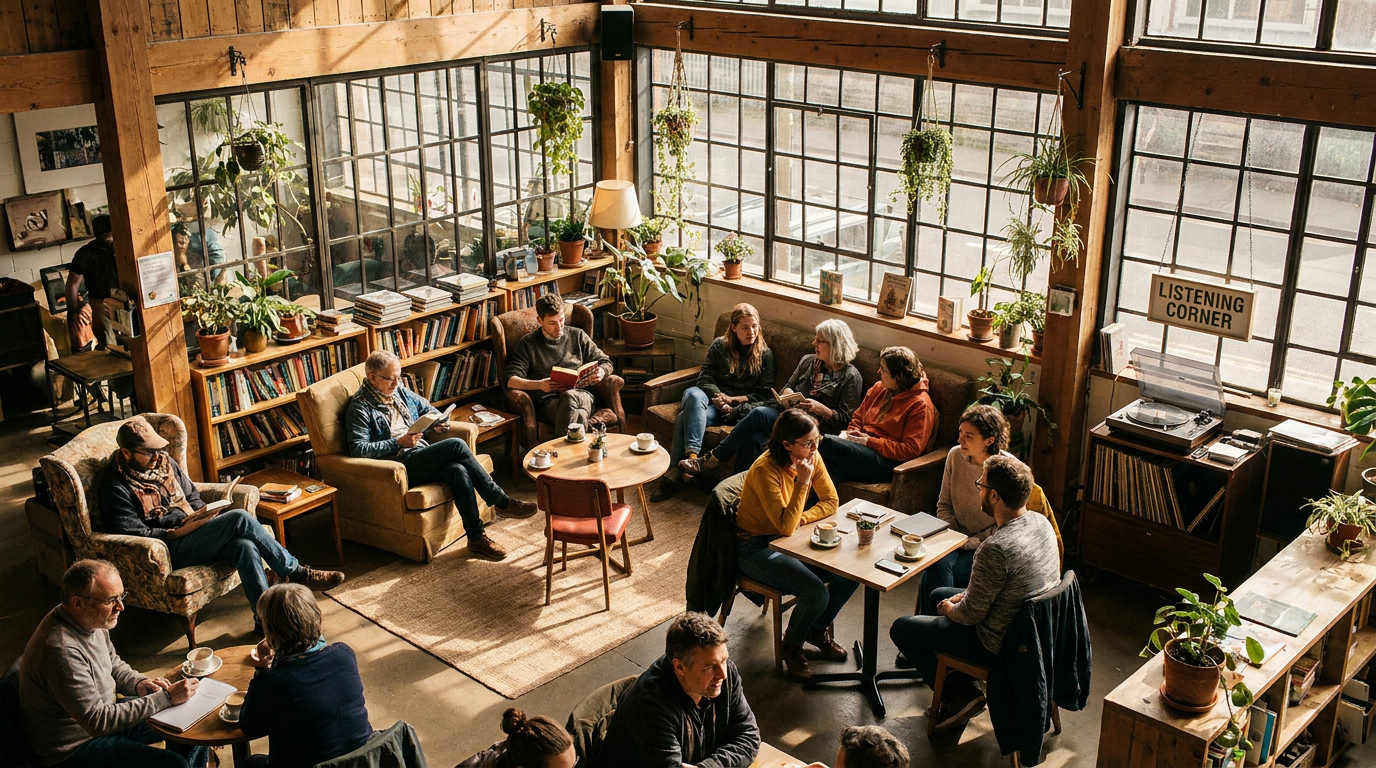
The concept of the "third place" was coined by urban sociologist Ray Oldenburg in his 1989 book The Great Good Place. If the home is the "first place" and the workplace or school is the "second place," the third place is the neutral, accessible ground where people gather informally. These are the environments where the primary activity is conversation, where participation is voluntary, and where the atmosphere is distinctly low-stakes. From the cozy neighborhood coffee shop to the sunlit corner of a public library, these spaces serve as the societal glue that binds individuals into a cohesive community.[3][8]
Historically, third places took the form of local pubs, barbershops, church basements, and bowling alleys. Their defining characteristic is a profound leveling effect: inside a true third place, an individual's corporate title, economic status, or social background ceases to matter. The only price of admission is showing up. In these environments, people are not performing for an audience or producing for an employer; they are simply participating in the shared rhythm of their neighborhood. This casual, unstructured mingling fosters the spontaneous interactions that eventually harden into lasting social bonds.[7]
However, the infrastructure supporting these interactions has been eroding for decades. In his seminal work Bowling Alone, political scientist Robert Putnam documented the steady collapse of American civic life, noting how the disappearance of community organizations and casual gathering spots weakened the social fabric. The rise of the digital "everything app," the convenience of e-commerce, and the lingering behavioral shifts from the pandemic only accelerated this retreat into the private sphere. As the physical third place vanished, the internet attempted to fill the void, but digital platforms often failed to replicate the spontaneity and depth of in-person connection.[1][7]
The data surrounding this civic retreat is stark. According to the 2024 American Social Capital Survey, the public's relationship with commercial and public gathering spaces has fractured dramatically. Half of all Americans report that they never or seldom visited a public park in the past year, and only 15 percent visit one on a weekly basis. The statistics for libraries are even more severe, with 63 percent of respondents stating they had not walked through a library's doors in the previous twelve months. This quiet disappearance of shared space has left a vacuum in the daily lives of millions.[1]

The consequences of this spatial deficit extend far beyond mere boredom, manifesting as a measurable public health crisis. Researchers note that third places serve vital roles in buffering against stress, alienation, and social isolation. The geography of these spaces directly correlates with human connection: Americans who lack access to neighborhood gathering places are more than three times as likely to report having zero close friends compared to those living in amenity-rich communities. Without these unassuming locales, individuals lose access to the crucial networks of trust and mutual support that sustain both mental health and democratic resilience.[1][2]
Yet, a quiet rebellion is currently underway, led largely by the demographic most immersed in the digital world: Generation Z. Having come of age in an era defined by lockdowns and algorithmic social feeds, younger adults are increasingly exhausted by the performative nature of online existence. They are actively logging off and seeking out "IRL" (in real life) experiences, trading the fleeting dopamine hits of endless scrolling for the tangible oxytocin of physical social connection. This demographic is re-pioneering the third place, demanding environments that offer authenticity, shared tempo, and genuine community.[4][5]
Yet, a quiet rebellion is currently underway, led largely by the demographic most immersed in the digital world: Generation Z.
This revival is taking diverse and innovative forms that move beyond the traditional coffee shop model. The new community hubs are highly intentional and often center around a shared, low-stakes activity. Listening bars have emerged as spaces dedicated to the communal, high-fidelity experience of appreciating an album from start to finish, creating a meditative collective vibe. Similarly, neighborhood run clubs, community gardens, and casual pottery studios are booming. These environments provide a structured reason to gather, allowing friendships to form organically over repeated, shared experiences.[5]

The mechanism behind these activity-based third places is particularly effective for those who feel socially out of practice. By centering the gathering around a specific task—whether it is knitting, rock climbing, or playing a board game—the activity itself carries the social load. This significantly lowers the barrier to entry for introverts or individuals experiencing social anxiety, as it removes the pressure to sustain constant, direct conversation. Participants can engage at their own pace, relying on the repeatability of the event to slowly build familiarity and trust week after week.[5][8]
Public institutions are also adapting to this cultural shift, reimagining their roles to better serve as modern third places. Libraries, once strictly guarded as silent study halls, are transforming into vibrant laboratories of community life. At universities and municipal centers alike, libraries now host maker spaces, repair cafés, language exchanges, and open game nights. By embracing the idea that conversation and collaboration are just as valuable as quiet reflection, these institutions are filling the cracks of civic life, offering free, accessible refuge for people to connect without the expectation of spending money.[1][3]

Crucially, well-designed third places possess the unique ability to bridge widening demographic divides. Academic studies highlight that these informal public spaces are essential for fostering intergenerational empathy and reducing ageist stereotypes. In an era where digital spaces often segregate users into generational silos, a physical community hub—like a local park or a mixed-use community center—forces different age groups to interact, share narratives, and co-create experiences. This reciprocal social relation helps dismantle polarization and nurtures a more inclusive, resilient societal identity.[6]
The commercial sector is taking note of this craving for connection, with businesses pivoting to accommodate the demand for experiential gathering spots. Traditional retail malls are being reimagined as lifestyle hubs featuring live entertainment, pop-up events, and communal dining. Meanwhile, independent cafes and restaurants are intentionally hosting curated meetups, supper clubs, and civic forums. These commercial spaces are realizing that their long-term viability depends less on transactional efficiency and more on their ability to foster a genuine sense of belonging among their patrons.[4][8]
However, the resurgence of the third place is not without its sociological challenges, chief among them being the threat of gentrification. As neighborhoods redevelop and certain community hubs become trendy, the resulting economic pressure can displace longtime residents and price out the mom-and-pop shops that historically anchored the area. When professional classes move into traditionally working-class neighborhoods, the cultural character of the local third places often transforms, risking the alienation of the very populations that rely on these spaces the most for daily social support.[3]

For a third place to truly function as intended, it must fiercely protect its accessibility. The ideal community space is open for long stretches of time, remains relatively affordable, and actively cultivates informal interaction among strangers from all walks of life. If a coffee shop requires a seven-dollar purchase just to secure a seat, it inherently excludes a significant portion of the neighborhood, failing the fundamental test of a third place. Inclusive design, both in terms of physical layout and economic barrier to entry, is non-negotiable for these spaces to serve as true societal equalizers.[3][8]
Ultimately, the revival of the third place represents a deliberate course correction in modern culture. It is a rejection of the idea that human connection can be fully optimized, digitized, or outsourced to an app. Rebuilding this vital social infrastructure requires more than just urban planning; it demands a personal, civic commitment to leave the house, engage with neighbors, and participate in the physical world. By intentionally carving out time for these unstructured spaces, communities are reclaiming the shared tempo and everyday pluralism that make life deeply meaningful.[7][8]
How we got here
1989
Sociologist Ray Oldenburg coins the term 'third place' in his book The Great Good Place.
2000
Political scientist Robert Putnam publishes Bowling Alone, documenting the severe decline of American social capital.
2020-2022
Pandemic lockdowns severely restrict access to physical gathering spaces, accelerating societal reliance on digital platforms.
2024-2025
Surveys reveal stark drops in public space usage, prompting a cultural pushback and a craving for 'IRL' connection.
2026
A noticeable resurgence of activity-based community hubs, such as listening bars, run clubs, and library maker spaces, takes hold.
Viewpoints in depth
The Public Health Perspective
Focuses on the medical and sociological necessity of these spaces to combat the loneliness epidemic.
Public health officials and sociologists view the decline of the third place not just as a cultural shift, but as a medical crisis. Research indicates that the absence of accessible community gathering spots directly correlates with higher rates of anxiety, depression, and social isolation. For this camp, funding public parks, libraries, and community centers is a critical investment in preventative healthcare, as these spaces naturally buffer against the stress and alienation of modern life.
The Generational Shift
Focuses on Gen Z's rejection of the digital 'everything app' and the craving for uncurated, offline reality.
Cultural observers note that the revival of the third place is largely driven by younger demographics who are exhausted by the performative nature of social media. Having grown up with digital-first friendships, this group is actively seeking out low-stakes, physical environments where they can simply exist without the pressure to curate a personal brand. This has led to the explosion of activity-based hubs—like run clubs and listening bars—where the shared activity lowers the barrier to entry for social interaction.
The Accessibility Challenge
Focuses on the tension between trendy new commercial third places and the gentrification that prices out working-class communities.
Urban planners and economic analysts caution that the commercialization of the third place carries inherent risks. As community hubs become trendy, they often attract wealthier patrons, driving up local rents and displacing the mom-and-pop establishments that historically served the neighborhood. This perspective emphasizes that a true third place must remain financially accessible; if a space requires a premium purchase just to participate, it ceases to be a community equalizer and instead becomes an exclusive amenity.
What we don't know
- Whether commercial third places can remain financially viable without raising prices to exclusionary levels.
- How suburban and rural areas, which lack dense walkable infrastructure, will adapt to the demand for new community hubs.
- The long-term impact of remote work on the daily utilization of neighborhood third places.
Key terms
- Third Place
- A sociological term for a neutral, accessible public space where people gather informally outside of their home and workplace.
- Social Capital
- The networks of relationships, trust, and cooperation among people who live and work in a particular society, enabling that society to function effectively.
- Gentrification
- The process whereby the character of a poor urban area is changed by wealthier people moving in, often displacing current inhabitants and local businesses.
- Social Infrastructure
- The physical places and organizations—such as libraries, parks, and community centers—that shape the way people interact and build relationships.
Frequently asked
What exactly is a 'third place'?
Coined by sociologist Ray Oldenburg, a third place is an informal, accessible gathering spot outside of the home (first place) and work or school (second place). Examples include cafes, libraries, parks, and community centers.
Why are third places disappearing?
The decline is attributed to a combination of factors, including the rise of digital connectivity and social media, the convenience of e-commerce, pandemic-era behavioral shifts, and the commercial gentrification of neighborhoods.
How do I find a third place if I'm introverted?
Experts recommend seeking out activity-based third places, such as a pottery studio, a run club, or a board game cafe. The shared activity carries the social load, removing the pressure to sustain constant conversation.
Can an online community count as a third place?
While online communities offer valuable niche connections, sociologists note they often lack the spontaneity, physical presence, and deep local ties that make physical third places crucial for combating isolation.
Sources
Source coverage
8 outlets
3 viewpoints surfaced







[1]Washington MonthlyCivic & Public Health Advocates
We're spending less time in 'Third Spaces'—informal gathering spots... How to revive them.
Read on Washington Monthly →[2]NIHCivic & Public Health Advocates
Third places: Centers of community and civic life
Read on NIH →[3]Boston UniversityCivic & Public Health Advocates
What makes a third place so important?
Read on Boston University →[4]Seen and UnseenCultural Observers
Gen Z is re-pioneering Third Places
Read on Seen and Unseen →[5]Young HollywoodCultural Observers
The Third Place Takes Over
Read on Young Hollywood →[6]Emerald InsightCivic & Public Health Advocates
Third places and intergenerational well-being
Read on Emerald Insight →[7]Path NineCultural Observers
Rebuilding the third place
Read on Path Nine →[8]Factlen Editorial TeamUrban Planners & Analysts
Synthesis by Factlen editorial team
Read on Factlen Editorial Team →


Every angle. Every day.
Get lifestyle stories with full source coverage and perspective breakdowns delivered to your inbox.