
How Hall Effect Joysticks Are Eradicating Controller Stick Drift
By replacing physical friction with magnetic sensors, Hall Effect technology is solving the most frustrating hardware failure in modern gaming.
By Factlen Editorial Team
- Hardware Enthusiasts & Repair Advocates
- Independent technicians and gamers view potentiometers as an unacceptable point of failure.
- Third-Party Manufacturers
- Challenger brands are using magnetic sensors to disrupt the console peripheral market.
- Electrical Engineers
- Industrial designers view the gaming application as just one small use-case for a foundational technology.
What's not represented
- · First-party console manufacturers (Sony, Microsoft, Nintendo)
Why this matters
Stick drift forces gamers to replace expensive controllers every few months. The industry-wide shift toward magnetic sensors promises to save consumers money and permanently eliminate a major point of hardware failure.
Key points
- Traditional controllers use potentiometers, which rely on physical friction and inevitably wear down over time.
- Hall Effect joysticks use magnets to measure movement, eliminating physical contact and the resulting wear.
- Third-party manufacturers are rapidly adopting the technology to win market share from first-party console makers.
- While immune to mechanical drift, Hall Effect sticks still require tiny software deadzones to account for physical spring tension.
The universal gamer frustration is a phenomenon known as stick drift. It manifests as a creeping crosshair in a first-person shooter, or a character slowly walking off a ledge when the player's hands are completely off the controller. It is the leading cause of death for modern gamepads, sending millions of expensive, otherwise perfectly functional controllers to landfills every year. For competitive and casual players alike, fighting the hardware instead of the enemy has become an accepted, infuriating reality of modern gaming.[1][7]
The culprits behind this epidemic are the standard analog sticks found in the PlayStation 5 DualSense, the Xbox Wireless Controller, and the Nintendo Switch Joy-Cons. Despite the advanced haptics, adaptive triggers, and sophisticated wireless technology packed inside these premium devices, their directional inputs rely on a mechanical design that is fundamentally doomed to fail. The gaming industry has long treated this degradation as an inevitable reality of hardware wear and tear, but a quiet revolution in peripheral engineering is finally offering a permanent cure.[1][6]
Enter the Hall Effect joystick. Once a niche feature reserved for specialized industrial equipment and a handful of retro consoles, it has rapidly become the most requested specification in modern gaming hardware. By replacing physical friction with magnetic fields, Hall Effect technology promises to eradicate stick drift at the source. Third-party manufacturers are aggressively using this technology to disrupt the peripheral market, and educated consumers are increasingly refusing to spend their money on premium gamepads that lack magnetic sensors.[1][2]
To understand the cure, one must first understand the disease. Traditional controllers use components called potentiometers to measure exactly where your thumb is pushing the analog stick. These components have been the industry standard for decades, prized by console manufacturers for their incredibly low production cost and ease of integration into mass-produced electronics. However, the very nature of how a potentiometer calculates physical movement makes it highly susceptible to long-term damage, especially in an application that requires thousands of rapid, forceful movements per hour.[6]

A potentiometer works through direct physical contact. Inside the joystick module beneath the plastic thumbstick, a tiny metal wiper blade drags across a curved strip of electrically resistive carbon. As the player moves the stick, the wiper slides back and forth along the track, changing the electrical resistance in the circuit. The controller's internal processor constantly reads this shifting resistance to calculate the stick's exact angle and tilt, translating that analog data into digital movement on the screen. It is an elegant, simple system, but one built on friction.[2][6]
That friction is the fatal flaw. Every time a player clicks the stick to sprint in a competitive shooter, forcefully steers a car in a racing simulator, or executes a rapid half-circle motion in a fighting game, that metal wiper scrapes aggressively against the carbon track. Over months of intense use, the physical track begins to wear down. The conductive material is literally scraped away by the player's inputs, compromising the structural integrity of the sensor and permanently altering its baseline electrical resistance.[2][3]
This degradation creates two distinct problems that ruin the controller. First, the uneven track prevents the wiper from reading a clean signal. Second, the scraping generates microscopic conductive dust that floats around inside the module, interfering with the sensor's delicate readings. Eventually, the controller begins registering movement even when the stick is resting perfectly at dead center. This phantom input is the mechanical reality of stick drift, and once it begins, it cannot be fixed without desoldering and replacing the entire module.[2][6]
Hall Effect joysticks eliminate this mechanical wear entirely by operating without any physical contact between the moving parts. The technology is named after American physicist Edwin Hall, who discovered the underlying scientific principle in 1879. While Hall was experimenting with electrical currents and magnets long before the invention of video games, his discovery laid the groundwork for modern solid-state sensors. Today, Hall Effect sensors are relied upon in mission-critical industrial applications, including automotive anti-lock braking systems, brushless motor controllers, and aerospace fluid monitors.[4]
Hall Effect joysticks eliminate this mechanical wear entirely by operating without any physical contact between the moving parts.
The Hall Effect occurs when a magnetic field is applied perpendicularly to an electrical current flowing through a conductor. The magnetic field exerts a Lorentz force on the moving electrons, pushing them to one side of the conductive material. This charge segregation creates a measurable voltage difference across the conductor, which engineers refer to as the Hall voltage. Crucially, this voltage changes in direct proportion to the strength and proximity of the magnetic field, allowing for incredibly precise measurements without any physical components touching one another.[3][4]

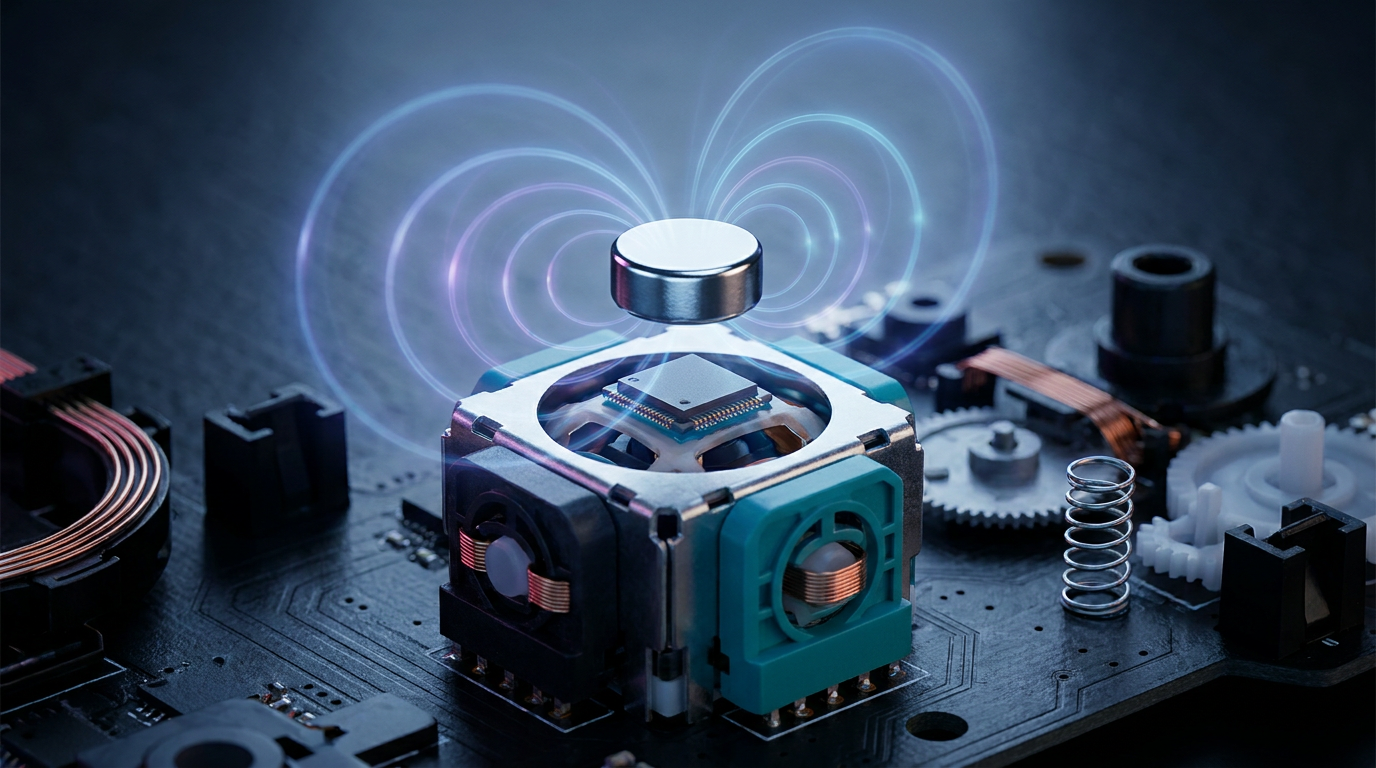
In a modern gaming controller, this 19th-century physics translates into a frictionless, highly durable joystick. Instead of a metal wiper scraping along a carbon track, a Hall Effect joystick places a small, permanent magnet directly on the base of the moving stick itself. The circuit board beneath the stick houses a stationary Hall Effect sensor. As the player manipulates the thumbstick, the magnet dances above the sensor, altering the magnetic field and changing the Hall voltage without ever making physical contact with the board.[2][6]
The stationary sensor detects the changing strength and angle of the magnetic field in real-time, converting that data into a precise electrical signal that the console understands as in-game movement. Because the magnet and the sensor never physically touch, there is zero friction involved in the measurement process. No carbon tracks are scraped, no conductive dust is generated, and the sensor's baseline reading remains pristine regardless of how aggressively the player mashes the sticks during a frantic multiplayer match.[3][4]
The difference in lifespan between the two technologies is staggering. Independent repair technicians and hardware analysts estimate that while standard potentiometers are nearly guaranteed to fail after a few million cycles—often translating to just 6 to 12 months of heavy use for a dedicated gamer—a Hall Effect sensor could theoretically outlast the console itself. By eliminating the primary mechanical failure point, these magnetic sticks offer a level of durability and long-term reliability that traditional gamepads simply cannot match, saving consumers significant money over a console's lifecycle.[2][3]
The gaming peripheral industry is currently undergoing a massive shift as a result of this magnetic technology. Third-party manufacturers like 8BitDo, GameSir, and Turtle Beach have aggressively adopted Hall Effect sticks across their premium and budget product lines. By heavily marketing the drift-proof guarantee, these challenger brands are successfully capturing market share from Sony, Microsoft, and Nintendo. They are proving that educated consumers are willing to invest in third-party hardware that respects their wallets and withstands the test of time, rather than defaulting to official controllers.[1][2]

Ironically, the technology is not entirely new to the gaming space. Sega famously utilized Hall Effect sensors for the analog stick on the Dreamcast controller back in 1999, delivering a highly durable input method well ahead of its time. However, the broader industry largely reverted to cheaper potentiometers in the decades that followed. Console manufacturers prioritized lower manufacturing costs, established supply chains, and perhaps the lucrative replacement market over long-term durability—a collective decision that ultimately led to the modern stick drift epidemic.[1][6]
While Hall Effect sticks solve mechanical drift, it is important to note that they are not entirely immune to minor centering imperfections. A controller's stick relies on a physical metal spring mechanism to snap back to the exact center position when released by the player's thumb. Over time, these physical springs can stretch, wear down, or lose tension due to manufacturing tolerances, meaning the stick might physically rest slightly off-center even when completely untouched by the user.[5]
Because Hall Effect sensors output incredibly precise, raw analog data, they will accurately report this slight physical misalignment to the console. This often registers as a 1% to 3% deviation from true zero. Manufacturers handle this by implementing tiny software "deadzones" that ignore these microscopic inputs, ensuring the crosshair remains perfectly still during gameplay. This is fundamentally different from potentiometer drift; it is a minor software calibration adjustment to account for spring tension, rather than a fatal, worsening mechanical failure of the sensor itself.[5]

Looking ahead, the hardware landscape is already preparing for the next evolution in stick technology: Tunnel Magnetoresistance (TMR) sensors. TMR technology operates on similar magnetic principles to the Hall Effect but offers even higher resolution, lower latency, and significantly lower power consumption. As TMR modules begin to appear in ultra-premium gamepads, the technology promises to push controller precision to new extremes, building upon the frictionless, drift-proof foundation that Hall Effect sensors have successfully established in the mainstream market.[5][7]
For now, the widespread adoption of Hall Effect joysticks represents a rare, definitive victory for consumers in the gaming space. By educating themselves on the mechanics of stick drift and demanding better engineering from peripheral makers, players are actively forcing the industry to abandon the era of planned obsolescence. The frustrating cycle of treating expensive, $70 controllers as disposable commodities is finally coming to an end, replaced by a new standard of magnetic hardware that is genuinely built to last.[7]
How we got here
1879
Edwin Hall discovers the Hall Effect, proving magnetic fields can alter electrical currents.
1999
Sega releases the Dreamcast, featuring a controller with a highly durable Hall Effect analog stick.
2017
The Nintendo Switch launches; widespread Joy-Con drift brings the potentiometer flaw into the mainstream spotlight.
2023-2026
Third-party manufacturers like 8BitDo and GameSir standardize Hall Effect sticks, pressuring the broader industry to adapt.
Viewpoints in depth
Hardware Enthusiasts & Repair Advocates
Independent technicians and gamers view potentiometers as an unacceptable point of failure.
For years, the repair community has highlighted the inherent flaw in physical carbon tracks, noting that stick drift is not a matter of if, but when. They argue that first-party manufacturers have relied on planned obsolescence, forcing consumers to replace $70 controllers annually. To this camp, the widespread availability of Hall Effect modules proves that durable, drift-free hardware is entirely viable and should be the mandatory baseline for the industry.
Third-Party Manufacturers
Challenger brands are using magnetic sensors to disrupt the console peripheral market.
Companies like 8BitDo, GameSir, and Turtle Beach have seized upon consumer frustration with stick drift as a major marketing opportunity. By integrating Hall Effect sensors into their gamepads, they offer a tangible durability advantage over the official controllers from Sony, Microsoft, and Nintendo. This camp emphasizes raw performance, longevity, and precision, using the technology to legitimize third-party controllers as premium alternatives rather than budget compromises.
Electrical Engineers
Industrial designers view the gaming application as just one small use-case for a foundational technology.
From an engineering perspective, the Hall Effect is a proven, century-old principle used in everything from automotive anti-lock brakes to aerospace fluid sensors. Engineers emphasize that the true value of the technology lies in its contactless nature, which makes it immune to environmental degradation like dust, moisture, and friction. To them, replacing mechanical potentiometers with solid-state magnetic sensors in gaming controllers is simply a logical, overdue modernization of consumer electronics.
What we don't know
- Whether first-party manufacturers like Sony, Microsoft, and Nintendo will adopt Hall Effect sticks for their next-generation default controllers.
- How quickly Tunnel Magnetoresistance (TMR) sensors will replace Hall Effect as the new premium standard.
Key terms
- Potentiometer
- A mechanical component that measures position by dragging a metal wiper across a resistive carbon track, prone to wear and tear.
- Stick Drift
- A hardware failure where a controller registers movement even when the joystick is not being touched, usually caused by worn potentiometers.
- Lorentz Force
- The force exerted on a charged particle moving through a magnetic field, which pushes electrons to one side of a conductor to create a measurable voltage.
- Deadzone
- A small area around the center of a joystick's resting position where physical movement is ignored by the software to prevent accidental inputs.
Frequently asked
Do Hall Effect controllers ever get stick drift?
They do not get drift from mechanical wear, which is the primary cause of controller failure. However, the physical centering spring can loosen over time, requiring a tiny software deadzone to keep the stick perfectly centered.
Can I upgrade my current PS5 or Xbox controller to Hall Effect?
Yes, but it is not a simple plug-and-play process. It requires advanced soldering skills to remove the old potentiometer modules and attach the new magnetic sensors, followed by software calibration.
Why don't Sony and Microsoft use Hall Effect sticks?
First-party manufacturers have historically prioritized lower manufacturing costs and existing supply chains. However, mounting consumer pressure and competition from third-party brands may force a shift in the next console generation.
Sources
Source coverage
7 outlets
3 viewpoints surfaced






[1]TechRadarHardware Enthusiasts & Repair Advocates
What are Hall effect controllers? The drift-proof technology explained
Read on TechRadar →[2]Turtle BeachThird-Party Manufacturers
Hall Effect Controllers Explained: The Stick Drift Solution
Read on Turtle Beach →[3]AIM ControllersThird-Party Manufacturers
Hall Effect Sensor Technology to Boost the Performance of Your Controller
Read on AIM Controllers →[4]Monolithic Power SystemsElectrical Engineers
Introduction to Hall Effect Sensors
Read on Monolithic Power Systems →[5]HYPR ControllersThird-Party Manufacturers
Understanding Deadzones and Hall Effect
Read on HYPR Controllers →[6]Controller RepairsHardware Enthusiasts & Repair Advocates
Hall Effect Joysticks: The End of Stick Drift
Read on Controller Repairs →[7]Factlen Editorial TeamElectrical Engineers
Synthesis by Factlen editorial team
Read on Factlen Editorial Team →
Every angle. Every day.
Get gaming esports stories with full source coverage and perspective breakdowns delivered to your inbox.