
How Beanless and Lab-Grown Coffee Are Engineering a Climate-Resilient Morning Brew
As climate change threatens traditional coffee crops and drives up prices, food-tech startups are recreating the beloved beverage using upcycled plants and cellular agriculture. These 'beanless' brews promise up to 95% lower emissions and a stable supply chain, without sacrificing flavor or caffeine.
By Factlen Editorial Team
- Food-Tech Innovators
- Focus on the biotechnology, cellular agriculture, and molecular engineering required to replicate coffee.
- Consumer & Sustainability Watchers
- Focus on Gen Z adoption, shifting morning rituals, and the environmental urgency of replacing traditional beans.
- Market & Investment Analysts
- Focus on the economic viability, B2B scalability, and price stability of beanless coffee.
What's not represented
- · Traditional Coffee Farmers
- · Specialty Coffee Roasters
Why this matters
With wholesale coffee prices surging and climate change threatening half of the world's suitable growing land by 2050, the morning cup of coffee is becoming an environmental and economic luxury. Beanless alternatives offer a way to stabilize prices and drastically reduce water and carbon footprints while preserving the daily ritual.
Key points
- Climate change threatens to halve the land suitable for growing Arabica coffee by 2050, driving up wholesale prices.
- Food-tech startups are creating "beanless" coffee using upcycled ingredients like date pits and chickpeas.
- Cellular agriculture is also being used to grow biologically identical coffee cells in lab bioreactors.
- These alternatives boast up to 95% lower carbon emissions and 98% less water usage than traditional coffee.
- To ease consumer transition and support farmers, many brands are launching 50:50 hybrid blends of real and beanless coffee.
- Nearly half of Gen Z consumers express a willingness to switch to cheaper, greener beanless alternatives.
For centuries, the morning cup of coffee has been a reliable, affordable ritual. But the arithmetic of global coffee production is rapidly breaking down under the weight of climate change. The Arabica bean, which accounts for the vast majority of the world's premium coffee, is notoriously sensitive to temperature and rainfall fluctuations. Agronomists project that the global land area suitable for cultivating Arabica could be slashed in half by 2050. This shrinking footprint, combined with an ever-growing global thirst for caffeine, has triggered severe supply shortages. Last year alone, wholesale Arabica prices spiked by 80%, forcing roasters and cafes to pass the costs onto consumers. As extreme weather events become the baseline rather than the exception, the coffee industry is facing an existential threat that traditional farming methods may not be able to solve alone.[1]
Beyond its vulnerability to a warming planet, traditional coffee cultivation is also a major contributor to the very climate crisis that threatens it. The environmental footprint of a standard cup of joe is staggeringly high. Producing the beans required for a single cup of coffee consumes approximately 140 liters of water. Furthermore, when factoring in the deforestation required to clear land for new coffee plantations, the crop ranks among the most carbon-intensive foods on the planet—trailing only behind dark chocolate and red meats like beef and lamb in greenhouse gas emissions per kilogram. For an industry that prides itself on sustainability pledges and fair-trade certifications, the fundamental mechanics of growing, washing, and shipping billions of pounds of beans across the globe are increasingly difficult to reconcile with global climate targets.[1][4]
In response to this looming crisis, a new sector of food-technology startups is attempting to decouple the coffee experience from the coffee plant entirely. Dubbed "beanless" or "molecular" coffee, this emerging category aims to recreate the exact flavor, aroma, and mouthfeel of traditional coffee without ever planting a single Coffea shrub. Over the past five years, investor interest in this space has surged, with alternative coffee companies raising hundreds of millions of dollars to scale their operations. By shifting production from vulnerable tropical highlands to controlled facilities, these companies promise a climate-resilient supply chain that is immune to droughts, frosts, and volatile commodity markets.[2][5]
The first major mechanism driving the beanless coffee revolution relies on upcycling abundant, low-impact plant materials. Companies like Seattle-based Atomo Coffee and California's Voyage Foods are reverse-engineering the chemical composition of roasted coffee using ingredients that would otherwise go to waste or require minimal resources to grow. Atomo, for instance, utilizes date pits rescued from farmers in the Coachella Valley, alongside a complex blend of ramon seeds, fenugreek, millet, and upcycled fruit fibers. Voyage Foods takes a slightly different approach, relying on a base of roasted rice hulls and chickpeas. By selecting ingredients that are cheap, abundant, and environmentally friendly, these startups are building a new foundation for the global coffee supply.[1][5]

Transforming a handful of date pits and chickpeas into a convincing cup of espresso requires precise molecular engineering. The secret lies in mastering the Maillard reaction—the chemical process responsible for the browning and complex flavor development that occurs when traditional coffee beans are roasted. Food scientists analyze the hundreds of volatile compounds that give Arabica its signature tasting notes, from dark caramel to bright, fruity acidity. They then marinate their upcycled plant bases in a proprietary blend of natural flavors and subject them to a highly controlled thermal process. This cross-Maillard reaction synthesizes the exact chemical markers found in conventional coffee, tricking the human palate into experiencing the familiar depth and bitterness of a morning brew.[1]
Of course, a convincing flavor profile is only half of the coffee equation; the functional energy boost is equally critical. Because the upcycled roots, seeds, and legumes used in beanless coffee do not naturally contain caffeine, manufacturers must introduce it during the formulation process. Most leading beanless brands opt to infuse their grounds and liquid concentrates with caffeine extracted from green tea. This approach not only matches the exact stimulant levels of a traditional cup but is often reported to provide a smoother, more sustained energy lift without the jittery spikes and crashes associated with high-acidity conventional coffee. The result is a functional beverage that delivers the expected physiological kick while remaining entirely bean-free.[1][5]
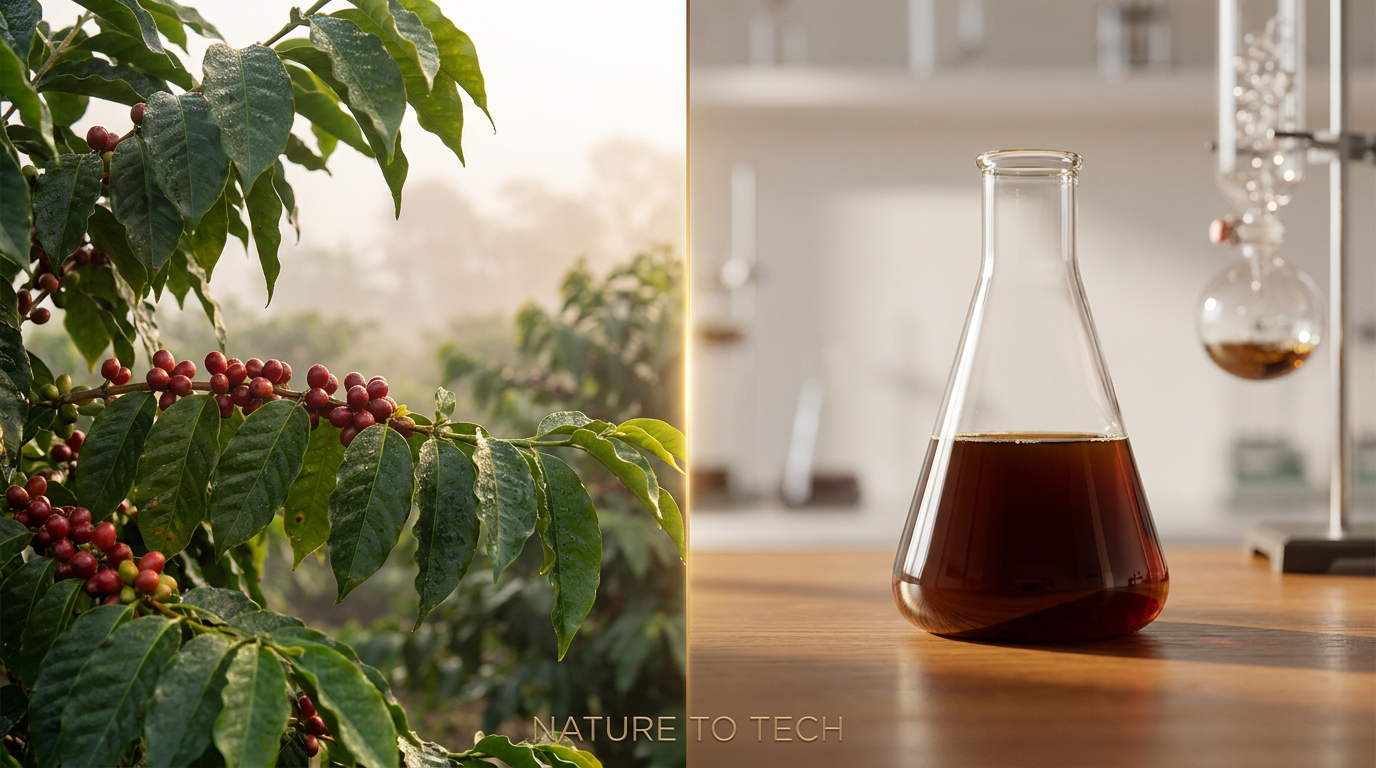
While upcycling offers a highly scalable solution, a second, more futuristic mechanism is quietly gaining traction: cellular agriculture. Rather than mimicking coffee with other plants, companies in this space are growing actual coffee from the cellular level up. Startups like Pluri and Swiss-based Food Brewer are pioneering the use of plant cell culture to cultivate authentic coffee biomass in a laboratory setting. This process mirrors the technology used to create cultivated meat, but applies it to the plant kingdom, offering a way to produce genuine coffee DNA without the need for vast agricultural acreage or the vulnerability of traditional farming.[4][7]
While upcycling offers a highly scalable solution, a second, more futuristic mechanism is quietly gaining traction: cellular agriculture.
The cellular agriculture process begins by extracting a small sample of cells from the leaf of a high-quality coffee plant. These native cells are placed into a nutrient-rich solution within a large, climate-controlled bioreactor. In this optimized environment, the cells rapidly multiply and expand, forming a dense biomass in a matter of weeks rather than the years it takes for a coffee shrub to mature and bear fruit. Once the biomass reaches the desired volume, it is harvested, dried into a powder, and roasted just like traditional green coffee beans. Because the end product is made entirely from native coffee cells, it is biologically identical to conventional coffee, offering an uncompromised flavor profile without the environmental baggage.[4][7]

The environmental arithmetic of both upcycled and lab-grown coffee is highly compelling. Life-cycle assessments conducted by leading beanless startups reveal dramatic reductions in resource consumption. Companies utilizing cellular agriculture and precision fermentation report up to a 98% reduction in water usage and a 95% decrease in land requirements compared to traditional coffee farming. Similarly, upcycled brands like Atomo and Koppie boast greenhouse gas emissions that are 83% to 95% lower than their conventional counterparts. By eliminating the need for deforestation, chemical fertilizers, and transcontinental shipping, beanless coffee offers a viable pathway to decarbonizing one of the world's most beloved beverages.[1][7]
Beyond the environmental benefits, beanless coffee presents a powerful economic proposition for the food service industry. As traditional coffee prices remain highly volatile, alternative brews offer a stable, predictable cost structure. Voyage Foods, which recently launched its bean-free range for commercial food service providers, notes that its product can be up to 40% cheaper than conventional coffee, depending on order volume. For cafes, restaurants, and consumer packaged goods manufacturers operating on razor-thin margins, this price stability is a massive draw. It allows them to hedge against supply chain disruptions and climate-induced price spikes while maintaining consistent quality for their customers.[1][5]
Despite these advantages, most beanless coffee executives recognize that entirely replacing traditional coffee is a monumental—and perhaps unnecessary—task. Instead, the industry is increasingly pivoting toward a "hybrid" strategy. Companies like Belgium's Koppie and Seattle's Atomo are actively partnering with established cafes and roasters to offer 50:50 blends, mixing conventional coffee beans with their beanless alternatives. Atomo recently rolled out its half-and-half blend across all 58 locations of the US specialty chain Bluestone Lane, proving that consumers are willing to embrace a compromised approach that balances tradition with sustainability.[1][2]
The hybrid model serves multiple strategic purposes. First, it significantly lowers the overall carbon footprint and water usage of a cafe's menu without requiring customers to abandon the traditional coffee they love. Second, it acts as a volume extender, allowing roasters to stretch their supply of premium, climate-threatened Arabica beans much further. By blending high-quality conventional coffee with a molecularly identical beanless base, cafes can maintain their signature flavor profiles while insulating themselves from the worst of the commodity market's price shocks. It is a pragmatic stepping stone that introduces consumers to the concept of alternative coffee in a familiar, low-risk format.[1]

The rise of beanless coffee inevitably raises concerns about the potential impact on the 125 million people globally whose livelihoods depend on traditional coffee farming. Critics worry that a massive shift toward lab-grown or upcycled alternatives could devastate rural economies in the Global South. However, alternative coffee founders argue that their goal is not to displace farmers, but rather to absorb the immense, compounding global demand that traditional agriculture simply cannot meet. As global coffee consumption continues to outpace production, beanless alternatives can fill the supply gap, preventing the need for farmers to clear new swaths of virgin rainforest to expand their acreage in a desperate bid to keep up.[1]
Ultimately, the success of beanless coffee will hinge on consumer acceptance, and early indicators suggest a generational shift is underway. While older demographics remain fiercely loyal to traditional, brew-at-home beans, younger consumers are demonstrating a remarkable openness to food-tech innovations. Recent industry surveys indicate that up to 48% of Gen Z consumers would willingly switch to a beanless coffee alternative if it proved to be cheaper and more environmentally friendly. This demographic is already driving the surge in cold brews, functional beverages, and plant-based milks, making them the ideal early adopters for a product that aligns with their climate anxieties and evolving palate.[3][4][6]
As the realities of a warming planet continue to reshape global agriculture, the definition of what constitutes a "real" cup of coffee is fundamentally expanding. Whether cultivated in a bioreactor from native leaf cells or meticulously engineered from roasted chickpeas and date pits, these innovations represent a necessary evolution of the morning ritual. By decoupling the beverage from the vulnerable Coffea plant, scientists and food-tech entrepreneurs are ensuring that future generations can still enjoy the comfort, flavor, and energy of coffee—even in a world where the traditional bean has become a rare luxury.[6][7]
How we got here
2019
Food-tech startups begin experimenting with molecular coffee, seeking to recreate the flavor profile without the bean.
2022
Atomo Coffee raises $40 million to accelerate the launch of its ready-to-drink beanless coffee range.
2024
Wholesale Arabica prices spike by 80% due to extreme weather, accelerating commercial interest in stable coffee alternatives.
May 2024
Voyage Foods secures $52 million to scale its bean-free brews made from roasted rice hulls and chickpeas.
Jan 2025
Atomo Coffee expands its 50:50 hybrid blend into major US cafe chains like Bluestone Lane.
Feb 2026
Belgian startup Koppie raises new funding to launch its legume-based hybrid coffee across the European market.
Viewpoints in depth
The Food-Tech Innovators' View
Startups engineering beanless coffee prioritize climate resilience and supply chain stability.
For the scientists and entrepreneurs behind companies like Atomo, Voyage Foods, and Pluri, traditional coffee agriculture is a mathematical impossibility in a warming world. They argue that the only way to meet growing global demand without accelerating deforestation is to decouple the beverage from the vulnerable Coffea plant. By utilizing upcycled agricultural waste or cellular bioreactors, this camp believes they can perfectly replicate the molecular experience of coffee while slashing water use and carbon emissions by over 90%. To them, the future of coffee is a precise, scalable recipe rather than a geographical harvest.
The Traditional Coffee Industry's View
Roasters and farmers emphasize the irreplaceable terroir of real beans and the livelihoods at stake.
Traditionalists in the specialty coffee sector view beanless alternatives with a mix of skepticism and concern. They argue that coffee is an agricultural art form defined by 'terroir'—the unique soil, altitude, and microclimate that give single-origin beans their distinct flavor profiles, which cannot be truly replicated in a lab. Furthermore, advocacy groups highlight the socio-economic stakes: over 125 million people in the Global South rely on coffee farming for their livelihoods. This camp insists that investment should flow toward developing climate-resilient Arabica hybrids and supporting farmers through the climate transition, rather than replacing their crops entirely.
The Climate Advocates' View
Environmentalists view beanless coffee as a necessary intervention to halt deforestation.
For climate advocates, the romance of traditional coffee is overshadowed by its staggering ecological footprint. Noting that coffee is among the most carbon-intensive foods—and a leading driver of tropical deforestation as farmers move to higher, cooler altitudes—this group champions beanless alternatives as a critical harm-reduction strategy. They point to the 140 liters of water required for a single conventional cup as an unsustainable luxury. While acknowledging the economic risks to farmers, these advocates argue that the sheer scale of the climate crisis demands radical shifts in how resource-heavy commodities are produced.
What we don't know
- Whether beanless coffee can truly replicate the complex terroir and nuanced flavor profiles of single-origin specialty coffees.
- How traditional coffee-producing nations will adapt their economies if lab-grown alternatives capture a significant market share.
- The long-term regulatory hurdles for cellular agriculture coffee in major markets like the EU and US.
Key terms
- Cellular Agriculture
- The production of agricultural products from cell cultures rather than whole plants or animals, often using bioreactors to grow the cells.
- Maillard Reaction
- A chemical reaction between amino acids and reducing sugars that gives browned food—including roasted coffee—its distinctive flavor.
- Precision Fermentation
- A technology that uses microorganisms to produce specific complex organic molecules, often used to recreate the exact flavor compounds found in traditional foods.
- Hybrid Coffee
- A blended beverage that mixes traditional roasted coffee beans with beanless or lab-grown coffee alternatives to reduce costs and environmental impact.
Frequently asked
Does beanless coffee contain real caffeine?
Yes. While the upcycled plant bases (like chickpeas or date pits) do not naturally contain caffeine, manufacturers extract natural caffeine from sources like green tea and add it to the brew, matching the exact stimulant levels of traditional coffee.
How is lab-grown coffee different from plant-based alternatives?
Plant-based alternatives use upcycled ingredients like date pits and legumes to mimic coffee's flavor. Lab-grown (or cellular agriculture) coffee uses actual cells taken from a coffee leaf, growing them in a bioreactor to create a product that is biologically 100% coffee.
Will beanless coffee put traditional farmers out of business?
Startups argue their goal is not to replace farmers, but to absorb the excess global demand that traditional agriculture cannot meet due to climate change. Many companies are focusing on 50:50 hybrid blends that still utilize conventional beans.
Is beanless coffee cheaper to buy?
At scale, beanless coffee can be significantly cheaper. Some manufacturers report their commercial bean-free concentrates are up to 40% cheaper than conventional wholesale coffee, offering price stability against volatile agricultural markets.
Sources
Source coverage
7 outlets
3 viewpoints surfaced





[1]Green QueenFood-Tech Innovators
Legume Lattes: Koppie Brews Up New Funding to Launch Beanless Coffee By Year-End
Read on Green Queen →[2]Perfect Daily GrindMarket & Investment Analysts
Investment opportunities are growing in the beanless coffee category
Read on Perfect Daily Grind →[3]ForbesConsumer & Sustainability Watchers
Brew Better with Sustainable Coffee Makers
Read on Forbes →[4]FoodUnfoldedConsumer & Sustainability Watchers
Lab-grown coffee: Changing tastes and preferences
Read on FoodUnfolded →[5]Ingredients NetworkMarket & Investment Analysts
Competition heats up in the beanless coffee category
Read on Ingredients Network →[6]Institute of Food TechnologistsConsumer & Sustainability Watchers
Coffee Companies Brew Up New Options
Read on Institute of Food Technologists →[7]Forward FoodingFood-Tech Innovators
Beyond the Bean: Alternative & Lab-Grown Coffee Fueling the Future
Read on Forward Fooding →
Every angle. Every day.
Get food drink stories with full source coverage and perspective breakdowns delivered to your inbox.