
How Virtual Reality is Revolutionizing Vocational Training and the Skilled Trades
Apprenticeships are undergoing a high-tech transformation as virtual reality simulators allow trainees to master complex, dangerous skills faster and safer than ever before.
By Factlen Editorial Team
- Labor Unions & Policymakers
- View VR as a critical tool to scale the workforce and secure infrastructure goals.
- Industry Employers
- Focus on the immediate cost reductions and objective performance analytics.
- Vocational Instructors
- Emphasize that VR is a powerful stepping stone, not a replacement for live practice.
What's not represented
- · Traditional Journeymen skeptical of digital tools
- · Small business owners unable to afford VR systems
Why this matters
As a massive generation of skilled tradespeople retires, the global economy faces a critical labor shortage that threatens housing, infrastructure, and green energy goals. Virtual reality is accelerating the training pipeline, ensuring the next generation of workers can safely and efficiently build the physical backbone of the future.
Key points
- The skilled trades are facing a severe labor shortage as millions of veteran workers reach retirement age.
- Virtual reality (VR) simulators are being rapidly adopted to accelerate apprenticeship training and improve safety.
- VR training can increase long-term knowledge retention to 80% and reduce workplace injuries by 45%.
- Academic research indicates a 'hybrid model'—combining VR simulation with live physical practice—is the most effective approach.
- Governments in the U.S. and Canada are investing tens of millions of dollars to expand tech-enabled Registered Apprenticeships.
The skilled trades are currently facing a massive demographic cliff across North America and Europe. Millions of veteran electricians, welders, plumbers, and heavy machinery operators are reaching retirement age, preparing to take decades of hard-earned muscle memory and troubleshooting instincts with them. This generational exit is creating a severe knowledge vacuum on job sites, leaving contractors scrambling to fill highly technical roles. The traditional apprenticeship model—where a novice spends years watching a master and practicing on live equipment—is simply too slow to replace this departing workforce at the necessary scale.[1]
At the exact same time, the demand for these specialized roles is surging to unprecedented levels. Driven by massive national infrastructure investments, a booming housing market, and the rapid transition toward green energy technologies, the need for skilled labor has never been higher. Contractors are tasked with building complex solar arrays, advanced manufacturing facilities, and next-generation electrical grids, all of which require a highly trained workforce. The industry is realizing that it cannot rely solely on the slow, methodical training methods of the past century if it hopes to meet the demands of the modern economy.[1]
Enter the "digital apprenticeship." Across the globe, vocational schools, labor unions, and major employers are turning to virtual reality (VR) and augmented reality (AR) to fundamentally rewire how the trades are taught. By integrating immersive digital environments into their curricula, these organizations are accelerating the learning curve and making the trades more accessible to a wider demographic. This technological shift is not about replacing the human element of craftsmanship; rather, it is about amplifying human ability and creating clearer, safer pathways from novice to expert.[1][8]
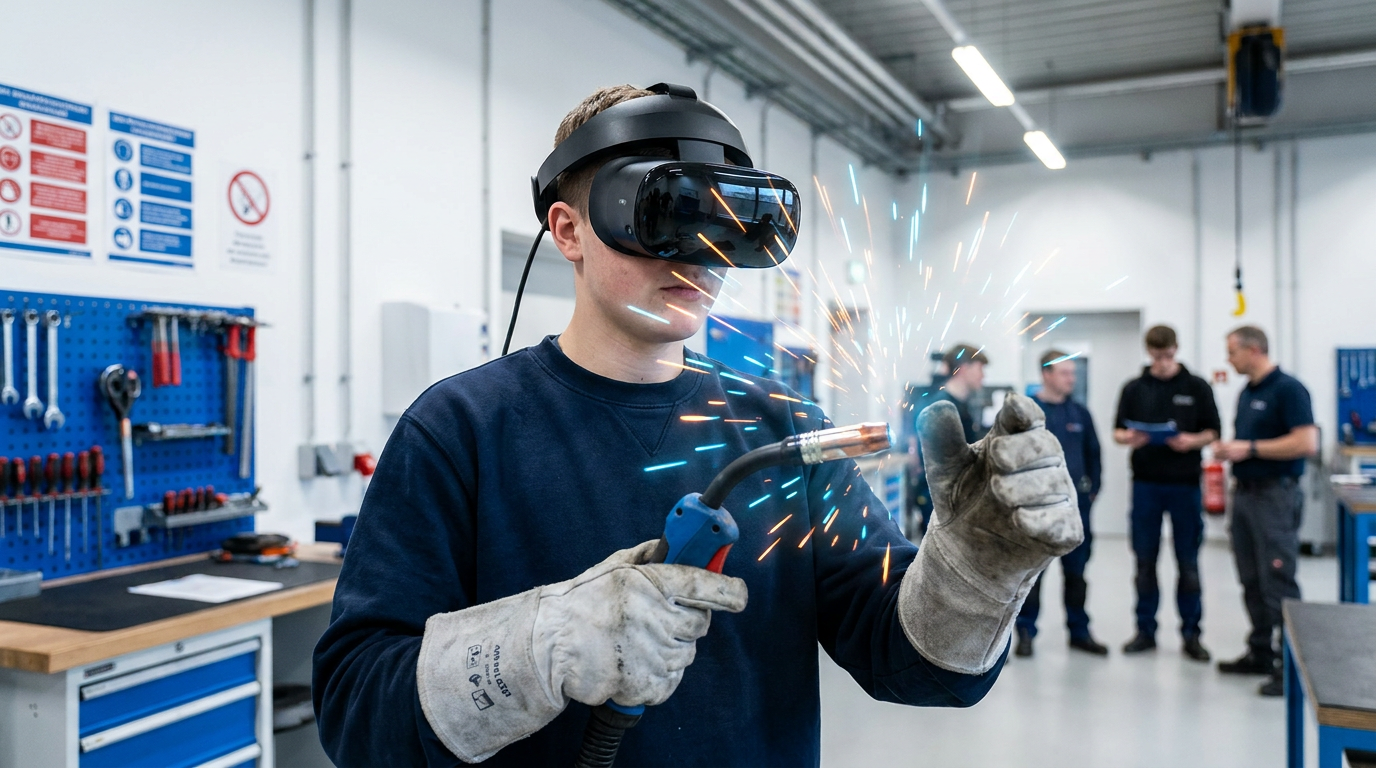
The core mechanism of this transformation is the VR simulator. By strapping on a high-resolution headset and picking up a specialized, weighted controller, a trainee can instantly step onto a virtual construction site or into a digital welding booth. Here, they can practice high-risk, complex procedures—such as operating a crane or wiring a high-voltage panel—in a completely controlled, consequence-free environment. If a mistake is made, the system simply resets, allowing the apprentice to try again without any physical danger or material cost.[1][8]

The technology powering these simulators goes far beyond simple visual representation. Modern VR systems incorporate precise haptic feedback, allowing users to physically feel the vibration of a power tool, the resistance of a piece of metal, or the kickback of a heavy machine. This tactile engagement is crucial for developing the muscle memory required in the trades. The brain processes these simulated physical sensations much like it would a real-world experience, bridging the gap between theoretical knowledge and practical application.[3]
In a virtual welding module, for example, the system tracks an astonishing array of data points in real-time. It monitors the exact angle of the torch, the travel speed across the joint, and the precise placement of the weld bead. If the apprentice moves too fast, holds the torch at an incorrect angle, or fails to maintain the proper distance, the system provides immediate visual and auditory corrections. This instant feedback loop prevents bad habits from forming and allows trainees to perfect their technique before they ever strike a real arc.[3]
This level of granular, objective feedback is completely transforming the educational learning curve. According to comprehensive research and industry reports from PwC, employees trained via virtual reality can retain up to 80 percent of the information they learn even a full year later. In stark contrast, traditional classroom methods—such as reading manuals or watching instructional videos—often yield retention rates of just 10 to 20 percent. The immersive, active nature of VR forces the brain to engage deeply with the material, cementing the knowledge permanently.[4]
Beyond the massive improvements in knowledge retention, the safety benefits of virtual reality training are profound. A detailed study conducted by the University of Maryland's Virtual Lab found that implementing VR training leads to a remarkable 45 percent reduction in workplace injuries and accidents. By allowing novices to familiarize themselves with dangerous environments digitally, they develop crucial situational awareness and a healthy respect for the hazards of the job long before they are exposed to real-world risks.[7]
Beyond the massive improvements in knowledge retention, the safety benefits of virtual reality training are profound.
In the virtual environment, trainees can safely experience the catastrophic consequences of a mistake. They can witness a simulated electrical arc flash, a structural collapse, or a dropped load from a crane, understanding the severity of the error without suffering any physical harm. This experiential learning builds a deep-seated culture of safety. When the apprentice eventually transitions to a live job site, they are already conditioned to recognize warning signs and follow proper safety protocols instinctively.[7][8]

The economic advantages of this technology are equally compelling for employers, unions, and vocational training centers. Practicing in a virtual environment means there is absolutely zero wasted material. Trainees do not burn through expensive steel plates, waste costly welding gas, or consume electricity unnecessarily. Furthermore, there is no wear-and-tear on actual heavy machinery, which can cost hundreds of thousands of dollars to repair or replace. This allows training programs to stretch their budgets further and accommodate larger cohorts of students.[1][3]
However, academic researchers and veteran trades instructors are quick to point out that virtual reality is not a wholesale replacement for the physical world. A comprehensive 2025 longitudinal action research study published by Emerald Publishing closely examined the efficacy of VR specifically within vocational welding training programs. The researchers sought to understand exactly where the digital simulation excelled and where it inevitably fell short when compared directly to traditional, hands-on workshop instruction. Their findings provided a highly nuanced view of exactly how this technology should be integrated into the modern educational curriculum.[3]
The study concluded that while VR drastically accelerated the acquisition of fundamental procedural skills and significantly reduced trainee anxiety, it could not fully replicate the visceral reality of the trade. The simulation could not perfectly mimic the intense, radiating heat of a live welding arc, the physical exhaustion of dragging heavy cables across a shop floor, or the unpredictable variables of working with imperfect materials. The physical endurance required for the trades still demands real-world conditioning.[3]
Because of these limitations, the academic and industry consensus points to a "hybrid training model" as the absolute gold standard for modern apprenticeships. In this model, apprentices build their procedural confidence, understand the safety protocols, and develop initial muscle memory in the virtual environment. Once they have mastered the digital metrics, they transition to live materials to refine their sensory experience and adapt to the unpredictable nature of a real-world job site.[3][8]
Recognizing the immense potential of this hybrid approach, governments across North America are pouring unprecedented levels of funding into modernized training pathways. In early 2026, the U.S. Department of Labor announced a massive $145 million funding initiative designed to expand performance-based Registered Apprenticeships. A significant portion of this funding is targeted at integrating advanced technologies into training programs for key infrastructure sectors, including advanced manufacturing and green energy.[5]

Similarly, the Government of Canada recently allocated close to $20 million in targeted funding to organizations like the United Brotherhood of Carpenters & Joiners. This substantial investment is specifically earmarked to deliver virtual reality training on complex tasks like rigging and hoisting to thousands of journeypersons and apprentices nationwide. These federal investments underscore a broad recognition that technological modernization is essential for national economic competitiveness.[6]
Beyond efficiency and safety, virtual reality is also breaking down stubborn geographic barriers to vocational education. In largely rural states like North Dakota, educational initiatives are deploying VR headsets directly into middle and high school classrooms. This allows students living hours away from major industrial centers to virtually tour advanced manufacturing facilities and explore technical careers without the logistical hurdles of physical travel, democratizing access to career exploration.[2]
This early, immersive exposure is proving crucial for attracting a younger, tech-native demographic to professions they might otherwise overlook or dismiss. When a high school student puts on a headset and realizes that modern manufacturing and construction involve robotics, artificial intelligence, and virtual reality, the outdated stigma surrounding "blue-collar" work begins to rapidly fade. The trades are successfully rebranding themselves as high-tech, forward-thinking career paths.[2][8]

Ultimately, the integration of virtual reality and augmented reality is doing much more than just speeding up the educational pipeline; it is fundamentally elevating the craft itself. By blending the tactile, time-honored foundation of the skilled trades with the precision, safety, and analytics of digital technology, the industry is evolving. The next generation of tradespeople is entering the workforce safer, smarter, and more capable than any generation that came before them.[1][8]
How we got here
2015–2019
Early VR simulators are introduced to vocational programs, primarily focusing on basic visual familiarization rather than precise physical mechanics.
2020–2023
The pandemic accelerates the adoption of digital training tools, pushing developers to improve haptic feedback and real-time analytics.
2025
Academic studies confirm that hybrid VR-traditional models outperform purely traditional training in both retention and safety metrics.
Early 2026
The U.S. and Canadian governments announce major funding initiatives to scale VR and tech-enabled apprenticeships across national infrastructure sectors.
Viewpoints in depth
Vocational Instructors
Emphasize that VR is a powerful stepping stone, not a replacement for live practice.
Veteran instructors acknowledge that VR drastically reduces the time it takes to learn the mechanics of a trade. However, they caution that a simulator cannot fully replicate the intense heat of a welding arc, the physical exhaustion of carrying heavy cables, or the unpredictable variables of an active construction site. For this group, the 'hybrid model'—where digital repetition is followed by extensive real-world finishing—is the only way to produce truly competent journeymen.
Labor Unions & Policymakers
View VR as a critical tool to scale the workforce and secure infrastructure goals.
Faced with a massive wave of retirements and ambitious national infrastructure projects, policymakers and union leaders see VR as a scalability multiplier. By reducing the bottleneck of limited physical lab space and instructor availability, they can push larger cohorts through the pipeline faster. Furthermore, the gamified, high-tech nature of VR training is viewed as a vital recruitment tool to attract younger, digitally native generations who might otherwise default to four-year university degrees.
Industry Employers
Focus on the immediate cost reductions and objective performance analytics.
For employers, the appeal of VR lies heavily in risk mitigation and cost savings. Training a novice on a $150,000 piece of heavy machinery carries immense liability and wear-and-tear costs. VR eliminates material waste—such as burned steel and welding gas—while providing objective, data-driven analytics on a trainee's progress. Employers can review a candidate's digital performance metrics before ever putting them on a live, high-stakes job site.
What we don't know
- Whether the long-term career trajectory of VR-trained apprentices differs significantly from those trained entirely through traditional methods over a 10-to-20 year horizon.
- How quickly smaller, independent contracting businesses will be able to afford and adopt these expensive VR simulator systems.
- The extent to which fully augmented reality (AR) glasses will eventually replace VR headsets by overlaying digital instructions directly onto live, physical job sites.
Key terms
- Haptic Feedback
- Technology that simulates the sense of touch by applying forces, vibrations, or motions to the user, allowing them to 'feel' virtual tools.
- Digital Apprenticeship
- A modernized training pathway that integrates AI, augmented reality, and virtual reality alongside traditional on-the-job mentorship.
- Hybrid Training Model
- An educational approach that sequences virtual simulation practice before transitioning the learner to live, physical tasks.
- Registered Apprenticeship
- An industry-driven, high-quality career pathway where employers can develop and prepare their future workforce, often backed by government standards and funding.
Frequently asked
Does virtual reality replace hands-on training in the trades?
No. Research shows that a 'hybrid model' is most effective. VR is used to build muscle memory and procedural confidence safely, but apprentices must still transition to live materials to experience the true physical demands of the job.
Which trades are currently using VR simulators?
VR is widely used in welding, HVAC, electrical work, spray painting, and heavy machinery operation (such as cranes, bulldozers, and forklifts).
How does VR training save money?
It eliminates the need for physical consumable materials during the early learning phases. Trainees don't waste expensive steel, gas, or electricity, and there is no wear-and-tear on actual heavy equipment.
Is the government supporting this technology?
Yes. Both the U.S. Department of Labor and the Government of Canada have recently announced tens of millions of dollars in grant funding to expand modernized, tech-enabled Registered Apprenticeships.
Sources
Source coverage
8 outlets
3 viewpoints surfaced








[1]PeopleReadyIndustry Employers
How technology is transforming skilled trades training
Read on PeopleReady →[2]EdSurgeLabor Unions & Policymakers
Tech to Supplement Lower Resourced Areas
Read on EdSurge →[3]Emerald PublishingVocational Instructors
Virtual reality in welding training: a longitudinal action research study
Read on Emerald Publishing →[4]PwCIndustry Employers
How virtual reality is redefining soft skills and technical training
Read on PwC →[5]U.S. Department of LaborLabor Unions & Policymakers
US Department of Labor announces $145M in funds supporting performance-based Registered Apprenticeship expansion across key industry sectors
Read on U.S. Department of Labor →[6]Government of CanadaLabor Unions & Policymakers
Government of Canada announces close to $20 million in funding for virtual reality training
Read on Government of Canada →[7]University of Maryland Virtual LabVocational Instructors
VR Training Efficacy and Workplace Safety Statistics
Read on University of Maryland Virtual Lab →[8]Factlen Editorial TeamIndustry Employers
Synthesis by Factlen editorial team
Read on Factlen Editorial Team →


Every angle. Every day.
Get education stories with full source coverage and perspective breakdowns delivered to your inbox.