
OLED vs. Mini-LED TVs: Comparing 2026's Premium Display Technologies
As television technology advances, the choice between OLED's perfect black levels and Mini-LED's blinding peak brightness comes down to your viewing environment and usage habits.
By Factlen Editorial Team
- Home Theater Purists
- Prioritize absolute black levels, infinite contrast, and pixel-perfect accuracy for cinematic viewing in dark rooms.
- Bright-Room Viewers
- Value peak brightness and glare reduction above all else to combat natural sunlight in open-concept living spaces.
- Hardcore Gamers
- Seek the lowest possible input lag and motion blur, but are divided on the risk of HUD burn-in.
- Value Maximizers
- Focus on the price-to-performance ratio, particularly when scaling up to massive 75-inch and 85-inch screen sizes.
What's not represented
- · Commercial Digital Signage Operators
- · Budget-Conscious Consumers
Why this matters
A premium TV is a multi-year investment often exceeding $1,500. Choosing the wrong panel technology for your living room's lighting or your gaming habits can lead to washed-out pictures, frustrating glare, or premature screen degradation.
Key points
- OLED TVs use self-illuminating pixels to achieve perfect black levels and infinite contrast.
- Mini-LED TVs use thousands of microscopic backlights, allowing them to achieve blinding peak brightness.
- OLED is the superior choice for dark rooms, wide seating arrangements, and cinematic movie viewing.
- Mini-LED is the definitive choice for bright, sunlit rooms and users who watch heavy amounts of static content.
- While OLED burn-in risk has been drastically reduced by modern software, Mini-LED remains entirely immune to it.
- Mini-LED technology scales to massive screen sizes (85+ inches) much more affordably than OLED.
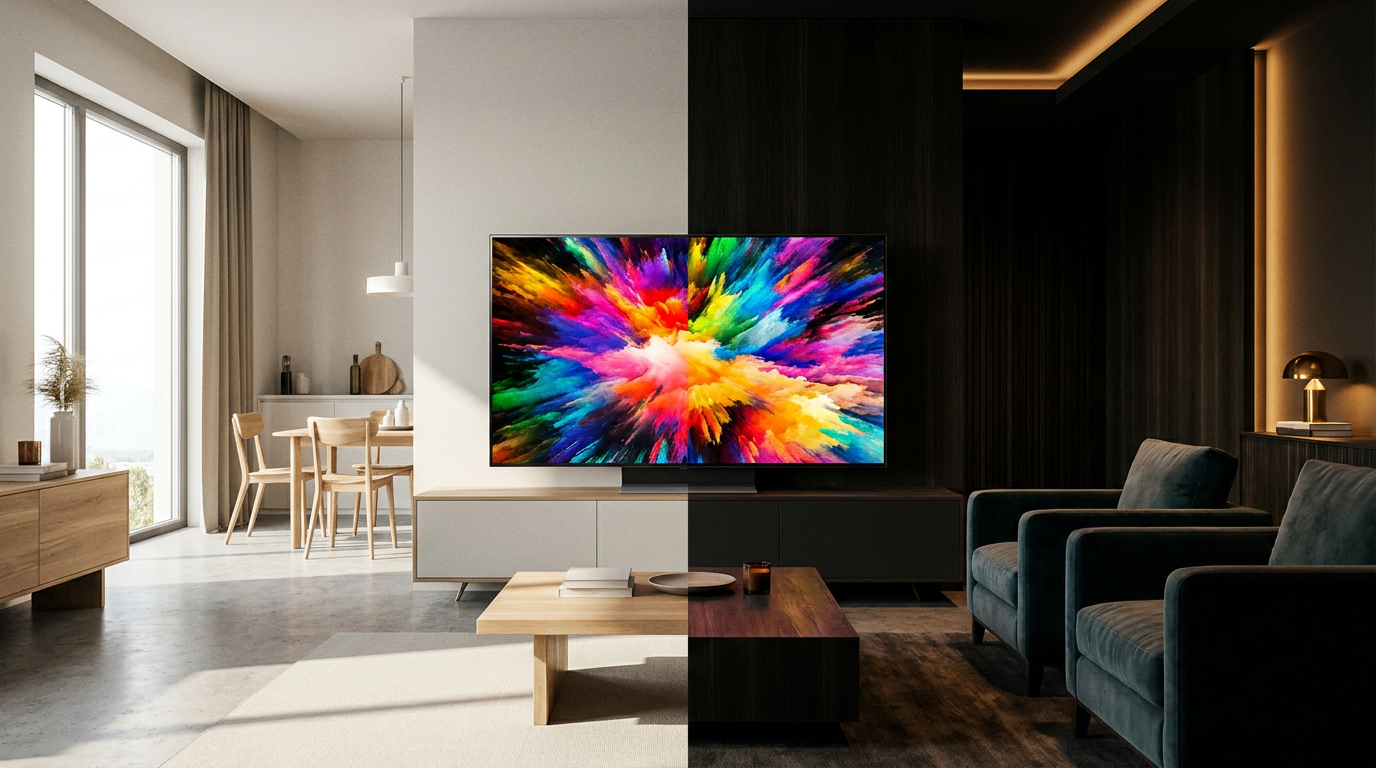
The premium television market in 2026 is defined by a two-horse race that has fundamentally changed how consumers experience home entertainment. Gone are the days of standard edge-lit LCDs dominating the high end; today, buyers are faced with a choice between two distinct, highly refined panel technologies: OLED (Organic Light-Emitting Diode) and Mini-LED. Both represent the absolute pinnacle of consumer display engineering, yet they achieve their breathtaking visuals through entirely opposing methods.[1][5]
While both technologies promise stunning 4K and 8K resolutions, vibrant colors, and smooth motion, the "best" TV is no longer an objective metric. Instead, it is a highly subjective decision dictated by the specific lighting conditions of your living room, the type of content you consume, and your primary viewing habits. Understanding the underlying mechanics of each panel type is the only way to ensure your investment matches your environment.[1][6]
At the heart of the OLED proposition is the concept of self-illuminating pixels. In an OLED display, there is no traditional backlight panel sitting behind the screen. Instead, each of the 8.3 million individual pixels in a 4K panel generates its own light and color independently when an electrical current is applied.[4]
This self-emissive nature allows OLEDs to achieve something no other consumer technology can: true, absolute black. When an OLED TV needs to display a dark night sky or a cinematic shadow, it simply turns off the power to the pixels in that specific area completely. The resulting infinite contrast ratio provides an image with a three-dimensional depth and "pop" that home theater enthusiasts have championed for over a decade.[2][5]

Mini-LED, conversely, represents the absolute apex of traditional LCD technology. Rather than relying on self-lit pixels, Mini-LED panels use a liquid crystal display layer that must be illuminated by a backlight. However, instead of a few dozen large LEDs, the backlight is composed of thousands of microscopic LEDs divided into thousands of independent "local dimming zones."[4][6]
By intelligently dimming or turning off specific zones behind dark areas of the picture, Mini-LEDs can simulate the deep blacks of an OLED. While early iterations of this technology suffered from "blooming"—a distracting halo effect around bright objects on dark backgrounds, like white subtitles on a black bar—2026's advanced processing algorithms and massively increased zone counts have reduced this artifact to near-imperceptible levels for the average viewer.[2][6]
Where Mini-LED truly flexes its engineering muscle is in sheer luminance. Because it relies on a dedicated, highly efficient backlight array rather than organic compounds, a premium Mini-LED TV can push peak brightness levels well past 3,000 nits. This blinding brightness is a game-changer for High Dynamic Range (HDR) content, allowing specular highlights—like the glint of sun on a car windshield or a fiery explosion—to render with lifelike, squint-inducing intensity.[3][5]
Where Mini-LED truly flexes its engineering muscle is in sheer luminance.
More importantly, this massive light output makes Mini-LED the undisputed champion of bright, sun-drenched living rooms. If your viewing space features large windows or skylights, an OLED panel can sometimes struggle to cut through the ambient glare, resulting in a washed-out image. A Mini-LED TV simply overpowers the sun, maintaining its punchy vibrancy regardless of the room's ambient light.[5][6]

OLED technology, however, has not remained stagnant in the brightness wars. The introduction of Micro Lens Array (MLA) technology and Quantum Dot OLED (QD-OLED) panels has significantly boosted OLED luminance over the past few years, allowing top-tier models to comfortably clear 1,500 nits in peak HDR highlights.[3][4]
Yet, OLEDs still employ an Automatic Brightness Limiter (ABL) to protect the panel from overheating and degradation. When a scene requires the entire screen to be bright—such as a hockey game or a snow-covered landscape—the TV will automatically dim the overall image to manage power and heat. Mini-LEDs suffer no such full-screen brightness limitations, holding their maximum brightness across the entire panel indefinitely.[2][4]
For gamers, the comparison becomes a fascinating trade-off of specialized benefits. OLED panels boast a near-instantaneous pixel response time of roughly 0.1 milliseconds. This eliminates motion blur entirely, resulting in crystalline clarity during fast-paced first-person shooters, fighting games, or racing simulators. The motion handling on an OLED is mathematically superior to any LCD-based panel.[2][5]
However, the specter of "burn-in" remains OLED's most persistent caveat. Because the organic compounds degrade over time with use, displaying static elements—like a news ticker, a sports score bug, or a video game heads-up display (HUD)—for thousands of hours can leave a permanent ghost image etched into the screen.[2]
Modern OLEDs employ aggressive mitigation tactics to combat this, including imperceptible pixel shifting, localized dimming of static logos, and automatic panel refresh cycles that run while the TV is in standby. Accelerated longevity testing confirms that for varied, mixed usage—watching a blend of movies, varied games, and TV shows—burn-in is highly unlikely to occur within the typical 7-to-10-year lifespan of the television.[2][6]
Still, for users who leave their TVs tuned to a single news network all day, or hardcore gamers who play the exact same HUD-heavy title for hundreds of hours consecutively, Mini-LED offers complete peace of mind. Mini-LED panels are entirely immune to permanent burn-in, making them the definitively safer long-term investment for static-heavy viewing habits.[2][5]

Ultimately, the decision in 2026 requires an honest assessment of your environment and habits. If you watch movies in a light-controlled or dark room, sit at wide angles, and crave perfect contrast and cinematic depth, OLED remains the gold standard. If your living room is flooded with daylight, you watch a lot of daytime sports, or you want a massive 85-inch screen without paying an exorbitant premium, Mini-LED is the triumphant, worry-free choice.[1][5][6]
How we got here
2013
The first large-screen OLED televisions enter the consumer market, establishing a new benchmark for contrast.
2019
Mini-LED technology debuts in premium consumer displays, offering a high-brightness alternative to OLED.
2022
Quantum Dot OLED (QD-OLED) panels are introduced, significantly boosting the color volume and brightness of emissive displays.
2026
Premium Mini-LED zone counts surpass 5,000, virtually eliminating blooming and closing the contrast gap with OLED.
Viewpoints in depth
Home Theater Purists
Prioritize absolute black levels, infinite contrast, and pixel-perfect accuracy for cinematic viewing in dark rooms.
For cinephiles who watch movies in light-controlled environments, OLED remains the undisputed king. This camp argues that the ability to turn a pixel completely off creates a three-dimensional depth to the image that no backlight system can replicate. They point to the pixel-level light control as essential for preserving the director's original intent in moody, shadow-heavy films, arguing that even the best Mini-LEDs will exhibit minor blooming around stars in a night sky or white text on a black background.
Bright-Room Viewers
Value peak brightness and glare reduction above all else to combat natural sunlight in open-concept living spaces.
Consumers with large windows, skylights, or open-concept living rooms prioritize raw luminance. This perspective argues that OLED's perfect blacks are useless if the screen acts as a mirror reflecting the room's ambient light. They champion Mini-LED for its ability to push past 3,000 nits, ensuring that daytime sports broadcasts and daytime gaming remain punchy, vibrant, and easily visible without needing to draw blackout curtains.
Hardcore Gamers
Seek the lowest possible input lag and motion blur, but are divided on the risk of HUD burn-in.
The gaming community is split based on the types of games they play. Competitive players favor OLED for its near-instantaneous 0.1ms response time, which eliminates motion blur during rapid camera movements. However, gamers who sink hundreds of hours into single titles with static heads-up displays (like MMOs or UI-heavy RPGs) often lean toward Mini-LED. The complete immunity to burn-in allows them to play marathon sessions without the anxiety of permanently etching a health bar into their premium display.
Value Maximizers
Focus on the price-to-performance ratio, particularly when scaling up to massive 75-inch and 85-inch screen sizes.
For buyers looking to maximize screen real estate, the manufacturing realities of the two technologies dictate the choice. Producing massive, defect-free sheets of OLED material is incredibly expensive, causing prices to skyrocket exponentially past 65 inches. Value-focused buyers point out that Mini-LED utilizes established LCD manufacturing infrastructure, allowing consumers to purchase an 85-inch Mini-LED for roughly the same price as a 65-inch OLED, making it the clear winner for sheer scale.
What we don't know
- Whether MicroLED—a technology combining OLED's self-lit pixels with Mini-LED's brightness and durability—will become affordable for average consumers before the end of the decade.
- Exactly how long the newest generation of QD-OLED and MLA OLED panels will last before noticeable brightness degradation occurs under heavy, real-world use.
Key terms
- OLED
- Organic Light-Emitting Diode; a display technology where each individual pixel generates its own light, allowing for perfect black levels.
- Mini-LED
- An advanced LCD technology that uses thousands of microscopic LEDs as a backlight, divided into zones that can dim independently to improve contrast.
- Nits
- A unit of measurement for the brightness of a display. A standard laptop screen is around 300 nits, while a premium HDR TV can exceed 2,000 nits.
- Local Dimming
- A feature on LED/LCD TVs that dims the backlight behind dark areas of the picture to improve black levels and contrast.
- Burn-in
- Permanent image retention caused by displaying static elements (like logos or game HUDs) for excessive periods, primarily affecting OLED panels.
- ABL (Automatic Brightness Limiter)
- A protective mechanism in OLED TVs that automatically dims the screen when a large portion of the image is bright, preventing overheating and panel damage.
Frequently asked
Is OLED burn-in still a major problem in 2026?
For the vast majority of users, no. Modern OLEDs feature aggressive mitigation technologies like pixel shifting and automatic refresh cycles. However, if you exclusively watch a single news channel with a static ticker all day, burn-in remains a risk.
Which technology is better for PS5 or Xbox gaming?
Both are excellent, but they offer different perks. OLED provides near-instantaneous response times for zero motion blur, while Mini-LED offers blinding HDR highlights and zero risk of permanent burn-in from static game HUDs.
Why are 85-inch OLED TVs so much more expensive than Mini-LEDs?
Manufacturing massive, defect-free sheets of organic emissive material is incredibly difficult and yields fewer usable panels per production run. Mini-LEDs use traditional LCD manufacturing infrastructure, which scales to massive sizes much more cost-effectively.
What is 'blooming' on a Mini-LED TV?
Blooming is a halo effect that occurs when the backlight zones behind a bright object (like white text) bleed light into the surrounding dark areas of the screen. High-end 2026 Mini-LEDs have largely minimized this with thousands of microscopic dimming zones.
Sources
Source coverage
6 outlets
4 viewpoints surfaced






[1]Factlen Editorial TeamHardcore Gamers
Synthesis by Factlen editorial team
Read on Factlen Editorial Team →[2]RTINGSHome Theater Purists
Accelerated Longevity and Burn-In Test: 2026 Update
Read on RTINGS →[3]Display Supply Chain ConsultantsValue Maximizers
Advanced TV Shipments Forecast: Mini-LED and OLED Market Share
Read on Display Supply Chain Consultants →[4]IEEE SpectrumHome Theater Purists
The Physics of Modern Displays: How Emissive and Transmissive Panels Work
Read on IEEE Spectrum →[5]WiredBright-Room Viewers
The Best TVs for Every Budget and Room Size
Read on Wired →[6]TechRadarBright-Room Viewers
OLED vs Mini-LED: Which TV tech should you buy?
Read on TechRadar →

Every angle. Every day.
Get shopping stories with full source coverage and perspective breakdowns delivered to your inbox.