
OLED vs. Mini-LED in 2026: How to Choose the Right TV Technology for Your Room
The gap between OLED and Mini-LED televisions has narrowed significantly in 2026, transforming the buying decision from a question of quality into a question of environment.
By Factlen Editorial Team
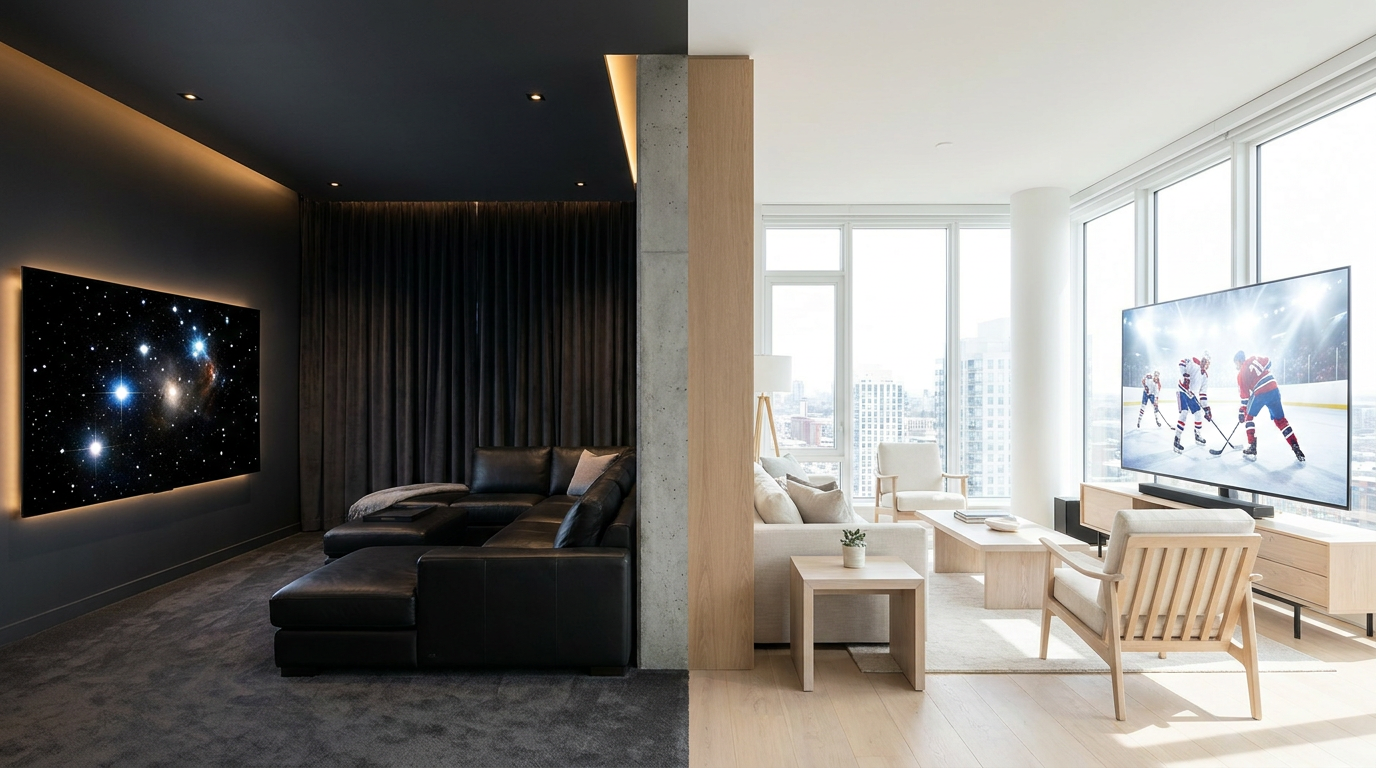
- Cinematic Purists
- Prioritizes absolute black levels and pixel-level contrast for mastering and viewing films.
- Bright-Room Viewers
- Prioritizes sustained full-screen brightness and glare reduction for daytime viewing.
- Creative Professionals
- Balances OLED's shadow detail against Mini-LED's sustained brightness stability for color grading.
- Value & Size Maximizers
- Focuses on getting the largest possible screen and long-term durability for the lowest price.
What's not represented
- · Environmental advocates concerned with the power consumption and e-waste implications of massive 100-inch displays.
- · Budget-conscious consumers who are priced out of both flagship OLED and high-zone Mini-LED models.
Why this matters
With flagship televisions now costing thousands of dollars, choosing the wrong display technology can result in a washed-out picture in a bright living room or distracting halos during movie night. Understanding the precise trade-offs between OLED and Mini-LED ensures you invest in a screen that actually matches your home's lighting and your daily viewing habits.
Key points
- The 2026 TV market offers two distinct flagship technologies: self-emissive OLEDs and backlight-driven Mini-LEDs.
- OLED televisions deliver perfect black levels, infinite contrast, and near-instantaneous response times, making them ideal for dark home theaters.
- Mini-LED televisions offer massive peak brightness up to 5,000 nits and immunity to burn-in, excelling in sunlit living rooms.
- OLED technology remains susceptible to automatic dimming in bright scenes and carries a slight risk of long-term image retention.
- Mini-LED panels can suffer from blooming around bright objects and color degradation when viewed from wide angles.
- Choosing the right television now depends entirely on matching the panel's specific engineering strengths to the lighting conditions of the room.
The television market in 2026 has reached a fascinating inflection point where the two dominant premium display technologies—OLED and Mini-LED—have largely solved their historical weaknesses. For years, the buying advice was simple: buy an OLED for a dark room and an LED for a bright one. Today, that binary choice is obsolete. Manufacturers have pushed organic light-emitting diode panels to unprecedented brightness levels using micro-lens arrays and tandem structures, while simultaneously equipping Mini-LED televisions with tens of thousands of microscopic dimming zones. The result is a consumer landscape where both technologies offer spectacular performance, but choosing the right one requires a precise understanding of how their underlying engineering interacts with your specific living room, viewing habits, and budget.[1][2][7]
At the architectural level, the difference comes down to how each screen generates light. OLED panels are self-emissive, meaning every single one of the 8.3 million pixels on a 4K display creates its own light and color independently. When an OLED pixel needs to display black, it simply turns off completely, resulting in an infinite contrast ratio and zero light bleed. Mini-LED, conversely, is a highly evolved liquid crystal display that relies on a backlight. Instead of a few dozen large bulbs, it uses thousands of microscopic inorganic light-emitting diodes grouped into local dimming zones. These zones dim or brighten based on the content, pushing light through a quantum dot layer to create the final image.[1][5]
When making the case for OLED, the primary argument centers on its absolute precision and flawless contrast. Because there is no backlight shining behind the pixels, OLED televisions deliver perfect black levels. A bright white star can sit directly next to the pitch-black vacuum of space without any light spilling over into the darkness. This pixel-level control creates a sense of depth and three-dimensionality that backlight-driven displays struggle to replicate perfectly. Furthermore, because the light is generated at the surface without passing through liquid crystal layers, OLED panels offer virtually perfect viewing angles, ensuring that colors remain accurate even if you are sitting far to the side of the screen.[5][7]

The evidence supporting OLED's dominance in precision is overwhelming, particularly in the gaming and home theater sectors. Independent testing of 2026 flagship models shows pixel response times of roughly 0.03 milliseconds, which is up to thirty times faster than the best Mini-LEDs. This near-instantaneous transition eliminates motion blur and ghosting during fast-paced esports or action films. Additionally, color grading professionals note that OLED's ability to hit absolute blacks around 0.0005 nits gives them unmatched control over near-black shadow detail, making it the reference standard for mastering cinematic content in dark studio environments.[3][7]
However, the case against OLED rests on two persistent engineering realities: automatic brightness limiters and long-term organic degradation. Because OLED pixels generate heat, the television's internal processor must protect the panel from overheating or burning out. When a scene features a massive expanse of bright white—such as a hockey rink or a snow-covered landscape—the television automatically dims the entire screen to manage power and thermals. While 2026 models have raised the threshold significantly, this aggressive roll-off can still frustrate viewers watching winter sports or bright commercials.[3]
However, the case against OLED rests on two persistent engineering realities: automatic brightness limiters and long-term organic degradation.
The evidence for these OLED drawbacks is well-documented in long-term stress tests. While outright hardware failure rates for modern OLEDs are remarkably low, 10,000-hour cumulative tests reveal that static elements can still cause uneven pixel wear. Users who leave news tickers running all day, or PC gamers who display static heads-up displays for marathon sessions, risk permanent image retention. Furthermore, while peak highlights on 2026 tandem OLEDs can briefly touch 2,800 nits, their sustained full-screen brightness hovers closer to 300 or 400 nits, which can look washed out in a sun-drenched living room with massive unshaded windows.[2][3][6]
Conversely, the argument for Mini-LED is built entirely on brute-force brightness, inorganic durability, and sheer scale. By utilizing gallium nitride semiconductors that do not decay in a biological sense, Mini-LED televisions can sustain massive amounts of heat and current without any risk of permanent burn-in. This makes them practically invincible against static logos, video game interfaces, and desktop taskbars. More importantly, they can hold a full-field white screen at maximum brightness indefinitely, punching through the worst daytime glare without ever triggering an automatic dimming algorithm.[1][6]

The evidence for Mini-LED's sheer power is staggering in the 2026 lineup. Flagship models routinely achieve peak HDR brightness levels between 3,000 and 5,000 nits, making highlights blindingly realistic and colors incredibly vibrant even in rooms flooded with natural sunlight. Furthermore, the technology scales much more cost-effectively than OLED. As consumers increasingly demand massive screens, Mini-LED has completely taken over the 98-inch to 115-inch market. For the price of a premium 77-inch OLED, buyers can often secure a 100-inch Mini-LED that transforms a living room into a commercial-scale theater.[2][4][5]
The argument against Mini-LED focuses on its inherent optical compromises: blooming and viewing angle degradation. No matter how many thousands of dimming zones a manufacturer packs into the backlight, those zones are still vastly larger than individual pixels. When a bright object moves across a dark background—like white subtitles on a black letterbox bar—the backlight zone illuminating the text inevitably spills light into the surrounding darkness. This creates a faint gray halo, or blooming effect, that can momentarily break the immersion of a moody, high-contrast scene.[1][5]
The evidence against Mini-LED is most apparent in off-axis viewing and complex starfield tests. Because the light must travel through multiple layers of quantum dots and liquid crystals, the image loses contrast and color saturation when viewed from the side. If your living room features a wide, horseshoe-shaped seating arrangement, guests sitting on the far ends will see a noticeably washed-out picture compared to the person in the center seat. Additionally, when displaying thousands of tiny stars, Mini-LED algorithms often have to crush the brightness of the stars to prevent massive blooming, losing the specular punch that OLED delivers effortlessly.[3][7]

Ultimately, the decision requires matching the technology to the environment. OLED fits perfectly when your primary viewing happens in a light-controlled room, when you prioritize cinematic shadow detail, or when you need the absolute fastest pixel response times for competitive gaming. It is the definitive choice for movie enthusiasts who want to see films exactly as the director mastered them in a dark grading suite. However, OLED does not fit well when the television will be placed in a sun-drenched room with open blinds, or if it will be used as a primary PC monitor displaying static windows for eight hours a day.[3][5][6]
On the other hand, Mini-LED fits exceptionally well when the television lives in a bright, open-concept living room where daytime sports viewing is a priority. It is the undisputed champion for buyers who want a massive 98-inch or larger screen without taking out a second mortgage, and it offers total peace of mind for households that leave news networks or static games paused for hours on end. Mini-LED does not fit well when your seating arrangement forces viewers to sit at extreme angles, or if your viewing diet consists entirely of dark, atmospheric cinema where even the slightest backlight haloing would ruin the experience.[1][4][7]
How we got here
2013
The first consumer OLED televisions hit the market, establishing a new benchmark for perfect black levels but struggling with low brightness.
2019
Mini-LED technology is introduced to consumer televisions, dramatically increasing the number of backlight zones to combat OLED's contrast advantage.
2022
QD-OLED panels launch, combining quantum dots with OLED to improve color saturation and peak brightness.
2024
Micro-lens array (MLA) technology pushes OLED brightness past 1,500 nits, narrowing the gap with traditional LED displays.
2026
Mini-LED zone counts reach 20,000 while OLEDs hit 2,800 nits, creating a market where both technologies offer flagship-tier performance without their historical flaws.
Viewpoints in depth
Cinematic Purists
Prioritizes absolute black levels and pixel-level contrast for mastering and viewing films.
For home theater enthusiasts and professional color graders, the conversation begins and ends with contrast. Because OLED can turn individual pixels completely off, it achieves a VESA True Black standard that backlight technologies cannot replicate. This camp argues that the depth and three-dimensionality created by perfect shadows far outweigh the need for blinding peak brightness, especially in light-controlled rooms where films are meant to be watched.
Bright-Room Viewers
Prioritizes sustained full-screen brightness and glare reduction for daytime viewing.
Viewers with open-concept, sunlit living rooms argue that infinite contrast is useless if the screen is covered in window reflections. This perspective champions Mini-LED for its ability to sustain 3,000 to 5,000 nits of brightness indefinitely without triggering automatic dimming limiters. For sports fans and daytime watchers, the sheer optical punch of a Mini-LED panel ensures the image remains vibrant and visible regardless of ambient light.
Value & Size Maximizers
Focuses on getting the largest possible screen and long-term durability for the lowest price.
As the demand for massive televisions grows, this camp focuses on the price-to-inch ratio. While OLED remains highly competitive up to 77 inches, Mini-LED dominates the 85-inch, 98-inch, and 115-inch categories. Furthermore, buyers in this camp value the inorganic durability of Mini-LED, arguing that the complete immunity to permanent burn-in makes it a safer long-term investment for households that leave the television running all day.
What we don't know
- How the newest 2026 tandem OLED structures will hold up to burn-in over a 10-year lifespan, as the technology is too new for decade-long real-world data.
- Whether the cost of manufacturing 100-inch OLED panels will ever drop enough to challenge Mini-LED's dominance in the ultra-large screen market.
Key terms
- OLED
- Organic Light-Emitting Diode; a display technology where each individual pixel generates its own light and can turn off completely for perfect blacks.
- Mini-LED
- An advanced LCD technology that uses thousands of microscopic LED bulbs grouped into dimming zones to provide highly controlled backlighting.
- Nits
- A standard unit of measurement for screen brightness; one nit is roughly equivalent to the light of one candle per square meter.
- Blooming
- A visual artifact on backlit televisions where light from a bright object bleeds into adjacent dark areas, creating a halo effect.
- ABL (Auto Brightness Limiter)
- A protective software mechanism in OLED televisions that automatically dims the screen when too much of the picture is bright white, preventing overheating.
- Local Dimming Zones
- Specific clusters of backlight LEDs that can dim or brighten independently to improve contrast on an LCD television.
Frequently asked
Does OLED still suffer from burn-in in 2026?
While modern mitigation features like pixel shifting and micro-lens arrays have drastically reduced the risk, cumulative burn-in is still possible if static images (like news tickers or PC taskbars) are displayed for thousands of hours.
What is blooming on a Mini-LED TV?
Blooming, or haloing, occurs when the backlight zones behind bright objects (like white subtitles) spill light into the surrounding dark areas of the screen, creating a faint gray glow.
Which TV is better for gaming?
OLED is generally preferred for competitive gaming due to its near-instantaneous 0.03ms response time and lack of motion blur, though Mini-LED is safer for gamers who play the same HUD-heavy game for marathon sessions.
Why are 98-inch TVs mostly Mini-LED?
Manufacturing massive OLED panels without defects is extremely expensive. Mini-LED technology scales much more cost-effectively, allowing manufacturers to offer 98-inch and 100-inch screens at accessible consumer prices.
Sources
Source coverage
7 outlets
4 viewpoints surfaced






[1]CNETBright-Room Viewers
Mini-LED vs. OLED: Which TV Tech Should You Get?
Read on CNET →[2]Data Wire SolutionsValue & Size Maximizers
Best TVs for 2026: 10 OLED and Mini-LED Picks by Room, Brightness, and Install Reality
Read on Data Wire Solutions →[3]KTCCreative Professionals
OLED vs. Mini-LED for 2026 Creative Pros: Which Panel Wins for Color Grading?
Read on KTC →[4]ZDNETBright-Room Viewers
The best 98-inch TVs of 2026
Read on ZDNET →[5]EcoPicksGoCinematic Purists
LG G5 OLED vs LG QNED9M Mini LED Comparison (2026 Buyer's Guide)
Read on EcoPicksGo →[6]Tech ShieldValue & Size Maximizers
DON'T Buy a 2026 OLED Until You See This Burn-In Protection Ranking
Read on Tech Shield →OLED vs Mini-LED — The Shocking Winner You Didn't Expect (2026)
Read on SenseCast →
Every angle. Every day.
Get shopping stories with full source coverage and perspective breakdowns delivered to your inbox.