
House Passes Landmark 'Faster Labor Contracts Act,' Setting Up Senate Showdown
The U.S. House of Representatives has passed a bipartisan bill that would fundamentally reshape federal labor law by imposing strict deadlines and binding arbitration on initial union contracts.
By Factlen Editorial Team
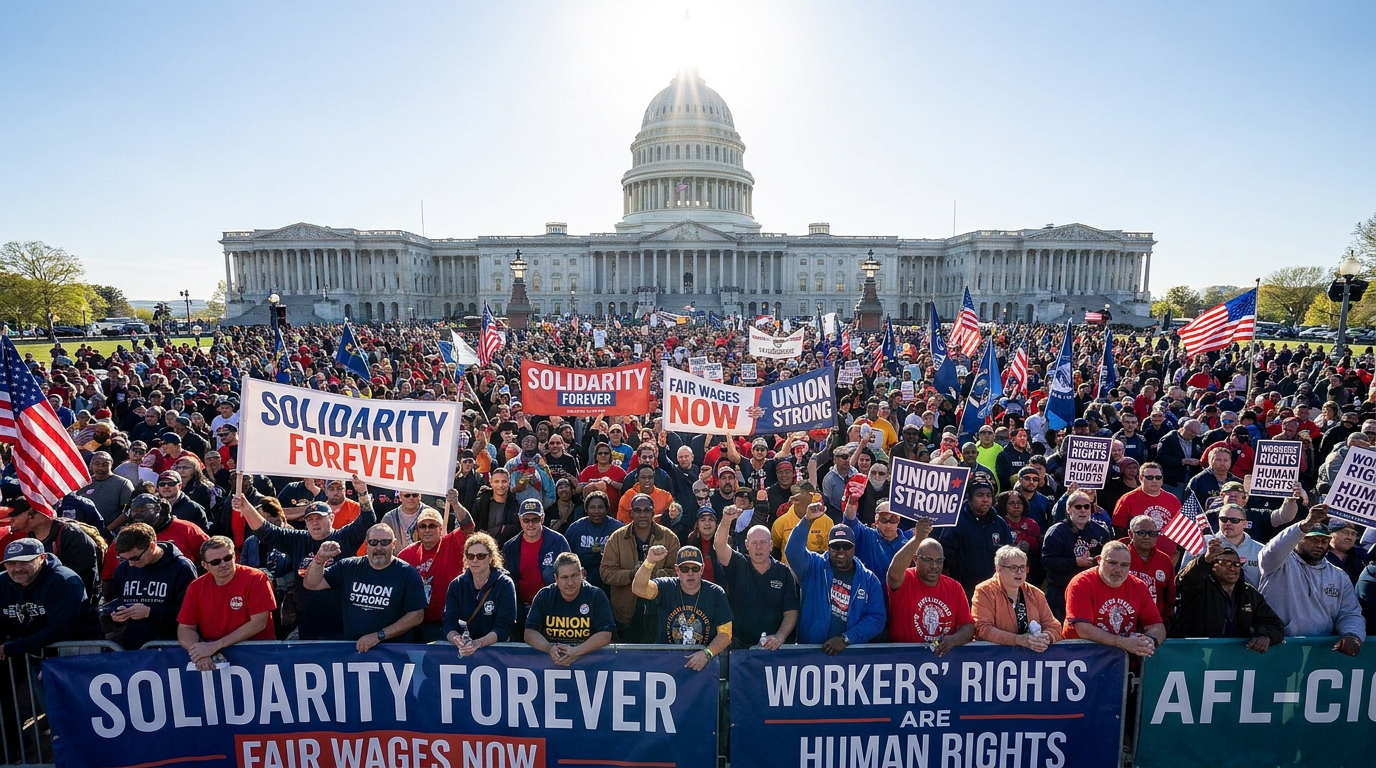
- Labor Unions & Advocates
- Argue that corporations exploit current law to endlessly delay negotiations, making binding arbitration necessary to secure first contracts.
- Corporate Employers
- Warn that government-imposed contracts strip companies of their bargaining leverage and threaten operational flexibility and business viability.
- Bipartisan Lawmakers
- Believe that if workers legally vote to unionize, management must be forced to acknowledge the result and reach a fair agreement promptly.
What's not represented
- · Non-unionized workers who might face altered hiring practices
- · Federal mediators who would have to handle the influx of 90-day deadlines
Why this matters
If enacted, the Faster Labor Contracts Act would fundamentally rewrite the rules of American corporate labor relations, stripping companies of their ability to stall negotiations and guaranteeing newly unionized workers a contract within months rather than years.
Key points
- The U.S. House passed the Faster Labor Contracts Act 230-193, with 20 Republicans supporting the measure.
- The bill requires employers to begin bargaining within 10 days of a union's certification.
- If no deal is reached in 90 days, the dispute moves to 30 days of federal mediation.
- Failing mediation, a three-person arbitration panel would impose a binding two-year contract.
- Business groups strongly oppose the bill, warning it strips employers of negotiation leverage.
The U.S. House of Representatives has passed a landmark labor bill that would fundamentally rewrite the rules of private-sector union negotiations, advancing the measure in a bipartisan 230-193 vote. The Faster Labor Contracts Act (FLCA) seeks to eliminate the years-long delays that often plague newly unionized workplaces by imposing strict bargaining deadlines and the threat of binding arbitration. Twenty Republicans broke ranks to join 210 Democrats in passing the legislation on June 9, 2026, sending shockwaves through corporate America.[1][2][3][5]
If enacted, the legislation would amend the 1935 National Labor Relations Act (NLRA) to establish a rigid timeline for first-contract negotiations. Under the new framework, employers would be legally required to commence bargaining within 10 days of receiving a written request from a newly certified union. The two parties would then have exactly 90 days to reach a collective bargaining agreement.[3][4][5]
Should the employer and the union fail to reach a deal within that 90-day window, either party can invoke mandatory mediation through the Federal Mediation and Conciliation Service (FMCS). The federal mediators would have 30 days to facilitate a compromise. If the deadlock persists, the dispute is escalated to a three-person arbitration panel empowered to dictate the terms of the contract.[3][4][5]

This final step—known as "interest arbitration"—represents a massive departure from over 80 years of federal labor policy. Historically, the NLRA has required both sides to bargain in good faith but explicitly stated that neither party could be forced to accept a specific proposal or make a concession. The FLCA would authorize the arbitration panel to impose a legally binding, two-year contract on the employer and the workers.[4][5]
The arbitrators would not pull numbers out of thin air. The legislation instructs the panel to weigh five specific factors when drafting the imposed contract: the employer's financial status, the size of the business, the local cost of living, the employees' ability to sustain their families, and the wages offered by comparable employers in the industry.[4]
Labor advocates have championed the bill as a necessary fix to a broken system. Currently, it takes an average of 465 days for a newly formed union to secure its first contract, according to Bloomberg Law data. High-profile unionization victories at major corporations like Starbucks and Amazon in 2021 and 2022 have famously stalled during the contract phase, leaving workers without the benefits they voted for. Teamsters General President Sean O'Brien praised the bill for holding corporate America accountable for "endlessly dragging out negotiations."[2][7]

Labor advocates have championed the bill as a necessary fix to a broken system.
The bill also strips employers of a long-held tactical advantage. Under current labor law, if negotiations reach a genuine, good-faith impasse, an employer is generally permitted to unilaterally implement its "last, best, and final offer." The FLCA appears to eliminate this tool entirely, requiring companies to maintain the status quo indefinitely until an agreement is reached or an arbitration panel imposes one.[4]
Business groups and corporate law firms have reacted with alarm. The Associated General Contractors of America (AGC) stated it strongly opposes the bill, warning that it significantly alters the collective bargaining process and strips management of its leverage. Legal analysts caution that the risk of a government-imposed contract introduces severe uncertainty regarding future labor costs and operational flexibility, fundamentally compressing the window companies have to negotiate.[5][6]

The bill's path to the House floor was highly unusual. Representative Donald Norcross, a New Jersey Democrat and former union electrician, utilized a procedural maneuver known as a discharge petition to bypass the Republican leadership that had refused to schedule a vote. Norcross successfully gathered 218 signatures—including seven from Republicans—to force the legislation onto the floor.[1][2][3]
The FLCA now heads to the Senate, where a companion bill has already been introduced. While the legislation faces steep hurdles and a potential filibuster in the upper chamber, the bipartisan nature of the House vote indicates a shifting political landscape. With a growing faction of populist Republicans expressing a willingness to support organized labor, the Senate battle over the future of American contract negotiations remains highly unpredictable.[1][3][5]
How we got here
1935
The National Labor Relations Act (NLRA) is passed, requiring good-faith bargaining but setting no deadlines for a contract.
2021-2022
High-profile union victories at companies like Starbucks and Amazon stall during the first-contract negotiation phase.
April 2026
Rep. Donald Norcross files a discharge petition to bypass House leadership and force a vote on the FLCA.
June 9, 2026
The House passes the Faster Labor Contracts Act 230-193, with 20 Republicans breaking ranks.
Viewpoints in depth
Labor Advocates' View
Argue that the current system is broken, allowing corporations to endlessly delay negotiations and effectively nullify successful union elections.
Union leaders and labor advocates argue that the National Labor Relations Act lacks the teeth necessary to force bad-faith employers to the bargaining table. They point to high-profile unionization efforts at massive corporations where, years after a successful vote, workers still lack a contract. From this perspective, binding arbitration is the only mechanism capable of neutralizing corporate delay tactics and ensuring that workers actually receive the benefits of collective bargaining.
Corporate Employers' View
Warn that handing contract terms over to a three-person arbitration panel removes their ability to control labor costs and operational flexibility.
Business associations and corporate legal teams view the FLCA as a dangerous government overreach that fundamentally breaks the free-market premise of the NLRA. They argue that forcing an employer into a two-year contract dictated by outside arbitrators strips management of its leverage and introduces severe financial uncertainty. Employers fear that arbitrators may not fully grasp the operational nuances of their specific industries, potentially imposing wage and benefit structures that threaten business viability.
Conservative Pro-Labor View
A growing faction of Republicans argues that if workers follow the rules and vote to unionize, management must acknowledge the result.
The 20 Republican votes in favor of the FLCA highlight a shifting dynamic within conservative politics. This camp argues that the free market requires fair play; if employees navigate the legal hurdles to form a union, corporations should not be allowed to exploit legal loopholes to ignore them. They view the strict timelines and arbitration backstop not as government overreach, but as a necessary enforcement mechanism to ensure that the rules of the road are respected by both labor and management.
What we don't know
- Whether the Senate will take up the companion bill or if it will face a filibuster.
- How the Supreme Court might rule on the constitutionality of government-imposed binding arbitration for private companies if the bill becomes law.
- Whether the 20 Republican House votes signal a permanent shift in conservative labor policy or an isolated bipartisan moment.
Key terms
- Discharge Petition
- A parliamentary procedure in the U.S. House that allows a majority of members to bring a bill to the floor for a vote, bypassing committee and leadership opposition.
- Binding Arbitration
- A process where an impartial third party hears a dispute and imposes a legally enforceable decision that both sides must accept.
- Impasse
- A deadlock in negotiations where neither side is willing to compromise further. Under current law, employers can often implement their final offer when this occurs.
- National Labor Relations Act (NLRA)
- The foundational 1935 U.S. labor law that guarantees private-sector employees the right to unionize and collectively bargain.
Frequently asked
Does this bill apply to all union contracts?
No, the strict timelines and binding arbitration provisions specifically apply to the negotiation of a first collective bargaining agreement after a workplace newly unionizes.
Can an employer appeal the arbitration panel's decision?
Under the proposed legislation, the arbitration panel's decision is binding and sets the terms of the contract for two years, leaving very limited avenues for legal appeal.
Has the bill become law yet?
Not yet. It has passed the House of Representatives and must now pass the Senate and be signed by the President to become law.
Sources
Source coverage
7 outlets
3 viewpoints surfaced





[1]TIMEBipartisan Lawmakers
20 House Republicans Break Ranks to Join Democrats in Passing Pro-Union Bill
Read on TIME →[2]CapRadioLabor Unions & Advocates
House approves labor-friendly bill with support from 20 Republicans
Read on CapRadio →[3]Westlaw TodayBipartisan Lawmakers
House passes Faster Labor Contracts Act
Read on Westlaw Today →[4]Labor Relations UpdateCorporate Employers
In a Surprise Move, House Passes Faster Labor Contracts Act
Read on Labor Relations Update →[5]Faegre DrinkerCorporate Employers
Bipartisan Push for Speedier Labor Agreements: Senators Unveil the Faster Labor Contracts Act
Read on Faegre Drinker →[6]Associated General Contractors of AmericaCorporate Employers
House Passes Faster Labor Contracts Act; Senate Fight Begins
Read on Associated General Contractors of America →[7]TeamstersLabor Unions & Advocates
Tell your senator to co-sponsor the bipartisan Faster Labor Contracts Act
Read on Teamsters →

More in news politics
See all 6 stories →Cognitive Security
Evidence Pack: Does 'Pre-Bunking' Actually Protect Voters From Misinformation?
6 sources

Strait of Hormuz
Iran Threatens to Re-Close Strait of Hormuz as Lebanon Ceasefire Collapses
8 sources

Strait of Hormuz
Iran Threatens to Reclose Strait of Hormuz Over Israeli Strikes in Lebanon, Testing Fragile US Truce
8 sources

Foreign Policy
US-Iran Pact on the Brink as Tehran Threatens Strait of Hormuz Over Israeli Strikes
8 sources

Every angle. Every day.
Get news politics stories with full source coverage and perspective breakdowns delivered to your inbox.