
The Rise of Small Language Models: How AI is Moving from the Cloud to Your Pocket
Compact, highly efficient AI models are bringing generative capabilities directly to smartphones and laptops, prioritizing privacy, speed, and offline access over massive scale.
By Factlen Editorial Team

- Enterprise Developers
- Value SLMs primarily for data sovereignty, compliance, and predictable operational costs without API fees.
- Global Development Advocates
- Champion 'Frugal AI' as a way to democratize technology in low-connectivity, resource-constrained regions.
- Hardware & Edge Enthusiasts
- Focus on the synergy between optimized SLMs and the new generation of Neural Processing Units (NPUs) in consumer devices.
- AI Researchers
- Study the technical boundaries of model compression, quantization, and knowledge distillation to maximize efficiency.
What's not represented
- · Cloud Infrastructure Providers facing reduced API demand
- · Cybersecurity Analysts evaluating local model vulnerabilities
Why this matters
By running AI locally rather than in the cloud, users gain absolute data privacy, zero-latency responses, and the ability to use advanced tools entirely offline. This shift democratizes AI access while dramatically reducing the environmental and financial costs of computing.
Key points
- Small Language Models (SLMs) operate with drastically fewer parameters than cloud-based LLMs.
- They run locally on smartphones and laptops, ensuring sensitive data never leaves the device.
- SLMs provide zero-latency responses and function entirely offline without internet connectivity.
- Techniques like knowledge distillation and quantization allow them to punch above their weight.
- The future of AI is hybrid, using local SLMs for daily tasks and cloud LLMs for heavy lifting.
For years, the artificial intelligence industry was obsessed with a singular metric: scale. The prevailing wisdom dictated that "bigger is better," culminating in massive Large Language Models (LLMs) that require sprawling server farms, specialized cooling systems, and immense energy grids to function. These behemoths became the generalist supercomputers of the digital age, capable of passing bar exams and writing complex code.[2][7]
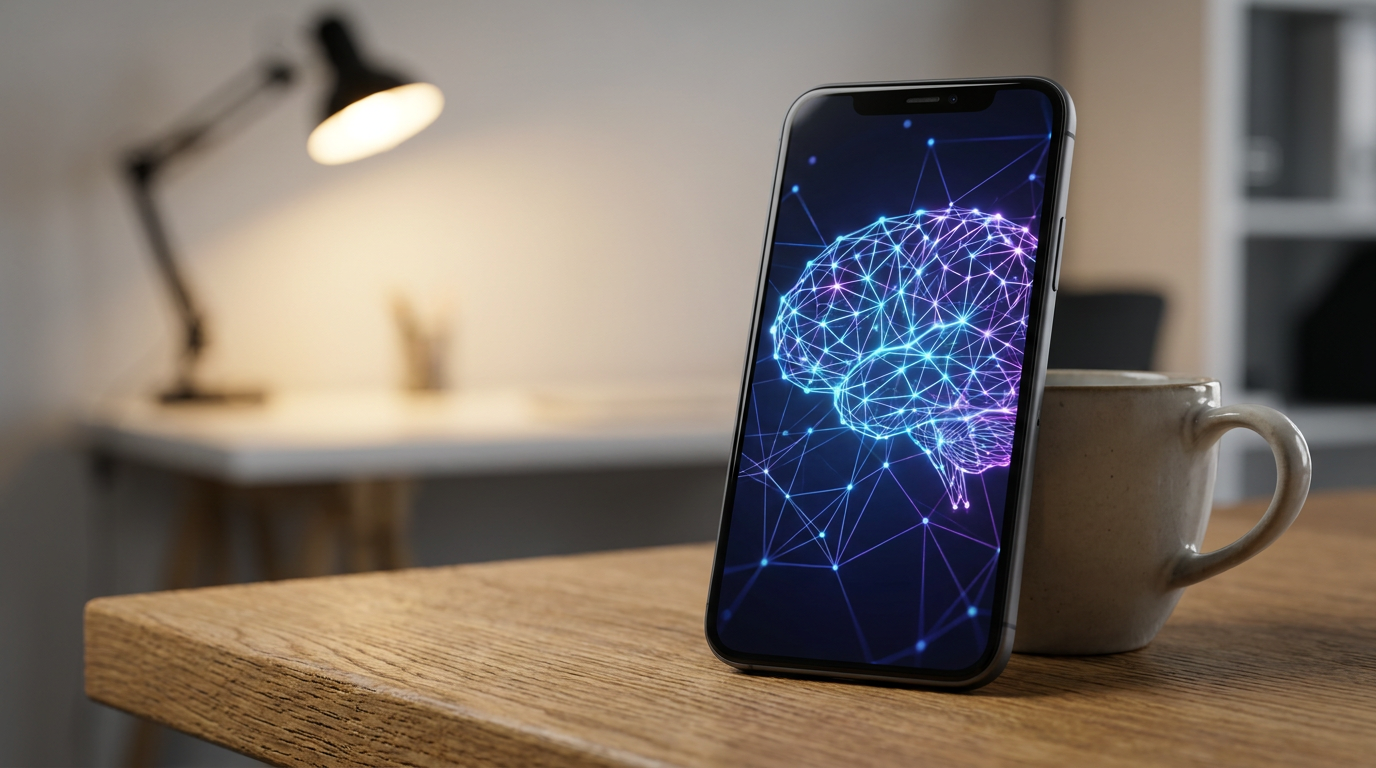
But in 2026, a quiet revolution is taking place in the opposite direction. The architectural moat has shifted from brute force to cognitive efficiency. Small Language Models (SLMs) are moving artificial intelligence out of remote data centers and directly into our pockets, laptops, and vehicles.[1][7]
While an LLM might boast hundreds of billions or even trillions of parameters—the neural connections that dictate how a model processes information—an SLM typically operates in the much leaner range of 500 million to 10 billion parameters. This drastic reduction in size means they do not need a supercomputer to run.[4][6]
Instead, SLMs can execute locally on consumer hardware. To achieve this efficiency without entirely sacrificing capability, engineers rely on three foundational pillars. The first is "Knowledge Distillation." In this teacher-student dynamic, a massive LLM trains the smaller model to mimic its reasoning patterns, transferring core logic without inheriting the trillion-parameter overhead.[1][6]

The second pillar is curated data. Rather than scraping the entire internet—which introduces noise, bias, and bloat—SLMs are trained on highly filtered, "textbook-quality" datasets. This dense, domain-specific information allows the model to learn far more efficiently, proving that the quality of the training data often matters more than the sheer volume.[1][2]
The third pillar is aggressive quantization. AI researchers compress the model's neural weights from standard 16-bit floating points down to 4-bit or even 1-bit precision. This mathematical shrinking reduces the memory footprint so dramatically that a 3-billion-parameter model, like Meta's Llama 3.2 or Google's Gemma 3, can fit into just 2 gigabytes of RAM.[1][3][6]
This software ingenuity is meeting a hardware renaissance. Modern smartphones and laptops are now equipped with dedicated Neural Processing Units (NPUs), such as Apple's Neural Engine or Qualcomm's Hexagon chips. These specialized processors are designed specifically to run quantized AI models efficiently, drawing minimal battery power while delivering rapid results.[3][7]
Modern smartphones and laptops are now equipped with dedicated Neural Processing Units (NPUs), such as Apple's Neural Engine or Qualcomm's Hexagon chips.
The most immediate and transformative benefit of this shift is privacy. Because an SLM runs entirely on the device, sensitive data never leaves the hardware. Whether a user is summarizing a patient's medical history, analyzing proprietary corporate code, or drafting personal text messages, the information is never transmitted to a third-party cloud server.[1][2]

This "data sovereignty" is solving the enterprise compliance bottleneck. Hospitals, financial institutions, and legal firms that previously banned cloud-based AI due to leakage risks are now deploying local SLMs to assist workers securely, knowing their intellectual property remains safely behind their own firewalls.[1][2]
Latency is another major advantage. By eliminating the need to send a query over the internet and wait for a response, SLMs enable sub-millisecond reaction times. This is critical for real-time applications, such as in-car voice assistants that must adjust the temperature or navigate a route instantly, even when driving through a tunnel with no cellular service.[1][5]
Then there is the democratization aspect, often referred to as "Frugal AI." Because SLMs do not require expensive API subscriptions or constant internet connectivity, they are bringing advanced computing to resource-constrained environments and remote regions.[5][7]
Educational tutoring tools, agricultural advisory systems, and healthcare diagnostics can now operate fully offline. This empowers communities in developing nations or rural areas that were previously priced out of the generative AI boom due to poor infrastructure.[4][5]

The environmental impact is equally profound. Training a massive LLM can cost millions of dollars and consume vast amounts of electricity. In contrast, an SLM can be trained for a fraction of the cost and runs on the minimal battery power of a smartphone, paving the way for a much more sustainable AI ecosystem.[4][5]
However, SLMs are not a universal replacement for their larger cousins. Their reduced parameter count means they lack the vast "world knowledge" of an LLM. If pushed outside their specific training domain or asked to recall obscure trivia, they are more prone to hallucination or simply failing to answer.[2][7]
They are specialized processors, not generalist supercomputers. They excel at targeted tasks—summarization, translation, code completion, and logic puzzles—but struggle with highly complex, multi-step reasoning that requires broad, cross-disciplinary context.[2][6]

Viewpoints in depth
Enterprise Developers
Focus on data sovereignty, compliance, and predictable operational costs.
For corporate IT departments and software engineers, the appeal of SLMs is primarily architectural control. Industries bound by strict compliance frameworks—such as healthcare (HIPAA) and finance—cannot risk sending sensitive Personally Identifiable Information (PII) to external cloud providers. By deploying SLMs directly onto company hardware, developers guarantee that proprietary data remains siloed. Furthermore, running models locally eliminates the unpredictable, recurring API costs associated with cloud-based LLMs, allowing companies to scale their AI usage without scaling their monthly bills.
Global Development Advocates
Champion 'Frugal AI' as a way to democratize technology in low-connectivity regions.
Advocates for digital equity view the massive, cloud-dependent LLMs as inherently exclusionary, requiring high-speed internet and expensive subscriptions. SLMs represent a paradigm shift toward 'Frugal AI.' By enabling sophisticated natural language processing on modest, older hardware without requiring an internet connection, SLMs allow NGOs and educators to deploy AI tutors, agricultural advisors, and medical diagnostic assistants in remote, resource-constrained communities across the globe.
Hardware Manufacturers
Focus on the synergy between optimized SLMs and the new generation of Neural Processing Units.
For chipmakers like Apple, Qualcomm, and Intel, the rise of SLMs is the ultimate validation of their heavy investments in Neural Processing Units (NPUs). These companies argue that the bottleneck for AI adoption is no longer software capability, but hardware efficiency. By designing silicon specifically tailored to run quantized, 4-bit models at low wattages, hardware manufacturers are turning everyday consumer devices into localized AI servers, extending battery life while delivering instant, on-device inference.
What we don't know
- How quickly open-source SLMs will close the reasoning gap with proprietary cloud models.
- Whether the aggressive quantization required for mobile devices introduces hidden biases or blind spots.
- How local models will be seamlessly updated with new 'world knowledge' without requiring massive daily downloads.
Key terms
- Small Language Model (SLM)
- A compact artificial intelligence system designed to perform natural language tasks using significantly fewer computational resources than large models.
- Knowledge Distillation
- A training technique where a massive, complex AI model teaches a smaller model how to replicate its reasoning and outputs.
- Quantization
- The process of mathematically compressing an AI model's data (often to 4-bit precision) so it requires less memory to run.
- Neural Processing Unit (NPU)
- A specialized hardware chip inside modern smartphones and laptops designed specifically to accelerate artificial intelligence tasks efficiently.
- Frugal AI
- An approach to artificial intelligence that prioritizes doing more with less, focusing on resource efficiency, sustainability, and accessibility.
Frequently asked
What exactly is a Small Language Model?
An SLM is a compact version of a generative AI system. While large models have hundreds of billions of parameters, SLMs typically have between 500 million and 10 billion, allowing them to run efficiently on everyday devices.
Why are SLMs better for privacy?
Because SLMs run locally on your phone or laptop's hardware, your prompts and data are never sent over the internet to a third-party cloud server. Your information stays entirely on your device.
Can an SLM work without an internet connection?
Yes. Once the model is downloaded to your device, it relies on your local processor (NPU or CPU) to generate text, summarize documents, or write code, making it fully functional offline.
Will SLMs replace Large Language Models like ChatGPT?
No. SLMs are specialized tools for specific, everyday tasks. For highly complex reasoning, vast world knowledge, or cross-disciplinary problem solving, massive cloud-based LLMs will still be required.
Sources
Source coverage
7 outlets
4 viewpoints surfaced







[1]MediumEnterprise Developers
The Rise of the Lean Machine: Why Small Language Models (SLM) are the New Enterprise Standard
Read on Medium →[2]KnowAIEnterprise Developers
Why Choose Small Language Models (SLM) Over Large Language Models (LLM) in 2026?
Read on KnowAI →[3]AIMagicXHardware & Edge Enthusiasts
A practical guide to running AI models locally on consumer hardware in 2026
Read on AIMagicX →[4]Ruh AIHardware & Edge Enthusiasts
Small Language Models (SLMs): The Efficient Future of AI in 2026
Read on Ruh AI →[5]Development GatewayGlobal Development Advocates
Frugal AI and the Shift Toward Small Language Models
Read on Development Gateway →[6]arXivAI Researchers
A Survey of Small Language Models
Read on arXiv →[7]Factlen Editorial Team
Synthesis by Factlen editorial team
Read on Factlen Editorial Team →

Every angle. Every day.
Get ai stories with full source coverage and perspective breakdowns delivered to your inbox.