
Inside F1's 2026 Revolution: The Nimble Car, Active Aero, and the 50/50 Power Split
Formula 1 has undergone its most radical technical overhaul in history, introducing 100% sustainable fuels, a 50/50 hybrid power split, and active aerodynamics.
By Factlen Editorial Team
- FIA & Regulators
- Focused on advancing the sport's Net Zero by 2030 goals and improving safety through sustainable fuels and controlled energy deployment.
- F1 Engineers & Teams
- View the regulations as a massive packaging and software challenge, prioritizing energy management and thermal efficiency.
- Drivers & Fans
- Prioritize the 'Nimble Car' concept for better agility, closer racing, and the strategic use of the new manual override button.
What's not represented
- · Independent Engine Suppliers
- · Lower-Tier Racing Categories
Why this matters
As the automotive industry shifts toward sustainable technology, F1's 2026 regulations serve as a high-speed laboratory for road-relevant innovations like advanced battery management and drop-in synthetic fuels, while attempting to make on-track racing closer and more competitive.
Key points
- The 2026 F1 cars are 30kg lighter, 100mm narrower, and feature a 200mm shorter wheelbase for improved agility.
- Power units now feature a 50/50 split between a simplified combustion engine and a massively upgraded 350kW electric motor.
- The complex MGU-H exhaust energy recovery system has been removed, enticing new manufacturers like Audi to join the grid.
- All 2026 cars run on 100% sustainable drop-in fuels, advancing the sport's Net Zero by 2030 environmental goals.
- Traditional DRS has been replaced by Active Aerodynamics, allowing cars to switch between high-downforce and low-drag modes.
- A mid-season update ahead of the Miami Grand Prix tweaked energy deployment rules to prevent dangerous speed differentials.
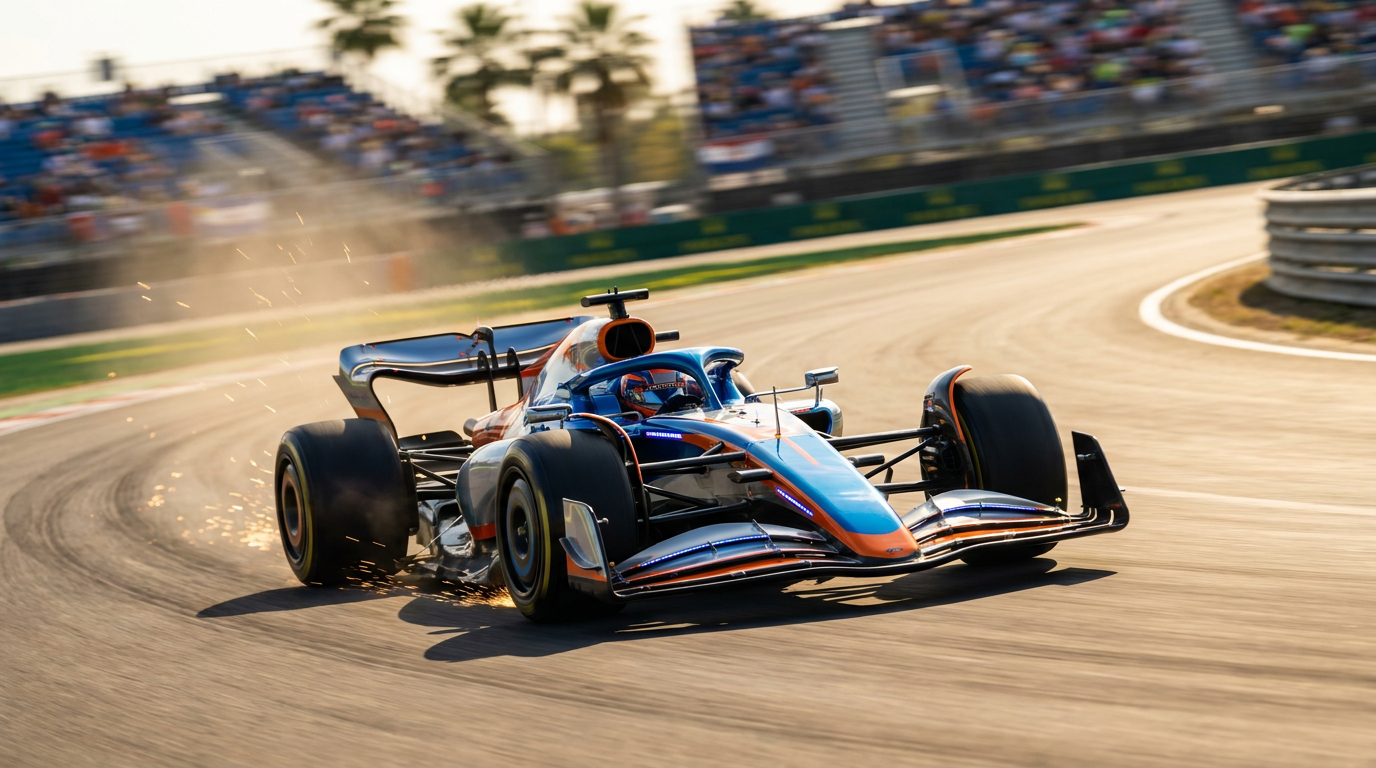
Formula 1 has officially entered its most radical technical era since the inception of the World Championship. The 2026 regulations, which debuted on track this season, represent a fundamental rethinking of what a Grand Prix car is, how it is powered, and how it races.[3][8]
For years, drivers and fans alike lamented the swelling silhouette of modern F1 machinery. The previous generation of cars had become the heaviest and largest in the sport's history, often criticized for being too cumbersome on tight street circuits and overly reliant on complex aerodynamics that generated turbulent 'dirty air.'[1][3]
To combat this, the FIA introduced the 'Nimble Car' concept. The 2026 chassis is visibly more compact: the maximum wheelbase has been reduced by 200 millimeters to 3400 millimeters, and the overall width has been cut by 100 millimeters.[5][10]
Crucially, the cars have been put on a diet. The minimum weight has dropped by 30 kilograms to 770 kilograms. While that may sound modest for a road vehicle, in a sport measured in thousandths of a second, a 30-kilogram reduction is a massive leap for agility, responsiveness, and driver feedback.[1][10]

Beneath the engine cover lies an equally dramatic transformation: the 50/50 power split. The 2026 power units shift away from a heavy reliance on the internal combustion engine, moving toward a near-equal partnership between combustion and electrification.[4][6]
The simplified 1.6-liter turbocharged V6 now produces around 400 kilowatts (roughly 540 horsepower), a deliberate reduction from previous years. However, the electrical output from the Motor Generator Unit-Kinetic (MGU-K) has nearly tripled, jumping from 120 kilowatts to a massive 350 kilowatts.[1][4][10]

To achieve this streamlined hybrid architecture, the FIA eliminated the Motor Generator Unit-Heat (MGU-H). This highly complex and expensive component harvested energy from exhaust gases, but its removal has significantly lowered the barrier to entry for new engine manufacturers, directly enticing automotive giants like Audi and Ford to join the 2026 grid.[1][4]
To achieve this streamlined hybrid architecture, the FIA eliminated the Motor Generator Unit-Heat (MGU-H).
The combustion engine itself is also breaking new ground by running on 100% sustainable 'drop-in' fuel. Derived from non-food biomass, municipal waste, or atmospheric carbon capture, this fuel ensures that no new fossil carbon is released into the atmosphere during a race.[2][3]
This mandate is a critical pillar of Formula 1's 'Net Zero by 2030' mission. By proving that high-performance combustion engines can run cleanly on synthetic fuels, the sport is developing scalable technologies that could eventually accelerate the decarbonization of everyday road transport and aviation.[2][8]
On the aerodynamic front, the 2026 regulations have fundamentally altered how cars manipulate the air. The Drag Reduction System (DRS), which defined overtaking for over a decade by opening a single rear-wing flap, has been completely replaced by a fully integrated Active Aerodynamics system.[5][6]
Both the front and rear wings now feature movable elements that operate in two distinct states. 'Z-Mode' is the default high-downforce configuration used for cornering and braking, maximizing grip. When a driver reaches a designated straight, they can switch to 'X-Mode,' which flattens the wing elements to shed up to 40% of the car's aerodynamic drag and boost top speed.[5][10]

Because X-Mode reduces drag so significantly, the cars require less energy to punch through the air on straights. This efficiency is vital for managing the battery's state of charge, as the massive 350-kilowatt electrical deployment drains energy reserves rapidly.[8][10]
To facilitate overtaking without traditional DRS, drivers now have access to a manual 'Override' or 'Boost' mode. This driver-operated energy deployment tool allows a chasing car to utilize maximum electrical power up to 355 km/h, while the leading car's electrical deployment naturally tapers off at high speeds, creating a slingshot effect.[1][10]

However, the transition to these new rules has not been entirely seamless. Early in the 2026 season, the massive electrical deployment and new aerodynamic profiles led to unintended racing dynamics, with some describing the on-track action as a 'game of leapfrog' due to extreme speed differentials between attacking and defending cars.[7][9]
In response, the FIA and teams ratified a mid-season update ahead of the Miami Grand Prix. The tweaks reduced the permitted qualifying recharge rate from 8 megajoules to 7 megajoules to encourage more flat-out driving, while capping the maximum race boost power at 150 kilowatts to mitigate dangerous closing speeds.[7][9]
These rapid adjustments highlight the immense engineering challenge of the 2026 era. Energy management has become the defining factor of performance, requiring drivers to make split-second tactical decisions about when to harvest energy and when to deploy it for maximum attack or defense.[4][10]
Ultimately, the 2026 regulations represent a bold gamble by Formula 1 to remain at the pinnacle of motorsport. By balancing the visceral appeal of combustion engines with cutting-edge electrification and sustainable fuels, the sport is charting a course that is both fiercely competitive on the track and highly relevant to the future of the automotive industry.[3][8]
How we got here
August 2022
The FIA officially approves the 2026 power unit regulations, prompting Audi to announce its entry into F1.
June 2024
The FIA unveils the 'Nimble Car' chassis regulations and active aerodynamics framework.
January 2026
Teams reveal their radically redesigned 2026 cars ahead of pre-season testing in Barcelona and Bahrain.
March 2026
The new era officially begins at the season-opening Australian Grand Prix.
May 2026
The FIA implements mid-season tweaks ahead of the Miami Grand Prix to refine energy deployment and racing dynamics.
Viewpoints in depth
FIA & Regulators
Focused on advancing the sport's Net Zero by 2030 goals and improving safety through sustainable fuels and controlled energy deployment.
For the governing body, the 2026 regulations are an existential necessity. The FIA recognizes that to keep major automotive manufacturers invested in Formula 1, the sport must align with global environmental targets. By mandating 100% sustainable drop-in fuels and a massive increase in electrification, regulators are positioning F1 as a high-speed laboratory for road-relevant technology. They also prioritize safety, implementing stricter crash tests and mid-season tweaks to energy deployment to ensure that the massive speed differentials created by the new hybrid systems do not compromise driver security.
F1 Engineers & Teams
View the regulations as a massive packaging and software challenge, prioritizing energy management and thermal efficiency.
Inside the garages, the 2026 rules have completely rewritten the engineering playbook. With the removal of the MGU-H and the tripling of the MGU-K's electrical output, teams are no longer just managing aerodynamics; they are managing complex energy algorithms. Engineers must optimize when the car harvests energy and when it deploys it, turning every lap into a strategic thermal management puzzle. The challenge is compounded by the 'Nimble Car' dimensions, which force designers to package larger batteries and cooling systems into a significantly smaller, lighter chassis.
Drivers & Fans
Prioritize the 'Nimble Car' concept for better agility, closer racing, and the strategic use of the new manual override button.
For those behind the wheel and in the grandstands, the success of 2026 hinges on the quality of the racing. Drivers have long complained that the previous generation of heavy, bulky cars felt sluggish in slow corners and generated too much 'dirty air.' The 30-kilogram weight reduction and shorter wheelbase are designed to bring back the visceral agility of classic F1 cars. Meanwhile, fans are closely watching the death of DRS and the birth of the manual 'Override' mode, hoping it will replace artificial highway-style passes with genuine, tactical battles on the straights.
What we don't know
- How the shift to 100% sustainable fuels will impact long-term engine reliability across a grueling 24-race calendar.
- Whether the new Active Aerodynamics and Override mode will genuinely improve overtaking or simply create different types of artificial passes.
- Which team has best optimized the complex energy management software required for the new 50/50 power split.
Key terms
- MGU-K
- Motor Generator Unit-Kinetic; an electric motor that recovers energy under braking and deploys it to boost acceleration.
- Active Aerodynamics
- A system where the car's front and rear wings physically change angle while driving to alternate between high grip and low drag.
- Sustainable Drop-in Fuel
- A fully synthetic or biomass-derived fuel that can be used in a standard combustion engine without releasing new fossil carbon.
- Override Mode
- A driver-activated button that deploys maximum electrical battery power to assist in overtaking, replacing the old DRS system.
- MGU-H
- Motor Generator Unit-Heat; a complex exhaust-energy recovery system used from 2014 to 2025, now removed to simplify the engines.
Frequently asked
Did Formula 1 get rid of DRS?
Yes. The Drag Reduction System (DRS) has been replaced by Active Aerodynamics, which adjusts both the front and rear wings simultaneously to reduce drag.
Are the 2026 F1 cars fully electric?
No. They use a hybrid power unit with a roughly 50/50 split between a traditional internal combustion engine and a powerful electric motor.
Why did Audi join Formula 1 in 2026?
Audi joined because the new regulations removed the highly complex MGU-H component, leveling the playing field for new engine manufacturers.
What was the mid-season rule change in 2026?
The FIA tweaked energy deployment limits and recharge rates ahead of the Miami Grand Prix to prevent extreme speed differences and 'leapfrog' overtaking.
Sources
Source coverage
10 outlets
3 viewpoints surfaced









[1]Formula CareersDrivers & Fans
The 2026 F1 Revolution: How New Rules Will Create a Brand-New Sport
Read on Formula Careers →[2]SUSTAINFIA & Regulators
SUSTAIN's guide to the F1 2026 regulations
Read on SUSTAIN →[3]SilverstoneDrivers & Fans
The five biggest changes coming with the F1 2026 regulations
Read on Silverstone →[4]RecrewitF1 Engineers & Teams
Formula 1 2026 Regulations Explained
Read on Recrewit →[5]Formula ReportsF1 Engineers & Teams
2026 F1 Rules Explained: The Complete Guide to Every Major Change
Read on Formula Reports →[6]DIRECTV InsiderDrivers & Fans
2026 New F1 Rules & Regulations, Explained
Read on DIRECTV Insider →[7]Crash.netDrivers & Fans
Everything you need to know about F1's revised 2026 rules ahead of Miami GP
Read on Crash.net →[8]Top Racing ShopF1 Engineers & Teams
F1 2026 Rules Explained: A Guide to the New Era Without Jargon
Read on Top Racing Shop →[9]Red BullFIA & Regulators
F1 2026 rule changes: Mid-season updates to the regulations
Read on Red Bull →[10]Formula OneFIA & Regulators
F1 2026 Regulations - Terminology Update
Read on Formula One →

More in sports
See all 9 stories →Interleague Clash
New York Yankees Host Cincinnati Reds in Saturday Matinee: Pitching Matchups, Lineups, and Stakes
6 sources

AL Central Matchup
Pre-Game Preview: Tigers Look to Build Momentum Against Division-Leading White Sox
8 sources

NWSL Expansion
NWSL Expansion Surges as Columbus Prepares to Host 2026 Challenge Cup
6 sources

PDC ProTour
Rob Cross Defeats Stephen Bunting 7-3 in High-Quality Clash En Route to Players Championship 22 Title
6 sources

Every angle. Every day.
Get sports stories with full source coverage and perspective breakdowns delivered to your inbox.