
How Solid-State Batteries Work: The Breakthrough Changing Electric Vehicles
By replacing flammable liquid electrolytes with stable solid materials, next-generation batteries are doubling EV ranges, eliminating fire risks, and cutting charge times to just 12 minutes.
By Factlen Editorial Team
- Commercial Automakers
- Focused on utilizing solid-state tech to eliminate range anxiety and dominate the next generation of the EV market.
- Battery Innovators
- Focused on the fundamental chemistry, safety improvements, and the immense challenge of scaling manufacturing.
- Alternative Applications
- Interested in how higher energy density unlocks electrification for aviation, motorcycles, and medical devices.
- Scientific Consensus
- Focused on the objective physics of solid electrolytes and lithium-metal anodes.
What's not represented
- · Lithium-Ion Manufacturers with sunk costs in current gigafactories
- · Raw material suppliers in the lithium mining sector
Why this matters
Solid-state batteries eliminate the fire risks of current EVs while doubling their range and slashing charge times to just 12 minutes. This breakthrough removes the final hurdles to mass electric vehicle adoption, fundamentally changing how we power transportation, aviation, and our daily lives.
Key points
- Solid-state batteries replace flammable liquid electrolytes with stable solid materials like ceramics or polymers.
- This shift eliminates the risk of battery fires and thermal runaway.
- Solid electrolytes allow the use of pure lithium-metal anodes, drastically increasing energy density.
- Next-generation EVs will feature ranges exceeding 1,000 kilometers and charge times around 12 minutes.
- Major automakers like Honda and Toyota are targeting 2027-2028 for commercial rollouts.
- Manufacturing solid ceramics at a gigawatt scale remains the final major hurdle.
For decades, the solid-state battery has been the automotive industry's holy grail—a revolutionary technology perpetually promised to be just five years away. But in the summer of 2026, that distant timeline abruptly collapsed into the present. In June, QuantumScape, a leading battery innovator, signed a landmark multi-year agreement with Honda to commercialize its solid-state lithium-metal technology. This major partnership follows rigorous independent testing where QuantumScape's prototype cells retained over 95 percent of their capacity after 1,000 charging cycles, completely shattering the industry standard of 80 percent after 700 cycles. Honda is not alone in this sudden acceleration toward commercialization. Toyota has recently broken ground on a large-scale solid electrolyte pilot plant in collaboration with Idemitsu, explicitly targeting commercial electric vehicle launches between 2027 and 2028. Meanwhile, Volkswagen has already integrated QuantumScape's advanced cells into a heavily modified Ducati motorcycle for real-world testing. The long laboratory era of solid-state chemistry is officially over; the global manufacturing race has definitively begun.[1][3][5]
To understand why this shift is so monumental, one must look inside the conventional lithium-ion batteries that currently power everything from smartphones to electric buses. Every battery consists of three primary components: a negative anode, a positive cathode, and an electrolyte sitting between them. In conventional batteries, that electrolyte is a liquid solvent. When the battery charges or discharges, lithium ions swim back and forth through this liquid highway. However, this liquid is the root cause of almost every limitation in modern electric vehicles. It is physically heavy, it degrades steadily over time, and most critically, it is highly flammable. If a liquid lithium-ion battery is punctured in a crash, overcharged, or exposed to extreme ambient heat, the solvent can ignite. This triggers a catastrophic, self-sustaining chain reaction known as thermal runaway. To prevent this, automakers must encase EV batteries in heavy, expensive cooling systems and thick protective armor, adding hundreds of pounds of dead weight that reduces the vehicle's overall efficiency and handling dynamics.[6][7][8]
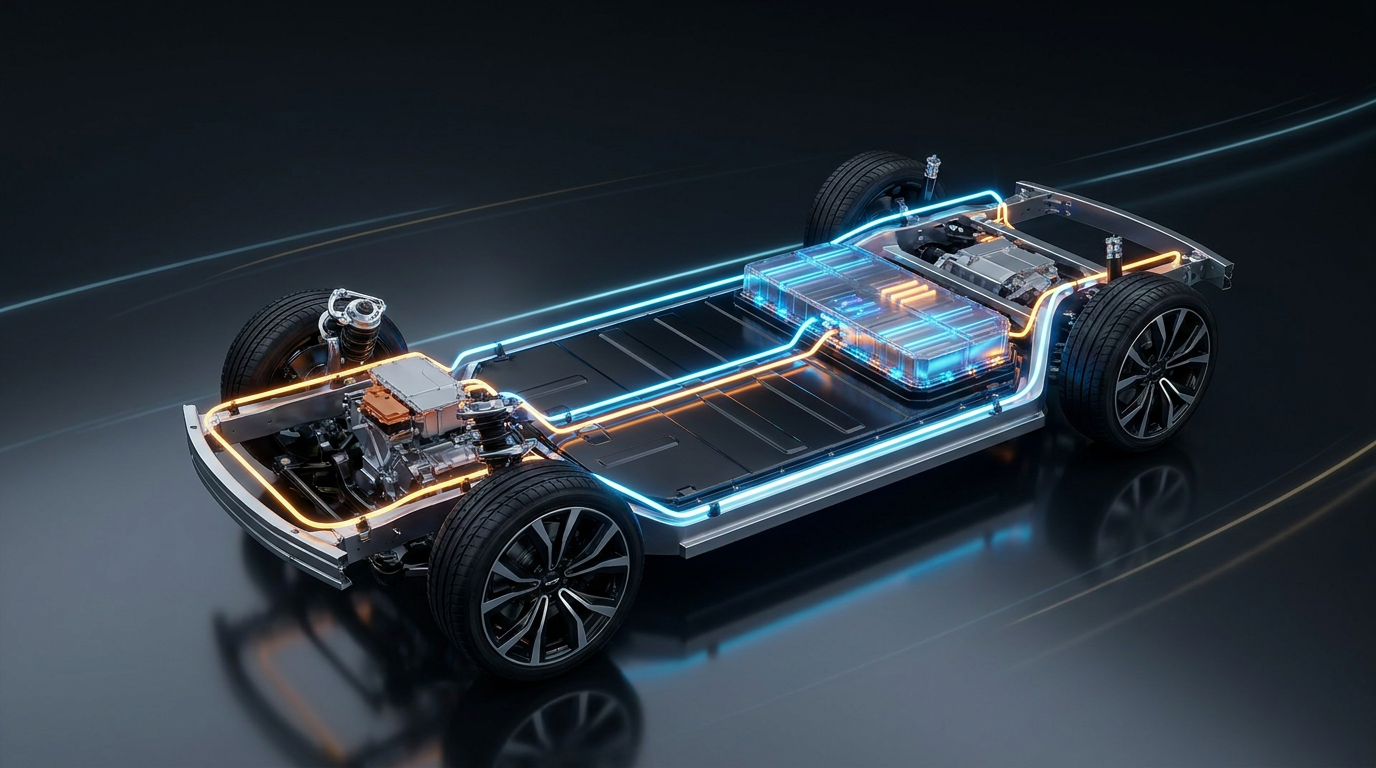
The solid-state breakthrough relies on a deceptively simple architectural swap: replacing that volatile liquid solvent with a highly stable solid material, typically a specialized ceramic, glass, or polymer composite. This solid electrolyte still allows lithium ions to pass through freely, but it acts as a rigid, fireproof physical barrier between the anode and cathode. Safety is the most immediate and profound benefit of this change. Comparative testing shows that thermal events in solid-state systems do not even begin until internal temperatures reach roughly 247 degrees Celsius, compared to just 90 degrees Celsius for conventional lithium-ion cells. They are virtually immune to the sudden fires that have occasionally plagued early electric vehicles. By eliminating the risk of thermal runaway, automakers can strip away the heavy liquid cooling jackets and thick armor plating, drastically reducing the overall weight and complexity of the battery pack before even accounting for the improvements in the chemistry itself.[6][7][8]

But the true prize of the solid electrolyte is what it allows chemical engineers to do to the rest of the battery. Because the solid barrier is so physically robust, it suppresses the formation of dendrites. Dendrites are microscopic, needle-like metallic whiskers that naturally grow inside liquid batteries over thousands of charge cycles, eventually piercing the thin plastic separator and causing catastrophic short circuits. By entirely eliminating the dendrite threat, battery designers can finally discard the bulky graphite anodes used in today's cells and replace them with pure lithium metal. In a traditional battery, graphite acts as heavy scaffolding used merely to safely hold lithium ions; removing it drastically shrinks the battery's physical size and weight. A pure lithium-metal anode can store vastly more energy in the exact same footprint, unlocking the enormous performance jump that the automotive industry has been chasing for the last two decades.[6][7][8]
But the true prize of the solid electrolyte is what it allows chemical engineers to do to the rest of the battery.
The resulting leap in energy density is staggering. Today's best commercial lithium-ion batteries max out at around 250 to 300 watt-hours per kilogram. Next-generation solid-state cells, like the QSE-5 developed by QuantumScape, are pushing past 400 watt-hours per kilogram, with volumetric densities reaching an incredible 844 watt-hours per liter. For the consumer, this translates directly into unprecedented range and convenience. A vehicle equipped with a solid-state pack can travel nearly twice as far on a single charge without increasing the physical footprint or weight of the battery. Ranges of 1,000 kilometers (over 600 miles) are quickly becoming the new baseline expectation for next-generation flagship electric vehicles. This effectively renders range anxiety obsolete, allowing electric vehicles to match or exceed the maximum driving range of traditional internal combustion engine vehicles on a single tank of gas.[2][5][7][8]

Charging speeds are also seeing a paradigm shift thanks to the thermal stability of the new materials. Because solid electrolytes resist heat and degradation far better than their liquid counterparts, they can safely absorb massive amounts of electricity in a fraction of the time without damaging the internal cell structure. QuantumScape's latest solid-state cells have demonstrated the ability to charge from 10 percent to 80 percent capacity in just 12.2 minutes. This approaches the convenience of a traditional gas station visit, removing one of the final major hurdles to widespread electric vehicle adoption. Furthermore, the lack of chemical degradation means these batteries will likely last the entire lifetime of the vehicle without needing replacement, significantly lowering the long-term total cost of ownership and reducing the environmental impact of battery recycling.[2][8]
The implications of this energy density leap extend far beyond passenger cars. The aviation industry, which has long been constrained by the sheer weight of liquid batteries, is already actively testing solid-state alternatives. Recently, modified motorized gliders equipped with 410 watt-hour-per-kilogram solid-state packs successfully flew to altitudes of 24,000 feet, hinting at a viable future for decarbonized regional air travel. Honda has also explicitly noted that its solid-state research agreement will encompass motorcycles and power equipment, where space and weight are at an absolute premium. Medical implants, wearable electronics, and grid-scale renewable energy storage are all poised to benefit from batteries that can pack more power into smaller, safer, and longer-lasting enclosures.[1][4]
Despite the undeniable momentum and proven laboratory performance, significant uncertainties remain—chiefly regarding the brutal economics and logistics of mass production. Manufacturing solid ceramics at a gigawatt-hour scale without introducing microscopic cracks or defects is an entirely different engineering challenge than building a handful of perfect prototype cells in a controlled laboratory. The manufacturing processes require entirely new assembly lines, pristine cleanrooms, and novel techniques like QuantumScape's proprietary fast-separator production method. Because of these immense capital costs and the need to build entirely new supply chains, solid-state batteries will not immediately make electric vehicles cheaper. The transition requires billions of dollars in upfront investment from automakers who are already heavily invested in traditional lithium-ion gigafactories.[2][6]

When these revolutionary batteries finally hit the consumer market in late 2026 and 2027, they will almost certainly be exclusively housed in premium luxury sedans and flagship sports cars, where high sticker prices can easily absorb the initial battery premium. Toyota, for instance, plans to debut the technology under its high-end Lexus brand before eventually scaling it down to everyday commuter vehicles as production costs fall. Yet, the technological trajectory is now firmly locked in. The transition from liquid to solid electrolytes represents the most significant leap in energy storage since the commercialization of the lithium-ion battery in 1991. As production yields improve and economies of scale take hold over the next decade, the electric vehicle will finally shed its last remaining compromises, ushering in a new era of clean, limitless mobility.[5][6]

How we got here
1991
Sony commercializes the first rechargeable lithium-ion battery, revolutionizing portable electronics.
2010
QuantumScape is founded with the goal of developing a scalable solid-state battery.
2020
Toyota demonstrates an early prototype solid-state vehicle, but acknowledges manufacturing challenges.
Jan 2024
Volkswagen confirms QuantumScape's prototype cells retained over 95% capacity after 1,000 cycles.
Jun 2026
Honda and QuantumScape sign a major multi-year agreement to commercialize solid-state technology for EVs and motorcycles.
2027–2028
Projected commercial launch window for the first mass-market solid-state electric vehicles from Toyota and Honda.
Viewpoints in depth
Automakers & OEMs
Emphasize the competitive advantage of 1000km ranges and 10-minute charging to finally conquer range anxiety.
For legacy automakers, solid-state batteries represent the ultimate weapon to convert the remaining electric vehicle skeptics. By offering a product that matches the convenience of a gas station visit—charging in 12 minutes and driving over 600 miles—they can entirely eliminate range anxiety. Brands like Toyota and Honda view this technology as the key to dominating the next decade of automotive sales, justifying massive investments in new pilot plants to ensure they are not left behind by early adopters.
Battery Innovators
Focus on the chemistry triumphs and the engineering challenge of scaling ceramic separators without micro-fractures.
Chemists and material scientists view the solid-state transition as a hard-won victory over dendrites—the metallic whiskers that have plagued battery design for decades. However, their current focus has shifted from the laboratory to the factory floor. The primary concern among innovators is the sheer difficulty of manufacturing ultra-thin ceramic or glass separators at a gigawatt-hour scale. Even microscopic defects or cracks during production can ruin a cell, making quality control the most significant barrier to cheap, mass-market availability.
Aviation & Off-Grid Sectors
Argue that the true revolution is in weight-sensitive applications where liquid batteries were simply too heavy to ever work.
While passenger cars dominate the headlines, engineers in the aerospace and medical fields see solid-state batteries as an existential enabler. Traditional lithium-ion batteries are simply too heavy to power commercial flight effectively. By nearly doubling the energy density per kilogram, solid-state technology suddenly makes regional electric aviation mathematically viable. Similarly, the enhanced safety profile allows for smaller, denser batteries in medical implants and wearable technology, where a liquid chemical leak or thermal event would be catastrophic.
What we don't know
- The exact price premium consumers will have to pay for the first generation of solid-state EVs.
- How quickly manufacturing yields can scale to bring the technology down to affordable commuter cars.
- Whether solid-state cells will suffer from unforeseen degradation issues in extreme real-world driving conditions over a decade.
Key terms
- Electrolyte
- The medium inside a battery that allows charged ions to travel between the positive and negative ends.
- Dendrites
- Microscopic, needle-like metallic whiskers that can grow inside liquid batteries and cause dangerous short circuits.
- Anode
- The negative electrode of a battery, traditionally made of heavy graphite in lithium-ion cells but replaced by pure lithium metal in solid-state designs.
- Thermal Runaway
- A dangerous chain reaction where a battery overheats uncontrollably, often leading to a fire.
- Energy Density
- A measure of how much power a battery can hold relative to its weight or size, usually expressed in watt-hours per kilogram (Wh/kg).
Frequently asked
Do solid-state batteries catch fire?
They are virtually fireproof. By replacing flammable liquid electrolytes with stable solid materials, they eliminate the risk of thermal runaway even at extreme temperatures.
When will solid-state cars be available?
Major automakers like Toyota and Honda are targeting 2027 to 2028 for their first commercial rollouts, likely starting with premium luxury models.
Will this make electric vehicles cheaper?
Not initially. Early solid-state batteries will be expensive due to the complex manufacturing required, but prices are expected to drop as gigawatt-scale production comes online.
How fast can they charge?
Solid electrolytes handle heat much better than liquids, allowing next-generation cells to charge from 10 percent to 80 percent in roughly 12 minutes.
Sources
Source coverage
8 outlets
4 viewpoints surfaced








[1]ElectrekCommercial Automakers
Honda, QuantumScape enter solid-state battery tie-up
Read on Electrek →[2]ElectriveBattery Innovators
QuantumScape signs Honda as solid-state battery partner
Read on Electrive →[3]EV Infrastructure NewsBattery Innovators
QuantumScape Announces Agreement with Honda on Solid-State Battery Technology
Read on EV Infrastructure News →[4]HackadayAlternative Applications
Solid-State Batteries Take To The Sky
Read on Hackaday →[5]CBT NewsCommercial Automakers
Toyota to launch solid-state battery production by 2026
Read on CBT News →[6]IDTechExBattery Innovators
Solid-State Batteries 2026-2036: Technology, Market, and Forecasts
Read on IDTechEx →[7]WikipediaScientific Consensus
Solid-state battery
Read on Wikipedia →[8]Flash BatteryBattery Innovators
What are solid-state batteries and how do they work
Read on Flash Battery →

Every angle. Every day.
Get guides stories with full source coverage and perspective breakdowns delivered to your inbox.