
How Auracast and Bluetooth LE Audio Are Rewriting the Rules of Wireless Headphones
The era of the one-to-one Bluetooth pairing dance is ending. A new broadcast technology called Auracast is turning modern headphones into devices that can tune into public TVs, airport announcements, and shared movies like a Wi-Fi network.
By Nabil Faris

In short
- Auracast replaces traditional Bluetooth pairing with a broadcast model, allowing unlimited headphones to join a single audio stream.
- The technology operates similarly to Wi-Fi, letting users scan and select public audio channels in places like gyms and airports.
- It offers a massive leap in accessibility by streaming clean, direct audio to compatible hearing aids, bypassing room noise.
For two decades, wireless audio has been defined by a familiar, often frustrating ritual: the pairing dance. Holding down a button, waiting for a blinking light, and hoping your smartphone finds the right device in a crowded room. It is a system that works well enough for solitary listening, but it fundamentally isolates the user.
If you want to share a podcast with a friend on a train, or listen to the muted television at a crowded sports bar, the underlying technology simply was not designed to accommodate you. Classic Bluetooth was built on a strict one-to-one relationship, creating an invisible tether between a single transmitter and a single receiver.
In 2026, that rigid architecture is finally being replaced. The consumer audio industry is currently undergoing its most significant wireless shift since the controversial removal of the smartphone headphone jack, driven by a new technology called Auracast.
Promoted heavily by the Bluetooth Special Interest Group, Auracast is not just an incremental update to connection speeds or battery life. It is a fundamental reimagining of how audio travels through the air, shifting the paradigm from a private, point-to-point tether to a public, one-to-many broadcast model that anyone with compatible hardware can join.[2]
To understand how this works, it is necessary to look at the broader ecosystem. Auracast is a specific broadcast audio feature built on top of the new Bluetooth Low Energy (LE) Audio standard.
Instead of pairing a specific transmitter to a specific receiver, Auracast allows a single source—like a laptop, a public address system, or a television—to broadcast an audio stream outward to an unlimited number of nearby listeners simultaneously. 'The relationship is something like: LE Audio is the road, Auracast is one very interesting car on that road,' explains Mohammad Afaneh, a Bluetooth protocol expert at Novel Bits.
Every Auracast-enabled device utilizes the LE Audio framework, but it specifically relies on a transmission method known as Broadcast Isochronous Streams. This protocol allows the source device to send data packets outward continuously, without requiring a two-way handshake or acknowledgment from the receiving headphones.
Because the transmitter does not need to manage individual connections, there is theoretically no limit to how many people can tune into the stream at once. It is the exact same principle as a traditional FM radio tower, but localized to a range of about one hundred feet and delivered with digital clarity.
The engine making this high-fidelity broadcast possible is the Low Complexity Communication Codec, commonly referred to as LC3. For years, standard Bluetooth audio relied on the aging SBC codec, which was functional but notoriously power-hungry and limited in its acoustic fidelity. LC3 completely changes the mathematical approach to audio compression.
It supports 48 kHz full-band audio at significantly lower bitrates than its predecessor, meaning it can deliver richer, more detailed sound while consuming a fraction of the battery power. This efficiency is what allows tiny wireless earbuds to process complex broadcast streams without dying in an hour.
Beyond battery life, the LC3 codec virtually eliminates the audio lag that has long plagued mobile gaming and video editing on wireless headphones. Auracast streams can achieve sub-millisecond synchronization across multiple receivers. If twenty people are watching the same movie on a tablet and listening through twenty different pairs of Auracast headphones, every single listener will hear the dialogue perfectly synced with the actors' lips, with no drift or echo across the room. This level of synchronization was previously only possible with expensive, proprietary radio-frequency headsets.
But the real magic of Auracast lies in how it changes the daily user experience. Instead of navigating a cumbersome Bluetooth pairing menu and putting devices into discovery mode, joining an Auracast stream feels exactly like joining a public Wi-Fi network. You simply open your smartphone, scan for local audio broadcasts, and select the channel you want. Your phone then securely passes the stream details to your earbuds, which instantly tune into the broadcast. The phone acts as a remote control, while the headphones do the actual listening.
The applications for public spaces are vast and transformative. The Bluetooth Special Interest Group projects that by the end of the decade, there will be nearly 2.5 million Auracast deployments globally in venues ranging from airports and cinemas to conference centers and houses of worship. Imagine walking into a busy gym where a dozen televisions are mounted on the wall. Instead of reading closed captions, you can simply pull out your phone, tap 'Gym TV 4,' and hear the sports commentary piped directly into your noise-canceling headphones.
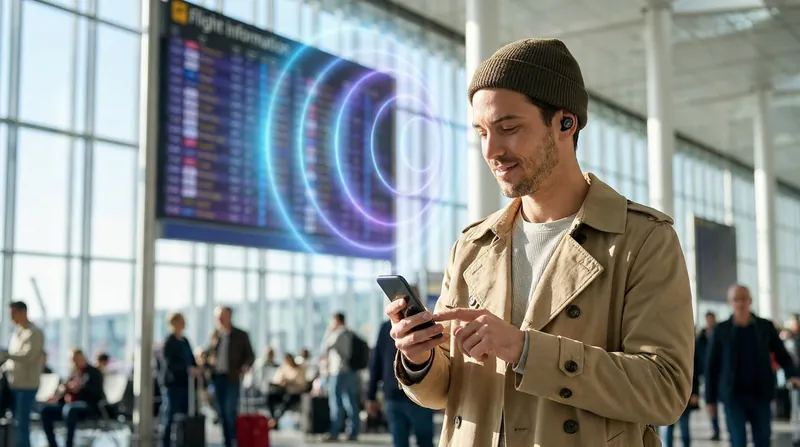
Similarly, in an airport terminal, the days of straining to hear muffled gate announcements over the din of the crowd could soon be over. Travelers will be able to opt into a dedicated Auracast stream for their specific flight.
When the gate agent speaks, the announcement will automatically override or blend with the music or podcast the traveler is already playing, ensuring they never miss a boarding call while waiting at a nearby restaurant or lounge. This targeted approach to public audio reduces noise pollution in shared spaces while drastically improving the clarity of essential information.[2]
Beyond public venues, Auracast elegantly solves the personal sharing problem that has frustrated consumers for years. A single laptop, tablet, or smartphone can now act as a personal broadcast station. A user can share a movie's audio with three friends on a train, or a tour guide can speak softly into a microphone and broadcast their voice directly to the headsets of thirty tour group members. The streams can be left open for anyone to join, or they can be password-protected for private listening, exactly like a mobile Wi-Fi hotspot.
Perhaps the most profound and immediate impact of Auracast, however, is in the realm of accessibility. For individuals who rely on hearing aids, navigating noisy public environments has always been an exhausting challenge.
Traditional assistive listening systems require expensive, venue-specific hearing loops that must be physically installed in the floorboards, or they force users to borrow clunky FM receivers from a front desk. Even then, the audio quality is often compromised by the acoustic properties of the room, as the hearing aid's external microphones struggle to separate the speaker's voice from the ambient chatter.
Auracast fundamentally changes this dynamic by allowing hearing aids to receive a clean, direct digital feed from a microphone or public address system. By bypassing the room's echo and background noise entirely, the listener receives a pristine audio signal. At recent industry testing events, major hearing aid manufacturers including WS Audiology, Sonova, and the GN Group have demonstrated strong early adoption of the standard. Their tests have proven that cross-brand compatibility is rapidly approaching mainstream readiness, signaling a massive leap forward for inclusive design.
Despite the clear technological advantages, the transition in the broader consumer headphone market remains a work in progress in 2026. While the Bluetooth 5.2 specification introduced the foundation for LE Audio several years ago, hardware implementation takes considerable time. A device must have the correct silicon, the right antenna design, and the necessary software stack to support Broadcast Isochronous Streams. Consumers cannot simply download an app to make a five-year-old pair of headphones Auracast-compatible; it requires modern hardware on both ends of the connection.[1]
Currently, premium models from legacy audio brands like JBL, Sony, Bose, and Sennheiser are leading the charge, often unlocking Auracast support retroactively via firmware updates for their newest flagship devices. Samsung has also been a major proponent, integrating LE Audio broadcasting capabilities directly into its recent Galaxy smartphones and earbuds, allowing users to turn their phones into mobile radio stations.
For older televisions and laptops that lack native support, dedicated audio companies like Avantree and aTitan are producing plug-and-play USB and HDMI transmitters to bridge the hardware gap, ensuring legacy equipment isn't left behind.
The primary bottleneck slowing universal adoption is ecosystem fragmentation, a common hurdle for any new wireless standard. While modern Android devices and Windows PCs are increasingly supporting LE Audio natively, Apple's integration of Auracast into iOS and its wildly popular AirPods lineup has been notably slower.
Because the iPhone is disproportionately influential in driving consumer accessory trends, many peripheral manufacturers have hesitated to fully commit to LE Audio until Apple officially embraces the broadcast standard across its entire product ecosystem. This hesitation has left a significant portion of the market in a holding pattern.[1][2]
Despite these growing pains, the long-term trajectory of wireless audio is clear. The limitations of point-to-point Bluetooth have been stretched as far as they can go, and the industry has collectively agreed on the solution.
As more transmitters light up in public spaces, and as the cost of LE Audio silicon drops enough to be included in budget-friendly earbuds, the concept of pairing a headphone to a single device will eventually feel as archaic as plugging in a physical audio cable. Auracast is poised to transform headphones from isolated accessories into connected nodes in a shared audio environment.[2]
Terms to know
- Auracast
- A Bluetooth broadcast feature that lets one audio source stream to an unlimited number of nearby receivers simultaneously.
- Bluetooth LE Audio
- The next-generation Bluetooth architecture that uses less power and supports advanced features like broadcasting.
- LC3 Codec
- The highly efficient audio compression standard required for LE Audio, delivering better sound at lower bitrates.
- Broadcast Isochronous Streams (BIS)
- The underlying data transmission method that allows Auracast to send audio outward without a two-way pairing handshake.
- Point-to-Multipoint
- A network model where a single transmitter sends data to multiple receivers at once, replacing the traditional one-to-one pairing.
Questions readers ask
Will my old Bluetooth headphones work with Auracast?
Generally, no. Auracast requires hardware that supports Bluetooth 5.2 or higher and the specific LE Audio architecture, though some older devices can use plug-in adapters.
Do I need to download a specific app to use Auracast?
No. On compatible smartphones, Auracast stream scanning is built directly into the operating system's Bluetooth or Wi-Fi settings menu.
Can anyone listen to my private Auracast stream?
Auracast streams can be left open for public venues or password-protected for personal sharing, much like a mobile Wi-Fi hotspot.
Different angles
Audio Hardware Innovators
Companies pushing the Auracast standard to replace classic Bluetooth and enable multi-stream sharing.
Hardware manufacturers view Auracast as the necessary evolution of wireless audio, solving the inherent limitations of point-to-point Bluetooth. Brands like Avantree, JBL, and Samsung are aggressively marketing LE Audio as a premium feature that enables social listening and seamless multi-device connectivity. For these companies, the LC3 codec and broadcast capabilities are not just incremental updates, but the foundation for an entirely new category of audio products that interact dynamically with public environments.
Accessibility Advocates
Groups viewing Auracast primarily as a revolutionary tool for assistive listening in public spaces.
For the hearing loss community and organizations like the Bluetooth SIG, Auracast is fundamentally an accessibility triumph. Traditional assistive listening systems, such as hearing loops, are expensive to install and often deliver subpar audio quality. Advocates argue that because Auracast is built into mainstream consumer electronics, it removes the stigma of assistive devices. By allowing hearing aids to tap directly into the same high-quality audio streams used by standard headphones, it democratizes access to clear audio in theaters, transit hubs, and lecture halls.
Consumer Tech Realists
Analysts noting that while the tech is promising, actual adoption is fragmented and heavily dependent on major players like Apple.
Tech reviewers and protocol experts acknowledge the brilliance of the LE Audio specification but remain cautious about the timeline for universal adoption. They point out that the consumer market is currently highly fragmented, with many users owning devices that lack the necessary hardware for Broadcast Isochronous Streams. Furthermore, this camp emphasizes that until Apple fully integrates Auracast into iOS and its dominant AirPods ecosystem, the technology will struggle to achieve the ubiquity required to convince public venues to invest heavily in broadcast transmitters.
- Audio Hardware Innovators
- Companies pushing the Auracast standard to replace classic Bluetooth and enable multi-stream sharing.
- Accessibility Advocates
- Groups viewing Auracast primarily as a revolutionary tool for assistive listening in public spaces.
- Consumer Tech Realists
- Analysts noting that while the tech is promising, actual adoption is fragmented and heavily dependent on major players like Apple.
Perspectives this story doesn't cover
- Venue Operators
- Live Event Producers
Sources
Source coverage
2 outlets
3 viewpoints surfaced


- [1]RedditConsumer Tech Realists
Do people think this is the year Auracast goes mainstream?
Read on Reddit → - [2]Factlen Editorial TeamConsumer Tech Realists
Synthesis by Factlen editorial team
Read on Factlen Editorial Team →
More in Shopping & Reviews
See all →Audio Tech
The End of Isolation: How Open-Ear Audio is Rewriting the Headphone Rulebook
3 sources
Audio Tech
The Science of Silence: How AI and Adaptive ANC Are Rewiring Headphones in 2026
4 sources
Audio Tech
The Science of Silence: How Active Noise Cancellation and Transparency Modes Work
2 sources
Audio Tech
Solid-State MEMS Speakers Are Replacing Traditional Headphone Drivers
3 sources
Comments
Every angle. Every day.
Get Shopping & Reviews stories with full source coverage and perspective breakdowns, free every day.