
How Trackless Trams Are Blurring the Line Between Buses and Light Rail
Autonomous Rapid Transit (ART) uses optical sensors and virtual painted tracks to deliver the capacity of a train at a fraction of the cost, sparking global interest and fierce debate.
By Factlen Editorial Team
- Urban Transit Innovators
- Argue that trackless trams provide the city-shaping benefits and ride quality of light rail at a fraction of the cost and disruption.
- Transit Skeptics
- Warn that the technology is a proprietary 'gadgetbahn' that functions as a heavy bus, risking severe pavement damage and vendor lock-in.
- System Developers & Adopters
- View the technology as a fast-to-deploy, green mobility solution for rapidly growing cities looking to leapfrog legacy rail infrastructure.
- Neutral Analysts
- Assess the technology as a fascinating convergence of automotive sensors and rail engineering, acknowledging both its cost advantages and physical limitations.
What's not represented
- · Disability advocates evaluating the platform gap and boarding accessibility of optical-guided vehicles.
- · Municipal public works departments responsible for maintaining the asphalt corridors.
Why this matters
For decades, cities have been forced to choose between cheap, low-capacity buses and expensive, disruptive light rail networks. The trackless tram introduces a third option that could dramatically accelerate how quickly growing suburbs and mid-sized cities get high-quality public transit.
Key points
- Trackless trams use optical sensors and LiDAR to follow virtual tracks painted on existing roads.
- The technology offers the passenger capacity and smooth ride of light rail without the cost of laying steel tracks.
- Multi-axle hydraulic steering allows the 30-meter vehicles to navigate tight urban corners without fishtailing.
- Roof-mounted supercapacitors enable the trams to flash-charge at stations in just a few minutes.
- Critics warn the heavy vehicles will cause severe asphalt rutting and lock cities into proprietary vendor contracts.
For decades, municipal governments and urban planners have found themselves trapped in a frustrating, binary dilemma when trying to solve the worsening crisis of urban traffic congestion. On one end of the spectrum, traditional subway systems and light rail networks offer massive passenger capacity, exceptional ride quality, and the permanence required to spur high-density real estate development along their corridors. However, these rail projects are prohibitively expensive, often taking decades to plan and requiring billions of dollars to excavate streets, move underground utilities, and lay steel tracks. On the other end of the spectrum, standard diesel or electric buses are cheap and can be deployed almost instantly on existing roads, but they suffer from low passenger capacity, a bumpy ride, and a general lack of appeal that fails to convince commuters to leave their private cars at home.[6]
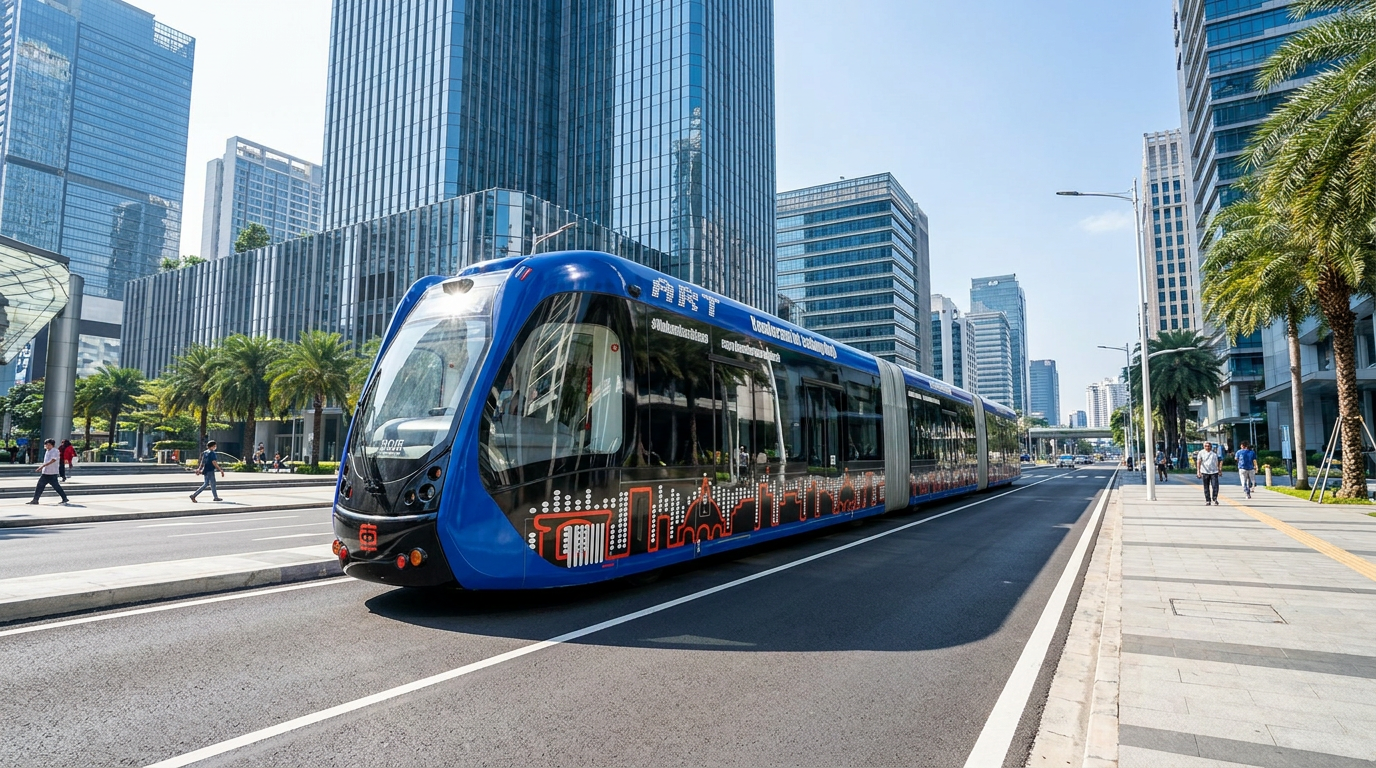
Enter the 'Trackless Tram,' formally known in the industry as Autonomous Rapid Transit, or ART. Developed by the China Railway Rolling Stock Corporation (CRRC)—the world’s largest manufacturer of traditional trains and high-speed rail equipment—this technology represents a fascinating convergence of automotive and railway engineering. At first glance, an ART vehicle looks exactly like a sleek, futuristic light rail train gliding down a city boulevard. It features a streamlined, aerodynamic nose, multiple articulated passenger carriages, and a fully low-floor design that allows for seamless, level boarding. However, a closer inspection reveals a critical difference: instead of riding on steel bogies locked into steel rails, the trackless tram rolls on heavy-duty rubber tires directly on the asphalt surface.[2]
The promise of this hybrid technology is intoxicating for city planners and transit advocates who are desperate for mid-tier solutions. Proponents argue that the trackless tram delivers the high passenger capacity and smooth, comfortable ride of a traditional tram, but at a fraction of the infrastructure cost and construction time. Because it does not require a physical track, a city can theoretically launch a new high-capacity transit line in a matter of months rather than years, avoiding the crippling business disruptions that typically accompany the tearing up of main streets for light rail construction. As cities from Perth, Australia, to Kuala Lumpur, Malaysia, begin launching high-profile trials, the technology is forcing the transportation sector to fundamentally rethink the future of public transit.[1][6]
To truly understand the appeal of the trackless tram, one must look under the hood at the complex mechanisms that allow it to mimic a train without the rails. Unlike traditional light rail, which relies on the physical guidance of steel tracks and draws continuous electrical power from overhead catenary wires, the ART system follows what engineers call a 'virtual track.' This virtual track requires zero excavation; it is simply a double dashed line painted directly onto the existing road surface. The vehicle is equipped with a sophisticated array of optical cameras, LiDAR sensors, and GPS units that continuously read these painted lines and the surrounding environment.[2][5]

As the vehicle moves, the onboard computer processes the optical and spatial data in real-time, calculating the precise trajectory required to keep the massive tram perfectly centered over the painted lines. This autonomous optical guidance system handles the steering with millimeter precision, ensuring that the vehicle never drifts out of its designated lane. The system is so precise that it can pull up to a station platform with the exact same minimal gap every single time, allowing wheelchairs and strollers to roll on and off without the need for ramps or driver assistance, perfectly replicating the accessibility of a fixed-rail subway station.[2]
However, the term 'autonomous' in Autonomous Rapid Transit comes with a significant caveat. While the optical guidance system handles the lateral steering along the virtual track, a human driver remains seated in the cabin at all times. The driver is responsible for controlling the vehicle's acceleration and braking, monitoring the advanced collision-warning systems, and interacting with mixed traffic at intersections. Furthermore, if the virtual track is blocked by a stalled car, an accident, or unexpected roadworks, the driver can simply grab the steering wheel, manually drive the tram around the obstacle like a standard bus, and then re-engage the optical tracking once the path is clear.[2][6]
The physical architecture of the vehicle also borrows heavily from high-speed rail engineering rather than standard bus design, solving one of the most persistent problems of long rubber-tired vehicles. Traditional articulated buses—often colloquially referred to as 'bendy buses'—suffer from a phenomenon known as fishtailing. When a standard articulated bus takes a sharp corner, the rear carriages tend to swing wide, requiring a massive amount of clearance and making them dangerous to operate on narrow, crowded urban streets. This dynamic instability has historically limited how long a bus can safely be built.[5]
The trackless tram solves this geometric problem by utilizing an advanced multi-axle hydraulic steering system. Instead of just the front wheels dictating the direction of travel, every single wheel on the 30-meter, three-carriage vehicle steers in perfect coordination. When the front carriage enters a turn, the onboard computer calculates the exact angle and relays it to the rear axles, causing them to follow the exact same path. This keeps the tram's 'swept path' incredibly narrow, allowing a massive, 300-passenger vehicle to navigate tight urban corners and roundabouts with the exact same precision and footprint as a train locked onto steel rails.[2][5]
Power delivery represents another major technological departure from legacy transit systems. Traditional electric trams require a continuous, unbroken connection to overhead wires, which are expensive to install, visually cluttered, and vulnerable to severe weather. Conversely, modern electric buses rely on massive, heavy lithium-ion battery packs that take hours to charge and reduce the vehicle's passenger capacity due to their sheer weight. The trackless tram bypasses both of these limitations by utilizing roof-mounted supercapacitors—advanced energy storage devices that prioritize rapid power delivery and absorption over long-term, slow-drip storage.[2]

Power delivery represents another major technological departure from legacy transit systems.
These supercapacitors are specifically designed for rapid energy transfer, enabling a concept known as 'flash charging.' When the trackless tram pulls into a designated station, a robotic overhead charging armature automatically drops down and connects to the roof of the vehicle. In the two to three minutes it takes for passengers to board and alight, the station pumps a massive burst of electricity into the supercapacitors—enough to power the tram for the next several kilometers. This allows the vehicle to operate continuously throughout the day without ever needing to return to a depot for a lengthy recharging session.[2]
Ultimately, the financial calculus is the primary driver of global interest in the trackless tram. Traditional light rail projects are notoriously expensive, routinely costing upwards of $20 million to $30 million per kilometer in ideal conditions, and significantly more in dense urban cores. The vast majority of this cost does not go toward the trains themselves, but rather the heavy civil engineering required to prepare the route. Laying steel tracks requires digging up the street, relocating water mains, reinforcing bridges, and installing complex electrical substations, all of which take years and paralyze local businesses.[1][5]
In stark contrast, transportation researchers estimate that a trackless tram system can be deployed for roughly $7 million to $15 million per kilometer. Because the vehicles run on existing road surfaces, the 'construction' phase is largely reduced to building the passenger stations, installing the flash-charging infrastructure, and painting the virtual track lines on the asphalt. This dramatic reduction in capital expenditure means that mid-sized cities, which could never justify the budget for a traditional light rail network, can suddenly afford to build a comprehensive, high-quality mass transit system.[1][5]

This compelling cost advantage has sparked a wave of rapid adoption, particularly in emerging markets and rapidly growing cities across the Asia-Pacific region. In Malaysia, for example, the ambitious Kuching Urban Transportation System is currently deploying a customized, hydrogen-fuel-cell variant of the ART. By opting for trackless trams over traditional rail, the state of Sarawak aims to leapfrog legacy infrastructure entirely, providing its citizens with a zero-emission, high-capacity transit network by 2026 without taking on the crippling debt associated with building a subway.[4]
Similarly, in Australia, the City of Stirling recently imported an ART vehicle for a high-profile trial, hoping to connect its coastal suburbs to the broader Perth rail network. Local officials view the trackless tram as the perfect middle-ground solution: it offers the permanence and premium feel necessary to encourage transit-oriented real estate development along the corridor, but it avoids the multi-year construction disruption that has historically triggered fierce political backlash from local residents and shop owners during light rail rollouts.[1]
However, the technology is not without its fierce and vocal critics. Traditional transit planners and rail advocates often dismiss the trackless tram as a 'gadgetbahn'—a derogatory industry term for proprietary, overhyped transportation technologies that promise to revolutionize mobility but ultimately fail to outperform conventional solutions. These skeptics argue that despite the sleek, train-like exterior and the sophisticated optical guidance systems, the ART is fundamentally just a very long, very heavy electric bus, subject to all the same physical limitations as any other rubber-tired vehicle.[3]
From a physics perspective, skeptics point out that rubber tires rolling on asphalt will never achieve the ultra-low rolling resistance of steel wheels gliding on steel rails. This means that a trackless tram inherently requires significantly more energy to move the same number of passengers than a traditional light rail vehicle. Furthermore, while the optical guidance system ensures a perfectly precise path, this precision introduces a severe, unintended consequence for the road surface itself, creating a massive headache for municipal public works departments.[3]
Because the trackless tram follows the exact same virtual line with millimeter precision, the massive weight of the vehicle—exacerbated by the heavy roof-mounted supercapacitors—is repeatedly concentrated on the exact same narrow strips of asphalt hundreds of times a day. Over time, this intense, localized pressure creates severe rutting and pavement degradation. Critics warn that cities may save money upfront by not laying steel tracks, but they will end up spending millions continuously rebuilding and reinforcing the asphalt corridors with specialized concrete to withstand the punishment.[3]

There is also the significant risk of vendor lock-in. If a city builds a standard light rail line, the tracks are built to an international gauge, meaning the city can solicit competitive bids from multiple global manufacturers—like Alstom, Siemens, or CAF—when it comes time to buy replacement trains. If a city builds an ART system, it is currently entirely dependent on CRRC for replacement parts, proprietary software updates, and new vehicles, stripping the municipality of its long-term negotiating power.[3][6]
Despite these valid uncertainties and the ongoing debates over long-term maintenance costs, the trackless tram represents a genuinely fascinating convergence of automotive and rail technology. It successfully takes the advanced sensor suites, LiDAR arrays, and autonomous software originally developed for the self-driving car industry and applies them to the mass-transit form factor of a high-capacity train. By doing so, it creates a unique hybrid vehicle that challenges our traditional, rigid definitions of public transportation, offering a flexible tool that can be adapted to a wide variety of urban environments and topographies.[6]
Whether the Autonomous Rapid Transit system ultimately replaces light rail entirely, or simply serves as a high-end, premium upgrade to existing Bus Rapid Transit networks, its rapid global proliferation is undeniable. As more cities look for ways to decarbonize their transport networks and reduce traffic congestion without bankrupting their municipal budgets, the trackless tram proves that the boundary between a bus and a train is no longer defined by heavy steel tracks, but rather by the invisible, intelligent guidance of software and sensors.[6]
How we got here
June 2017
CRRC unveils the first Autonomous Rail Rapid Transit (ART) prototype in Zhuzhou, China.
2018
The first commercial ART line begins passenger service in China.
2023
Sarawak Metro in Malaysia receives its first hydrogen-powered ART prototype for the Kuching urban transit project.
Early 2024
The City of Stirling in Western Australia commences a high-profile trial of the trackless tram.
Late 2025
Expected rollout of passenger service for the first phase of Malaysia's ART networks.
Viewpoints in depth
Transit Innovators' view
Focuses on the massive cost savings and rapid deployment potential of the technology.
Proponents view the trackless tram as a genuine paradigm shift for mid-sized cities. By stripping away the need for heavy civil engineering—specifically the excavation required for steel tracks and the installation of overhead catenary wires—ART systems can be deployed for a fraction of the cost of light rail. Innovators argue that the technology successfully ports the ride-stabilization and multi-axle steering of high-speed rail onto rubber tires, providing the premium, city-shaping permanence required to spur transit-oriented development without bankrupting municipal budgets.
Skeptics' view
Focuses on the physical limitations of rubber tires and the risks of proprietary technology.
Traditional transit planners often dismiss the trackless tram as an overhyped 'gadgetbahn.' They argue that rubber tires on asphalt will never match the energy efficiency of steel wheels on steel rails. More pressingly, skeptics warn that running a 30-ton, battery-laden vehicle over the exact same optical path hundreds of times a day will inevitably cause severe asphalt rutting, shifting the infrastructure costs from upfront track-laying to perpetual road maintenance. They also highlight the risk of vendor lock-in, noting that cities adopting ART become entirely dependent on a single manufacturer for parts and software.
Adopters' view
Focuses on leapfrogging legacy infrastructure in rapidly growing urban centers.
For transit authorities in emerging markets and rapidly expanding cities, the trackless tram represents an opportunity to bypass legacy rail systems entirely. Regions like Sarawak, Malaysia, are actively deploying hydrogen-powered ART networks to quickly establish zero-emission, high-capacity transit corridors. For these adopters, the speed of implementation is just as valuable as the financial savings, allowing them to address crippling traffic congestion before it permanently stifles regional economic growth.
What we don't know
- The true long-term maintenance costs of the asphalt corridors subjected to the concentrated weight of the trams.
- How the optical guidance systems will perform over decades in cities with severe winter weather or heavy snowfall.
- Whether other global manufacturers will develop interoperable trackless tram systems to break the current single-vendor monopoly.
Key terms
- Autonomous Rapid Transit (ART)
- A multi-carriage, rubber-tired transit vehicle that mimics a train by following virtual tracks using optical sensors.
- LiDAR
- Light Detection and Ranging, a remote sensing method used by ART systems to map the road and detect obstacles in real-time.
- Supercapacitor
- A high-capacity energy storage device that charges much faster than traditional batteries, used to power ART vehicles between stations.
- Gadgetbahn
- A derogatory term used by transit planners for speculative or proprietary transport technologies that overpromise and underdeliver compared to conventional rail or buses.
- Swept Path
- The envelope of space a vehicle occupies when making a turn; ART uses multi-axle steering to keep this path remarkably narrow.
Frequently asked
Does a trackless tram need a driver?
Yes. Despite the 'autonomous' name, current ART systems require a human driver for safety, overriding the system during emergencies, and navigating complex mixed-traffic intersections.
How is it different from a bendy bus?
It uses rail-style bogies, multi-axle hydraulic steering, and active suspension to prevent the 'fishtailing' common in articulated buses, providing a smoother, rail-like ride with a much narrower turning footprint.
How does it charge without overhead wires?
It uses roof-mounted supercapacitors that receive a rapid burst of electricity—often in under 10 minutes—via an overhead armature at designated station stops.
Do trackless trams damage the road?
Critics warn that running a heavy, battery-laden vehicle over the exact same wheel path repeatedly can cause severe asphalt rutting, potentially requiring cities to reinforce the lanes with expensive concrete.
Sources
Source coverage
6 outlets
4 viewpoints surfaced






[1]Curtin University Sustainability Policy InstituteUrban Transit Innovators
Trackless Trams: The next generation of urban transit
Read on Curtin University Sustainability Policy Institute →[2]CRRC CorporationSystem Developers & Adopters
Autonomous Rail Rapid Transit (ART) System Specifications
Read on CRRC Corporation →[3]Public Transport Association AustraliaTransit Skeptics
The Gadgetbahn Illusion: Why Trackless Trams Fall Short
Read on Public Transport Association Australia →[4]Sarawak MetroSystem Developers & Adopters
Kuching Urban Transportation System (KUTS) Project Overview
Read on Sarawak Metro →[5]Journal of Transportation TechnologiesUrban Transit Innovators
The Trackless Tram: Is It the Transit and City Shaping Catalyst We Have Been Waiting For?
Read on Journal of Transportation Technologies →[6]Factlen Editorial TeamNeutral Analysts
Synthesis by Factlen editorial team
Read on Factlen Editorial Team →
Every angle. Every day.
Get automotive stories with full source coverage and perspective breakdowns delivered to your inbox.