
The Modern Pilgrimage Boom: Why Millions Are Walking Ancient Paths in 2026
From Spain's Camino de Santiago to Japan's Kumano Kodo, ancient spiritual routes are seeing record-breaking crowds as modern travelers seek physical challenge, mental clarity, and digital detox.
By Factlen Editorial Team
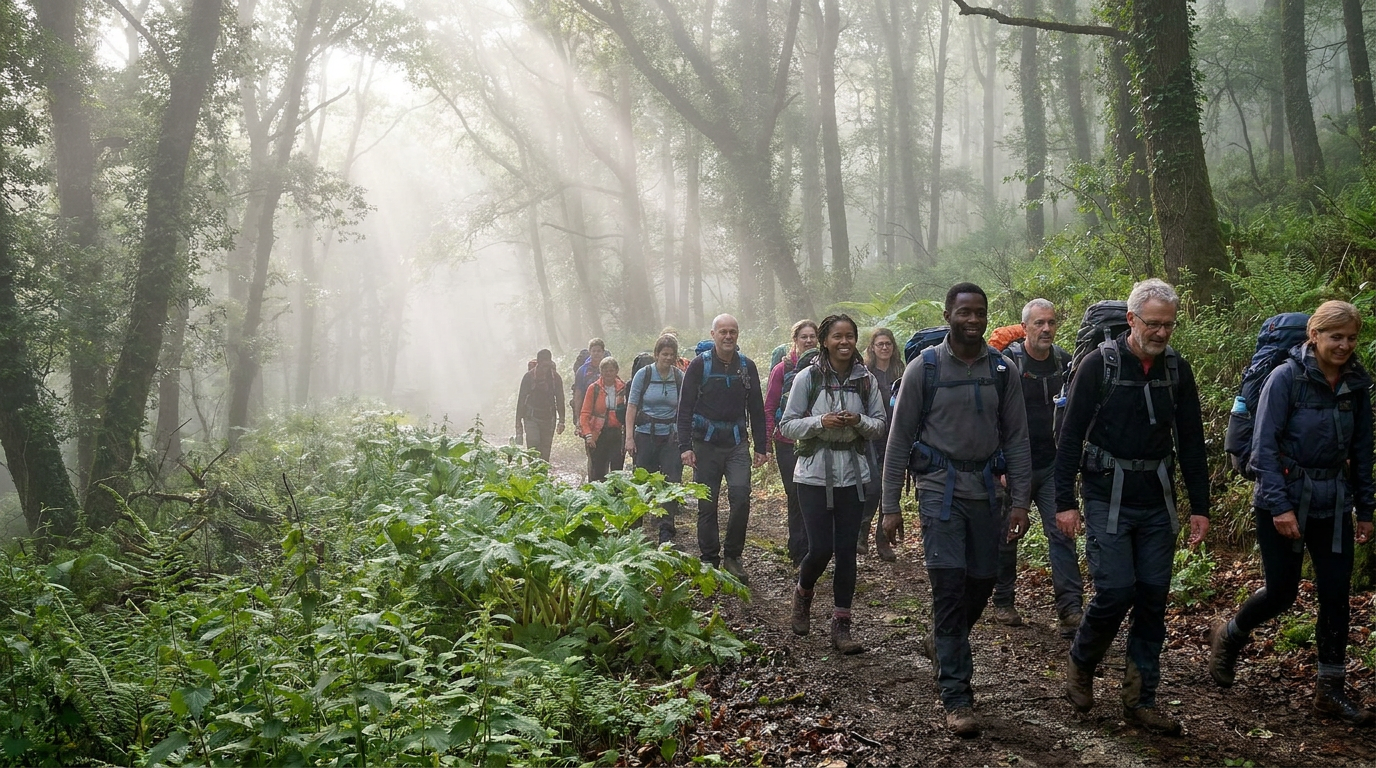
- Secular Wellness Seekers
- View pilgrimage primarily as a psychological tool for digital detox, stress reduction, and physical health.
- Traditional Faithful
- Undertake the journey as an act of religious devotion, penance, or spiritual communion.
- Cultural Adventurers
- Drawn by the historical significance, natural beauty, and cross-cultural community of ancient routes.
What's not represented
- · Rural residents in pilgrimage towns
- · Indigenous voices on sacred land use
Why this matters
As rates of digital burnout and anxiety climb, the resurgence of ancient walking routes reveals a growing human need for structured, physical journeys to process stress and find community outside of screens.
Key points
- The Camino de Santiago saw a record 530,987 official completions in 2025, driven heavily by international walkers.
- Psychological studies show 74% of modern pilgrims are motivated by 'psycho-existential' reasons rather than strict religion.
- Long-distance walking reduces activity in the brain's medial prefrontal cortex, helping to break cycles of anxiety and rumination.
- Japan's Kumano Kodo trail is experiencing a similar boom, drawing travelers seeking deep nature immersion.
- Traditional faith-based travel is also rising, highlighted by the 2026 National Eucharistic Pilgrimage in the US.
In 2025, the Camino de Santiago reached an unprecedented milestone. According to the Pilgrim's Reception Office in northwestern Spain, a record 530,987 people completed the journey and received their official Compostela certificate [1]. When accounting for those who walk sections without registering, the true number of participants is estimated at over 1.5 million [1]. This surge confirms a structural, rather than episodic, shift in global travel habits. What was once a quiet, predominantly European religious trek has transformed into a massive international movement [7].[1][7]
The demographic profile of today's pilgrim looks vastly different than it did two decades ago, when barely 100,000 people walked the route. Today, international walkers make up 58% of the total, with the United States emerging as the second-largest country of origin [1]. Women now account for a slight majority of those receiving certificates [1]. As the famous Camino Francés route grows more crowded, travelers are increasingly diversifying their paths; the Camino Portugués Coastal route saw a 20% jump in traffic over the past year as walkers sought quieter, more reflective environments [1].[1]
While the infrastructure is rooted in medieval Catholicism, the motivations driving this modern exodus are increasingly secular. Recent psychological studies indicate that 74% of participants are driven by "psycho-existential" motives rather than strict religious dogma [3]. In an era defined by digital saturation, chronic stress, and social atomization, the physical act of walking hundreds of miles offers a structured escape. Pilgrims are seeking a digital detox, a physical challenge, and a rare opportunity for uninterrupted introspection [7].[3][7]

Science is beginning to quantify what pilgrims have intuitively known for centuries: walking is a potent form of medicine. Researchers studying the neurological impacts of long-distance walking have found that it significantly reduces activity in the medial prefrontal cortex, the brain region closely associated with rumination and negative thought loops [6]. Stripped of daily distractions, the mind is forced to adapt to new landscapes and physical challenges, which helps disrupt cycles of anxiety and depression [6].[6]
This therapeutic effect is amplified by the sheer physical rhythm of the journey. Psychologists note that walking step after step, day after day, induces a "flow state"—a condition of complete immersion where time and self-consciousness fade [6]. The quiet space allows suppressed thoughts and emotions to surface in a context rendered safe by the simplicity of the task and the support of fellow travelers [6]. Some researchers describe this process as a "regression in the service of growth," allowing individuals to process unresolved trauma and build emotional resilience [3].[3][6]
This therapeutic effect is amplified by the sheer physical rhythm of the journey.
The phenomenon is not limited to Europe. In Japan, the Kumano Kodo—a network of ancient Shinto and Buddhist trails across the mountainous Kii Peninsula—is experiencing a similar renaissance [2]. Designated as a UNESCO World Heritage site and officially twinned with the Camino de Santiago, the Kumano Kodo connects twelve centuries of spiritual history [2]. Today, it draws a global crowd seeking the restorative power of its misty cedar forests and hidden shrines [2].[2]

The Japanese concept of komorebi—the ethereal effect of sunlight filtering through the forest canopy—captures the deep nature immersion that defines the Kumano Kodo experience [2]. Studies show that this prolonged exposure to nature resets circadian rhythms, lowers cortisol levels, and boosts the production of serotonin and dopamine [6]. Whether walking the accessible Nakahechi route or the rugged, isolated Kohechi path, travelers find that the physical exertion of climbing ancient stone steps acts as a catalyst for mental clarity [2].[2][6]
A recent study published in the Psychology of Religion and Spirituality identified six interconnected stages of growth experienced by modern pilgrims across Spain, Japan, and Taiwan [3]. The research found that the journey enables participants to step back and rebuild their inner balance through a sequence of physical and sensory stimuli [3]. The process culminates in an "upward and beyond" phase, characterized by deep inner self-dialogue, a profound sense of gratitude, and an enhanced acceptance of life's complexities [3].[3]
While secular wellness drives much of this growth, traditional faith-based pilgrimage is also seeing a robust revival. In the United States, the 2026 National Eucharistic Pilgrimage has mobilized thousands of Catholics [5]. Coinciding with the nation's 250th anniversary, the summer-long event features "perpetual pilgrims" walking an East Coast route from Florida to Philadelphia [5]. The journey blends public witness with historical commemoration, demonstrating that the physical act of procession remains a vital expression of communal faith [5].[5]

Similarly, Asia is witnessing a massive boom in spiritually motivated travel. According to recent industry data, 19% of Indian travelers are planning journeys with a spiritual purpose in 2026, making India the leading market for such travel in the region [4]. This trend is evolving beyond traditional temple visits; modern travelers are increasingly blending religious observance with cultural exploration, local cuisine, and leisure, creating a more holistic approach to the pilgrimage experience [4].[4]
The rapid expansion of these ancient routes does present modern challenges. As the Camino de Santiago approaches the scale of a major corporate enterprise, local municipalities must balance the economic windfall with the strain on rural infrastructure [7]. The influx of half a million walkers requires careful management to preserve the authentic, contemplative nature of the journey without turning sacred paths into crowded tourist corridors [7].[7]

Yet, the enduring appeal of the pilgrimage suggests it fulfills a fundamental human need that modern society struggles to meet. In a world that often feels fragmented and overwhelmingly fast, the pilgrimage offers a return to human scale [7]. It provides a clear destination, a supportive community of strangers, and the simple, profound satisfaction of moving forward one step at a time [6].[6][7]
How we got here
10th Century
The Nakahechi route of the Kumano Kodo is extensively used by the Japanese imperial family.
1998
The Camino de Santiago and the Kumano Kodo are officially twinned as sister pilgrimages.
2004
The Kumano Kodo pilgrimage routes are registered as a UNESCO World Heritage site.
2025
The Camino de Santiago surpasses half a million official completions for the first time in its history.
Viewpoints in depth
Secular Wellness Seekers
This group views the pilgrimage primarily as a psychological tool for digital detox, stress reduction, and physical health.
For wellness seekers, the ancient infrastructure of the pilgrimage provides a necessary framework for modern healing. They point to clinical research showing that extended walking in nature lowers cortisol and deactivates the brain regions responsible for anxiety. To this camp, the religious origins of the routes are secondary to the universal human need for physical challenge, simplicity, and a temporary escape from the hyper-connected digital world.
The Traditional Faithful
This camp undertakes the journey as an act of religious devotion, penance, or spiritual communion.
Traditional believers emphasize that these routes were forged by centuries of faith and prayer. Whether participating in the US National Eucharistic Pilgrimage or walking to the shrine of St. James in Spain, they view the physical hardship of the journey as a form of spiritual purification. They argue that while the secular benefits of walking are real, the true transformative power of the pilgrimage lies in its connection to the divine and the historic communion of saints.
Cultural Adventurers
This group is drawn by the historical significance, natural beauty, and cross-cultural community of ancient routes.
Cultural adventurers see the pilgrimage as the ultimate form of slow travel. They value the opportunity to walk through centuries of history, stay in rural villages, and interact with a diverse, global community of walkers. For this camp, the appeal lies in the shared human experience—the leveling effect of the trail where CEOs and students walk side-by-side, sharing meals, stories, and the physical reality of the road.
What we don't know
- Whether rural infrastructure can sustainably support the continued year-over-year growth of these routes.
- How climate change and extreme summer temperatures will alter traditional walking seasons.
- If the commercialization of popular routes will eventually dilute their psychological and spiritual benefits.
Key terms
- Compostela
- The official certificate of completion awarded to pilgrims who walk at least 100 kilometers of the Camino de Santiago.
- Kumano Kodo
- A network of ancient Shinto and Buddhist pilgrimage trails in Japan's Kii Peninsula, designated as a UNESCO World Heritage site.
- Psycho-existential motive
- A drive to undertake a journey not for strict religious dogma, but to seek personal meaning, mental clarity, and identity.
- Flow state
- A psychological concept describing complete immersion and focus in an activity, often achieved during long-distance walking.
- Medial prefrontal cortex
- The brain region associated with rumination and negative thought patterns, which shows reduced activity during extended time in nature.
Frequently asked
Do I need to be religious to walk a pilgrimage route?
No. While routes like the Camino de Santiago have Catholic origins, studies show the vast majority of modern walkers cite psychological, cultural, or fitness motivations rather than strict religious adherence.
How long does it take to walk the Camino de Santiago?
The most popular route, the Camino Francés, takes about 30 to 35 days to complete in its entirety. However, many walkers choose to complete shorter 5- to 7-day sections to earn their certificate.
What is the connection between the Camino and the Kumano Kodo?
Both are ancient pilgrimage networks and are the only two such routes designated as UNESCO World Heritage sites. They established a "Dual Pilgrim" program in 1998 to encourage travelers to experience both.
Are these trails becoming overcrowded?
Popular starting points can be crowded during peak summer months, prompting many modern pilgrims to seek alternative paths—like the Portuguese Coastal route—or travel during the shoulder seasons.
Sources
Source coverage
7 outlets
3 viewpoints surfaced







[1]CaminoWaysCultural Adventurers
Camino de Santiago Statistics 2025: Pilgrim Numbers
Read on CaminoWays →[2]ForbesCultural Adventurers
Walking Japan's Fabled Kumano Kodo Pilgrimage
Read on Forbes →[3]PsyPostSecular Wellness Seekers
New study reveals six stages of spiritual growth experienced during a pilgrimage
Read on PsyPost →[4]TravelSpanTraditional Faithful
India Set to Lead Asia in Spiritually Motivated Travel in 2026
Read on TravelSpan →[5]OSV NewsTraditional Faithful
Perpetual pilgrims selected for 2026 National Eucharistic Pilgrimage
Read on OSV News →[6]PilgrimapsSecular Wellness Seekers
Walking to Heal: The Science of Pilgrimage
Read on Pilgrimaps →[7]Factlen Editorial TeamCultural Adventurers
Synthesis by Factlen editorial team
Read on Factlen Editorial Team →
Every angle. Every day.
Get culture stories with full source coverage and perspective breakdowns delivered to your inbox.