
The Science of Aquafaba: How Chickpea Water Replaced the Egg White
Food scientists are decoding the exact chemical properties that allow the discarded liquid from canned chickpeas to mimic the complex behavior of egg whites in baking.
By Factlen Editorial Team
- Food Technologists
- Focuses on the physicochemical properties and the need for precise adjustments to mimic egg functionality.
- Vegan Bakers & Home Cooks
- Focuses on the accessibility and democratization of plant-based baking.
- Sustainability Advocates
- Focuses on the environmental benefits of upcycling legume wastewater.
What's not represented
- · Commercial Egg Producers
- · Legume Processors
Why this matters
Understanding the chemistry of aquafaba demystifies plant-based baking, allowing home cooks to reliably replace eggs while reducing the environmental footprint of their desserts.
Key points
- Aquafaba is the protein-rich liquid from cooked legumes that mimics egg whites.
- Saponins in the liquid reduce surface tension, allowing a foam to form rapidly.
- Legume proteins unfold during whipping to stabilize the air bubbles.
- Adding acid drops the pH to 4.0, which is crucial for structural stability.
- Aquafaba cannot replace eggs in curds because it lacks thermal coagulation.
- Upcycling legume water offers a zero-waste alternative to resource-intensive egg production.
For decades, plant-based baking faced an insurmountable hurdle: the egg white. A marvel of evolutionary biology, the egg white provides structure, lift, and aeration that alternative ingredients simply could not replicate. Without it, delicate desserts like macarons, meringues, and airy mousses were effectively off-limits to those avoiding animal products.
That changed in 2014 when a French musician named Joël Roessel made a bizarre discovery. While experimenting with legume waters, he found that the viscous, yellowish liquid discarded from canned chickpeas could be whipped into a stable foam. A year later, software engineer Goose Wohlt refined the technique, coined the term "aquafaba" (a portmanteau of the Latin words for water and bean), and an open-source culinary revolution began.[5]
Today, aquafaba is no longer just a viral pantry hack; it is the subject of rigorous, peer-reviewed food science. Researchers and food technologists are actively decoding the exact physicochemical properties that allow this humble legume byproduct to mimic the complex behavior of animal proteins.[1]
To understand how aquafaba works, one must first understand what makes egg whites so unique. Egg whites are roughly 90 percent water and 10 percent protein, primarily ovalbumin. When whipped, the mechanical force denatures, or unfolds, these proteins. They align at the boundary between the water and the incorporated air, creating a flexible, viscoelastic network that traps bubbles and holds its shape.
Aquafaba achieves a remarkably similar result, but through a different chemical pathway. The liquid is essentially a complex broth of starches, proteins—specifically albumins and globulins like vicilin and legumin—and carbohydrates that leach out of the chickpeas during the cooking process.[1][3]

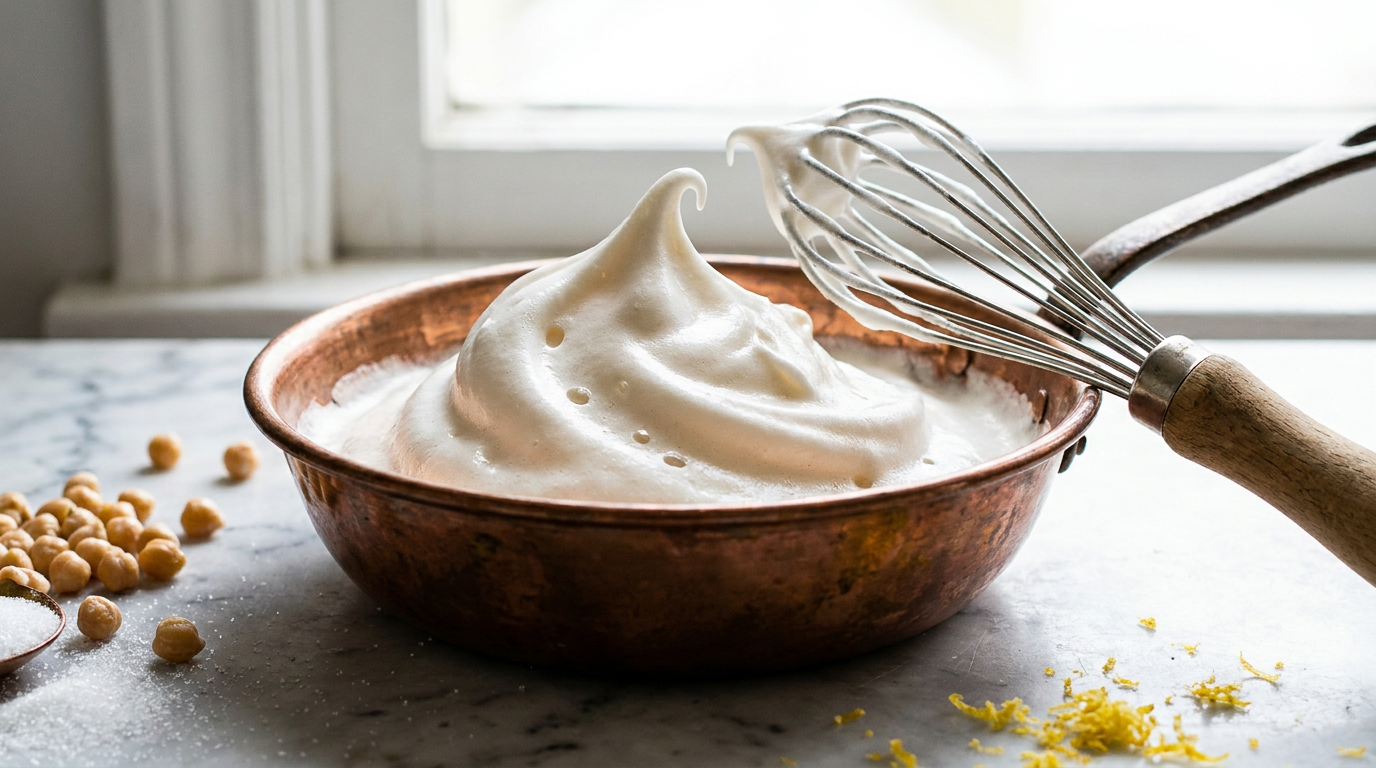
The secret to aquafaba's initial foaming capacity lies in a class of chemical compounds called saponins. Saponins are natural surfactants, meaning they reduce surface tension. When the chickpea liquid is agitated by a whisk, saponins lower the energy required to create bubbles, allowing a creamy, voluminous foam to form rapidly.[1]
However, saponins alone cannot hold a permanent structure. That is where the leached legume proteins step in. Just like the ovalbumin in egg whites, the globulins in aquafaba unfold under the mechanical stress of whipping. They migrate to the air-water interface, forming a protective film around the newly created air bubbles and preventing them from collapsing.[1]
Just like the ovalbumin in egg whites, the globulins in aquafaba unfold under the mechanical stress of whipping.
Despite this structural similarity, aquafaba is inherently more fragile than egg whites. Food technologists have found that the stability of the foam is highly dependent on the liquid's pH level. Chickpea water is naturally close to neutral, which can lead to rapid foam degradation if left untreated.[4]
By introducing an acid—such as cream of tartar, lemon juice, or citric acid—bakers can drop the pH of the aquafaba to around 4.0. This acidic environment alters the electrical charge of the proteins, encouraging them to bond more tightly to one another rather than repelling each other, which significantly increases the foam's structural stability.[4]

Concentration also plays a critical role. The liquid straight from a commercial can of chickpeas can vary wildly in its water content. For optimal results, especially in delicate pastries that require exact hydration levels, the aquafaba must often be reduced on a stovetop to evaporate excess water, mimicking the precise 10 percent solid concentration found in a natural egg white.
Yet, despite its miraculous properties in meringues and mousses, aquafaba is not a universal egg replacement. Its chemical limitations become glaringly obvious when heat is applied in specific culinary contexts, such as the preparation of curds, custards, or quiches.[5]
The fundamental difference lies in thermal coagulation. When egg proteins are heated, they form tight, interlocking strands that create a solid gel—the mechanism that sets a lemon curd. Aquafaba proteins lack this specific heat-triggered coagulation property. If you attempt to make an aquafaba curd, the interlocking protein strands will not form, and the mixture will remain a liquid.[5]
Furthermore, in baked goods like cakes, aquafaba exhibits a lower water-binding capacity than eggs. Studies have shown that cakes made with a 100 percent aquafaba substitution experience higher "baking loss"—meaning more moisture evaporates in the oven. This can lead to a denser, less fluffy crumb unless hydrocolloids like xanthan gum are added to trap the moisture.[2][3]

Beyond the chemistry, the rise of aquafaba represents a significant win for food sustainability. Commercial egg production is highly resource-intensive, requiring substantial water inputs and generating considerable greenhouse gas emissions.[4][6]
By upcycling the cooking liquid from legumes—a byproduct that millions of households and commercial kitchens previously poured down the drain—aquafaba offers an elegant, zero-waste solution. It transforms a discarded waste stream into a high-value functional ingredient, proving that sometimes the most profound scientific breakthroughs are hiding in plain sight.[6]
How we got here
December 2014
French musician Joël Roessel discovers that canned chickpea liquid can be whipped into a stable foam.
March 2015
Software engineer Goose Wohlt coins the term 'aquafaba' and popularizes the first vegan meringue recipe online.
2018–Present
Food scientists begin publishing peer-reviewed studies detailing the physicochemical properties of aquafaba.
Viewpoints in depth
Food Technologists' view
Focuses on the physicochemical properties and the need for precise adjustments to mimic egg functionality.
For food scientists, aquafaba is a fascinating but imperfect emulsion system. They emphasize that while saponins provide excellent initial foaming, the lack of thermal coagulation means aquafaba cannot replicate the structural gelling of eggs in custards. Technologists advocate for the addition of hydrocolloids like xanthan gum and precise pH adjustments to overcome its natural limitations in commercial baking.
Vegan Bakers' view
Focuses on the accessibility and democratization of plant-based baking.
Home bakers and vegan chefs view aquafaba as a revolutionary ingredient that unlocked previously impossible recipes. Because it utilizes a cheap, widely available pantry staple, it democratized high-end pastry techniques like macarons and Swiss meringues for those with egg allergies or ethical dietary restrictions, relying on community-driven experimentation rather than expensive commercial substitutes.
Sustainability Advocates' view
Focuses on the environmental benefits of upcycling legume wastewater.
Environmental advocates highlight aquafaba as a prime example of circular food systems. By repurposing the cooking liquid from chickpeas—a byproduct traditionally treated as wastewater—the food industry can reduce the heavy water and carbon footprint associated with commercial poultry farming, turning a discarded waste stream into a valuable functional ingredient.
What we don't know
- The exact molecular structure of the protein-saponin interactions at the air-water interface is still being mapped.
- How different legume varieties (beyond chickpeas and soybeans) alter the specific foaming capacity of their cooking water.
- Long-term commercial scalability of extracting and standardizing aquafaba powder for industrial food manufacturing.
Key terms
- Aquafaba
- The starchy, protein-rich liquid left over from cooking legumes, used as a plant-based egg substitute.
- Saponins
- Natural chemical compounds found in legumes that act as surfactants, reducing surface tension and allowing foams to form.
- Denaturation
- The process where proteins unfold from their natural structure, often caused by mechanical whipping or heat.
- Viscoelastic network
- A flexible but stable structure formed by proteins at the boundary of air and water, essential for trapping bubbles in a foam.
Frequently asked
What exactly is aquafaba?
Aquafaba is the starchy, protein-rich liquid left over from cooking legumes, most commonly chickpeas. It is used as a plant-based egg substitute.
Why do you need to add acid to aquafaba?
Adding an acid, like lemon juice or cream of tartar, lowers the pH of the liquid. This changes the electrical charge of the proteins, helping them bond together and stabilize the foam.
Can aquafaba replace eggs in any recipe?
No. While it works exceptionally well for foams, meringues, and cakes, it lacks the ability to coagulate under heat, meaning it fails in recipes like curds or quiches.
Does aquafaba taste like chickpeas?
The raw liquid has a mild bean scent, but when whipped with sugar and baked into desserts, the flavor becomes completely neutral.
Sources
Source coverage
6 outlets
3 viewpoints surfaced






[1]MDPIFood Technologists
Aquafaba as an Egg Substitute in Food Technology
Read on MDPI →[2]Oxford AcademicFood Technologists
Aquafaba in Hi-Ratio Cakes: Volume and Texture Analysis
Read on Oxford Academic →[3]International Food Research JournalFood Technologists
Potential of soybean aquafaba as a viable egg substitute
Read on International Food Research Journal →[4]Chemical Engineering TransactionsFood Technologists
Appropriate Conditions for the Use of Chickpea Aquafaba
Read on Chemical Engineering Transactions →[5]FoodalVegan Bakers & Home Cooks
The Science of Aquafaba: Kitchen Magic
Read on Foodal →[6]Factlen Editorial TeamSustainability Advocates
Synthesis by Factlen editorial team
Read on Factlen Editorial Team →
Every angle. Every day.
Get food drink stories with full source coverage and perspective breakdowns delivered to your inbox.