
Gas from Uranus reveals it has an icy centre, settling a long-standing planetary debate
The first detection of carbon monoxide deep in Uranus’s atmosphere confirms the planet is packed with ice rather than rock, resolving a decades-old mystery about its formation.
By Factlen Editorial Team
- Observational Astronomers
- Researchers focused on the technical challenges of detecting faint molecular signatures across billions of miles.
- Planetary Formation Theorists
- Scientists focused on how the solar system evolved from a primordial disk of gas and dust.
- Science Communicators
- Writers and educators focused on resolving the public mystery of the planets.
What's not represented
- · Aerospace engineers designing future atmospheric entry probes
- · Astrophysicists studying exoplanet ice giants in other star systems
Why this matters
This discovery resolves one of the biggest lingering mysteries in our solar system, proving that Uranus and Neptune are planetary twins rather than distant cousins. Understanding how these ice giants formed is crucial for interpreting the thousands of similar-sized exoplanets we are now discovering across the galaxy.
Key points
- Astronomers have detected carbon monoxide in the deep troposphere of Uranus for the first time.
- The discovery was made using high-resolution spectral mapping from the ALMA radio telescope array in Chile.
- The presence of deep carbon monoxide indicates a massive supply of oxygen, confirming Uranus is an 'ice giant' rather than a 'rock giant'.
- A separate layer of carbon monoxide in the upper stratosphere was likely deposited by a comet impact centuries ago.
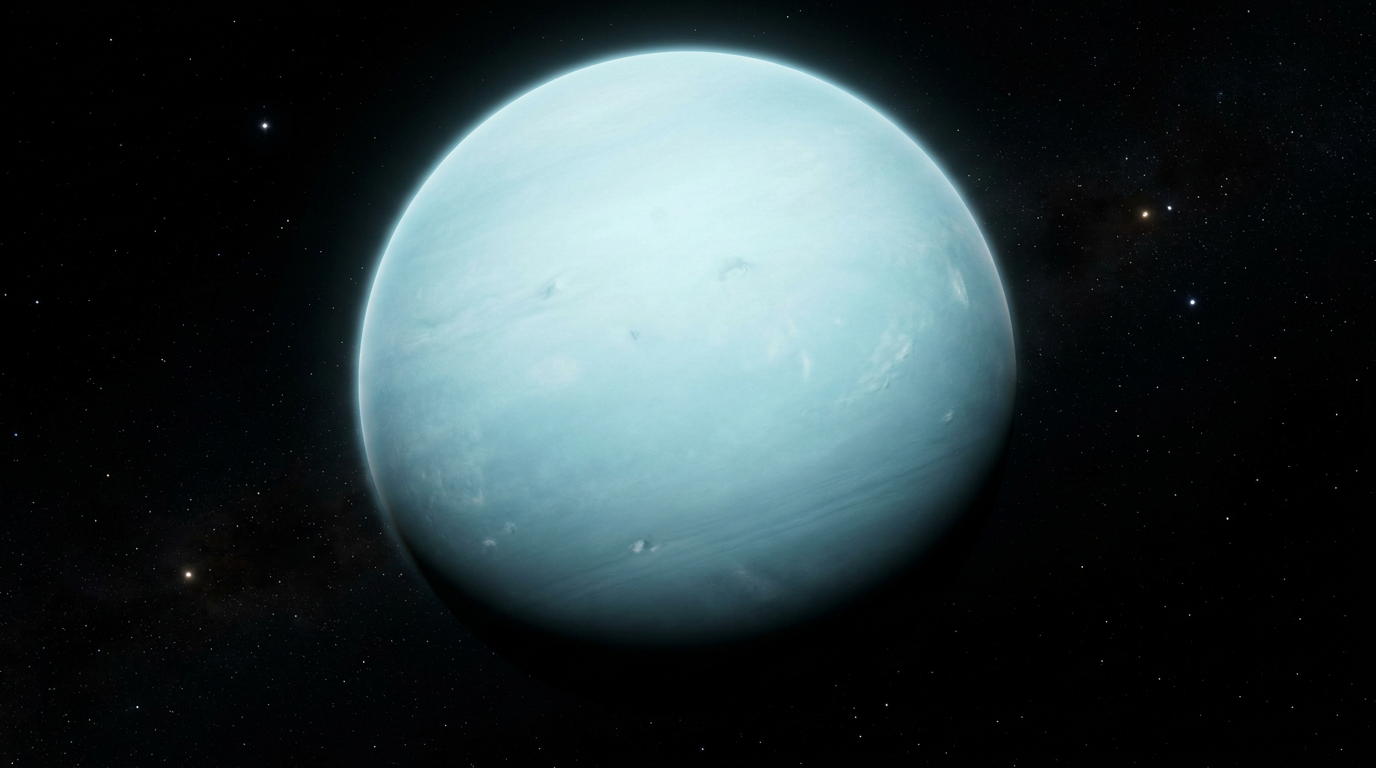
For decades, Uranus has harbored a fundamental identity crisis. While textbooks confidently label the seventh planet from the Sun an "ice giant," a persistent faction of planetary scientists has argued that it might actually be a "rock giant."[4][5]
The debate stems from a frustrating lack of data. Because Uranus is wrapped in a thick, opaque blanket of hydrogen and helium gas, peering into its deep interior is virtually impossible.[2][6]
To understand what lies beneath, astronomers must sniff the upper layers of the atmosphere for chemical clues dredging up from the abyss.[2][4]
For years, the key missing ingredient on Uranus was carbon monoxide. On its sister planet, Neptune, carbon monoxide is abundant in the deep atmosphere, strongly indicating a vast interior reservoir of oxygen and water ice.[4]
Uranus, however, appeared stubbornly devoid of deep-atmosphere carbon monoxide. This absence led to a controversial hypothesis: perhaps Uranus was fundamentally different from Neptune, built primarily of dry rock rather than volatile ices.[2][4]

Now, that controversy appears to be settled. A team of astronomers led by Thibault Cavalié at the University of Bordeaux has successfully detected carbon monoxide in Uranus's deep troposphere for the very first time.[1][2][3]
"We find that Uranus is more on the ice-giant side than on the rock-giant side," Cavalié noted following the discovery. "It tells us that this controversy is over now."[2]
The breakthrough relied on the Atacama Large Millimeter/submillimeter Array (ALMA), a sprawling network of radio antennas situated high in the Chilean desert.[2][3]
Between 2022 and 2024, the research team pointed ALMA at Uranus, conducting high-resolution spectral mapping to search for the faint rotational signatures of specific molecules.[3][7]

ALMA's unprecedented sensitivity allowed the team to peer deeper into the Uranian atmosphere than previous infrared or radio observatories.[3]
ALMA's unprecedented sensitivity allowed the team to peer deeper into the Uranian atmosphere than previous infrared or radio observatories.
The data revealed an unambiguous signature of carbon monoxide residing in the troposphere—the lowest, densest layer of the planet's atmosphere where deep internal gases mix.[3]
To understand the implications of this gas, the researchers ran the ALMA data through complex thermochemical and hydrodynamic computer simulations.[1][3]
Carbon monoxide requires a massive supply of oxygen to form. The simulations demonstrated that the only way Uranus could sustain this specific concentration of carbon monoxide is if its deep interior is enriched with oxygen by at least a factor of 11 compared to the primordial solar nebula.[3]
In planetary chemistry, abundant oxygen equates to abundant water ice. The presence of the gas confirms that Uranus's core and mantle are absolutely stuffed with frozen volatiles, firmly cementing its status as a true ice giant.[1][2]

Interestingly, the ALMA observations also solved a secondary mystery regarding gases in the planet's upper atmosphere.[3]
The researchers detected a separate, distinct layer of carbon monoxide, along with hydrogen cyanide, floating high up in the Uranian stratosphere.[3][7]
Because the cold "tropopause" layer acts as a barrier preventing deep gases from rising that high, this stratospheric carbon monoxide had to come from an external source.[7]
The team's models indicate that this upper-atmosphere gas was likely deposited by a massive, rogue comet that smashed into Uranus several centuries ago.[2][3]
By confirming that Uranus and Neptune share similar icy interiors, the findings streamline our understanding of how the outer solar system formed.[1][2]

It suggests both planets coalesced in the same distant, freezing region of the protoplanetary disk—likely along the "carbon monoxide ice line"—before migrating to their current orbits.[4]
While ALMA has provided the crucial remote evidence, planetary scientists emphasize that definitively mapping the interior of Uranus will ultimately require a dedicated spacecraft.[4]
How we got here
1986
NASA's Voyager 2 probe flies by Uranus, providing the only close-up observations but leaving its deep internal structure a mystery.
2014–2020
Theoretical models debate whether Uranus and Neptune are 'ice giants' or 'rock giants,' fueled by the apparent lack of deep carbon monoxide on Uranus.
2022–2024
Astronomers use the ALMA telescope array in Chile to conduct high-resolution spectral mapping of Uranus.
June 2026
Researchers announce the unambiguous detection of deep-atmosphere carbon monoxide, confirming Uranus's icy interior.
Viewpoints in depth
Planetary Formation Theorists
Scientists focused on how the solar system evolved from a primordial disk of gas and dust.
For theorists, the confirmation of Uranus as an ice giant solves a major headache regarding planetary migration. If Uranus had been a rock giant while Neptune was an ice giant, models would have to explain how two vastly different planets formed in the same outer region of the solar system. The new carbon monoxide data allows theorists to confidently place the formation of both planets near the 'carbon monoxide ice line' of the early solar nebula, before complex gravitational dances pushed them into their current orbits.
Observational Astronomers
Researchers focused on the technical challenges of detecting faint molecular signatures across billions of miles.
Observational astronomers emphasize the sheer technical triumph of this discovery. Because Uranus is so cold and its deep atmosphere is shielded by a 'cold trap' tropopause, dredging up molecular signals requires instruments of immense sensitivity. The ALMA array's ability to conduct high-resolution submillimeter spectral mapping was the only way to separate the faint rotational signatures of deep tropospheric carbon monoxide from the gas deposited in the upper stratosphere by comets.
Space Mission Advocates
Scientists and engineers lobbying for a dedicated robotic mission to the ice giants.
While celebrating the ALMA findings, this camp argues that remote observation has reached its limits. They point out that carbon monoxide is just a proxy tracer for oxygen and water ice. To truly understand the internal structure, magnetic field, and complex chemistry of Uranus, advocates argue that space agencies must launch a dedicated orbiter equipped with an atmospheric entry probe—similar to the Galileo mission to Jupiter—to directly sample the gases.
What we don't know
- The exact ratio of water, ammonia, and methane in the supercritical fluid mantle.
- Whether it rains diamonds deep within the Uranian interior, as some high-pressure models suggest.
- The precise size and composition of the comet that deposited the stratospheric carbon monoxide centuries ago.
Key terms
- Ice Giant
- A giant planet composed largely of elements heavier than hydrogen and helium, such as oxygen, carbon, nitrogen, and sulfur.
- Troposphere
- The lowest, densest part of a planet's atmosphere, where deep internal gases can sometimes mix and be detected.
- Stratosphere
- The upper layer of the atmosphere, where gases are often deposited by external sources like comets or interplanetary dust.
- ALMA
- The Atacama Large Millimeter/submillimeter Array, a network of radio telescopes in Chile used to detect faint molecular signatures in space.
- Protoplanetary Nebula
- The rotating disk of dense gas and dust surrounding a newly formed star, from which planets coalesce.
Frequently asked
Why is Uranus called an ice giant if it isn't solid?
Astronomers use the term 'ice' to describe volatile elements like water, ammonia, and methane that were frozen when the planet formed. Inside Uranus today, extreme pressure and heat compress these materials into a dense, supercritical fluid.
How did astronomers detect carbon monoxide on Uranus?
Researchers used the ALMA radio telescope array in Chile to detect the faint submillimeter wavelength emissions of carbon monoxide molecules deep within the planet's troposphere.
Why does carbon monoxide prove the planet is icy?
Carbon monoxide requires a massive supply of oxygen to form. Computer simulations show that the deep atmosphere's carbon monoxide levels are only possible if the planet's interior is heavily enriched with oxygen, which equates to abundant water ice.
Did the carbon monoxide come from a comet?
Uranus actually has carbon monoxide in two different layers. The gas in the upper stratosphere likely came from a comet impact centuries ago, while the newly discovered gas in the deep troposphere comes from the planet's icy interior.
Sources
Source coverage
7 outlets
3 viewpoints surfaced







[1]New ScientistObservational Astronomers
Gas from Uranus reveals it has an icy centre
Read on New Scientist →[2]Daily StarScience Communicators
Scientists sniffing around Uranus discover massive icy secret in its deep interior
Read on Daily Star →[3]ResearchGateObservational Astronomers
Detection of stratospheric HCN and tropospheric CO in Uranus and the implication for their sources
Read on ResearchGate →[4]Royal Society PublishingPlanetary Formation Theorists
Neptune and Uranus: ice or rock giant?
Read on Royal Society Publishing →[5]Sky at Night MagazinePlanetary Formation Theorists
10 facts about Uranus
Read on Sky at Night Magazine →[6]WikipediaScience Communicators
Uranus
Read on Wikipedia →[7]CopernicusObservational Astronomers
ALMA mapping of CO in the stratosphere of Uranus
Read on Copernicus →

More in science
See all 5 stories →Evolutionary Biology
The Tropical Butterfly That Defies Aging: How a Pollen Diet Unlocked Extreme Longevity
6 sources

Ice Giants
Carbon Monoxide Discovery Reveals Uranus's True Icy Core
7 sources
Cellular Therapy
Stem Cells Banish Severe Autoimmune Disease for 15 Years: The Evidence for Immune 'Reboot' Therapies
6 sources

Every angle. Every day.
Get science stories with full source coverage and perspective breakdowns delivered to your inbox.