
Carbon Monoxide Discovery Reveals Uranus's True Icy Core
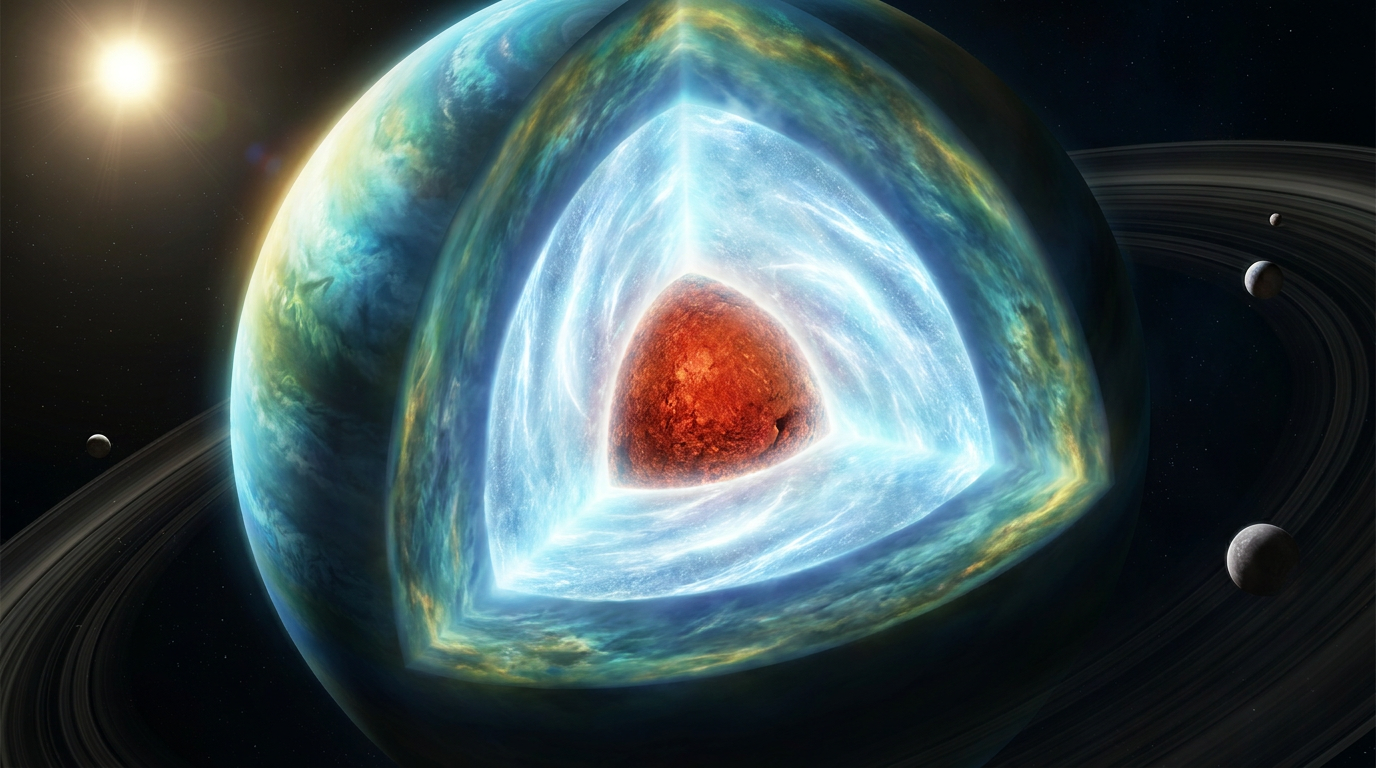
Astronomers using the ALMA telescope have detected carbon monoxide deep within Uranus's atmosphere, definitively proving the planet is a true 'ice giant' rather than a rocky world. The discovery settles a decades-old debate and provides crucial insights into how the most common type of planet in the universe forms.
By Factlen Editorial Team
- Planetary Formation Theorists
- Focus on how the discovery validates models of the early solar nebula and the carbon monoxide ice line.
- Observational Astronomers
- Emphasize the technical achievement of using radio telescopes to probe beneath opaque planetary atmospheres.
- Space Exploration Advocates
- Argue that these remote discoveries underscore the urgent need for a dedicated robotic mission to Uranus.
What's not represented
- · Exoplanet Atmospherics Modelers
- · Deep-Space Mission Engineers
Why this matters
Uranus and Neptune belong to the most common class of planets in the universe, yet they remain the least understood in our solar system. Confirming that Uranus is a true 'ice giant' rather than a rocky anomaly rewrites our understanding of how planets form and provides a crucial baseline for interpreting the thousands of similar worlds orbiting distant stars.
Key points
- Astronomers detected carbon monoxide welling up from the deep atmosphere of Uranus using the ALMA radio telescope.
- The presence of deep carbon monoxide proves the planet's interior is overwhelmingly composed of ice rather than rock.
- The discovery settles a decades-old debate and confirms Uranus formed in the outer solar system near the carbon monoxide ice line.
- Understanding Uranus's true composition provides a crucial baseline for studying the thousands of similar 'ice giant' exoplanets discovered in our galaxy.
For decades, Uranus has been the solar system’s quietest enigma. Orbiting the sun at a staggering distance of 1.8 billion miles, the pale blue world is officially classified as an "ice giant," a sibling to the slightly smaller but more massive Neptune. Yet, behind the scenes, planetary scientists have harbored a nagging doubt. While Neptune’s interior was confidently modeled as a slushy mix of water, ammonia, and methane ices, Uranus’s composition remained frustratingly ambiguous. Some theoretical models even suggested that Uranus might not be an ice giant at all, but rather a "rock giant"—a massive terrestrial core cloaked in a thin veneer of gas.[1][5]
Resolving this identity crisis is not just a matter of cosmic bookkeeping. Data from the Kepler space telescope has revealed that planets roughly the size of Uranus and Neptune are the most common type of world in the Milky Way galaxy. If astronomers cannot understand the fundamental architecture of the ice giants in our own solar system, their ability to interpret the thousands of exoplanets orbiting distant stars is severely compromised. Uranus serves as a critical "ground truth" for planetary formation, making its internal structure a matter of profound scientific importance.[1][7]
Now, that long-standing controversy has been definitively settled. A team of astronomers led by Thibault Cavalié at the University of Bordeaux has successfully peered beneath the opaque cloud decks of Uranus, detecting a crucial chemical signature welling up from the planet’s deep interior: carbon monoxide. The findings, based on years of meticulous observations, confirm that Uranus is packed with a massive icy mantle. The rock giant hypothesis is dead; Uranus is a true ice giant.[2][3]

The key to unlocking Uranus’s interior lay in understanding the behavior of carbon monoxide in the early solar system. In the primordial disk of gas and dust that surrounded the young sun 4.5 billion years ago, different chemical compounds froze into solid grains at specific distances, known as "ice lines." Carbon monoxide is highly volatile and only condenses into solid ice at incredibly frigid temperatures—around 25 Kelvin, or minus 414 degrees Fahrenheit.[4][6]
If a planet formed far enough away from the sun to sweep up these frozen carbon monoxide grains, its deep interior would be permanently enriched with the molecule. Conversely, if a planet formed closer to the sun from rocky building blocks and only later migrated outward, it would lack this deep reservoir of carbon monoxide. To determine Uranus’s true origin, astronomers needed to measure the abundance of this specific gas hiding beneath the planet’s upper atmosphere.[4][6]
To achieve this, the research team turned to the Atacama Large Millimeter/submillimeter Array (ALMA), a sprawling network of radio antennas situated high in the Chilean desert. Between 2022 and 2024, ALMA was pointed at Uranus, tuning its receivers to the specific microwave frequencies emitted by carbon monoxide molecules. Unlike visible light, which bounces off the planet’s upper cloud tops, these radio waves can penetrate the hazy atmosphere, allowing astronomers to perform a virtual ultrasound on the distant world.[3]
The ALMA data revealed two distinct populations of carbon monoxide. The first was a thin smattering of the gas in the planet’s extreme upper atmosphere. Astronomers have long suspected that this high-altitude carbon monoxide was delivered by a rogue comet that smashed into Uranus centuries ago, leaving a chemical scar in the stratosphere. But the second population was the prize: a steady, unmistakable signature of carbon monoxide welling up from the troposphere, the deep, dense layer of the planet’s atmosphere.[2]

The ALMA data revealed two distinct populations of carbon monoxide.
Armed with this new data, the researchers ran extensive computer simulations to model the planet’s internal chemistry. They found that the only way to explain the sheer volume of carbon monoxide rising from the depths was if the planet’s core and mantle were overwhelmingly dominated by ice. If Uranus had been a rock-heavy planet, the chemical reactions in its interior would have locked the carbon away in different forms, leaving the deep atmosphere devoid of carbon monoxide.[2][4]
The confirmation fundamentally rewrites the timeline of how the outer solar system assembled itself. It proves that Uranus must have formed in the deep freeze of the outer solar nebula, right at the carbon monoxide ice line, rather than forming closer to the sun and being violently ejected outward by the gravity of Jupiter and Saturn. The data leaves little room for alternative interpretations, cementing the planet's icy origins.[1][4]
This discovery also reunites Uranus and Neptune as true planetary siblings. While Neptune has long exhibited the chemical signatures of an ice-rich interior, Uranus’s lack of internal heat and bizarre, tilted rotation axis had led some to wonder if it was an adopted cousin with a completely different origin story. The new carbon monoxide data confirms that both worlds were built from the same primordial, ice-rich building blocks, even if their subsequent evolutionary paths diverged.[2][5]
It is important to note that the "ice" inside Uranus bears little resemblance to the ice cubes in a freezer. Under the crushing pressure and searing heat deep inside the planet’s mantle, water, ammonia, and methane cannot exist as normal solids, liquids, or gases. Instead, they are compressed into a "supercritical fluid"—a dense, electrically conductive slush that behaves like a liquid but expands like a gas.[1][5]

This churning, supercritical ocean of ice is believed to be the engine behind one of Uranus’s most baffling features: its magnetic field. Unlike Earth’s magnetic field, which is generated by a molten iron core and aligns roughly with the planet’s poles, Uranus’s magnetic field is wildly off-center and tilted by 59 degrees. The confirmation of a massive, fluid icy mantle provides the exact kind of electrically conductive environment needed to generate this lopsided magnetic dynamo.[5]
Beyond our solar system, the implications of the Bordeaux team’s discovery are vast. When the James Webb Space Telescope and future observatories peer at distant exoplanets, they frequently encounter worlds in the "sub-Neptune" size range. By establishing a firm, chemically verified baseline for what a true ice giant looks like, astronomers can now build far more accurate models to determine whether these distant exoplanets are water-rich ocean worlds or dense, rocky super-Earths.[6][7]
Despite this triumph of remote observation, the discovery also highlights the urgent need for a return to the ice giants. NASA’s Voyager 2 spacecraft is the only human-made object to have ever visited Uranus, completing a brief flyby in 1986. While ALMA and James Webb can work miracles from afar, they cannot measure the planet’s precise gravitational field, map its complex moon system, or drop a probe directly into its atmosphere to sample the chemistry firsthand.[1][5]

In recent years, the planetary science community has ranked a dedicated Uranus Orbiter and Probe as the highest priority flagship mission for the coming decade. As this new detection of carbon monoxide proves, Uranus is not a stagnant, featureless cueball, but a dynamic, complex world holding the secrets to planetary formation. After four decades of waiting, the solar system’s most misunderstood planet is finally coming into focus, and the case for going back has never been stronger.[1]
How we got here
1986
NASA's Voyager 2 spacecraft makes the first and only close flyby of Uranus, revealing a featureless blue sphere.
2014
Theoretical models suggest Uranus and Neptune may have formed at the carbon monoxide ice line, predicting high carbon abundances.
2022–2024
Astronomers use the ALMA telescope in Chile to conduct deep observations of Uranus's atmosphere.
June 2026
Researchers announce the definitive detection of deep atmospheric carbon monoxide, confirming Uranus's ice-rich interior.
Viewpoints in depth
Planetary Formation Theorists
Argue that this discovery fundamentally rewrites the timeline of the early solar system.
For theorists, the confirmation of an ice-rich Uranus solves a major headache. If Uranus had been a 'rock giant,' it would have required complex models where the planet formed closer to the sun and migrated outward through a chaotic game of gravitational billiards. By proving the planet is packed with ice, theorists can now confidently place its formation further out in the solar nebula, near the carbon monoxide ice line. This provides a much cleaner, more elegant model for how the outer solar system assembled itself.
Observational Astronomers
Focus on the technical triumph of peering beneath the cloud decks of a distant world.
Observers view this as a testament to the power of modern radio astronomy. Uranus is shrouded in a thick, hazy atmosphere that blocks visible light from penetrating its depths. By using the ALMA array to detect the faint microwave signatures of carbon monoxide, astronomers effectively performed an ultrasound on a planet nearly two billion miles away. They emphasize that this technique can now be turned toward other celestial bodies, opening a new window into the deep interiors of gas and ice giants.
Space Exploration Advocates
View the finding as a catalyst for launching a dedicated flagship mission to the ice giants.
For the exploration community, this discovery highlights how much we still don't know about our own cosmic backyard. Voyager 2 provided only a fleeting glance at Uranus forty years ago. Advocates argue that while telescopes like ALMA and James Webb are incredibly powerful, they cannot replace the sustained, close-up data gathered by an orbiting spacecraft. They are using these new findings to lobby space agencies for a dedicated Uranus orbiter and probe, which was recently ranked as the highest priority for the next decade of planetary science.
What we don't know
- Whether the carbon monoxide is uniformly mixed throughout the deep mantle or concentrated in specific layers.
- The exact mechanism that caused Uranus's extreme 98-degree axial tilt, which remains unexplained by the ice-giant formation model alone.
- How the internal heat dynamics of Uranus differ so drastically from Neptune, given their similar compositions.
Key terms
- Ice Giant
- A class of giant planets composed mainly of elements heavier than hydrogen and helium, such as oxygen, carbon, nitrogen, and sulfur.
- Supercritical Fluid
- A state of matter where distinct liquid and gas phases do not exist, occurring under extreme temperature and pressure deep inside planets.
- Protoplanetary Disk
- The rotating disk of dense gas and dust surrounding a newly formed star, from which planets eventually coalesce.
- Ice Line
- The specific distance from a young star where temperatures drop low enough for volatile compounds (like water or carbon monoxide) to condense into solid ice grains.
- Core Accretion
- The primary model of planet formation where a solid core builds up through collisions before capturing a massive envelope of gas.
Frequently asked
What kind of ice is inside Uranus?
It is not like the ice in a freezer. Under the immense pressure and temperature deep inside the planet, water, ammonia, and methane exist as a hot, dense 'supercritical fluid' that behaves like both a liquid and a gas.
Why is carbon monoxide so important?
Carbon monoxide acts as a chemical tracer. Because it only freezes at extremely low temperatures, finding large amounts of it deep inside Uranus proves the planet formed from frozen, ice-rich building blocks far from the sun.
How did astronomers see inside the planet?
They used the ALMA radio telescope array in Chile to detect the specific microwave frequencies emitted by carbon monoxide molecules welling up from the planet's lower atmosphere.
Does this mean Uranus and Neptune are identical?
They are very similar, but not identical. While both are now confirmed to be ice-rich, they still have distinct differences in their internal heat, atmospheric dynamics, and magnetic fields.
Sources
Source coverage
7 outlets
3 viewpoints surfaced







[1]Factlen Editorial TeamSpace Exploration Advocates
Synthesis by Factlen editorial team
Read on Factlen Editorial Team →[2]University of BordeauxObservational Astronomers
Carbon monoxide in Uranus's deep atmosphere indicates an ice-rich interior
Read on University of Bordeaux →[3]ALMA ObservatoryObservational Astronomers
ALMA probes the deep atmospheres of the Ice Giants
Read on ALMA Observatory →[4]arXivPlanetary Formation Theorists
The Measured Compositions of Uranus and Neptune from Their Formation on the CO Iceline
Read on arXiv →[5]NASASpace Exploration Advocates
Uranus: In Depth
Read on NASA →[6]IcarusPlanetary Formation Theorists
Formation of Ice Giants and the Carbon-to-Oxygen Ratio
Read on Icarus →[7]James Webb Space TelescopeObservational Astronomers
Webb's view of the Ice Giants
Read on James Webb Space Telescope →
Every angle. Every day.
Get science stories with full source coverage and perspective breakdowns delivered to your inbox.