
The Rise of the Cozy Web: Why the Internet Is Retreating to Private Spaces
As social media fatigue sets in, users are abandoning algorithmic public feeds in favor of group chats, Discord servers, and niche forums.
By Factlen Editorial Team

- Digital Minimalists
- Advocates for intentional, low-noise digital environments to protect mental health and focus.
- Community Builders
- Focuses on cultivating deep, moderated, and shared-interest groups over mass audiences.
- Digital Marketers
- Seeks new ways to reach audiences as public feeds decline in engagement and dark social rises.
What's not represented
- · Platform Regulators
- · Open-Web Advocates
Why this matters
The era of the public digital town square is ending. Understanding the shift toward private, gatekept communities is essential for anyone looking to maintain genuine relationships, protect their mental health, or navigate the future of digital communication.
Key points
- Users are increasingly abandoning public, algorithmic social media feeds in favor of private, gatekept digital spaces.
- This network of group chats, Discord servers, and niche forums is known as the 'cozy web.'
- The shift is driven by a desire to escape the 'dark forest' of the internet, which is filled with ads, bots, and performative pressure.
- These new spaces function as 'digital third places,' prioritizing chronological feeds and human-led moderation over viral reach.
- The migration challenges traditional digital marketing, forcing brands to adapt to 'dark social' environments where attention cannot be easily bought.
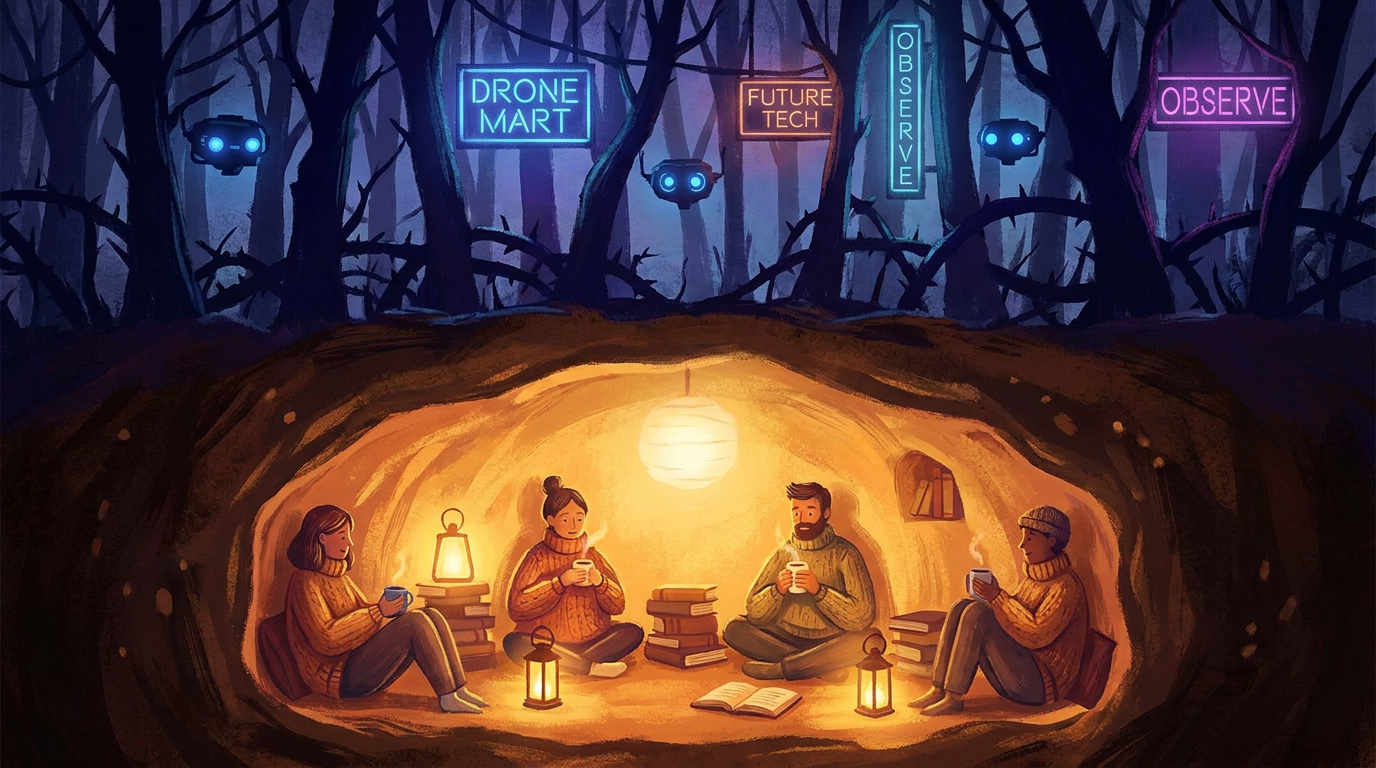
For the better part of a decade, the default mode of internet existence was public broadcasting. Users were encouraged to share their thoughts, photos, and milestones in a massive, open digital town square, optimizing for likes, retweets, and maximum visibility. But a profound cultural shift is quietly rewriting the rules of online socialization. The era of the performative public feed is fading, replaced by a mass migration toward smaller, private, and highly intentional digital spaces. This phenomenon is not a rejection of the internet itself, but rather a rejection of its current algorithmic architecture. Users are retreating from the noise and seeking shelter in what internet theorists have dubbed the "cozy web"—a network of group chats, private servers, and niche forums where human connection takes precedence over viral reach.[5][6]
The data behind this migration paints a stark picture of social media fatigue. Recent polling indicates that nearly a third of all social media users are posting less frequently on public platforms than they did just a year ago, while more than half of Generation Z users report taking active steps to reduce their exposure to algorithmic feeds. As platforms like Instagram and X evolved from chronological updates among friends into endless, algorithmically sorted streams of entertainment and sponsored content, the core social element was hollowed out. Mark Zuckerberg himself has acknowledged that the time users spend viewing content from actual friends has dropped meaningfully. In response, users are taking their conversations elsewhere, moving their digital lives off the main stage and into the private living rooms of the internet.[2][5]
To understand why this migration is happening, internet theorists often point to the "Dark Forest" theory of the web, a concept popularized by writer Yancey Strickler and built upon by strategist Venkatesh Rao. The theory borrows from science fiction to describe the modern public internet as a dark, predatory environment. In a dark forest, any creature that makes a noise risks drawing the attention of predators. On the public web, those predators take the form of data-scraping bots, aggressive advertisers, outrage-driven algorithms, and bad-faith trolls. Revealing one's authentic self in such an environment has become psychologically unsafe and emotionally exhausting. The rational response for survival is to stay quiet, stop broadcasting, and retreat to safer, hidden enclaves.[1][3][4]

The sanctuary from that dark forest is the cozy web. Coined by Rao, the term describes the high-gatekeeping, unindexed, and messily human spaces that algorithms cannot easily penetrate. The cozy web lives in Discord servers, WhatsApp group chats, Telegram channels, Slack workspaces, and private Substack communities. Unlike the public internet, these spaces are not optimized for scale, engagement metrics, or search engine optimization. You cannot easily Google your way into a private neighborhood group chat or a niche hobbyist Discord server. They are bounded by digital gates, requiring an invitation, a shared interest, or a direct connection to enter. This friction is a feature, not a bug, as it keeps the noise out and fosters a sense of psychological safety.[1][3][5][6]
At the heart of the cozy web is the resurrection of the "digital third place." In sociology, a third place—a concept developed by Ray Oldenburg—is a physical location outside of the home and work where people gather to socialize, relax, and build community. Think of local coffee shops, public parks, or neighborhood pubs. For years, the internet promised to be the ultimate global third place, but the hyper-commercialization of major platforms turned them into digital shopping malls plastered with billboards. The cozy web reclaims the third place by offering digital park benches and virtual living rooms. These are low-stakes environments where people can simply exist with their friends, free from the pressure to perform for an invisible audience or build a personal brand.[3][4][6]
Think of local coffee shops, public parks, or neighborhood pubs.
The architecture of these cozy spaces fundamentally changes how communication flows. On the mainstream web, algorithms dictate what you see, prioritizing content that triggers strong emotional reactions—often anger or anxiety—to maximize time-on-site. In contrast, the cozy web operates on human protocols. Feeds are typically chronological, meaning you see what your friends posted in the exact order they posted it. Content curation is done manually by the participants, who cut and paste links, screenshots, and memes into the chat stream. Because there are no likes or retweets to chase, the incentive structure shifts from performing for strangers to genuinely connecting with peers. The metric of success is no longer reach; it is intimacy.[1][4][5][6]

This shift toward intimacy is driving a broader renaissance in how online communities are structured and funded. As the open web increasingly functions as an ad network, users are showing a willingness to pay for curated, high-quality spaces. The rise of membership-based models, such as paid newsletters, specialized forums, and Patreon-backed Discord servers, reflects a desire for environments where the dynamic is conversing with the committed rather than broadcasting to the void. In these spaces, users are not the product being sold to advertisers; they are the patrons sustaining the community. This economic model aligns the incentives of the platform creators with the well-being of the users, prioritizing long-term trust over short-term engagement spikes.[4][5]
The software enabling this migration has evolved specifically to support bounded communities. While early group chats were limited to simple text threads, modern platforms like Discord, Geneva, and Guild offer sophisticated infrastructure for digital nesting. Users can create distinct channels for different topics, host spontaneous voice hangouts, and assign roles to members, effectively building custom-tailored virtual clubhouses. Even legacy platforms are adapting to this demand; Instagram’s introduction of Close Friends stories and broadcast channels, alongside Twitter’s Communities feature, represent attempts by major tech companies to capture the cozy web's energy within their existing walled gardens. However, true digital coziness often requires a complete departure from the platforms that created the fatigue in the first place.[1][6]
For brands, marketers, and digital advertisers, the expansion of the cozy web presents a formidable challenge, often referred to in the industry as "dark social." Because these conversations happen in encrypted messaging apps and private servers, they are invisible to traditional tracking tools and analytics software. A meme shared in a group chat of six close friends might carry significantly more cultural weight and influence than a sponsored post viewed by a million strangers, but it cannot be measured or monetized by outside observers. Forward-thinking organizations are realizing that they can no longer simply buy attention; they must earn the right to be invited into these spaces by providing genuine value, or they must build their own owned-and-operated community platforms.[2][5]

The psychological benefits of retreating to the cozy web are profound. Media ecologists argue that the dominant internet overstimulates the human brain, keeping users in a constant state of reactive anxiety through infinite scrolls and push notifications. Cozy digital spaces, with their slower pace and threaded conversations, promote mindfulness and intentionality. They allow users to engage deeply with niche interests—whether that is a specific video game, a local mutual aid group, or a shared creative hobby—without the distraction of trending outrage. By returning to the fundamentals of human connection, these spaces provide an antidote to the isolation and burnout that so often accompany modern digital life.[2][4][6]
Crucially, the cozy web relies on active, human-led moderation rather than automated, one-size-fits-all policy enforcement. Because these spaces are smaller and community-oriented, norms and rules can be highly specific to the group's culture. A Discord server for amateur botanists can enforce strict rules about staying on topic, while a private group chat among college friends might operate with zero restrictions. This localized governance empowers users to shape their own digital environments, quickly removing bad actors and resolving conflicts through direct communication. It is a labor-intensive process, but this shared responsibility is precisely what binds the community together and keeps the digital garden healthy.[3][4][6]
Ultimately, the rise of the cozy web represents a maturation of internet culture. After two decades of scaling up, maximizing connections, and tearing down boundaries, users are recognizing the value of walls, privacy, and human-scale interaction. The public square will not disappear; it will remain a necessary utility for breaking news, global announcements, and mass entertainment. But for the actual work of socializing, building relationships, and finding belonging, the future of the internet looks remarkably like its past. It is becoming smaller, weirder, more fragmented, and infinitely more comfortable.[1][4][5][6]

How we got here
Early 2000s
The internet is dominated by niche forums, personal blogs, and chronological feeds.
2010s
The rise of algorithmic feeds and the consolidation of the 'public square' on major platforms.
2019
The 'Dark Forest' theory of the internet gains traction as users report growing social media fatigue.
2020-2022
Pandemic lockdowns accelerate the adoption of digital third places like Discord and private group chats.
2025-2026
Data confirms a mass migration away from public broadcasting toward the 'Cozy Web' and membership models.
Viewpoints in depth
Digital Minimalists
Advocating for intentional, low-noise digital environments to protect mental health.
Digital minimalists view the cozy web as a necessary survival tactic in an attention economy. They argue that algorithmic feeds are fundamentally designed to exploit human psychology, creating addiction and anxiety. By retreating to private spaces, minimalists reclaim their time and cognitive bandwidth, treating internet usage as a deliberate tool rather than a passive habit.
Community Builders
Focusing on cultivating deep, moderated, and shared-interest groups.
For community builders and moderators, the cozy web is about quality over quantity. They emphasize that healthy socialization requires boundaries, shared context, and active human moderation—elements that are impossible to maintain at a global scale. They view the friction of joining these private spaces as a positive filter that ensures members are genuinely invested in the community's culture and success.
Digital Marketers
Seeking new ways to reach audiences as public feeds decline in engagement.
The marketing industry views the rise of the cozy web with a mix of fascination and concern, often labeling it 'dark social.' Because these private conversations cannot be tracked or targeted with traditional ads, brands are losing visibility into consumer behavior. Marketers argue that to survive this shift, companies must pivot from buying ads to building their own high-value communities or partnering with trusted creators who already hold the keys to these gated spaces.
What we don't know
- How major social platforms will ultimately adapt their business models if public posting continues to decline.
- Whether the fragmentation of the internet into private groups will increase ideological echo chambers.
- How the economics of the creator industry will shift as reach becomes less important than deep community engagement.
Key terms
- Cozy Web
- Private, gatekeeper-bounded spaces of the internet, such as group chats and niche forums, where users interact away from algorithms.
- Dark Forest Theory
- The concept that the public internet is a hostile environment filled with trolls and bots, prompting real users to hide in private spaces.
- Digital Third Place
- An online environment outside of work and home where people gather to socialize and build community without commercial pressure.
- Dark Social
- Web traffic and social sharing that occurs through private channels (like messaging apps) and cannot be accurately tracked by analytics tools.
- Algorithmic Feed
- A content stream curated by machine learning to maximize user engagement, often prioritizing emotionally charged material over chronological updates.
Frequently asked
Is the cozy web the same as the dark web?
No. The dark web requires special software to access hidden, often illicit sites. The cozy web simply refers to everyday private spaces like WhatsApp groups, Discord servers, and Slack channels.
Why are people leaving public social media?
Users report feeling overwhelmed by algorithmic feeds, advertising, and the pressure to perform for a large audience. They are seeking more authentic, low-stakes environments.
Can brands participate in the cozy web?
Yes, but traditional advertising does not work. Brands must either build their own valuable communities or earn invitations into existing spaces by providing genuine utility rather than disruption.
Will public social media disappear?
It is unlikely to disappear, but its function is shifting. Public platforms are increasingly becoming entertainment broadcasting networks rather than places for personal socialization.
Sources
Source coverage
6 outlets
3 viewpoints surfaced






[1]Maggie AppletonCommunity Builders
The Dark Forest and the Cozy Web
Read on Maggie Appleton →[2]MeyocksDigital Marketers
The cozy web: Social becomes less social
Read on Meyocks →[3]SubstackCommunity Builders
The Alt-Digital is Community-Oriented
Read on Substack →[4]MediumDigital Minimalists
Finding Digital Coziness in an Overstimulating Online World
Read on Medium →[5]Inflow NetworkDigital Marketers
The Great Migration from the Public Square to the Private Living Room
Read on Inflow Network →[6]Factlen Editorial TeamDigital Minimalists
Synthesis by Factlen editorial team
Read on Factlen Editorial Team →


Every angle. Every day.
Get culture stories with full source coverage and perspective breakdowns delivered to your inbox.