
Comparing the Top Health and Longevity Wearables of 2026: Apple Watch vs. Oura vs. Garmin vs. Whoop
As fitness trackers evolve into clinical-grade longevity tools, the choice between Apple Watch, Oura, Whoop, and Garmin comes down to distinct hardware trade-offs. Independent validation studies reveal that no single device perfectly balances active workout tracking with precise overnight recovery data.
By Factlen Editorial Team
- Passive Biometric Advocates
- Argues that the best wearable is the one you forget you are wearing, prioritizing comfort and overnight data.
- Active Endurance Athletes
- Prioritizes live workout metrics, GPS accuracy, and rugged durability over marginal gains in sleep staging.
- Medical Ecosystem Integrators
- Values FDA-cleared clinical features and the ability to merge data across multiple apps and devices.
- Behavioral Optimization Coaches
- Believes raw data is useless without a strict algorithm that tells the user exactly how hard to train and when to rest.
What's not represented
- · Budget tracker users (Fitbit/Amazfit)
- · Clinical sleep specialists
Why this matters
Choosing the right wearable determines whether you actually use the data to improve your sleep, recovery, and long-term health. Understanding the specific trade-offs of each device prevents you from wasting hundreds of dollars on hardware that doesn't fit your daily habits.
Key points
- The Apple Watch offers the most FDA-cleared medical features but suffers from short battery life.
- The Oura Ring provides the most accurate overnight recovery data due to its finger-based sensor placement.
- Whoop excels at behavioral coaching, explicitly linking daily workout strain to required sleep.
- Garmin remains unmatched for outdoor endurance athletes needing multi-band GPS and long battery life.
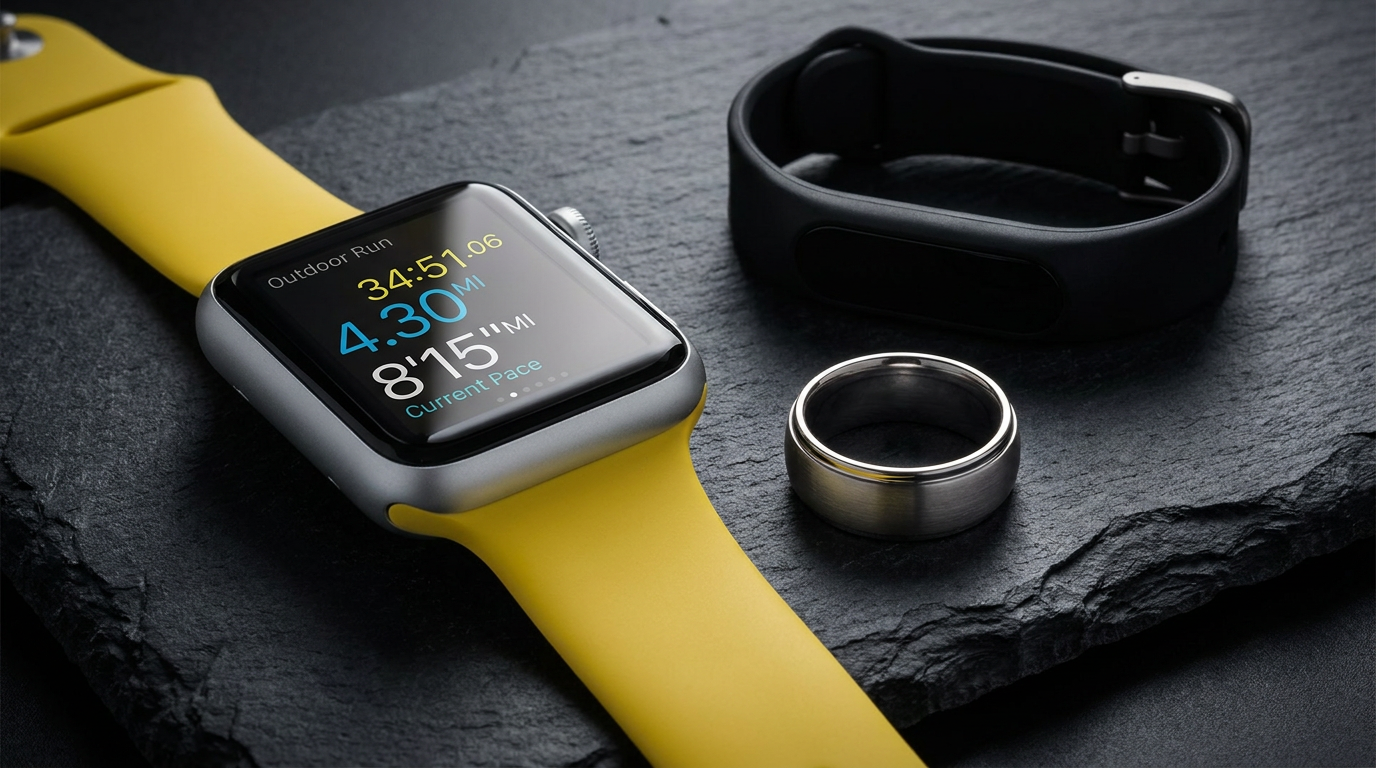
The wearable technology landscape of 2026 has fully transitioned from rudimentary step counters to clinical-grade longevity tools. Devices now continuously measure heart rate variability, blood oxygen, skin temperature, and sleep stages to predict recovery and metabolic health. Four platforms currently dominate the high-end market: the Apple Watch, the Oura Ring, the Whoop strap, and Garmin’s endurance watches. Choosing between them is no longer about which device is objectively best, but rather which hardware trade-offs align with a user's specific behavioral goals and tolerance for friction. Independent validation studies reveal that no single piece of hardware can flawlessly execute every tracking function, forcing consumers to prioritize either active workout data or passive overnight biometrics.[1][7]
The Apple Watch Series 10 and Ultra 3 represent the ultimate all-in-one smartwatch ecosystem. The primary argument for the Apple Watch is its unmatched sensor density and clinical utility. Packing up to eleven distinct health sensors, it is the only device in this tier offering multiple FDA-cleared features, including electrocardiogram readings, atrial fibrillation detection, and sleep apnea notifications. It integrates seamlessly into daily life, providing cellular connectivity, global positioning system tracking, and a vast third-party app ecosystem that can interpret its raw data through advanced coaching platforms.[3][7]
The argument against the Apple Watch centers entirely on its battery life and form factor. Even the Ultra models require charging every few days, while standard models need daily charging. This creates a friction point for continuous longevity tracking, as users often charge the device overnight—precisely when the most critical heart rate variability and sleep staging data must be collected. Furthermore, many users find a full-sized, illuminated smartwatch uncomfortable to wear to bed, leading to gaps in longitudinal data that undermine the accuracy of long-term recovery trends.[2][3]
The clinical evidence for the Apple Watch is robust but nuanced. In head-to-head polysomnography validation studies, the device excels at detecting awake time and overall sleep duration, but it frequently struggles to accurately classify deep sleep stages. For cardiovascular metrics, independent testing shows the Apple Watch achieves an impressive 0.98 intraclass correlation for heart rate variability compared to medical-grade electrocardiograms. Ultimately, the Apple Watch fits well when a user wants a single device for notifications, safety features, and active workout tracking, but it does not fit well when passive, frictionless overnight tracking is the primary goal.[4][6]

The Oura Ring Generation 4 takes the opposite approach, prioritizing passive, invisible data collection. The core argument for Oura is its form factor and sensor placement. By reading blood flow through the dense vasculature of the finger using an eighteen-path photoplethysmography system, it captures a cleaner biometric signal with significantly less motion artifact than wrist-based alternatives. It requires no active input, boasts an eight-day battery life, and disappears into the background of daily life, making it widely considered the most comfortable option for consistent overnight wear.[3][5]
The argument against the Oura Ring is its limited utility during active, high-intensity workouts. Because it lacks a screen, a global positioning system, and the ability to broadcast live heart rate data to gym equipment, it cannot serve as a real-time pacing tool for runners or cyclists. Additionally, the rigid titanium ring form factor can be uncomfortable or easily scratched during weightlifting sessions, requiring users to remove it and consequently lose valuable cardiovascular strain data for those specific strength-training activities.[2][5]
The evidence supporting Oura’s accuracy is currently the strongest in the consumer market. A recent validation study from The Ohio State University demonstrated a near-perfect 0.99 concordance correlation coefficient for heart rate variability against electrocardiogram references. Sleep laboratory studies consistently show Oura achieving roughly 91 percent accuracy for sleep staging, outperforming all wrist-based competitors. The Oura Ring fits well when a user prioritizes precise sleep data, passive recovery tracking, and traditional watch aesthetics, but it does not fit well when the user needs live workout metrics or outdoor navigation.[3][4][6]

The evidence supporting Oura’s accuracy is currently the strongest in the consumer market.
Whoop 5.0 occupies a unique space as a screenless, subscription-based behavioral coach. The argument for Whoop is its proprietary strain-to-recovery algorithm. Rather than just presenting raw data, Whoop explicitly connects how hard a user trained to how much sleep they need, creating a daily accountability loop. The hardware features a twenty-six hertz sampling rate—the fastest in its class—and a fourteen-day battery life that can be charged on the wrist via a slide-on battery pack, ensuring the strap never has to be removed for charging.[1][3]
The argument against Whoop is its ongoing cost and demanding interface. Unlike the other devices, Whoop requires a continuous monthly or annual subscription to access the data, making it the most expensive option over a three-year period. Furthermore, the system is notoriously strict; if a user does not actively engage with the recovery loop and adjust their sleep habits, the device simply becomes an expensive guilt trip. It also lacks a screen, meaning users must rely entirely on their smartphone to view any metrics or check the time.[2][3]
Evidence for Whoop’s accuracy places it firmly in the top tier, though slightly behind Oura for passive resting metrics. Validation studies show Whoop achieves a 0.94 concordance correlation coefficient for heart rate variability and performs exceptionally well in tracking rapid eye movement and light sleep stages. Whoop fits well when a serious athlete wants a dedicated coach to prevent overtraining and optimize daily strain, but it does not fit well when a casual user simply wants to count steps or avoid recurring subscription fees.[4][6]

Garmin’s high-end models, such as the Fenix 8 and Venu 3, remain the gold standard for outdoor and endurance athletes. The argument for Garmin is its unparalleled depth of active training data. Featuring multi-band global navigation satellite systems, offline topographical maps, and battery life that stretches past twenty days, it is built specifically for the wilderness and long-distance racing. Its software ecosystem provides deep insights like Body Battery and Training Readiness without requiring any ongoing subscription fees, making it a comprehensive one-time purchase.[1][3]
The argument against Garmin lies in its bulk and slightly lower precision for passive recovery metrics. The rugged, heavy design of the Fenix series makes it the least comfortable device for sleep tracking, leading many users to take it off at night. Additionally, because the sensors sit on the wrist and the algorithms heavily prioritize active movement, Garmin’s overnight data collection is less granular than the dedicated recovery wearables, sometimes missing the subtle physiological shifts that indicate impending illness or overtraining.[4][5]
Clinical evidence highlights these specific trade-offs. While Garmin’s resting heart rate accuracy is excellent, its heart rate variability tracking scored a 0.87 concordance correlation coefficient in recent studies—a meaningful gap compared to Oura and Whoop, particularly at the elevated ranges that matter most to highly trained athletes. Sleep lab tests also show Garmin struggling with rapid eye movement detection compared to the leaders. Garmin fits well when endurance sports, GPS accuracy, and multi-week battery life are non-negotiable, but it does not fit well when the user prioritizes lightweight comfort and clinical-grade sleep staging.[3][6]

Because no single device perfectly bridges the gap between active training and passive recovery, a growing number of longevity enthusiasts and serious athletes are adopting a two-device strategy. The most common pairing combines a Garmin watch for daytime GPS and workout tracking with an Oura Ring for precise overnight heart rate variability and sleep staging. Software layers like Apple Health or third-party aggregators can then merge these data streams, allowing users to bypass the inherent hardware limitations of any single platform and build a complete physiological profile.[5][7]
Ultimately, the best longevity wearable is the one that successfully changes user behavior without introducing unsustainable friction. A technically inferior sensor worn consistently will always generate better health outcomes than a clinical-grade device left on a nightstand because it was too bulky or required too much charging. Buyers must evaluate whether they need a smartwatch, a sleep tracker, a behavioral coach, or an endurance tool, as the 2026 market proves that no single piece of hardware can flawlessly execute all four functions simultaneously.[6][7]
Viewpoints in depth
The Passive Tracking Camp
Advocates for devices that disappear into the background and require zero active input.
This perspective, championed by Oura Ring users, argues that the best health data is collected when the user isn't thinking about it. By removing screens, notifications, and charging anxiety, passive trackers ensure higher compliance. Proponents point out that a device only works if you actually wear it to bed, making comfort the most critical hardware feature for longevity tracking.
The Active Ecosystem Camp
Believes wearables should serve as comprehensive tools for both safety and live performance.
Users of Apple Watch and Garmin devices argue that a wearable must provide utility during the day, not just while sleeping. This camp values the ability to leave their phone at home while running, track precise pacing via GPS, and receive medical alerts for conditions like atrial fibrillation. They view the necessity of frequent charging as a fair trade-off for having a powerful computer on their wrist.
The Behavioral Coaching Camp
Focuses on actionable algorithms rather than raw data collection.
The Whoop community argues that simply knowing your heart rate variability is useless unless a system tells you what to do with it. This camp values strict, algorithm-driven coaching that dictates exactly how hard to push in the gym based on the previous night's sleep. They are willing to pay an ongoing subscription fee for software that actively attempts to change their daily habits and prevent overtraining.
What we don't know
- Whether optimizing daily heart rate variability scores actually translates to a statistically significant increase in human lifespan.
- How upcoming non-invasive continuous glucose monitors will integrate into these existing wearable ecosystems.
Key terms
- Heart Rate Variability (HRV)
- The tiny fluctuations in time between individual heartbeats; a higher HRV generally indicates better recovery and a more resilient nervous system.
- Polysomnography
- The gold-standard medical test used in sleep labs to diagnose sleep disorders, measuring brain waves, oxygen levels, and heart rate.
- Photoplethysmography (PPG)
- The optical technology used by wearables to measure heart rate by shining light into the skin and detecting changes in blood volume.
- Concordance Correlation Coefficient (CCC)
- A statistical measurement used in validation studies to determine how closely a wearable's data matches medical-grade equipment.
Frequently asked
Can I wear two wearables at the same time?
Yes. A popular strategy among serious athletes is wearing a Garmin watch for daytime workouts and an Oura Ring at night for sleep tracking, merging the data via Apple Health or a third-party app.
Is Whoop worth the ongoing subscription cost?
Whoop is worth the cost if you actively use its daily strain and recovery recommendations to change your behavior. If you just want to passively view your data, a non-subscription device is a better investment.
Does the Apple Watch track sleep accurately?
The Apple Watch is excellent at detecting total sleep time and awake periods, but independent sleep lab studies show it struggles slightly more with classifying deep sleep stages compared to the Oura Ring.
Which wearable is best for weightlifting?
Wrist-based trackers and rings often struggle with heart rate accuracy during weightlifting due to wrist flexion and gripping. Whoop offers a bicep band accessory that bypasses this issue, making it a favorite for strength athletes.
Sources
Source coverage
7 outlets
4 viewpoints surfaced







[1]WareableBehavioral Optimization Coaches
Best fitness trackers 2026: The top wearables for health and longevity
Read on Wareable →[2]LifehackerPassive Biometric Advocates
The Best Fitness Trackers for Sleep and Recovery
Read on Lifehacker →[3]Sensai FitBehavioral Optimization Coaches
Apple Watch vs Oura Ring vs WHOOP vs Garmin: Which Fitness Tracker Should You Actually Buy in 2026?
Read on Sensai Fit →[4]We Love CyclingPassive Biometric Advocates
Which Wearable Tracks Sleep Best? A 2026 Sleep Lab Study
Read on We Love Cycling →[5]Athlete Data HealthActive Endurance Athletes
The Case for Wearing Two Devices: Garmin, Oura, and WHOOP Accuracy
Read on Athlete Data Health →[6]MediumMedical Ecosystem Integrators
Validation Studies Reveal the Most Accurate Health Wearables
Read on Medium →[7]Factlen Editorial TeamMedical Ecosystem Integrators
Synthesis by Factlen editorial team
Read on Factlen Editorial Team →
More in guides
See all 5 stories →

Every angle. Every day.
Get guides stories with full source coverage and perspective breakdowns delivered to your inbox.