
Scientists Brew Espresso With Ultrasonic Waves, Cutting Energy Use by 75%
Researchers have developed a method to brew espresso-strength coffee using room-temperature water and high-frequency sound waves, eliminating the need for heat.
By Factlen Editorial Team
- Scientific Researchers
- Focus on the physics of acoustic cavitation and the potential to radically reduce energy consumption in food science.
- Coffee Industry
- View the technology as a highly scalable solution for manufacturing ready-to-drink cold brews and concentrates faster and cheaper.
- Coffee Enthusiasts
- Prioritize the sensory experience, noting that the ultrasonic method successfully replicates the taste, aroma, and mouthfeel of a traditional hot shot.
What's not represented
- · Traditional espresso machine manufacturers
- · Cafe owners concerned about the 3-minute brew time
Why this matters
Heating water for coffee is one of the most energy-intensive processes in both commercial cafes and home kitchens. By replacing heat with sound waves, this technology could drastically reduce the carbon footprint of the global coffee industry while making industrial cold-brew production significantly faster and cheaper.
Key points
- Australian researchers have brewed espresso-strength coffee using room-temperature water and ultrasonic sound waves.
- The process relies on acoustic cavitation, where sound waves create microscopic bubbles that extract flavor and caffeine from the grounds.
- The ultrasonic method reduces the energy required to brew a shot by 75% compared to traditional machines.
- In a blind taste test, 100 coffee drinkers could not tell the difference between the ultrasonic brew and a traditional hot espresso.
- While it takes 3 minutes to brew a single shot, the technology could revolutionize industrial production of cold brew and ready-to-drink coffee.
The morning coffee ritual is defined by a familiar sequence: a machine warming up, pressure building, and hot water forcing its way through tightly packed grounds to produce a rich shot of espresso. It is a process that has remained fundamentally unchanged for over a century. But that reliance on boiling water makes espresso machines some of the most energy-intensive appliances in both commercial cafes and home kitchens.[1][8]
Now, a team of researchers at the University of New South Wales (UNSW) in Sydney has successfully challenged that core assumption. They have developed a method to brew espresso-strength coffee using room-temperature water, completely eliminating the need for a heating element. Instead of thermal energy, the new process relies on high-frequency ultrasonic sound waves to extract the coffee's flavor, oils, and caffeine.[1][5]
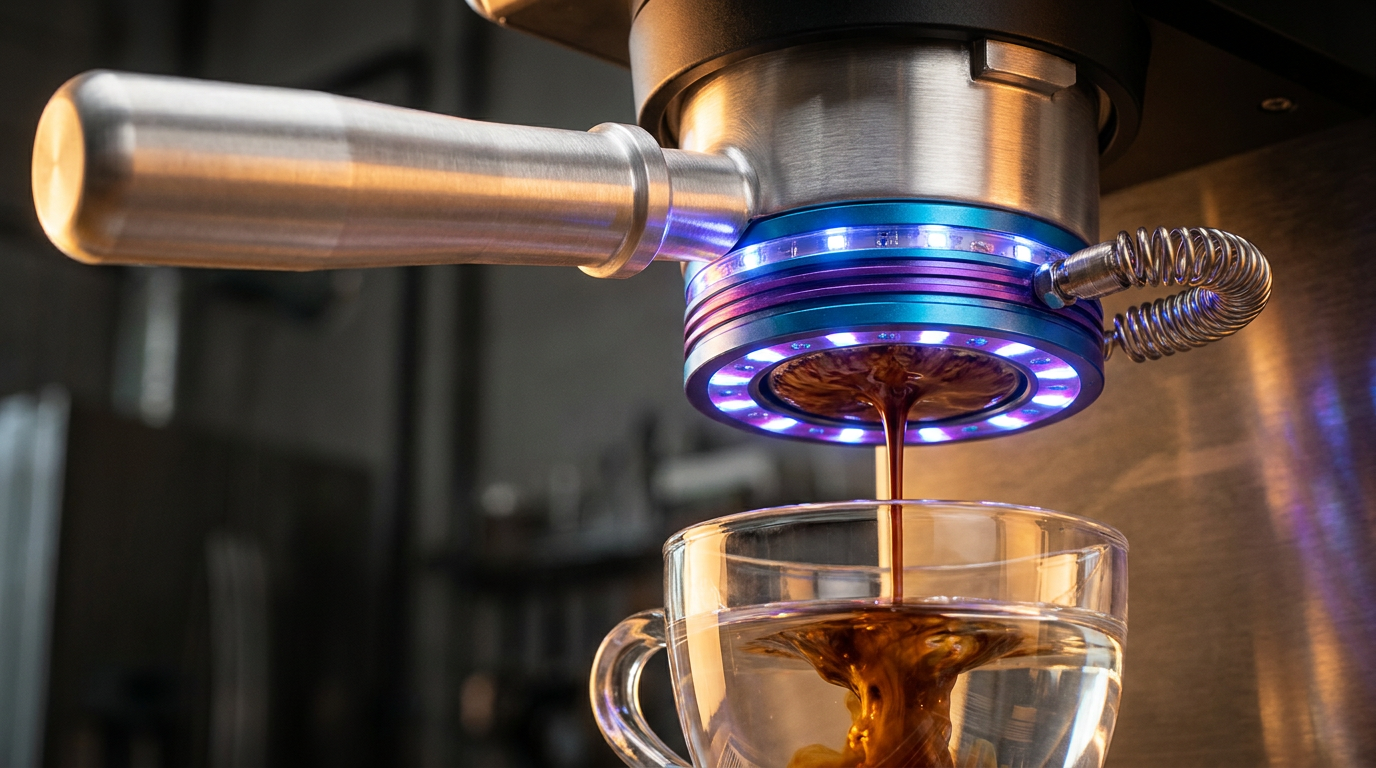
The breakthrough, detailed in the Journal of Food Engineering, centers on a custom-built device called a horn transducer. The researchers attached this small metal mechanism directly to the side of a standard espresso machine's filter basket. When activated, the transducer sends ultrasonic vibrations—sound waves operating at frequencies far beyond human hearing—pulsing through the room-temperature water and the coffee grounds.[2][6]

These intense vibrations trigger a physical phenomenon known as "acoustic cavitation." As the sound waves travel through the liquid, they cause thousands of microscopic bubbles to rapidly form and collapse. According to Dr. Francisco Trujillo, the study's lead author, these collapsing bubbles act like microscopic scrubbing brushes. They generate tiny, powerful jets of liquid that pit and fracture the surface of the coffee grounds, forcing the rapid release of flavor compounds and caffeine without the need for heat.[3][5][8]
The primary advantage of this sonic brewing method is its dramatic efficiency. By removing the energy required to heat water to near-boiling temperatures, the ultrasonic system uses just 24.3 percent of the electricity required by a conventional single-group espresso machine. That translates to a 75 percent reduction in overall energy consumption, a massive saving when scaled across the millions of coffees brewed globally every day.[4][6]
The primary advantage of this sonic brewing method is its dramatic efficiency.
There is, however, a trade-off in speed. While a traditional hot espresso shot takes roughly 30 seconds to pull, the ultrasonic method requires between two and three minutes of continuous sound-wave exposure to achieve the same concentration. The researchers had to carefully tinker with the brew ratio—the exact amount of water used per gram of coffee—and the grind consistency to ensure the final beverage wasn't under-extracted or overly bitter.[2][7][8]

Despite the lack of heat and the longer brew time, the final product easily passes the ultimate test: human taste. The UNSW team conducted a blind sensory study with 100 regular coffee drinkers, serving them both traditional hot espresso and the room-temperature ultrasonic version. The participants were unable to reliably distinguish between the two, rating them equally on aroma, flavor, and overall enjoyment.[1][4][5]
Chemical analysis backed up the taste testers' palates. Laboratory tests confirmed that the ultrasonic brew contained the same levels of caffeine and chlorogenic acid—a key antioxidant found in coffee—as a standard hot espresso. The sound waves successfully emulsified the coffee's natural oils, producing a beverage with the same viscous mouthfeel and boldness that espresso drinkers expect.[4][5]

While a three-minute wait might deter a busy cafe barista during a morning rush, the researchers see massive potential for the technology in the industrial sector. Companies that manufacture ready-to-drink coffee products, such as canned cold brews and coffee concentrates, currently rely on massive vats that steep grounds for up to 24 hours. The ultrasonic method could compress that day-long process into just a few minutes while slashing the factory's electricity bill.[5][7][8]
The UNSW team has already filed a patent for their ultrasonic brewing system and is actively looking to scale the design for commercial manufacturing. If adopted by the beverage industry, the technology could fundamentally alter the economics and environmental footprint of cold coffee production, proving that sometimes the best way to improve a classic recipe is to make some noise.[4][8]
How we got here
May 2024
UNSW researchers publish their first study using ultrasound to accelerate the cold-brew coffee process.
June 2026
The team publishes new findings in the Journal of Food Engineering, proving the technology can replicate highly concentrated espresso.
June 2026
UNSW files a patent for the ultrasonic brewing system, targeting commercial beverage manufacturers.
Viewpoints in depth
Scientific Researchers
Engineers view this as a breakthrough in energy-efficient food processing.
For the chemical engineers at UNSW, the ultrasonic espresso is a proof-of-concept for a much larger goal: decarbonizing energy-intensive food preparation. By proving that acoustic cavitation can effectively replace thermal energy in a process as stubborn as espresso extraction, researchers believe sound waves could be applied to other resource-heavy culinary and industrial processes. The 75 percent energy reduction demonstrates that heat is often an inefficient brute-force tool when targeted physical disruption—like microscopic collapsing bubbles—can achieve the same chemical extraction.
Coffee Industry
Manufacturers see a highly lucrative way to speed up cold-brew production.
The commercial coffee sector is less interested in replacing the cafe espresso machine and more focused on the booming ready-to-drink market. Currently, brewing commercial cold brew requires massive vats of coffee grounds steeping in water for 12 to 24 hours, taking up valuable factory floor space and time. If ultrasonic transducers can achieve the same extraction yield in three minutes, beverage companies could drastically increase their production volume while simultaneously slashing their electricity and operational costs.
Coffee Enthusiasts
Purists are surprised that a heatless process can replicate the complex sensory profile of true espresso.
In the specialty coffee world, temperature stability is treated as gospel. Traditional wisdom dictates that water must be between 195°F and 205°F to properly dissolve the oils and acids that give espresso its signature crema and body. However, blind taste tests have forced enthusiasts to reconsider what makes an espresso an espresso. Because the ultrasonic waves successfully emulsify the coffee's natural oils without introducing the bitterness that sometimes comes from over-heating, many tasters found the room-temperature shots to be just as viscous, aromatic, and balanced as their hot counterparts.
What we don't know
- It is unclear how much an industrial-scale ultrasonic brewing system will cost to manufacture and install.
- We don't yet know if the technology will ever be miniaturized and priced affordably for home consumer use.
- It remains to be seen how the lack of heat affects the extraction of lighter, more acidic coffee roasts compared to traditional dark roasts.
Key terms
- Acoustic Cavitation
- The rapid formation and collapse of microscopic bubbles in a liquid, caused by high-frequency sound waves, which generates intense local forces.
- Transducer
- An electronic device that converts energy from one form to another; in this case, converting electrical energy into ultrasonic sound vibrations.
- Portafilter
- The spoon-like handle and metal basket on an espresso machine that holds the tamped coffee grounds during brewing.
- Chlorogenic Acid
- A natural antioxidant compound found in coffee beans that contributes to the beverage's health benefits and flavor profile.
Frequently asked
Does ultrasonic espresso taste different?
In blind taste tests with 100 coffee drinkers, participants could not reliably distinguish the ultrasonic espresso from a traditionally brewed hot shot. They rated it equally on flavor, aroma, and bitterness.
How long does it take to brew?
While a traditional espresso takes about 30 seconds, the ultrasonic method requires 2 to 3 minutes of sound-wave exposure to achieve the same concentration.
Is the coffee hot when it finishes brewing?
No. The process uses room-temperature water and relies entirely on sound waves for extraction, meaning the resulting espresso shot is served at room temperature.
Can I buy an ultrasonic espresso machine for my home?
Not yet. The technology is currently patented by UNSW Sydney researchers, who are primarily looking to scale the system for industrial ready-to-drink coffee manufacturers.
Sources
Source coverage
8 outlets
3 viewpoints surfaced








[1]WiredScientific Researchers
Scientists Invent a Way to Brew Espresso With Ultrasonic Waves—No Hot Water Required
Read on Wired →[2]Popular ScienceCoffee Enthusiasts
The process is 75 percent more energy efficient—and makes a great cup of joe
Read on Popular Science →[3]TechRadarCoffee Enthusiasts
Who needs hot water? Researchers made an ultrasonic espresso machine that brews coffee without heat
Read on TechRadar →[4]Daily Coffee NewsCoffee Industry
Researchers Develop 'Ultrasonic Espresso' Using Room-Temp Water
Read on Daily Coffee News →[5]UNSW SydneyScientific Researchers
Ultrasonic espresso brews up a storm
Read on UNSW Sydney →[6]Anthropocene MagazineScientific Researchers
It is made without heat and 75% less energy
Read on Anthropocene Magazine →[7]Fresh Cup MagazineCoffee Industry
Ultrasonic Soundwaves Brew Espresso-Strength Coffee
Read on Fresh Cup Magazine →[8]The Optimist DailyCoffee Industry
How do soundwaves make espresso?
Read on The Optimist Daily →



Every angle. Every day.
Get technology stories with full source coverage and perspective breakdowns delivered to your inbox.