
How 'Green Cloud' Architecture is Turning Data Centers into Heating Plants
As AI and cloud computing drive unprecedented energy demand, a new wave of data centers is slashing emissions by reusing server heat to warm homes, pools, and factories.
By Wei Zhang

In short
- Data centers are projected to consume 1,000 TWh of electricity globally by 2026.
- High-density AI processors require liquid cooling, which produces high-temperature waste heat.
- This heat is being captured and pumped into municipal district heating networks to warm homes.
Every time you ask an artificial intelligence a question, stream a movie, or save a file to the cloud, a physical server somewhere on Earth gets a little bit warmer. For decades, the cloud computing industry has treated this heat as a costly nuisance. Data centers have traditionally functioned like massive refrigerators, consuming vast amounts of electricity to power the servers, and then consuming even more electricity to run the air conditioning and cooling towers required to keep those servers from melting down.[2]
The scale of this thermal challenge is staggering. Data centers currently account for roughly 2 percent of global electricity consumption, and with the explosive growth of generative AI, that figure is accelerating rapidly. Industry projections suggest global data center energy use could hit 1,000 terawatt-hours by 2026. This trajectory has sparked widespread concerns about the digital economy's carbon footprint and its strain on local power grids.
But a paradigm shift is underway in how the tech industry handles its thermal exhaust. Instead of venting millions of degrees of heat into the atmosphere, a new generation of "Green Cloud" architecture is treating server heat not as waste, but as a valuable commodity. By capturing this thermal energy and redirecting it, data centers are transforming from energy sinks into municipal heating plants.[2]
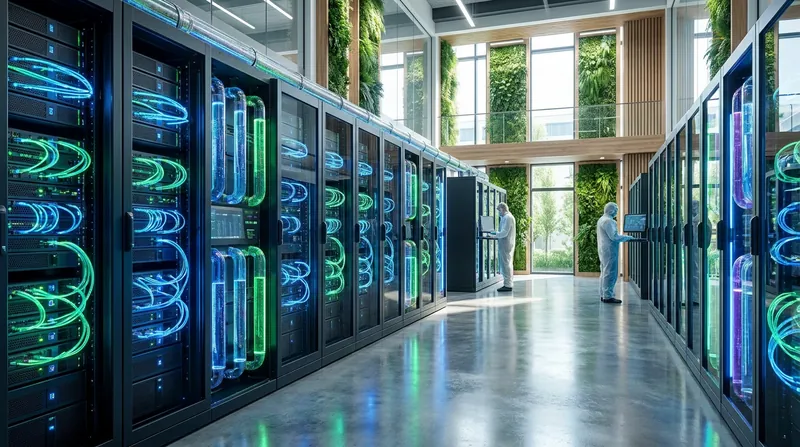
The mechanism behind this transformation relies on advanced heat recovery systems. In a traditional air-cooled data center, the exhaust air is often too diffuse and low-temperature to be practically useful for external heating. However, the extreme density of modern AI processors has forced the industry to adopt direct-to-chip liquid cooling to prevent hardware failure.
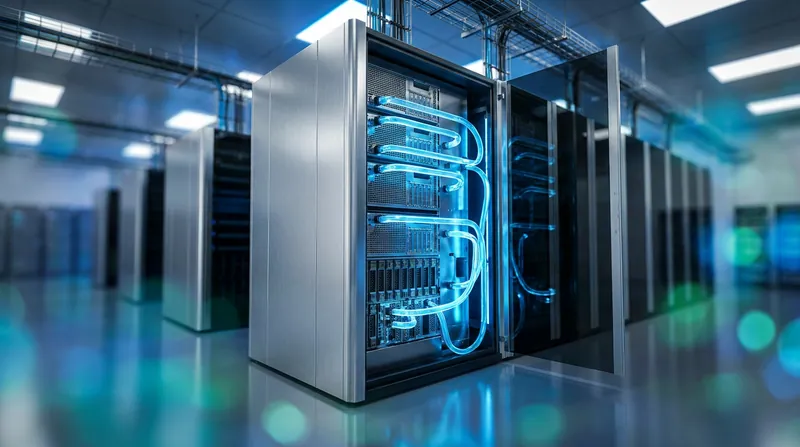
Liquid cooling circulates a specialized coolant directly across the graphics processing units (GPUs) and central processing units (CPUs). Because liquid is significantly more efficient at transferring thermal energy than air, these systems can absorb massive amounts of heat. More importantly, they produce a high-temperature liquid exhaust—often reaching temperatures that are ideal for immediate reuse in industrial or residential applications.
Once the hot liquid leaves the server rack, it passes through a heat exchanger. This device transfers the thermal energy from the data center's closed cooling loop into a secondary water system without the two fluids ever mixing. From there, the heated water can be pumped out of the facility and into the surrounding community.
The most common application for this recovered energy is district heating. In many European cities, homes and businesses are warmed not by individual furnaces, but by a centralized network of insulated underground pipes carrying hot water. By connecting a data center's heat exchanger to a district heating network, cloud providers can directly replace the fossil fuels normally used to heat the municipal water supply.[1]
The impact of this sector coupling is substantial. A single megawatt of high-temperature heat recovered from a data center can slash annual carbon dioxide emissions by over 30,000 metric tons when it replaces natural gas boilers. It creates a closed-loop ecosystem where the electricity powering the cloud does double duty: computing data and warming citizens.
Real-world deployments are already proving the viability of this model. In the United Kingdom, a company called Deep Green has pioneered the concept of the "digital boiler." In 2023, they installed a small-scale edge data center at a public leisure center in Exmouth. The heat generated by the servers is captured and used to keep the public swimming pool warm, drastically reducing the facility's reliance on expensive gas heating.
Larger-scale projects are also breaking ground across the continent. In Mainz, Germany, the municipal energy company KMW is constructing a campus of three data centers with a combined IT capacity of 54 megawatts. Powered entirely by renewable wind energy, the facilities are designed from the ground up to feed their waste heat directly into the city's district heating grid, aligning digital infrastructure with municipal climate goals.[1]
This shift is not entirely voluntary; it is increasingly being driven by strict government mandates. The European Union has made energy-efficient cloud computing a legislative priority. Under the EU's revised Energy Efficiency Directive (EED), data centers with an energy input of 1 megawatt or more are now legally required to reuse their waste heat unless they can prove it is technically or economically unfeasible.
Individual nations are going even further to enforce sustainability. Germany's Energy Efficiency Act (EnEfG) mandates that new data centers must be powered entirely by renewable electricity by 2027. Furthermore, they must capture and reuse their waste heat via local networks or adjacent buildings, forcing cloud providers to integrate their blueprints with local urban planning from day one.
To track compliance and efficiency, the industry relies on strict metrics, primarily Power Usage Effectiveness (PUE). PUE is the ratio of a facility's total power consumption to the power actually used by the computing equipment. A perfect PUE of 1.0 means zero energy is wasted on overhead like cooling, lighting, or power distribution.
Historically, data centers operated with PUEs around 1.5 or 1.6, meaning a massive portion of their power draw was wasted on cooling. However, new regulations are tightening the belt. The EU is pushing for new facilities to achieve a PUE of 1.2 or lower within two years. By utilizing liquid cooling and heat recovery, operators can drastically lower their PUE, as the energy previously spent on active cooling towers is eliminated.
Another critical metric is Water Usage Effectiveness (WUE). Traditional evaporative cooling towers consume millions of gallons of fresh water to keep servers operational. By switching to closed-loop liquid cooling and heat recovery, data centers can reduce their water consumption by 30 to 50 percent, alleviating pressure on local water supplies in drought-prone regions.
Despite the clear environmental benefits, scaling heat reuse presents significant logistical challenges. Thermal energy degrades quickly over distance. For a data center's waste heat to be useful, the facility must be built in close proximity to a district heating network or an industrial user, such as a factory that needs heat for drying processes.[1]
This geographic constraint forces a fundamental rethink of data center site selection. Cloud providers can no longer simply build massive server farms in isolated rural areas where land and power are cheap. They must negotiate complex institutional and contractual alignments with municipal governments and utility companies to ensure the heat has a reliable destination.[1]
The financial calculus is also shifting. While installing industrial heat pumps and heat exchangers requires a higher upfront capital expenditure—often five to ten times the cost of conventional cooling—it creates a new economic model. Data centers can sell their waste heat to local utilities, turning a massive operational expense into a steady revenue stream.
As the demand for artificial intelligence continues to surge, the cloud will only grow hotter and more power-hungry. However, the rise of green cloud architecture offers a sustainable path forward. By tearing down the silos between digital infrastructure and municipal utilities, the tech industry is proving that the cloud doesn't have to be a burden on the physical world.[2]
Ultimately, the data centers of the future will not be isolated fortresses of computation. They will be integrated civic utilities—engines of the digital economy that simultaneously provide the foundational warmth for the cities built around them.[2]
Jargon, explained
- Power Usage Effectiveness (PUE)
- A metric measuring how efficiently a data center uses energy; a perfect score of 1.0 means all power goes to computing, none to cooling overhead.
- Water Usage Effectiveness (WUE)
- A metric measuring the amount of water used for cooling per kilowatt-hour of computing power.
- District Heating
- A system for distributing heat generated in a centralized location through a network of insulated pipes for residential and commercial heating.
- Direct-to-Chip Liquid Cooling
- A thermal management technique where liquid coolant is circulated directly across processors to remove heat more efficiently than air.
- Digital Boiler
- A small-scale edge data center deployed in a facility specifically to provide computing power while capturing 100% of the generated heat for the host building.
Common questions
Does reusing data center heat slow down cloud computing?
No. Heat recovery systems operate on the cooling exhaust, meaning the servers run at optimal temperatures without any performance degradation.
Why can't all data centers reuse their heat?
Thermal energy degrades over distance. To effectively reuse heat, the data center must be located near a district heating network or an industrial facility.
How does AI impact data center heat?
AI workloads require high-density server racks that consume significantly more electricity and generate much higher temperatures than traditional cloud storage, making advanced cooling essential.
Competing readings
Cloud Infrastructure Providers
Focused on scaling AI compute while optimizing efficiency and lowering operational costs.
For hyperscalers and colocation providers, the shift to green cloud architecture is driven as much by economics and physics as by environmentalism. Traditional air cooling simply cannot handle the thermal density of modern AI processors. By adopting liquid cooling, providers can pack more compute power into a smaller footprint while simultaneously lowering their Power Usage Effectiveness (PUE). Selling the resulting waste heat to local utilities transforms a massive cooling expense into a new revenue stream, making the massive capital investments in heat pumps financially viable.
Urban Planners & Municipalities
View data centers as potential utility partners that can decarbonize local heating networks.
City governments and utility operators are increasingly looking at data centers through the lens of 'sector coupling'—integrating digital infrastructure with municipal energy grids. For urban planners, a locally situated data center represents a massive, reliable source of fossil-free thermal energy. However, capitalizing on this requires early alignment in zoning and infrastructure planning, ensuring that new server farms are built within viable proximity to existing district heating pipes rather than in isolated rural areas.
Environmental Regulators
Mandate strict energy efficiency standards to mitigate the tech sector's growing climate impact.
Regulators, particularly in the European Union, are no longer relying on voluntary corporate sustainability pledges. Recognizing that data centers could consume an ever-growing share of global electricity, lawmakers are implementing strict mandates. Directives like the EU's EED and Germany's EnEfG force cloud providers to adopt circular economy practices, legally requiring them to reuse waste heat and transition to 100 percent renewable energy. From a regulatory perspective, the goal is to ensure the digital transition does not derail national climate targets.
- Cloud Infrastructure Providers
- Focused on meeting AI compute demands while optimizing efficiency metrics like PUE and lowering operational costs.
- Urban Planners & Municipalities
- View data centers as potential utility partners that can decarbonize local heating networks through sector coupling.
- Environmental Regulators
- Mandate strict energy efficiency standards and circular economy practices to mitigate the tech sector's climate impact.
Perspectives this story doesn't cover
- Local Residents Near Data Centers
- Hardware Manufacturers
Sources
Source coverage
2 outlets
3 viewpoints surfaced


- [1]District EnergyUrban Planners & Municipalities
Data Heat - Sector Coupling of Data Centers & District Heating
Read on District Energy → - [2]Factlen Editorial TeamEnvironmental Regulators
Synthesis by Factlen editorial team
Read on Factlen Editorial Team →

More in Technology
See all →Green Cloud
The Zero-Carbon Cloud: How Geothermal Energy and AI Are Decarbonizing Data Centers
6 sources
Sustainable Cloud
How 'Zero-Water' Liquid Cooling is Solving the AI Cloud's Thirst
3 sources
AI Orchestration
How Open-Source AI Agent Orchestration is Changing Cloud Workflows
6 sources

Green Tech
How Carbon-Aware Cloud Computing Routes Workloads to Chase the Sun and Wind
3 sources

Comments
Every angle. Every day.
Get Technology stories with full source coverage and perspective breakdowns, free every day.