
The Tropical Butterfly That Defies Aging: How a Pollen Diet Unlocked Extreme Longevity
Researchers have discovered that Heliconius butterflies can live up to a year without showing physical signs of aging, driven by a unique pollen-rich diet and evolved genetic adaptations.
By Factlen Editorial Team
- Evolutionary Biologists
- Emphasizes how a behavioral shift to eating pollen altered the species' evolutionary trajectory and pushed back the selection shadow.
- Gerontologists
- Focuses on the butterfly's ability to maintain physical performance and avoid age-related muscular decline.
- Nutritional Scientists
- Highlights the specific amino acid and lipid payload of pollen compared to nectar, and how metabolic context dictates its utility.
What's not represented
- · Entomological Conservationists
Why this matters
Understanding how a simple dietary shift triggered a cascade of genetic adaptations for extreme longevity in butterflies offers researchers a powerful new natural model for studying the biology of aging and cellular maintenance.
Key points
- Heliconius butterflies can live up to 348 days, compared to just 14 days for some closely related species.
- They are the only butterflies known to actively consume pollen, which provides essential amino acids and fats.
- Physical tests show the butterflies experience 'graceful aging,' maintaining their grip strength without age-related decline.
- Diet-swap experiments prove their extreme longevity is an evolved genetic adaptation, not just a direct result of eating pollen.
- The species offers a powerful new natural model for scientists studying the biology of aging and cellular maintenance.
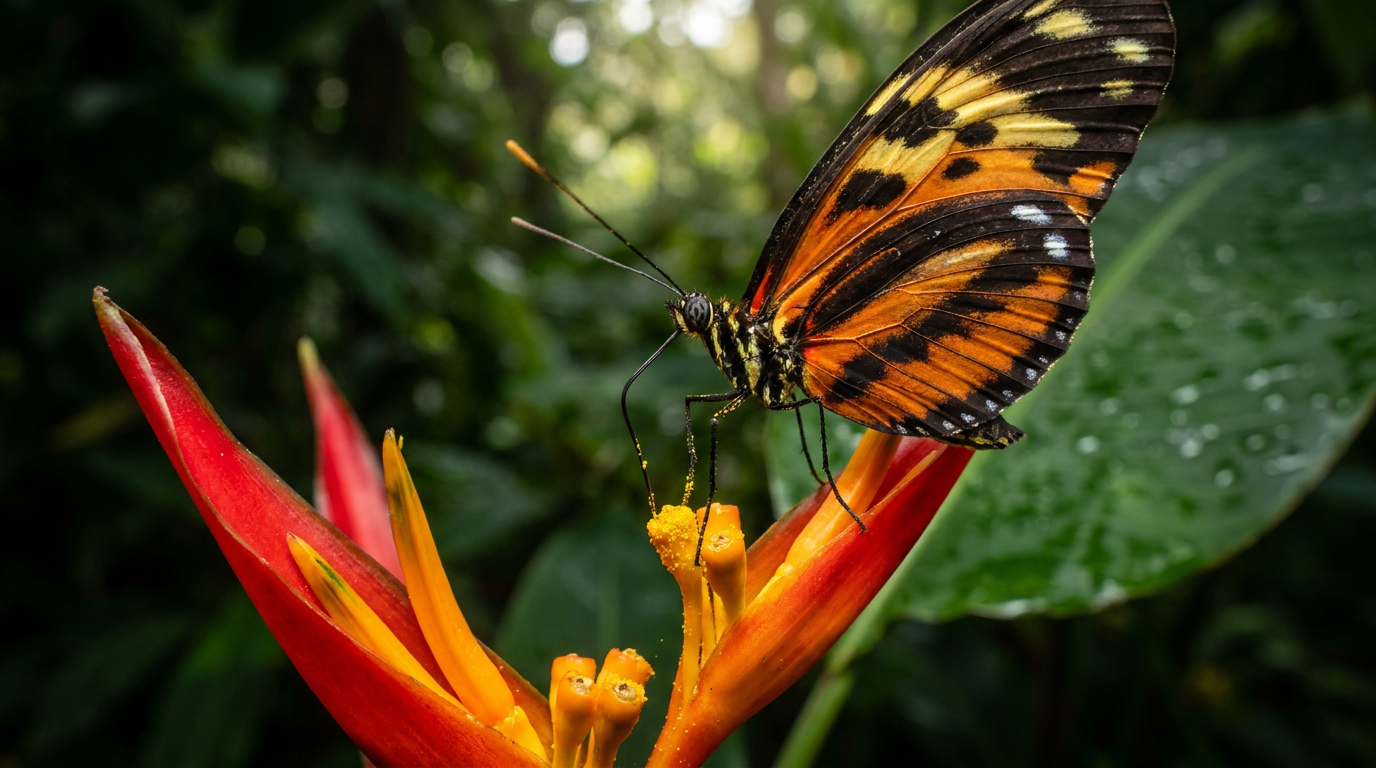
In the animal kingdom, butterflies are the quintessential symbol of ephemeral beauty. Most species survive in their adult form for merely a few weeks, sipping nectar for a quick energy burst before reproducing and rapidly dying. Their delicate bodies are built for a brief, spectacular reproductive window, not for endurance or long-term cellular maintenance. But deep in the lush tropical rainforests of South and Central America, one specific group of insects has completely rewritten the biological rules of aging. By evolving a unique dietary habit, these butterflies have unlocked a mechanism for extreme longevity, offering scientists a masterclass in how ecological shifts can fundamentally alter the trajectory of a species' lifespan.[3]
Butterflies belonging to the genus Heliconius exhibit an extraordinary capacity for longevity, surviving for months and sometimes nearly a full year in the wild. A comprehensive new study published in Nature Communications has mapped this phenomenon in unprecedented detail, revealing a staggering 25-fold difference in maximum lifespan among closely related species within the Heliconiini tribe. Researchers compiled data from field observations, public butterfly houses, and mark-release-recapture studies to build a definitive database of butterfly lifespans, uncovering an evolutionary gap in longevity that has few parallels anywhere in the animal kingdom.[2][5]
The raw numbers from the study highlight the sheer scale of this biological anomaly. While a closely related, nectar-sipping species like Dione juno has a maximum recorded lifespan of just 14 days, the pollen-eating Heliconius hewitsoni can live for up to 348 days—an eternity in insect terms. Across the board, the data showed that pollen-eating Heliconius species boast an average maximum lifespan of 177 days. In stark contrast, their non-pollen-eating relatives average a maximum of just 58 days. This massive divergence occurred between species that share a relatively recent common ancestor, making it a perfect natural experiment for evolutionary biologists.[4][6]

Yet, it is not merely the sheer length of their lives that has captivated biologists, but the remarkable quality of their extended age. Heliconius butterflies appear to experience what scientists call 'graceful aging,' a phenomenon known formally in biology as negligible senescence. In most animals, including humans, advancing age brings a predictable cascade of physical deterioration—muscles weaken, cellular repair slows, and baseline mortality risk skyrockets. Heliconius butterflies, however, seem to pause this biological clock, maintaining their physical vigor and showing almost no outward signs of the physiological decline that normally accompanies the passage of time.[1][3]
To rigorously quantify this lack of physical decline, researchers from the University of Bristol designed a clever, butterfly-scaled 'deadlift' test to measure grip strength. Grip strength is a standard, highly reliable metric used across biology to assess physical performance and muscular deterioration over time. The researchers tested various species at different stages of their lives to see how firmly the insects could hold onto a surface. In short-lived relatives like Dryas iulia, the results were exactly as expected: grip strength predictably and steadily weakened as the insects aged, mirroring the standard trajectory of animal senescence.[2][5]
However, when the research team tested older individuals of the long-lived Heliconius hecale, the results defied conventional biology. They found absolutely no detectable deterioration in physical strength. The older butterflies performed just as well on the grip test as the youngest individuals in the cohort. This finding is highly unusual; age-related physical decline is close to a universal law in the animal kingdom. Finding a complex organism that appears to largely escape this deterioration demands a mechanical explanation, prompting researchers to look closely at the butterfly's unique daily habits.[2][5]
The primary driver behind this evolutionary leap is a highly specialized dietary innovation. While almost all of the world's butterfly species rely exclusively on flower nectar—a simple, sugary liquid that provides rapid flight energy but lacks complex structural nutrients—Heliconius butterflies actively seek out and consume pollen. They are the only butterflies known to do this as adults. This behavioral shift from sipping simple sugars to harvesting complex plant matter required significant anatomical and chemical adaptations, fundamentally changing the resources available to the insect's body.[3][6]
The primary driver behind this evolutionary leap is a highly specialized dietary innovation.
Pollen is an incredibly nutrient-dense food source, packed with essential amino acids, beneficial lipids, and complex proteins. Because butterflies do not have chewing mouthparts, Heliconius species have evolved a specialized, external feeding technique to access these nutrients. They gather pollen on their proboscis and secrete a specialized saliva over the grains. This saliva breaks down and dissolves the pollen externally, allowing the butterfly to drink the resulting nutrient-rich slurry. This daily intake of amino acids provides the essential building blocks necessary for long-term tissue maintenance and cellular repair.[6]

This rich nutritional profile supports robust immune defenses and sustained energy storage, which a nectar-only diet simply cannot provide. Nectar is essentially biological jet fuel—great for a quick sprint, but useless for rebuilding a damaged engine. The amino acids derived from pollen allow Heliconius to continuously rebuild that engine. But researchers faced a critical question: is the pollen itself a magic dietary bullet that automatically extends life, or is there a deeper, hard-coded genetic component that allows these specific butterflies to utilize the fuel so efficiently?[4][6]
To isolate the variables and answer this question, the research team conducted a controlled, cross-species diet-swap experiment. They took cohorts of the long-lived, pollen-eating Heliconius hecale and completely deprived them of their natural pollen diet, forcing them to survive in the laboratory on nectar alone. Simultaneously, they took the short-lived, nectar-dependent Dryas iulia and provided it with a nutrient-rich pollen diet, testing whether the high-quality food could artificially boost the lifespan of a species not adapted to eat it.[4]
The results of the deprivation test were highly revealing. While the pollen-deprived Heliconius butterflies did experience a steeper decline in body mass than their well-fed peers—proving that the diet is indeed crucial for optimal health—they still significantly outlived the non-pollen-eating species. Even when starved of their evolutionary superfood, the Heliconius retained a massive longevity advantage over their close relatives. This proved that their extended lifespan is not merely a temporary state induced by eating well, but a permanent physiological baseline.[3][4]
Conversely, the reverse experiment yielded equally definitive results. When researchers fed the nutrient-dense pollen diet to the short-lived Dryas iulia, the butterfly did not suddenly develop a Heliconius-like lifespan. It failed to gain any significant longevity benefits from the upgraded diet. This failure indicates that the short-lived species simply lacks the biological machinery—the specialized digestive enzymes, the metabolic pathways, and the cellular allocation strategies—to properly process and deploy the complex nutrients hidden within the pollen.[4][6]

This stark asymmetry proves that diet is only half of the longevity equation. The extreme lifespan of the Heliconius is a deeply evolved genetic adaptation. The butterflies have developed specific physiological traits that allow them to capitalize on the pollen's nutrient payload. It is a perfect biological synergy: the behavior of eating pollen provides the raw materials, but millions of years of evolution have provided the cellular blueprints required to use those materials for long-term somatic maintenance rather than just immediate reproduction.[2][6]
Evolutionary biologists believe this dietary shift triggered a profound cascade of adaptive changes. By securing a steady supply of amino acids, the ancestral butterflies were able to extend their reproductive window. This longer reproductive lifespan fundamentally altered their evolutionary math. It pushed back the 'selection shadow'—the point at which natural selection stops weeding out harmful, age-related mutations because the organism has already finished breeding. With older butterflies still actively reproducing, evolution actively selected for traits that maintained cellular health and delayed senescence.[3]
For the broader scientific community, the Heliconius genus now represents a highly promising, natural model for studying the biology of aging. It offers a rare, real-world example of how an ecological shift in diet can interact with genetics to fundamentally alter the pace of cellular senescence. By comparing the genomes of these long-lived butterflies with their short-lived cousins, researchers hope to isolate the specific genetic pathways that govern protein turnover, mitochondrial health, and muscular maintenance over extended periods.[2][5]
These findings also carry a vital, overarching lesson for aging research across all species, including humans. The butterfly diet-swap experiment vividly demonstrates that the quality of nutrients matters immensely, but only when paired with a metabolic system adapted to utilize them. Pushing the boundaries of lifespan requires more than just identifying a perfect diet or a superfood; it requires a deep understanding of the genetic and metabolic context in which those nutrients operate. The Heliconius proves that extreme longevity is never just about what you eat—it is about what evolution has taught your body to do with it.[6]
How we got here
~15-20 million years ago
The Heliconiini tribe diverges, with the Heliconius genus evolving the unique behavior of pollen feeding.
Early 2000s
Field researchers first document the unusually long lifespans of Heliconius butterflies in the wild, noting their unique pollen-collecting behavior.
June 2026
A comprehensive study in Nature Communications quantifies the 25-fold lifespan difference and proves the longevity is genetically encoded, not just dietary.
Viewpoints in depth
Evolutionary Biologists' View
Emphasizes how a behavioral shift to eating pollen altered the species' evolutionary trajectory.
Evolutionary biologists view the Heliconius butterfly as a textbook example of how ecological niche expansion drives genetic change. By unlocking a new protein source, the ancestral butterflies extended their reproductive window. This pushed back the 'selection shadow'—the point at which natural selection stops weeding out harmful mutations because the organism has already reproduced. With older butterflies still breeding, evolution actively selected for traits that maintained cellular health and delayed senescence.
Gerontologists' View
Focuses on the butterfly's ability to maintain physical performance and avoid age-related decline.
For researchers studying the mechanics of aging, the most exciting aspect of the Heliconius is not its maximum lifespan, but its 'healthspan.' The grip-strength tests demonstrating negligible physical decline offer a rare natural model of successful aging. Gerontologists are particularly interested in how the butterfly's cells manage protein turnover and mitochondrial health over 300+ days, hoping to identify cellular pathways that might have analogs in mammalian biology.
What we don't know
- The exact genetic pathways and cellular mechanisms that allow Heliconius to translate pollen nutrients into delayed aging remain unidentified.
- It is unclear exactly how the specialized saliva used to dissolve pollen evolved from the nectar-sipping mouthparts of their ancestors.
- Researchers do not yet know if the cognitive functions of these butterflies, such as spatial memory for foraging routes, are preserved as flawlessly as their physical grip strength.
Key terms
- Negligible Senescence
- The lack of symptoms of aging in some organisms, characterized by no measurable decline in survival capability or physical performance as they get older.
- Proboscis
- The elongated, tubular mouthpart of a butterfly, typically used for sucking nectar, but adapted in Heliconius to dissolve and ingest pollen.
- Selection Shadow
- An evolutionary concept describing the period in an organism's life after reproduction has ceased, where natural selection no longer weeds out genetic mutations that cause aging.
- Amino Acids
- Organic compounds that combine to form proteins, crucial for tissue repair and immune function, found abundantly in pollen but lacking in nectar.
Frequently asked
Do any other butterflies eat pollen?
No, butterflies in the genus Heliconius are the only known butterflies that actively consume and digest pollen as adults. Other species rely entirely on nectar.
How much longer do they live than normal butterflies?
While many butterflies live for only two to four weeks, some Heliconius species can live for nearly a year (up to 348 days), representing a 25-fold increase in lifespan over close relatives.
Can feeding pollen to a normal butterfly make it live longer?
No. Experiments showed that short-lived butterfly species do not gain a longevity boost from eating pollen, as they lack the evolved genetic adaptations to properly digest and utilize the complex nutrients.
Where do Heliconius butterflies live?
They are native to the tropical rainforests of South and Central America.
Sources
Source coverage
6 outlets
3 viewpoints surfaced






[1]NatureEvolutionary Biologists
A long-lived butterfly’s secret to graceful ageing
Read on Nature →[2]University of BristolGerontologists
Butterflies that defy aging
Read on University of Bristol →[3]Discover MagazineNutritional Scientists
These Tropical Butterflies Boast Long Lifespans and Barely Age — Their Secret May Be Eating Lots of Pollen
Read on Discover Magazine →[4]ScienceAlertEvolutionary Biologists
An Incredibly Long-Lived Butterfly May Hold The Secret To Slower Aging
Read on ScienceAlert →[5]Earth.comGerontologists
'Geriatric' butterfly species lives nearly three times as long as their relatives
Read on Earth.com →[6]ProHealthNutritional Scientists
The extreme butterfly lifespan puzzle
Read on ProHealth →


Every angle. Every day.
Get science stories with full source coverage and perspective breakdowns delivered to your inbox.