
SpaceX Options Volume Explodes Following Historic IPO and $60 Billion Cursor Acquisition
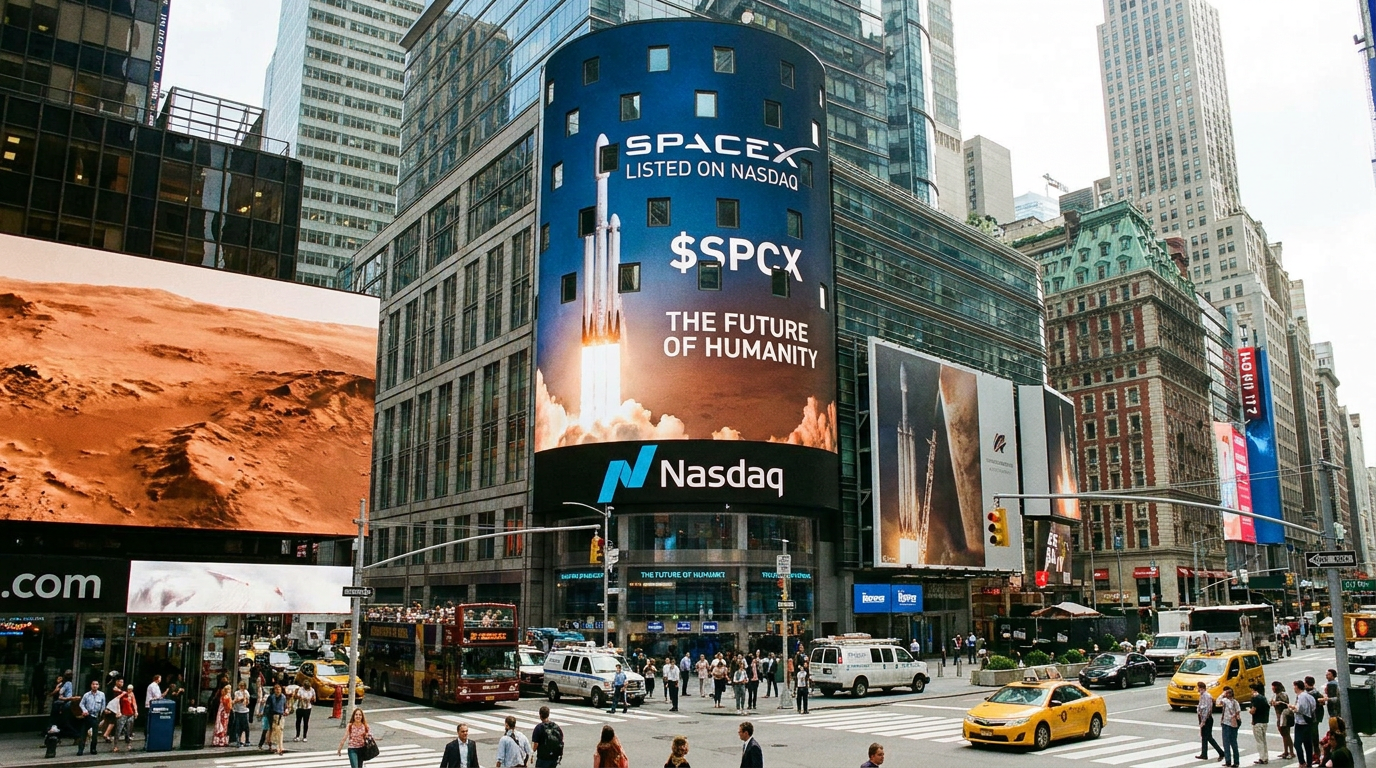
Following a blockbuster Nasdaq debut that pushed its valuation past $2.5 trillion, SpaceX has seen record-shattering options trading and immediately moved to acquire AI coding startup Cursor for $60 billion.
By Factlen Editorial Team
- Retail Options Traders
- Views SpaceX as the new primary growth engine of the stock market, replacing legacy tech giants.
- Enterprise Tech Analysts
- Focuses on the strategic threat the combined SpaceX-Cursor entity poses to existing AI market leaders.
- Institutional Investors
- Evaluates the sustainability of the $2.5 trillion valuation and the execution risks of the $60 billion merger.
What's not represented
- · Antitrust regulators who may scrutinize a $60 billion acquisition by a $2.5 trillion company.
- · OpenAI and Anthropic executives responding to the sudden consolidation of their primary competitor.
Why this matters
SpaceX's public market debut has instantly reordered the hierarchy of global tech giants, shifting retail investor focus away from the legacy 'Magnificent Seven.' By immediately deploying its new public stock to acquire Cursor, SpaceX is signaling a massive, well-funded challenge to OpenAI and Microsoft in the enterprise AI space.
Key points
- SpaceX went public on the Nasdaq, with shares surging 56% to reach a $2.53 trillion market cap.
- The company overtook Amazon to become the fifth-largest publicly traded firm in the world.
- Options trading volume shattered records, with retail investors buying more SpaceX than the entire Magnificent Seven.
- SpaceX immediately announced a $60 billion all-stock acquisition of AI coding startup Cursor.
- Cursor recently crossed $4 billion in annualized revenue, used by 67% of Fortune 500 companies.
- The deal turns Cursor's four 20-something co-founders into billionaires, worth an estimated $2.7 billion each.
Elon Musk’s SpaceX has officially entered the public markets, and its arrival has instantly reshaped the hierarchy of global equities. Following a blockbuster Nasdaq debut on June 12, the company's shares surged more than 56% from their $135 IPO price, pushing its market capitalization to a staggering $2.53 trillion.[2]
That meteoric rise has propelled SpaceX past Amazon to become the fifth-largest company in the world, closing in rapidly on Microsoft and Apple. The sheer scale of the listing has captivated Wall Street, prompting analysts to coin new acronyms like "MANGOS" as the traditional "Magnificent Seven" tech giants suddenly look like legacy plays.[1][5]
The enthusiasm has spilled over into the derivatives market. Options trading for SpaceX (ticker: SPCX) kicked off this week with record-shattering volume. Retail investors have poured into the stock, reportedly buying more SpaceX shares in recent days than all of the Magnificent Seven companies combined.[1]

The speculative frenzy is palpable. On the first day of options trading, the composite implied volatility—a measure of expected price swings—hit an extraordinary 93%. While that figure has begun to temper, it underscores the massive "FOMO" mentality driving retail and institutional traders alike to secure a piece of the space and AI behemoth.[1]
But SpaceX did not wait for the dust to settle before deploying its newly minted public currency. Just days after the IPO, the company announced it would acquire Anysphere, the parent company of the wildly popular AI coding assistant Cursor, in an all-stock deal valued at $60 billion.[2][4]
The takeover executes on a peculiar arrangement struck in April, wherein SpaceX secured an option to either acquire the San Francisco-based startup for $60 billion or pay a $1.5 billion breakup fee alongside $8.5 billion in computing resources. With the IPO successfully completed, SpaceX pulled the trigger on the full acquisition.[3][4]
With the IPO successfully completed, SpaceX pulled the trigger on the full acquisition.
Cursor’s ascent has been nothing short of historic. Founded in 2022 by four MIT undergraduates, the platform uses artificial intelligence to predict and write code, dramatically accelerating software development. By early June 2026, Cursor had crossed $4 billion in annualized revenue, up from $2 billion just four months prior.[3]
The tool has achieved massive enterprise penetration. Currently, 67% of Fortune 500 companies utilize Cursor's technology, and the platform's AI agents write more than 100 million lines of code per day for corporate clients.[7]

The $60 billion all-stock buyout translates into a staggering windfall for Cursor's 20-something co-founders—Michael Truell, Aman Sanger, Sualeh Asif, and Arvid Lunnemark. Each holds a roughly 9% stake in the company, which will convert into SpaceX Class A common stock, giving them an estimated net worth of $2.7 billion apiece.[3][4]
Early venture backers are also reaping massive rewards. Andreessen Horowitz, which holds a roughly 10% stake, will see its position valued at $6 billion, while Thrive Capital's 7% stake translates to $4.2 billion. The deal price represents a massive premium over Cursor's last private funding round in November, which valued the startup at $29.3 billion.[3][4]
Strategically, the acquisition is a direct assault on the enterprise AI market currently dominated by Microsoft, OpenAI, and Anthropic. Cursor had found itself on the defensive earlier in the year following the launch of Anthropic's Claude Code, shifting into "wartime" mode to maintain its market lead.[3][6]
By joining forces with SpaceX, Cursor gains an unparalleled structural advantage. SpaceX, which merged with Musk's xAI (maker of the Grok chatbot) in February, boasts the massive Colossus supercomputer. The two companies have already spent months jointly training a next-generation AI model that will be deployed across both Cursor and Grok.[2][3]

For investors, the combination of a global space monopoly and a premier enterprise AI platform justifies the premium valuation. However, some analysts caution that a $2.5 trillion market cap leaves little room for error, requiring flawless execution as SpaceX integrates its sprawling rocket, satellite internet, and artificial intelligence divisions.[1][2]
How we got here
Early 2023
Cursor launches its first AI coding product, founded by four MIT undergraduates.
February 2026
SpaceX merges with Elon Musk's xAI, bringing the Grok chatbot and Colossus supercomputer in-house.
April 2026
SpaceX secures an option to acquire Cursor for $60 billion, pausing the deal while preparing for its IPO.
June 12, 2026
SpaceX debuts on the Nasdaq at $135 per share in a blockbuster initial public offering.
June 16, 2026
SpaceX officially announces the $60 billion all-stock acquisition of Cursor as options trading begins.
Viewpoints in depth
Retail Investors & Traders
Retail markets view SpaceX as a generational wealth-building opportunity that eclipses legacy tech giants.
For retail traders, the SpaceX IPO represents the ultimate convergence of space exploration and artificial intelligence. The unprecedented options volume and 93% implied volatility on opening day highlight a massive 'FOMO' (fear of missing out) mentality. Many retail investors are rotating capital out of the traditional 'Magnificent Seven' stocks, betting that SpaceX's dual dominance in orbital logistics and enterprise AI offers a higher growth ceiling for the next decade.
Enterprise AI Competitors
Rival AI labs view the SpaceX-Cursor merger as a formidable threat backed by virtually unlimited compute.
Companies like OpenAI, Anthropic, and Microsoft are watching the Cursor acquisition closely. Cursor was already winning the developer market with its standalone product, but integrating it with SpaceX's Colossus supercomputer changes the paradigm. Competitors recognize that SpaceX can now subsidize massive AI training runs and offer enterprise clients a vertically integrated coding assistant that doesn't rely on third-party cloud providers, escalating the AI arms race.
Institutional Analysts
Wall Street analysts are bullish on the structural advantages but wary of the pricing perfection required.
Institutional watchers acknowledge that SpaceX has successfully executed a masterclass in capital allocation by using its highly valued public stock to acquire a $4 billion revenue business. However, they caution that a $2.53 trillion valuation prices in near-perfect execution. Analysts note that managing a sprawling conglomerate that spans reusable rockets, global satellite internet, and cutting-edge enterprise AI will test the limits of the company's executive bandwidth.
What we don't know
- How antitrust regulators will view a $60 billion acquisition by a newly public $2.5 trillion mega-cap company.
- Whether the massive 93% implied volatility in the options market will lead to severe near-term price swings for retail investors.
- How quickly SpaceX can fully integrate Cursor's software team with its existing xAI and aerospace engineering divisions.
Key terms
- Implied Volatility (IV)
- A metric used in options trading that captures the market's forecast of a likely movement in a security's price; high IV indicates expectations of large price swings.
- Options Trading
- Financial derivatives that give buyers the right, but not the obligation, to buy or sell an underlying asset at an agreed-upon price and date.
- Magnificent Seven
- A Wall Street buzzword referring to a group of high-performing, influential tech stocks (historically Apple, Microsoft, Alphabet, Amazon, Nvidia, Meta, and Tesla).
- Enterprise AI
- Artificial intelligence solutions designed specifically for large corporate environments to improve productivity, such as automated code generation.
Frequently asked
How much is SpaceX worth after its IPO?
Following its Nasdaq debut, SpaceX shares climbed over 56%, giving the company a market capitalization of approximately $2.53 trillion.
What does Cursor do?
Cursor is an AI-powered coding assistant that predicts and writes code for software developers. It is currently used by 67% of Fortune 500 companies.
How are the Cursor founders being paid?
The $60 billion acquisition is an all-stock deal. The founders' stakes will convert into SpaceX Class A common stock, making them worth an estimated $2.7 billion each.
Why is SpaceX buying an AI coding company?
SpaceX is building a massive enterprise AI division to compete with OpenAI and Anthropic. Cursor will gain access to SpaceX's Colossus supercomputer to train next-generation models.
Sources
Source coverage
7 outlets
3 viewpoints surfaced






[1]MarketWatchRetail Options Traders
SpaceX options volume explodes as trading kicks off. Here is a low-risk strategy to play the massive surge.
Read on MarketWatch →[2]ReutersEnterprise Tech Analysts
SpaceX buying Cursor for $60 Billion in bid for enterprise AI market
Read on Reuters →[3]ForbesInstitutional Investors
SpaceX's $60 Billion Cursor Acquisition Doubles 20-Something Cofounders' Net Worths
Read on Forbes →[4]QuartzInstitutional Investors
SpaceX agrees to buy Cursor parent Anysphere for $60 billion
Read on Quartz →[5]MorningstarInstitutional Investors
SpaceX overtakes Amazon to become the fifth-largest company in the world
Read on Morningstar →[6]AP NewsEnterprise Tech Analysts
SpaceX buys AI startup Cursor for $60 billion
Read on AP News →[7]FortuneEnterprise Tech Analysts
Cursor's meteoric rise to $4 billion in revenue and a $60 billion SpaceX buyout
Read on Fortune →

More in finance
See all 5 stories →Assumable Mortgages
How Assumable Mortgages Are Unlocking 3% Interest Rates in a 7% Housing Market
7 sources

Climate Tech
How Parametric Insurance is Rewiring Climate Resilience with Instant Payouts
7 sources

Phased Retirement
The Evidence for Phased Retirement: How Working Part-Time Boosts Cognitive and Financial Health
7 sources

Every angle. Every day.
Get finance stories with full source coverage and perspective breakdowns delivered to your inbox.